Java Functional Programming: Lambdas, Streams, and Practical Patterns
Java functional programming with lambdas, functional interfaces, streams, method references, and Optional, plus refactoring imperative code and when to use each.
On this page⌄
- What is functional programming in Java?
- Which functional-programming principles matter most in Java?
- What do you need to start using functional Java?
- How do Java's functional features work together?
- How do you refactor imperative Java into functional style?
- Which stream operation should you choose?
- What are the benefits of functional programming in Java?
- What are the main risks and pitfalls?
- When should you use functional style, and when shouldn't you?
- How should a team adopt functional Java safely?
- Conclusion
- FAQ
Functional programming in Java means writing code as composable, deterministic transformations built from lambda expressions, functional interfaces, and the Stream API, rather than as sequences of mutable state changes. Java stays multi-paradigm. It doesn't enforce purity, but Java 8 and later give you the tools to write functional-style code alongside ordinary object-oriented and imperative code.
This guide focuses on practical decisions rather than academic theory. You'll learn:
- How lambdas, functional interfaces, method references, streams, and
Optionalfit together as one model. - How to refactor a typical imperative method into a tested, readable functional version.
- When functional style genuinely improves Java code, and when a plain loop is the better choice.
What is functional programming in Java?
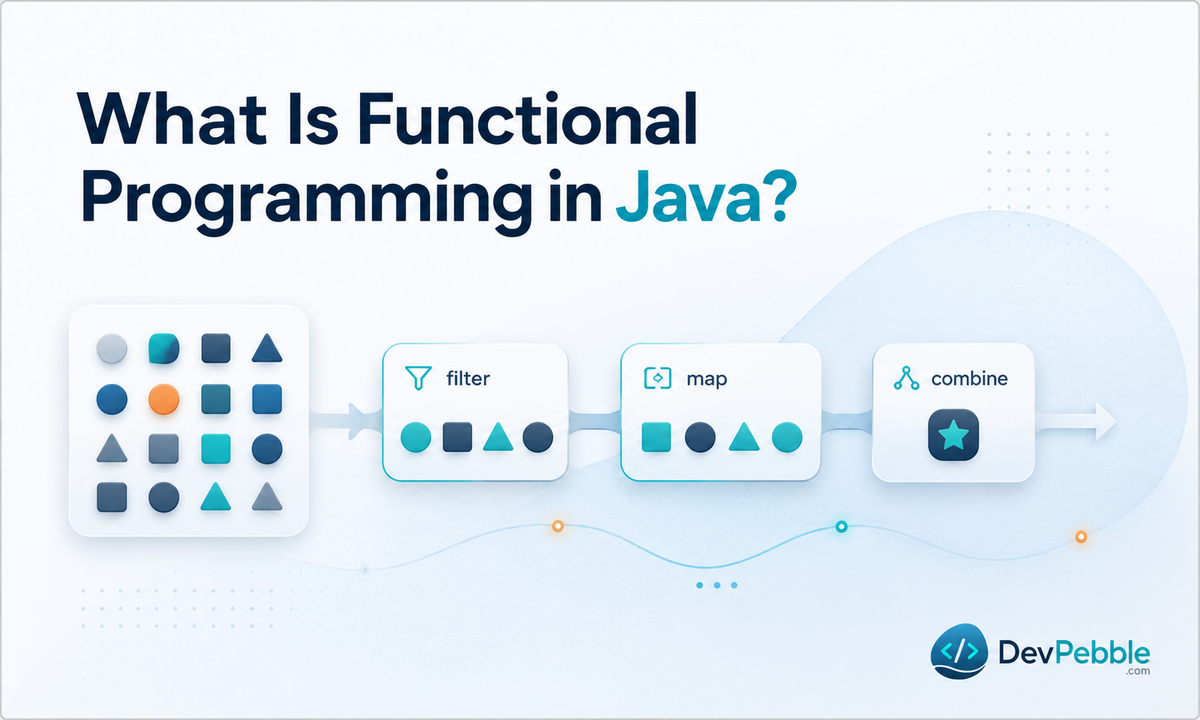
Functional programming in Java is the practice of expressing computation as transformations of values (filtering, mapping, and combining data) while preferring pure functions and immutable values where practical. Java supports this style through lambdas, functional interfaces, method references, and streams, and it keeps its object-oriented and imperative foundations intact.
Rather than describing loop mechanics, functional-style code describes what transformation is needed: select these orders, convert them to totals, combine the totals. Functions or function-like objects can be passed into APIs as behavior, not just as data. Pure functions and immutable values are preferred where they don't create unnecessary friction, but Java permits these practices without ever forcing them. It helps to separate "functional Java" from "streams." Streams are one prominent functional-style API, not the whole paradigm. You can write pure, composable functions without ever calling .stream(), and you can write a stream pipeline riddled with side effects.
Is Java a functional programming language?
Not purely. Java is a multi-paradigm language. It supports functional-style programming through lambdas, functional interfaces, and streams, but classes, objects, statements, mutable state, and side-effecting APIs remain central. Nothing in the language requires a function to be pure.
Lambda expressions are evaluated against functional-interface target types defined by the Java Language Specification, not against a standalone function type the way some functional languages define them. In practice, Java code usually mixes object-oriented domain modeling with functional-style transformations rather than committing to one paradigm exclusively.
Functional vs. imperative Java: what changes?
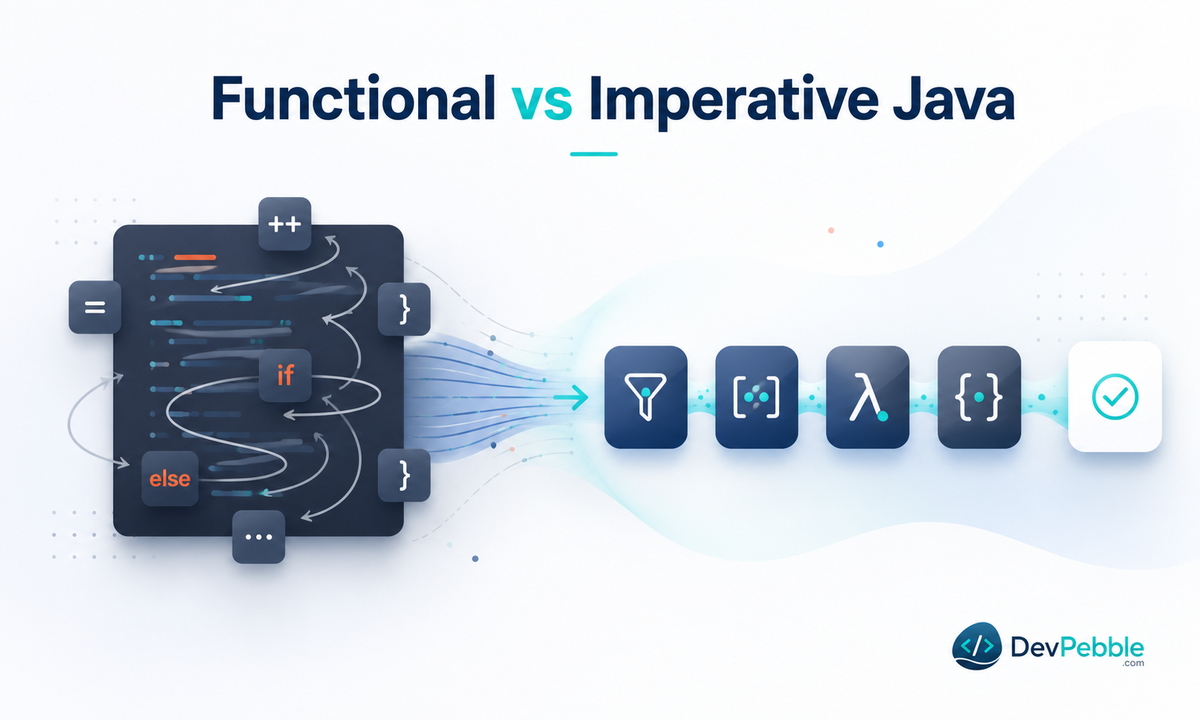
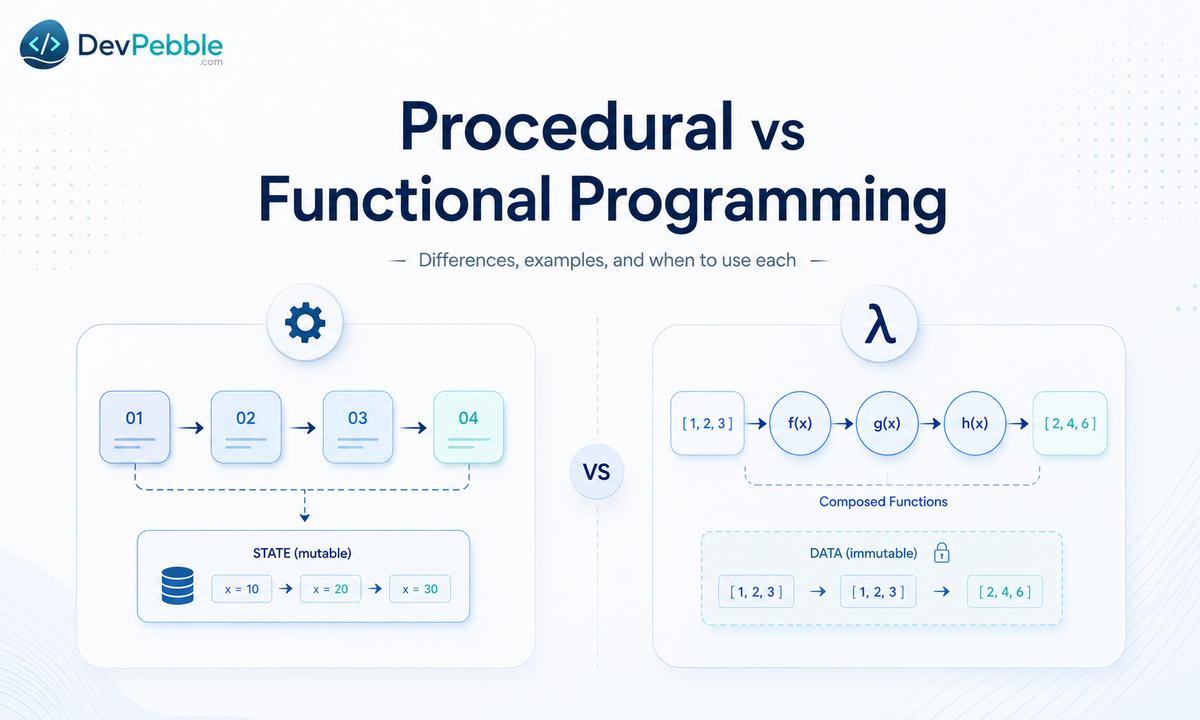
The main shift is from describing how each step executes to describing what transformation is required. Imperative code commonly uses loops, conditionals, and mutable accumulators; functional-style code commonly uses filter, map, composition, and reduction. Neither form is automatically clearer, because readability depends on the problem shape and on naming.
| Dimension | Imperative Java | Functional-style Java | |---|---|---| | Focus | How each step executes | What transformation is required | | State | Often updated in place | Prefer new values or controlled accumulation | | Reuse | Extract methods or objects | Compose functions and operations | | Best fit | Stateful workflows and simple loops | Data transformations and reusable rules |
A short, well-named pipeline can be easier to verify at a glance than the equivalent loop. A long pipeline hiding several business rules is often harder to debug than the loop it replaced.
Which functional-programming principles matter most in Java?
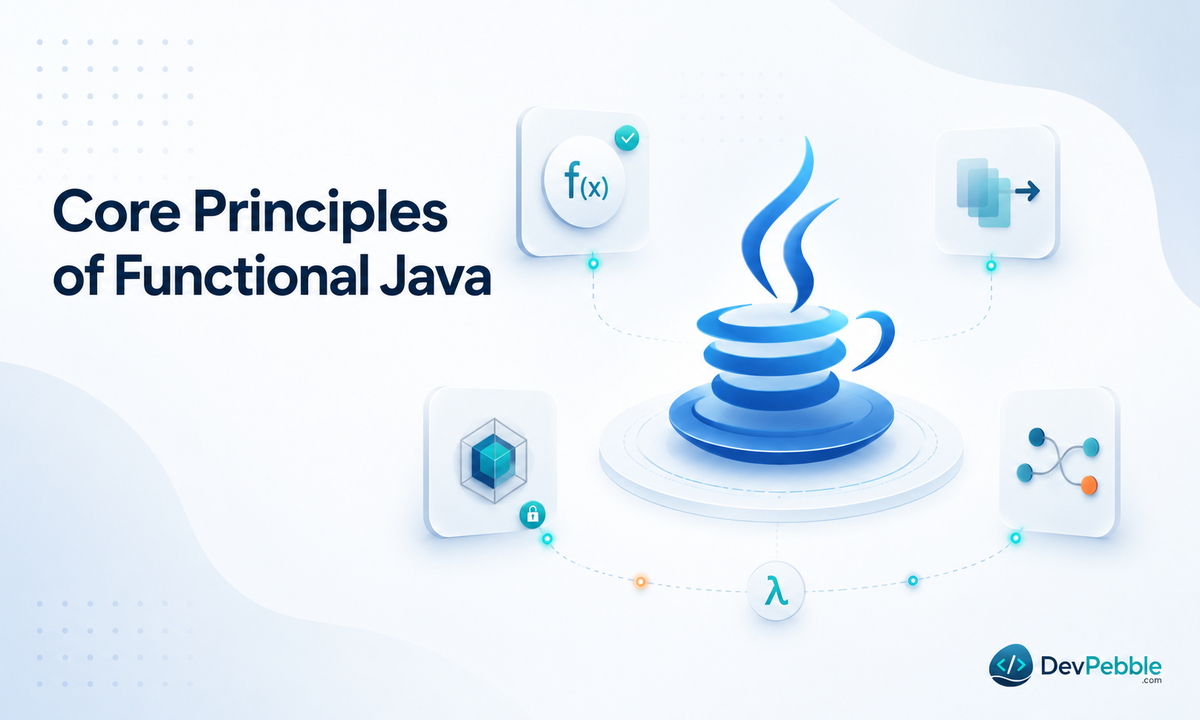
Four principles deliver most of the practical benefit: pure functions, limited mutation, higher-order behavior, and declarative composition. You don't need to implement every concept from functional-programming theory to get real value from this style; currying, monads, and category theory rarely change an everyday Java decision.
Pure functions and controlled side effects
A pure function returns the same result for the same explicit input and doesn't modify shared state. Side effects such as database writes, file I/O, logging, reading the system clock, or generating random values are unavoidable somewhere in real software. The goal is to keep calculation logic pure and push those effects toward the edges of the application, not to eliminate them everywhere.
Immutability and referential transparency
final, "immutable," and "unmodifiable" are not synonyms, and conflating them causes bugs:
finalprevents reassignment of a variable, not mutation of the object it references.- Records are shallowly immutable, so a record field can still hold a mutable object.
- Unmodifiable collections can still contain mutable elements, so a defensive copy may still be necessary.
Referential transparency, the ability to swap an expression for its computed value without changing behavior, is what makes a chain like price.add(tax).multiply(quantity) predictable to reason about.
Higher-order functions and function composition
Java APIs accept functional-interface instances as behavior, and interfaces like Function and Predicate support composition methods (andThen, compose, and and) for building reusable logic from smaller pieces. Keep composed chains short enough to name and unit-test individually. A composition chain nobody can explain in one sentence has usually grown too long.
Declarative transformations
A declarative pipeline states the selection, transformation, and aggregation it wants, while the implementation still controls how traversal happens underneath. This isn't inherently superior to a loop. It's a different way of expressing the same logic, and its readability depends entirely on domain naming and pipeline length.
What do you need to start using functional Java?
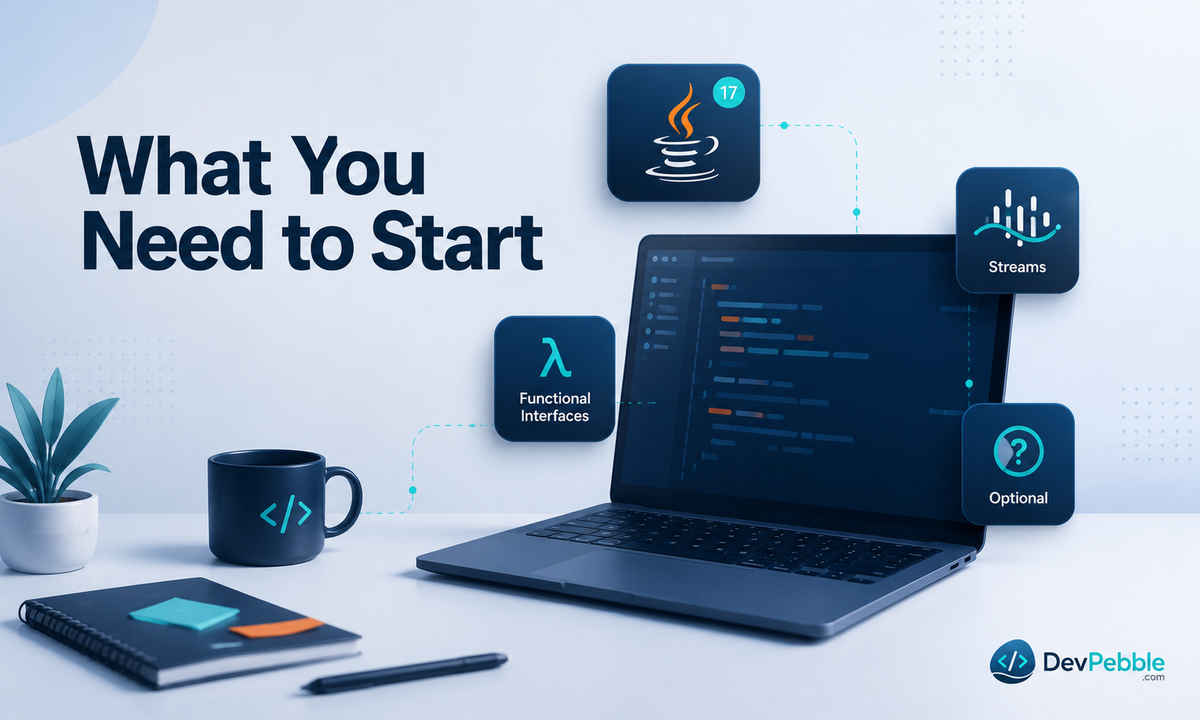
The core feature set (lambdas, functional interfaces, streams, and Optional) requires Java 8 or later, along with working knowledge of generics and collections. For new projects, target a currently supported JDK. For existing codebases, keep examples compatible with whatever version you actually run in production.
Java version and imports
Three packages cover almost everything: java.util.function, java.util.stream, and java.util.Optional. All three date to Java 8. As of mid-2026, Java 25 is the current Long-Term Support (LTS) release and Java 26 is the current short-term feature release, per the Oracle Java SE Support Roadmap. Check that page directly before you rely on it, since Oracle ships a new feature release every six months.
| Feature | Available since | Needed for core examples? |
|---|---|---|
| Lambdas, java.util.function, streams, Optional | Java 8 | Yes |
| Records | Java 16 | No (used only for immutability notes) |
| Stream.toList() | Java 16 | No (collect(Collectors.toList()) also works) |
Prerequisite Java knowledge
Before working through functional examples, you should be comfortable with generics, the Collections Framework, method signatures, basic exception handling, and how equals works for value comparison. Advanced concurrency knowledge isn't required for the core material.
Running example and coding conventions
Examples throughout this guide use a shared domain of Order, OrderLine, and Customer. Tasks include calculating totals, selecting paid orders, and grouping results by status. Input and output stay separate from the transformation logic itself, and expected results appear alongside each example.
How do Java's functional features work together?
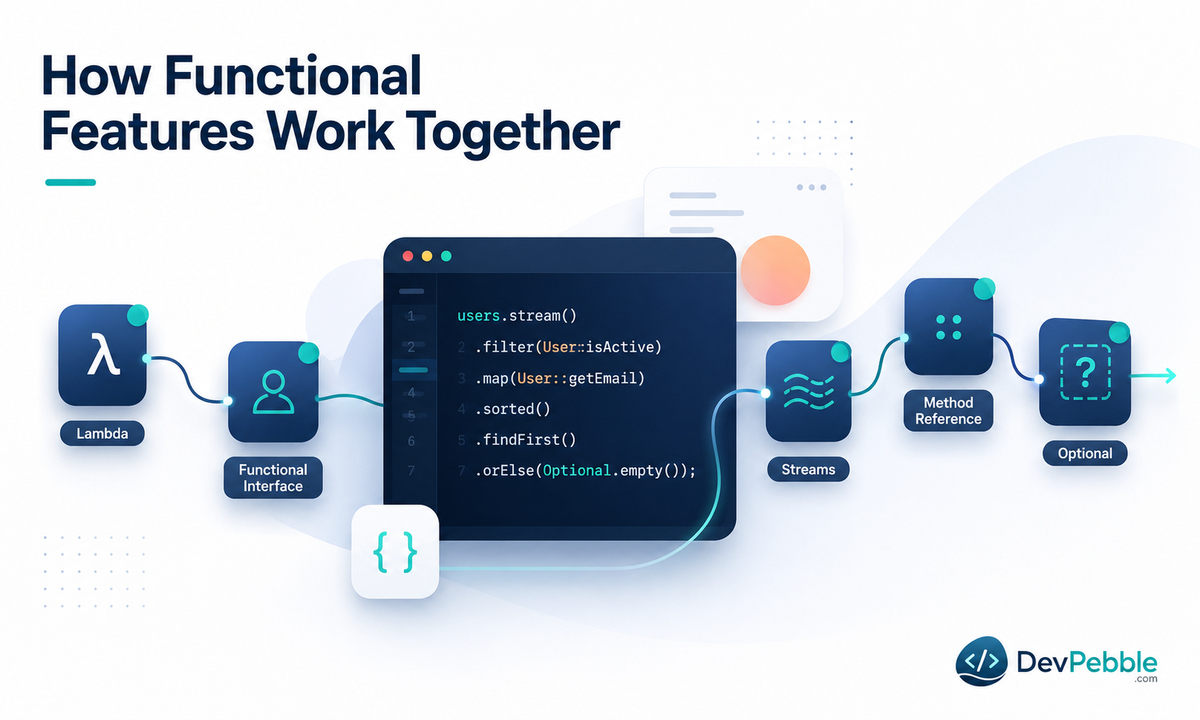
A lambda or method reference supplies behavior to a functional interface, and APIs like the Stream pipeline and Optional accept that interface to filter, transform, combine, or react to values. Understanding this relationship, rather than memorizing isolated syntax, is what makes the rest of the API predictable.
Lambda expressions and target typing
A lambda expression has the form (parameters) -> expression or (parameters) -> { statements }. It has no type of its own; Java infers its meaning from the target type, the functional interface expected at that position. The compiler matches parameter and return types against the interface's single abstract method.
Local variables a lambda captures from its enclosing scope must be final or effectively final, meaning assigned once and never reassigned afterward. This isn't a style preference. It's a language rule that prevents a lambda from observing a variable change after capture, which matters most once the lambda escapes to another thread or is stored for later execution.
Functional interfaces in java.util.function
Choose a functional interface by matching its input and output shape to your need, not by guessing from its name. An interface is "functional" because it declares exactly one abstract method. The @FunctionalInterface annotation documents that intent for the compiler and reader, but it isn't what makes the interface eligible.
| Interface | Input | Output | Typical use |
|---|---|---|---|
| Function<T,R> | One value | Another value | Transformation |
| Predicate<T> | One value | boolean | Filtering or validation |
| Consumer<T> | One value | No result | Deliberate side effect |
| Supplier<T> | No input | One value | Deferred creation |
| UnaryOperator<T> | One T | One T | Same-type transformation |
| BinaryOperator<T> | Two T values | One T | Combination or reduction |
For numeric-heavy code, primitive specializations such as IntFunction, ToIntFunction, and IntPredicate avoid boxing a primitive into its wrapper class on every call. Reach for them once a numeric pipeline runs often enough for allocation to matter, not as a default habit.
Method references and function composition
A method reference replaces a lambda that does nothing but call an existing method. It comes in four forms: a static method (Type::method), a bound instance (instance::method), an unbound instance (Type::instanceMethod), or a constructor (Type::new). Use one only when it stays immediately readable. Order::getTotal is clear; a method reference to an overloaded method with a non-obvious signature often isn't.
Function and Predicate also support composition: andThen and compose chain functions in a fixed order, and and, or, and negate combine predicates. A short composed chain with named intermediate functions documents intent better than one long lambda body.
Stream pipelines: source, intermediate, and terminal operations
A stream doesn't store data. It's a pipeline over a source, made of lazy intermediate operations and a single terminal operation that triggers traversal. Nothing runs until the terminal operation executes, which lets short-circuiting operations like findFirst or anyMatch skip unnecessary work. A stream is consumed once; calling a terminal operation twice on the same stream throws IllegalStateException.
Common intermediate operations: filter, map, flatMap, distinct, sorted, limit, skip, peek.
Common terminal operations: collect, reduce, count, findFirst, anyMatch, forEach, and (Java 16+) toList as a shorter alternative to collect(Collectors.toList()).
Lifecycle warning: once a stream has been traversed by a terminal operation, it's finished. Obtain a new stream from the source for any further traversal.
Optional for composable absence
Optional exists mainly as a return type for methods that may legitimately return no result, not as a general substitute for null everywhere. Use map when the transformation returns a plain value and flatMap when it already returns an Optional, which avoids nesting one Optional inside another. Prefer orElseGet over orElse when building the fallback value is expensive, since orElse always evaluates its argument. Don't let an Optional reference itself be null, which defeats its purpose entirely.
How do you refactor imperative Java into functional style?
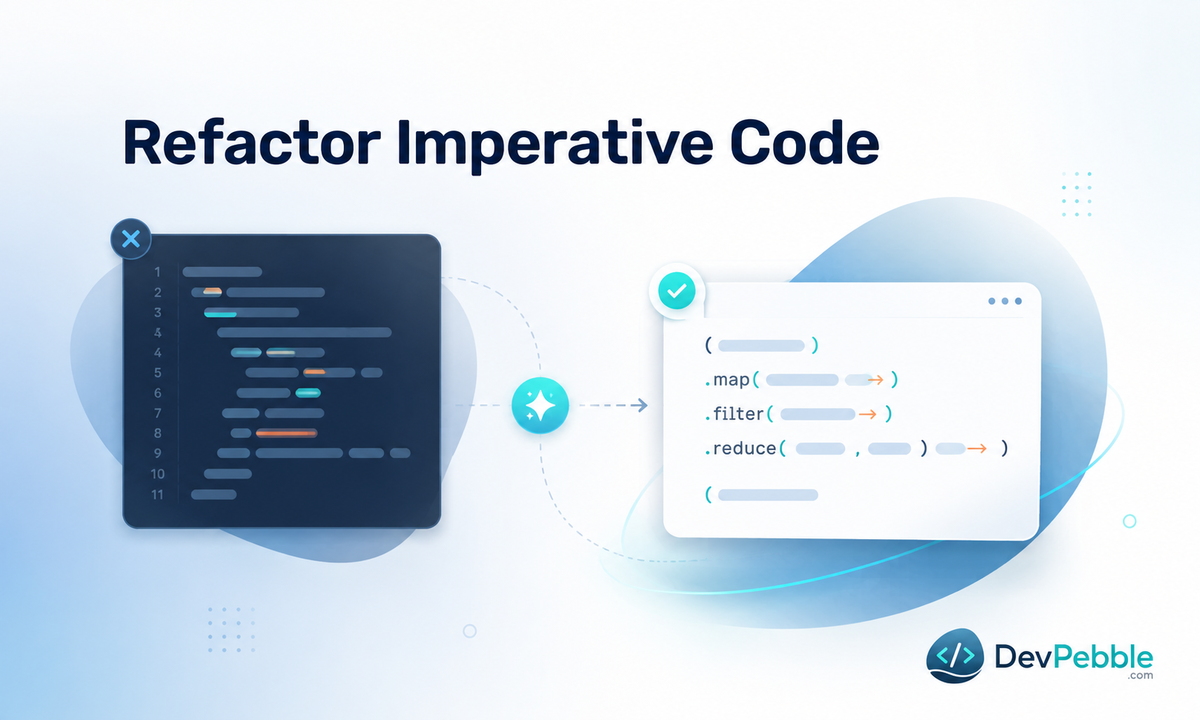
Refactoring should start by naming the desired transformation, isolating side effects, and preserving existing tests. The goal is code whose domain steps are visible and independently testable, not the shortest possible pipeline. If a stream version becomes harder to follow than the loop it replaces, that's a signal to stop rather than push further.
Step 1: State the transformation
Before writing any stream code, work out five things: which source collection is involved, what selection rule applies, what value transformation is needed, what shape the result should take, and which side effects (logging, persistence, output) belong outside the transformation entirely. For a method that totals paid orders for a customer, the source is customer.getOrders(), the filter is OrderStatus.PAID, the transformation is each order's total, and the result is a single BigDecimal sum.
Step 2: Use filter, map, and reduction deliberately
Imperative baseline:
BigDecimal total = BigDecimal.ZERO;
for (Order order : customer.getOrders()) {
    if (order.getStatus() == OrderStatus.PAID) {
        total = total.add(order.getTotal());
    }
}
Functional refactoring:
BigDecimal total = customer.getOrders().stream()
    .filter(order -> order.getStatus() == OrderStatus.PAID)
    .map(Order::getTotal)
    .reduce(BigDecimal.ZERO, BigDecimal::add);
Behavioral equivalence: both versions take the same list of orders and return the same BigDecimal sum of paid-order totals. Assert that equivalence with a test rather than assuming it. Note the identity value BigDecimal.ZERO and the associative BigDecimal::add operation, both required for reduce to behave correctly and for the same pipeline to stay safe if it ever runs in parallel. Money is deliberately handled with BigDecimal, never double, since binary floating point cannot represent most decimal fractions exactly.
Step 3: Extract named functions and test them
Once a pipeline holds more than a trivial predicate or calculation, extract that logic into a named method, such as isPaid(Order order) or orderTotal(Order order), and unit-test it directly, including edge cases like an empty order list, a rejected order, or a duplicate line item. The pipeline itself then reads as an orchestration statement: filter(this::isPaid).map(this::orderTotal).reduce(...). This keeps business rules testable in isolation instead of buried inside an anonymous lambda that only the full pipeline exercises.
Which stream operation should you choose?
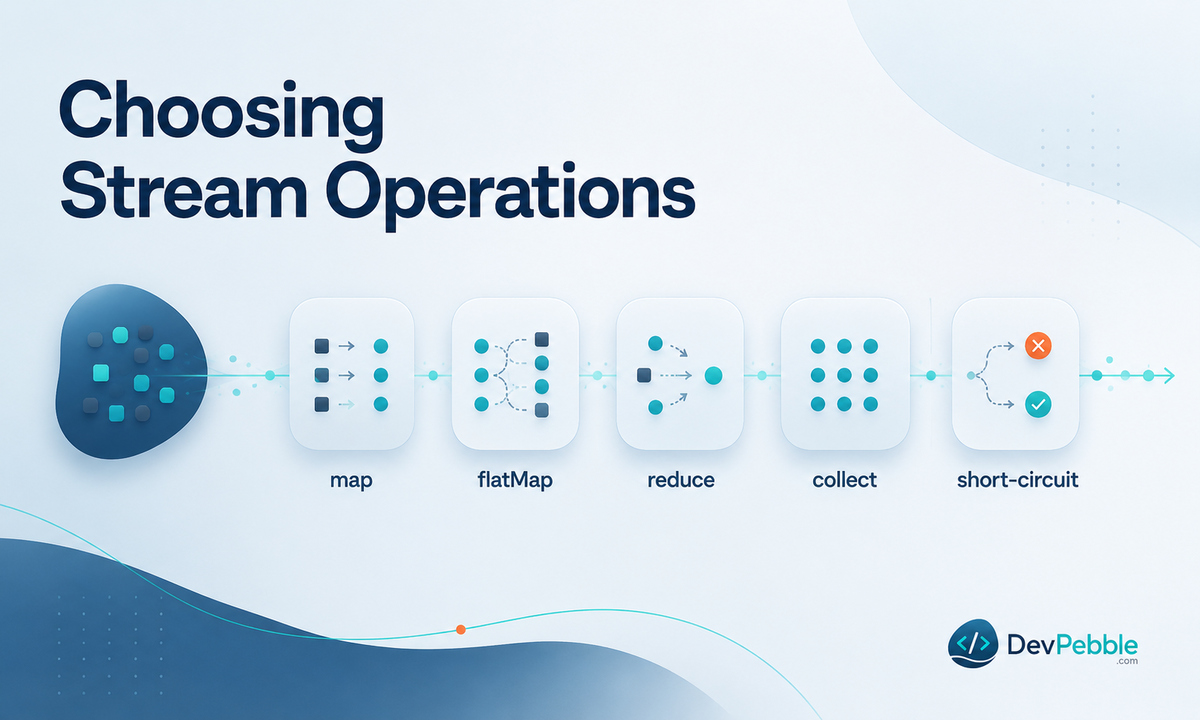
Operation choice depends on the shape of the result you need. map transforms one value into one value, flatMap flattens nested results, reduce combines immutable values into a single result, and collect builds a mutable container (a list, map, or grouped structure) through a collector.
Choosing map or flatMap
Use map for Stream<T> → Stream<R> or Optional<T> → Optional<R>. Use flatMap when the mapping function itself returns a stream or an Optional; otherwise you end up with a nested Stream<Stream<R>> or Optional<Optional<R>> instead of a flat result.
Choosing reduce or collect
Use reduce for combining values into a single immutable result, such as a sum, a maximum, or a concatenated total. Use collect when the result is a mutable structure: a List, a Map, grouped data via Collectors.groupingBy, or a joined String.
Choosing short-circuit operations
When you only need to know whether something exists or to find the first match, reach for anyMatch, allMatch, noneMatch, or findFirst instead of collecting the full result set. These stop as soon as the answer is determined, which avoids traversing the rest of the stream.
What are the benefits of functional programming in Java?
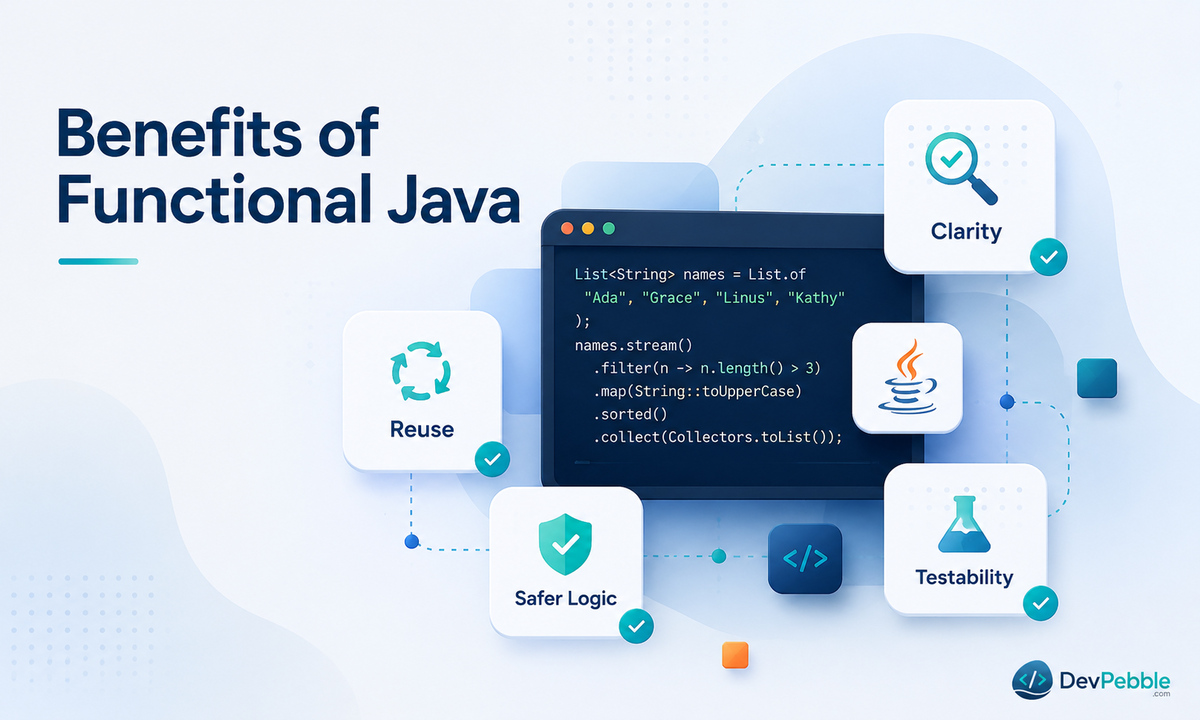
Functional techniques can improve local reasoning, reuse, testing, and the clarity of collection transformations, but only when functions stay small and side effects are controlled. None of these benefits are automatic. They depend on disciplined use and on whether the team can read the result comfortably.
- Pure calculations can be tested in isolation, without mocking collaborators or managing shared state.
- Named predicates and functions compose into new behavior without duplicating logic.
- A well-named pipeline can state a transformation's purpose more directly than the equivalent loop.
- Reducing shared mutable state lowers the chance of race conditions, though it doesn't remove it.
- Lazy intermediate operations and short-circuiting terminal operations can skip unnecessary work.
- A stateless, associative reduction is a candidate for safe parallel execution, which is a design property rather than a performance guarantee.
What are the main risks and pitfalls?
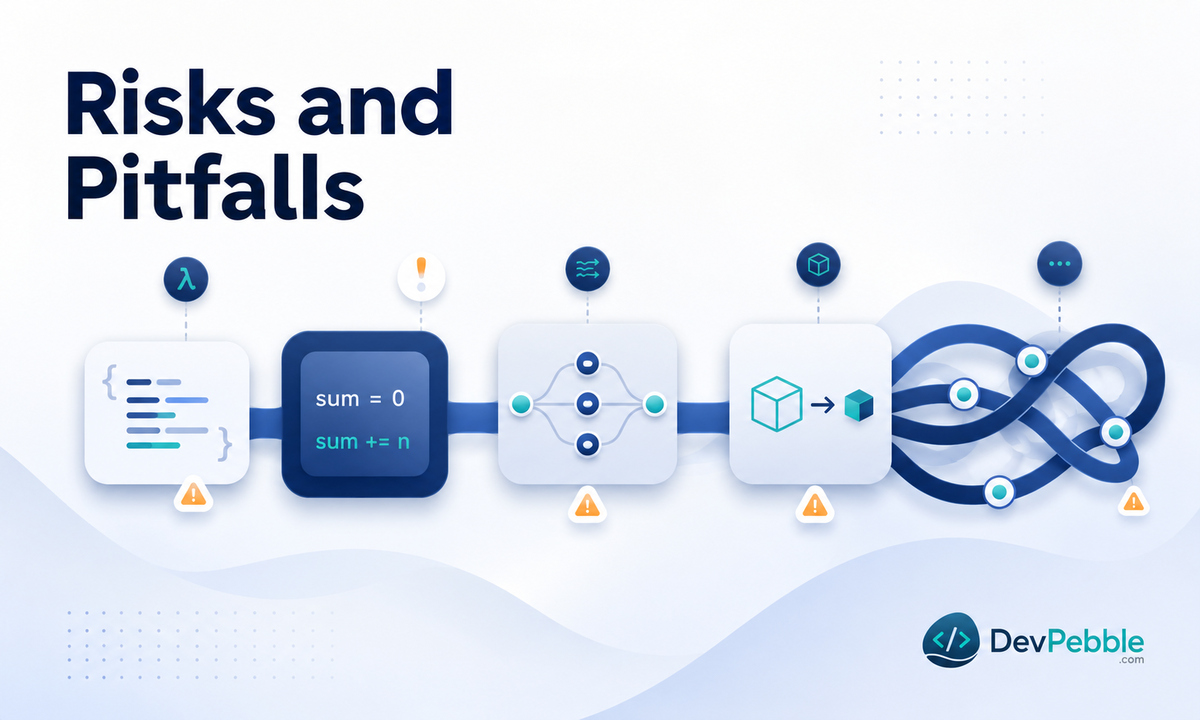
Functional syntax can make Java code worse when pipelines hide domain logic, lambdas mutate shared state, parallel execution is assumed to be faster without evidence, or unnecessary boxing complicates debugging. Prioritize correctness risks first, then performance risks, and prefer a benchmark over an assumption whenever performance is the real concern.
Stateful lambdas and stream side effects
Don't mutate a stream's source during pipeline execution, and don't append results to a shared external collection from forEach. Both violate the non-interference contract streams expect and can produce nondeterministic results, especially under parallel execution. Build the result with collect or toList instead, and treat peek as a diagnostic tool rather than core logic.
Parallel streams and ordering
Calling .parallel() is not a free speed improvement. Partitioning, thread coordination, and result-combining all add overhead; ordered or stateful operations can erode the benefit further; and small datasets often lack enough work to offset the coordination cost. Benchmark the actual workload on representative hardware before adopting parallel streams in production.
Boxing, allocation, and performance assumptions
Generic streams over Integer, Long, or Double box every primitive value, which adds allocation overhead in numeric-heavy paths. IntStream, LongStream, and DoubleStream avoid this. Don't guess at performance from code length. Use JMH rather than wall-clock timing loops, and report the benchmark's warm-up, iterations, and variance alongside any result.
Long pipelines, debugging, and checked exceptions
Extract complex lambdas into named methods, and split a pipeline at meaningful domain boundaries rather than chaining a dozen operations in one statement. Avoid generic "sneaky throw" helpers for checked exceptions inside lambdas, and handle them explicitly. When a pipeline stops being easy to step through in a debugger, a loop may communicate the workflow more clearly.
When should you use functional style, and when shouldn't you?
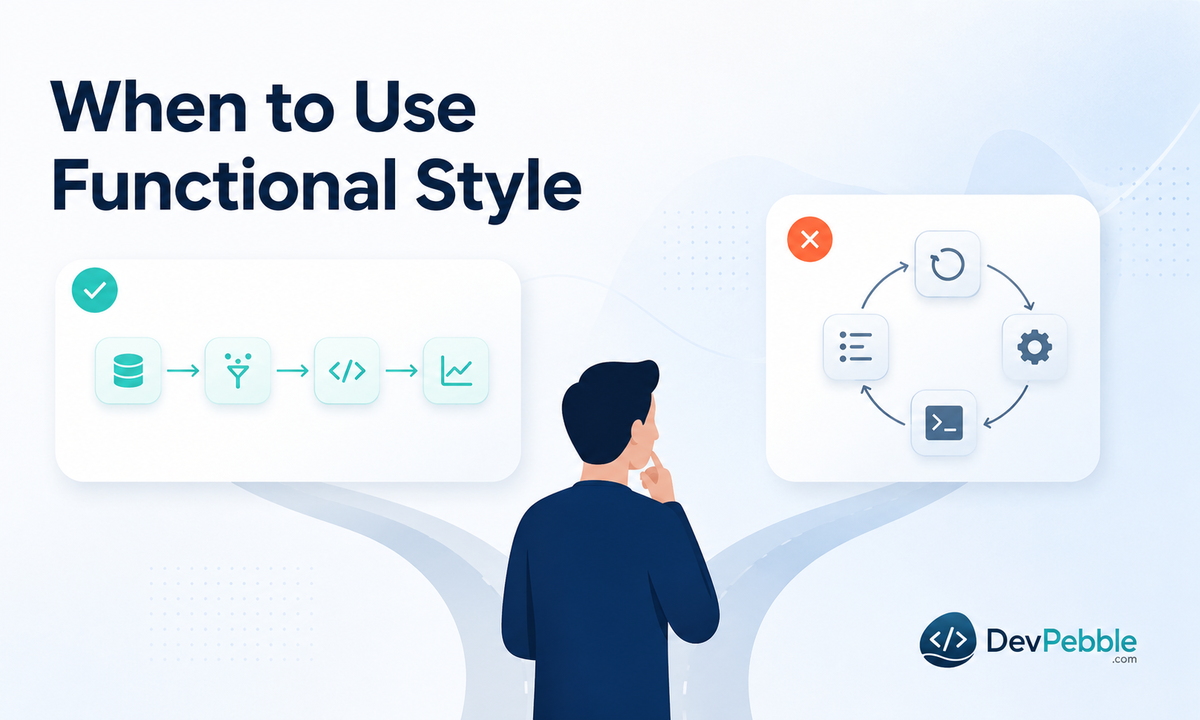
Favor functional style for bounded transformations, reusable business rules, aggregation, and chained absence-handling. Favor a straightforward loop or object method for highly stateful workflows, complex exception control, stepwise mutation, or any pipeline that becomes harder to read than the code it replaced. Neither paradigm should be treated as mutually exclusive with the other.
Good-fit criteria
Collection transformation, validation-rule composition, aggregation and grouping, pure calculations, Optional-based result chaining, and event transformation without shared mutation are all strong candidates for functional style.
Prefer loops or object methods when...
Reach for a loop or an object method when the algorithm is inherently stateful, when early exits and exception handling dominate the logic, when a pipeline would need several temporary debugging stages to inspect, when mutation is local and obviously safe, or when the team can't quickly explain what a composed result actually does.
How should a team adopt functional Java safely?
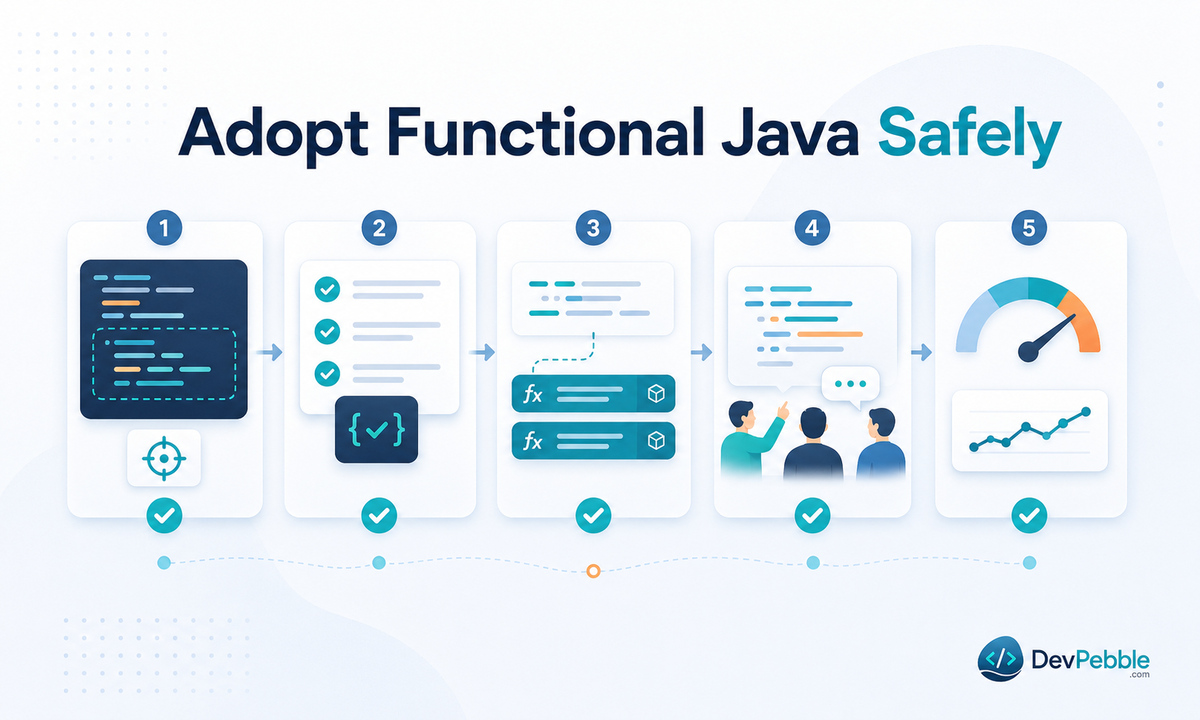
Adopt incrementally: begin with small, bounded collection transformations, preserve existing tests through the refactor, extract pure domain functions with clear names, prohibit shared mutation inside pipelines, and reserve benchmarking effort for genuinely performance-sensitive paths. Functional style should serve code quality rather than become a blanket mandate enforced through lint rules alone.
Five-step adoption checklist
- Choose and document a target JDK version for the codebase.
- Refactor one bounded transformation as a pilot.
- Preserve behavior with tests before and after the change.
- Extract and name reusable functions instead of inlining complex logic.
- Review for readability, and benchmark only where performance is a real constraint.
Conclusion
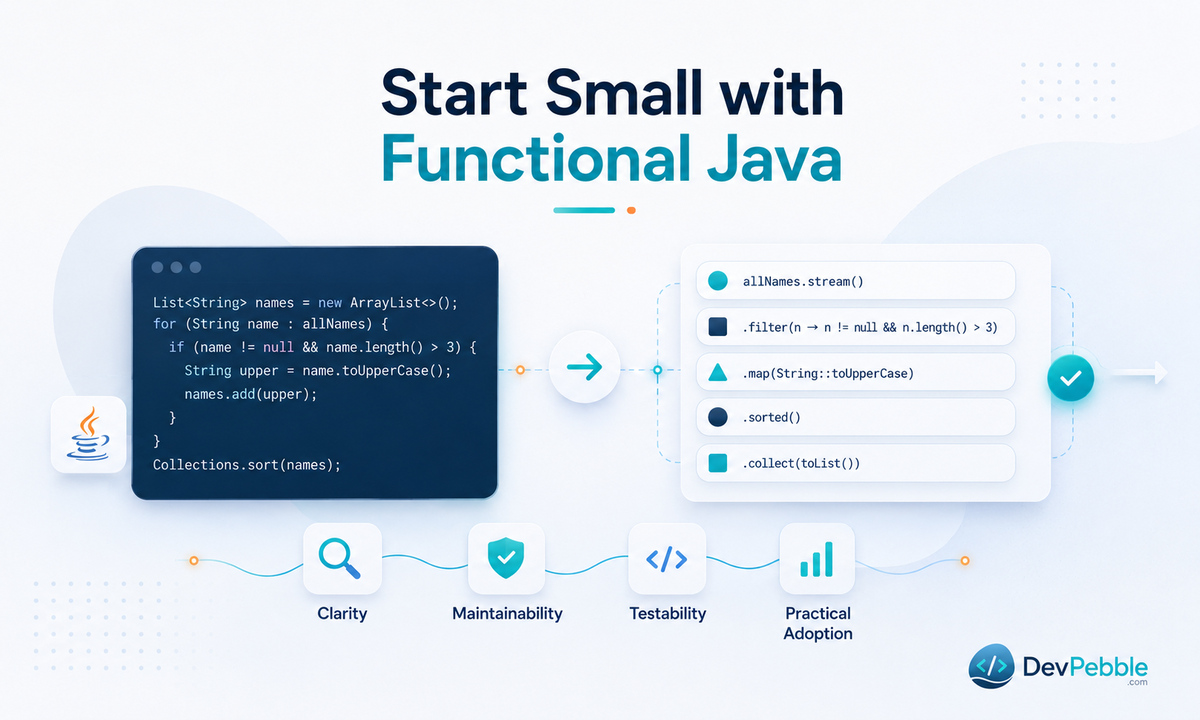
Functional programming is a useful part of modern Java, not a wholesale replacement for loops or objects. It earns its place on bounded, well-defined transformations (filtering, mapping, aggregating, chaining absent results) where pure functions and immutability make code easier to test and reason about.
Start small. Refactor one collection-processing method, keep the tests passing before and after, and give the extracted logic clear domain names. Use functional interfaces and streams intentionally rather than by default, keep side effects at the edges of the pipeline, and treat any performance claim as something to benchmark rather than assume. For anything the API surface doesn't make obvious, the official java.util.function and java.util.stream documentation remains the most reliable next reference.