Programming paradigms explained: a practical guide for developers
Programming paradigms explained: imperative vs declarative, plus procedural, object-oriented, functional, and logic programming, with examples and how to choose.
On this page⌄
If you have ever wondered why some code reads like a recipe and other code reads like a math proof, you have already bumped into programming paradigms. A paradigm is the underlying style a language pushes you toward. It shapes how you structure logic, handle data, and even think about a problem before you type a single line.
Most developers pick up their first paradigm by accident. It is usually whatever their first language happened to teach. That works fine until you hit a problem the style does not suit, and the code starts fighting back. Learning how paradigms actually differ fixes that. It lets you match the approach to the task instead of forcing every problem through the one pattern you already know.
This guide covers what a programming paradigm really is, the main types with plain examples, and how they show up in the languages you use every day. By the end you will know when to reach for objects, when to reach for pure functions, and why almost every modern language lets you mix both.
What is a programming paradigm?
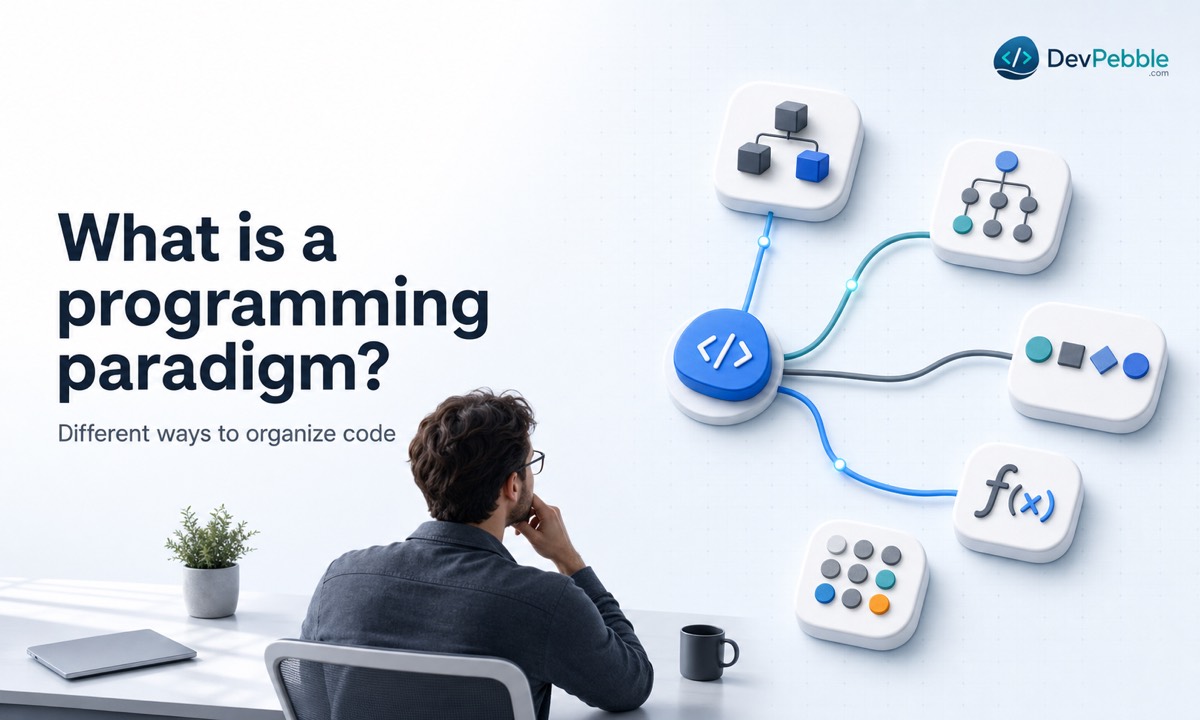
A programming paradigm is a way of thinking about and organizing code. It is a set of ideas and rules about how programs should be built and how logic should flow. Two developers can solve the same problem, in the same language, and write completely different code because they are working in different paradigms.
Picture building a house. One builder works room by room in a fixed order, laying every brick by hand. Another orders prefabricated sections and bolts them together on site. Both end up with a house. Their tools, habits, and order of operations differ because their basic approach differs. Paradigms are those basic approaches, applied to software instead of bricks.
A paradigm is not the same thing as a language. A language is the tool. A paradigm is a philosophy about how to use that tool. A few languages are built tightly around a single paradigm, but most of the popular ones support several. That is why the same language can feel procedural in one file and functional in the next.
Why should you care as a working developer? Because paradigms affect real outcomes. They influence how easy your code is to test, how well it handles many things happening at once, how simple it is to change later, and how quickly a new teammate can read it. Pick a style that fits the problem and the code stays clean. Pick the wrong one and you spend your afternoons untangling logic that never wanted to be written that way.
The two big families: imperative and declarative
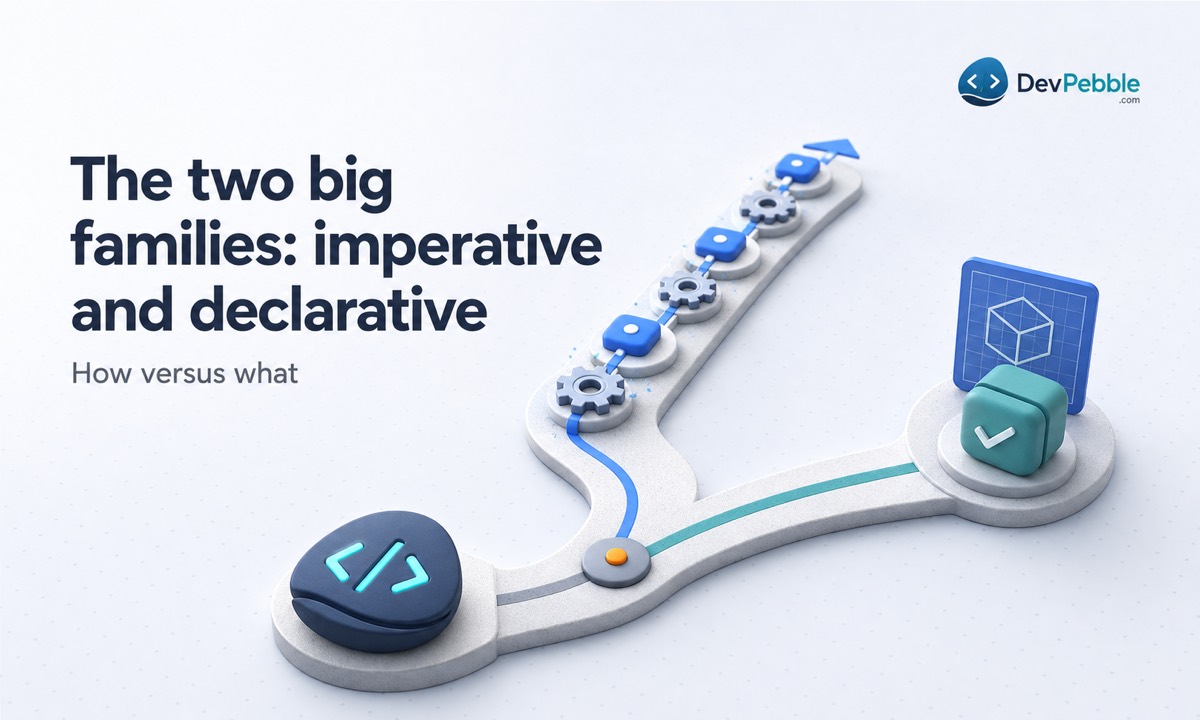
Almost every paradigm falls under one of two broad families. Getting these two straight makes everything else click into place.
Imperative programming
Imperative programming is about the how. You write explicit, step by step instructions that tell the computer exactly what to do and in what order. You manage the program's state directly, changing variables as you go. If you have ever written a loop that counts up, checks a condition, and updates a total, that is imperative thinking in action.
Here is the mental model. Imperative code is a set of commands. Do this, then do that, then check this, then repeat. The computer follows your instructions literally. You are the one deciding the exact path from start to finish.
A short example in plain terms: to find the largest number in a list, imperative code starts with the first number as the current maximum, walks through each remaining number, and replaces the maximum whenever it finds something bigger. You spell out every step.
Declarative programming
Declarative programming flips the focus to the what. You describe the result you want and let the language or engine figure out how to produce it. You are not managing every step or tracking state by hand. You state the goal and trust the underlying system to reach it.
SQL is the classic example that most developers already know. When you write a query, you say which rows you want and under which conditions. You do not tell the database how to scan tables, use indexes, or order the work. The query planner handles all of that. You declared the outcome; the engine chose the path.
Back to that list of numbers. A declarative version says something like "give me the maximum value in this list." There is no loop and no running variable in your code. The heavy lifting happens somewhere you do not have to see.
Neither family is better in the abstract. Imperative code gives you tight control, which matters for performance work and low level systems. Declarative code hides the machinery, which keeps higher level logic short and readable. Most of the specific paradigms below are simply refined versions of these two ideas.
The main programming paradigms explained
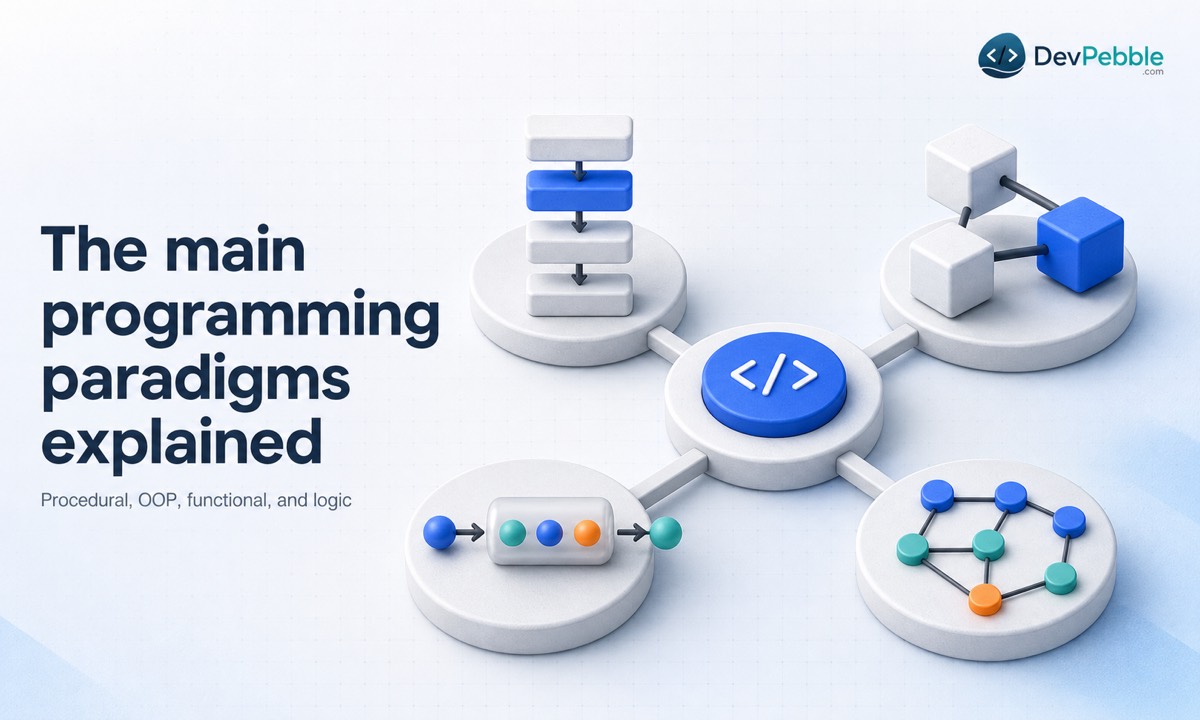
Under those two families sit the paradigms you will meet by name in tutorials, job listings, and code reviews. Here are the four that matter most, plus a couple of honorable mentions.
Procedural programming
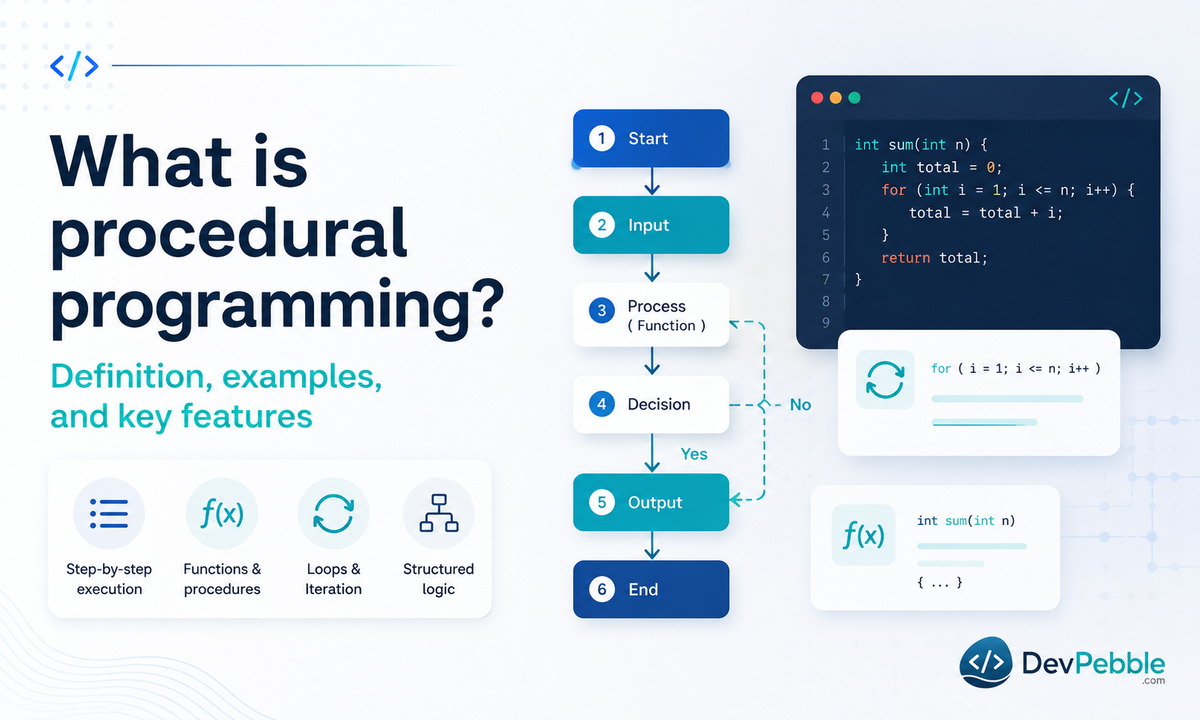
Procedural programming is imperative code organized into procedures, also called functions or routines. Instead of one long script, you group related steps into reusable blocks and call them when needed. The program runs top to bottom, jumping into procedures and returning from them.
This paradigm shaped a whole generation of software. C, Pascal, and early BASIC lean heavily procedural, and Fortran, released in 1957, is often cited as the first widely used language of this kind. Procedural code is easy to follow because it mirrors how people describe a process out loud: first do this, then do that.
The catch shows up as programs grow. When data lives in shared variables and dozens of procedures touch it, tracking who changed what becomes a headache. That pain is a big part of why the next paradigm caught on.
Object-oriented programming (OOP)
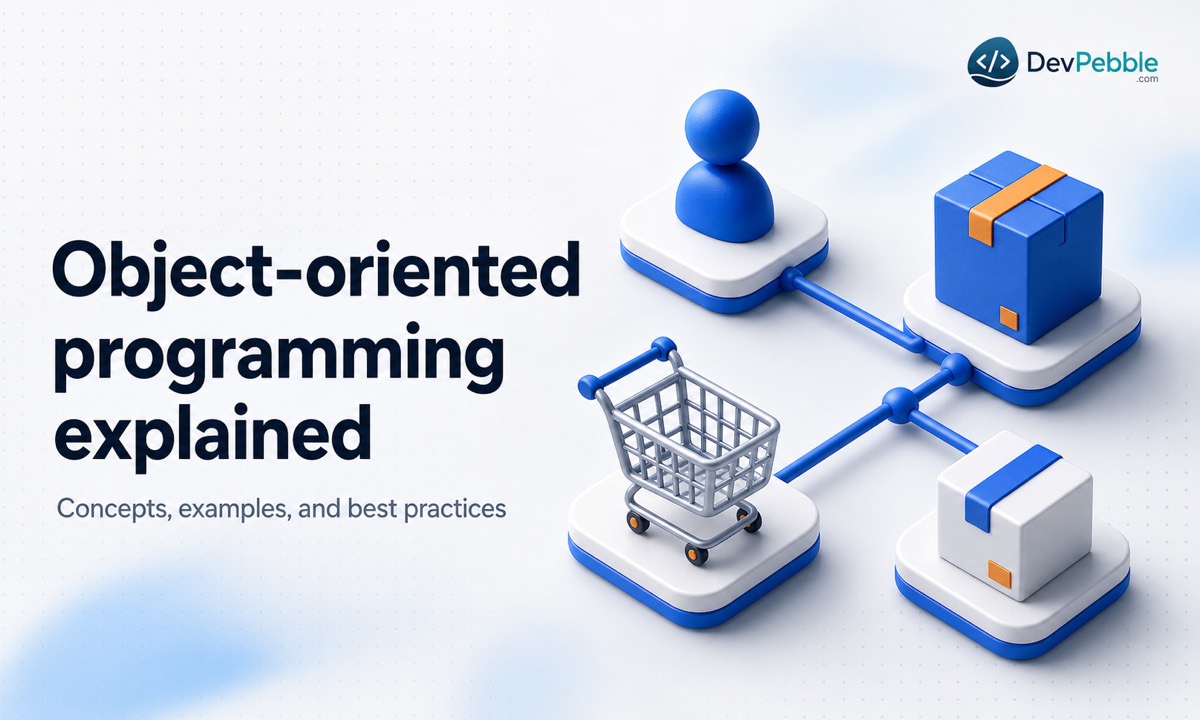
Object-oriented programming bundles data and the behavior that acts on it into single units called objects. Each object is built from a blueprint called a class. Instead of loose variables and procedures floating around, you get self-contained pieces that model real things: a user, an order, a bank account, a game character.
OOP rests on four core ideas. Encapsulation keeps an object's internal data hidden and exposes only what other code needs, so nothing pokes at fields it should not touch. Inheritance lets one class build on another, reusing shared behavior instead of copying it. Polymorphism lets different objects respond to the same instruction in their own way, so a shape's "draw" call works whether the shape is a circle or a square. Abstraction hides messy details behind a simple interface.
The ideas trace back to Simula in the 1960s, which introduced classes and objects, and Smalltalk in the 1970s, which popularized the full object-oriented style. Alan Kay, who worked on Smalltalk, is usually credited with coining the term object-oriented. Today Java, C#, C++, Python, and Ruby all support OOP, and it remains the default way large teams structure business software.
OOP shines when your problem maps naturally onto things with state and behavior. It can get heavy when developers pile on deep inheritance chains and abstract layers that add ceremony without adding clarity. Used with restraint, it keeps big codebases organized. Used carelessly, it buries simple logic under classes nobody needs.
Functional programming
Functional programming treats computation as the evaluation of functions, and it takes the idea seriously. It grew out of Lisp, released in 1958, and it has surged in popularity as developers look for cleaner ways to handle concurrency and state.
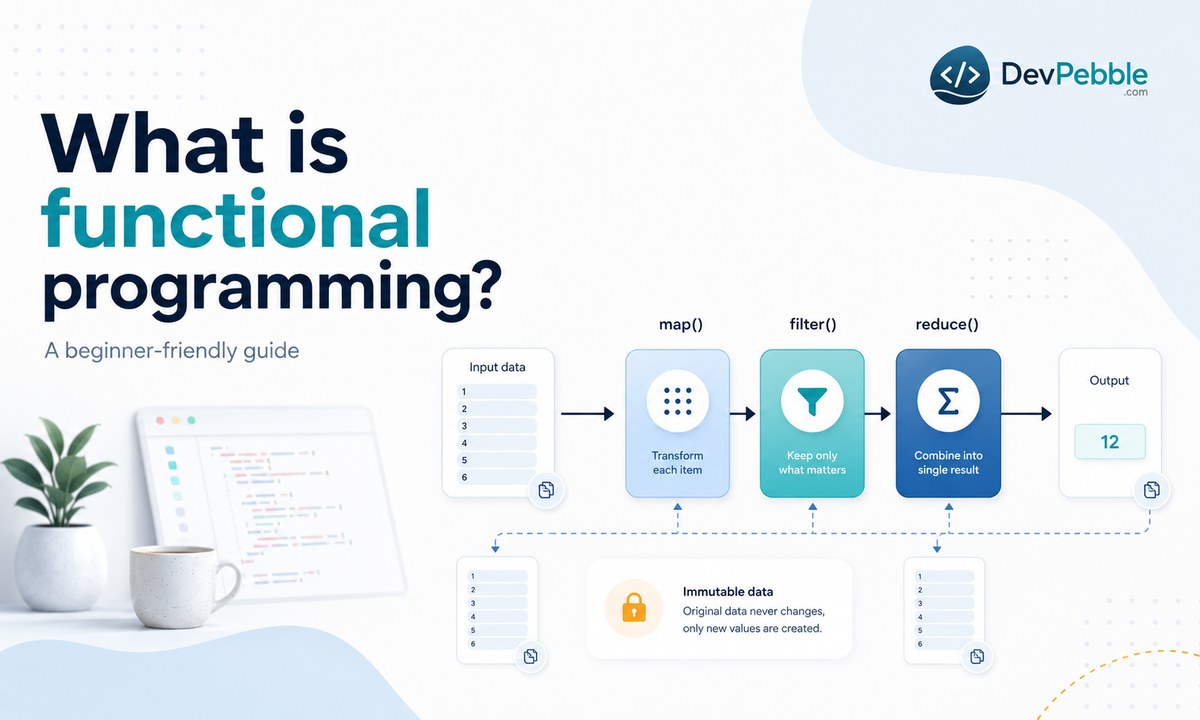
Two ideas sit at the center. The first is pure functions. A pure function always returns the same output for the same input and never changes anything outside itself. It has no side effects, so it does not write to a database, mutate a global, or print to the screen as a hidden action. That predictability makes pure functions easy to test and easy to reason about, because you never have to ask what else the function quietly touched.
The second is immutability. Instead of changing existing data, functional code creates new data. A function that "adds" an item to a list returns a fresh list rather than editing the original. This sounds wasteful, but it prevents a whole category of bugs where two parts of a program step on the same shared value at the wrong moment.
Functional code also treats functions as first class values. You can pass a function into another function, return one, and store one in a variable. Higher order functions like map, filter, and reduce come straight from this idea, and if you have used them in JavaScript or Python, you have already written functional code without labeling it that way.
Haskell is purely functional, meaning it enforces these rules strictly. Erlang, Elixir, Clojure, and F# are strong functional languages used in production, especially where many operations run at once. The main hurdle is the learning curve. Concepts like recursion over loops and avoiding shared state take practice for developers raised on imperative habits.
Logic programming
Logic programming is the most declarative of the bunch and the one most developers never touch. You do not write step by step instructions at all. You state a set of facts and rules, then ask questions. The system works out the answers by applying logic to what you told it.
Prolog, which appeared in the early 1970s, is the language most associated with this style. You might declare facts such as "Tom is the parent of Bob" and a rule such as "X is a grandparent of Z if X is a parent of Y and Y is a parent of Z." Then you ask who Bob's grandparents are, and the engine derives the answer. You never wrote a loop or a search. The logic did it.
This paradigm has real uses in expert systems, natural language processing, and certain artificial intelligence problems where relationships and rules matter more than raw sequences of steps. It stays niche because most everyday software is easier to express in imperative or object-oriented terms.
A few others worth knowing
Two more names come up often enough to recognize. Event-driven programming structures a program around events such as clicks, messages, or sensor readings, with handlers that fire when those events occur. It is the backbone of user interfaces and much of modern JavaScript. Reactive programming builds on that idea and focuses on data streams that update automatically as their inputs change, which suits live dashboards and interfaces that refresh in real time.
How paradigms show up in real languages
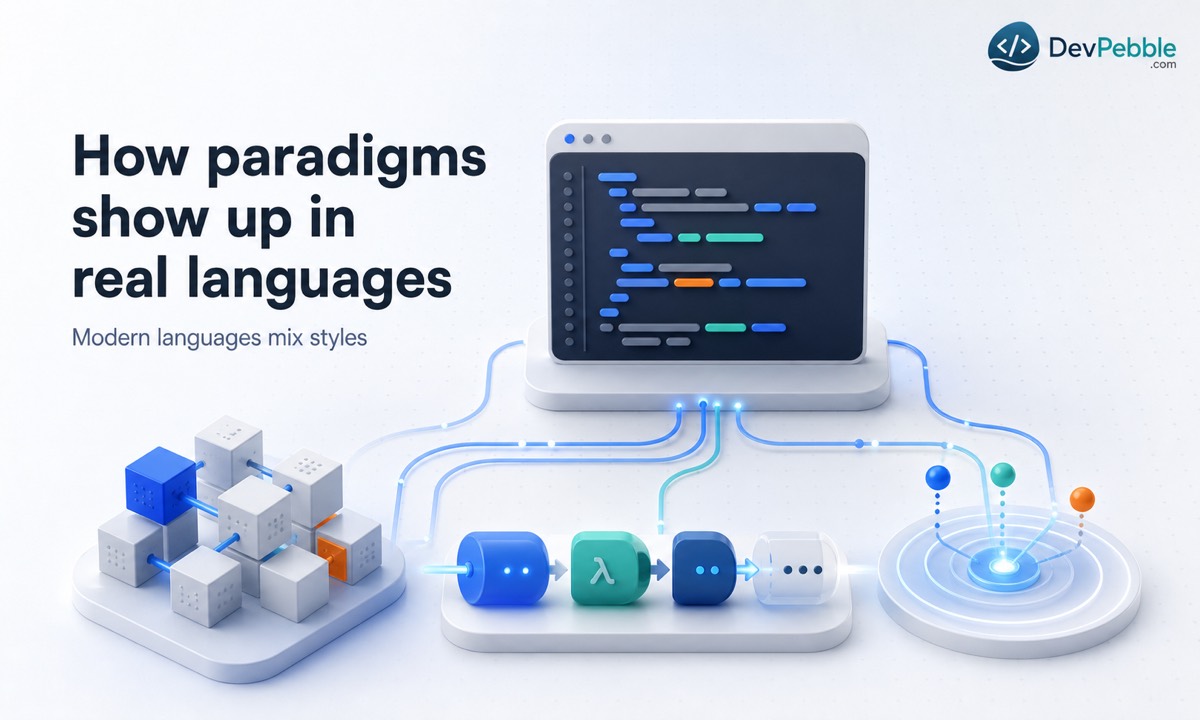
Here is the part that trips up beginners. Most languages are not locked to one paradigm. They are multi-paradigm, which means they support several styles and let you choose based on the task.
Python is a good example. You can write a quick procedural script, model your domain with classes when you need OOP, and lean on map, filter, and comprehensions when a functional approach reads cleaner. The 2025 Stack Overflow Developer Survey found that Python's usage jumped about 7 percentage points year over year, driven largely by data science, backend work, and artificial intelligence, all areas where mixing paradigms is common.
JavaScript is similar. It handles objects, embraces functional patterns through first class functions, and runs the event driven model that powers the browser. It stayed the most used language in that same survey, with roughly 66 percent of developers reporting they worked with it. C++ blends procedural code, OOP, and generic programming. Scala and Rust both marry functional ideas with imperative control. Even Java, long treated as strictly object-oriented, added lambdas and streams to support a functional style.
The takeaway is practical. You rarely choose a paradigm once and stick to it forever. Inside a single project you might model your data with objects, transform it with functional pipelines, and wire up user actions with event handlers. Knowing several paradigms means you can reach for whichever one makes a given piece of code simplest.
Imperative versus declarative in practice
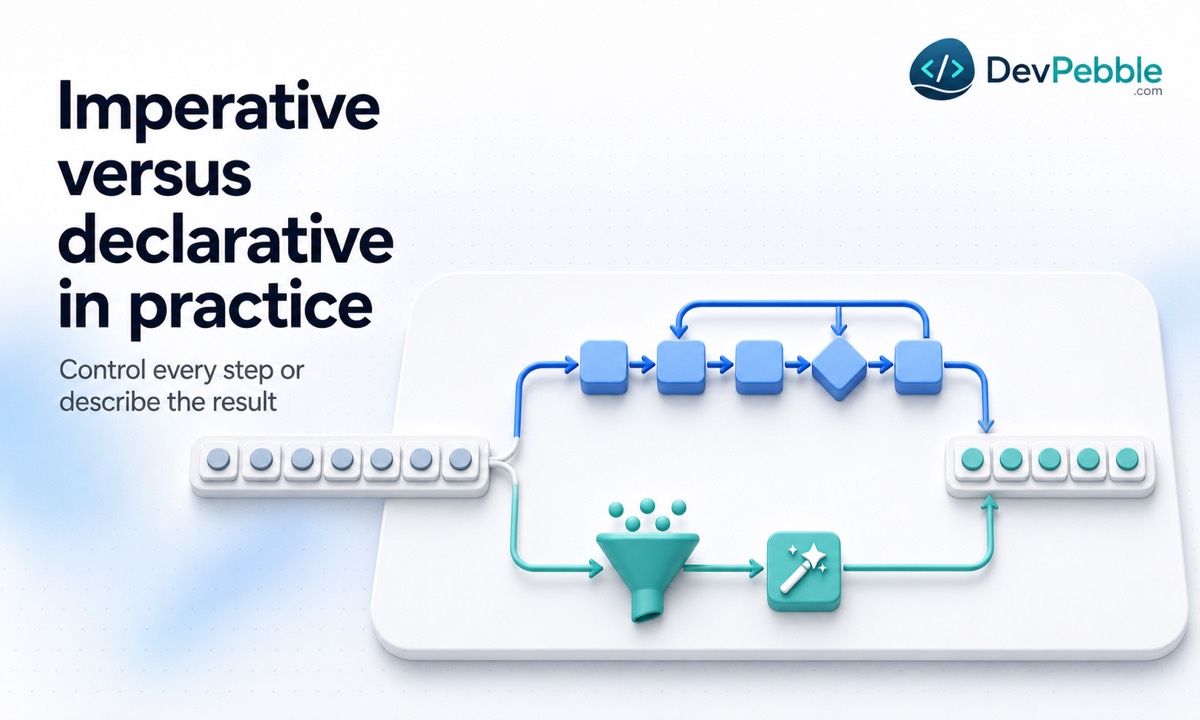
A concrete comparison makes the difference obvious. Say you want to take a list of numbers and produce a new list containing only the even ones, doubled.
The imperative approach spells out every step. You create an empty result list, loop through each number, check whether it is even, and if it is, double it and append it to the result. You control the loop, the condition, and the order. Nothing happens that you did not write.
The declarative approach describes the transformation instead. You say "filter this list down to even numbers, then double each one," usually with a chain of functions such as filter and map. There is no visible loop and no result list you manage by hand. You stated the outcome, and the language handled the iteration.
Both produce the same output. The imperative version gives you precise control and is easy to step through in a debugger. The declarative version is shorter and often easier to read once you are used to the pattern, because it hides the bookkeeping. Neither is wrong. The right choice depends on the situation and the people who will read the code later.
How to choose the right paradigm
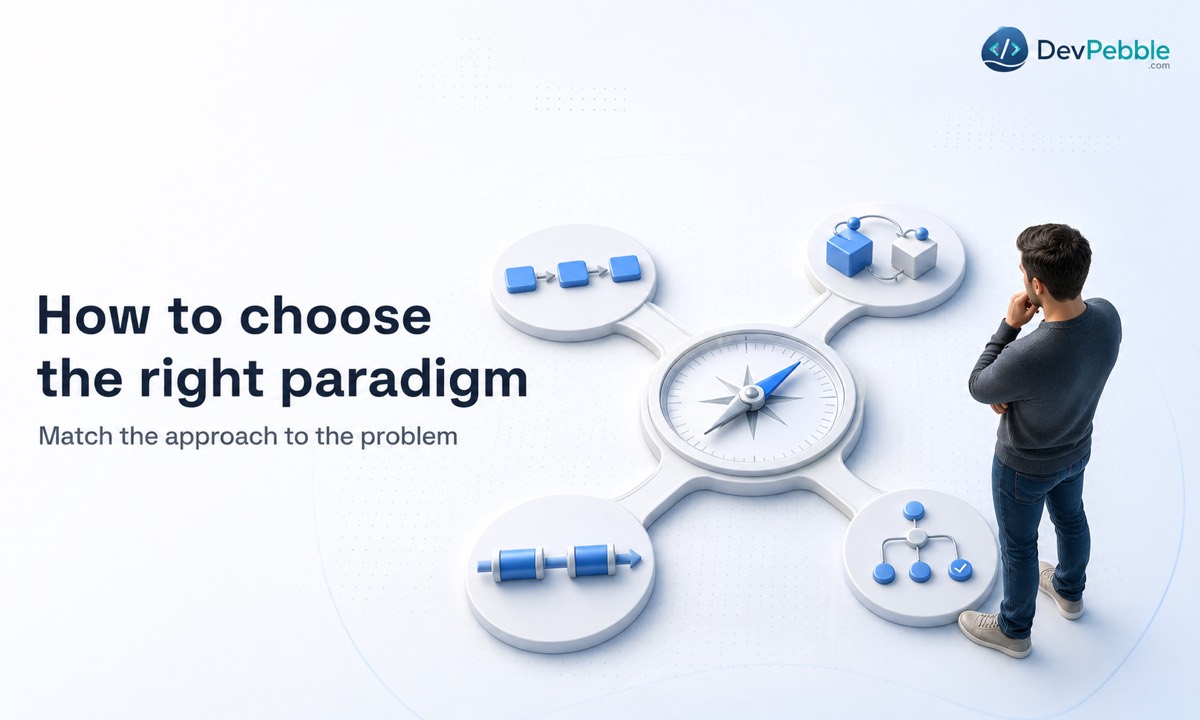
There is no universal winner, and anyone who tells you one paradigm beats the rest for everything is selling something. The better question is which paradigm fits the problem in front of you.
Reach for procedural code when the task is a straightforward sequence of steps, like a script that reads a file, processes it, and writes the result. Reach for OOP when your problem is full of things that have both data and behavior and when a team needs a shared structure for a large codebase. Reach for functional programming when correctness and concurrency matter, when you want to avoid bugs from shared mutable state, or when your work is mostly transforming data. Consider logic programming when your problem is really about rules and relationships rather than sequences.
A few practical factors weigh on the decision too. Consider what your team already knows, since a paradigm nobody understands will slow everyone down. Consider the ecosystem, because some problems have far better libraries in one style. Consider maintenance, because the code will be read many more times than it is written. In most real projects you will blend paradigms rather than commit to one, and that is a sign of judgment, not indecision.
Common mistakes beginners make with paradigms
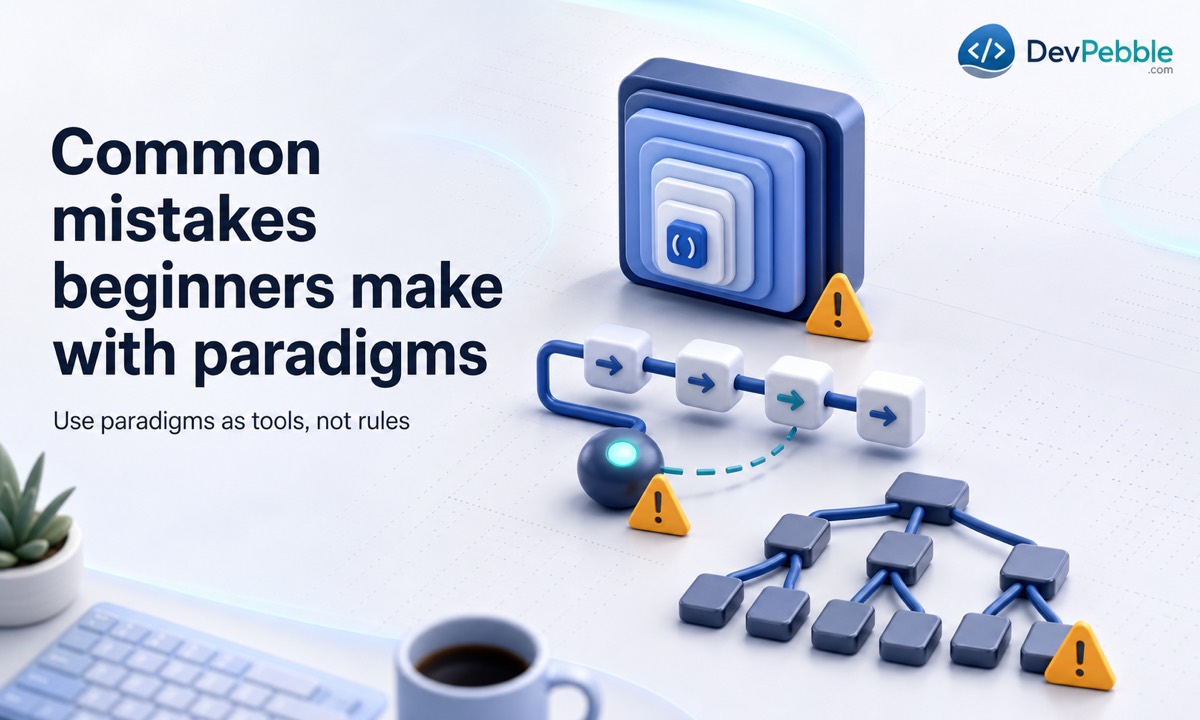
A few traps catch almost everyone learning this material, and knowing them ahead of time saves a lot of frustration.
The first is treating a paradigm like a religion. Beginners often learn OOP, then wrap everything in classes even when a simple function would do. Forcing a single style onto every problem produces awkward code. The paradigm is a tool, not a rule you must obey.
The second is confusing a language with a paradigm. People say "Python is object-oriented" as if that is the whole story, when Python happily supports several styles. The language sets what is possible. You choose the paradigm within it.
The third is misunderstanding what pure functions and immutability are for. Newer functional developers sometimes copy the syntax, like using map everywhere, while still mutating shared state underneath. The syntax is not the point. The discipline of avoiding hidden side effects is what actually pays off.
The last is ignoring readability. A clever functional one liner or a deep inheritance tree can feel impressive and still be a nightmare to maintain. Whatever paradigm you pick, the code has to be clear to the next person, who is often you in six months with no memory of what you were thinking.
Final takeaway
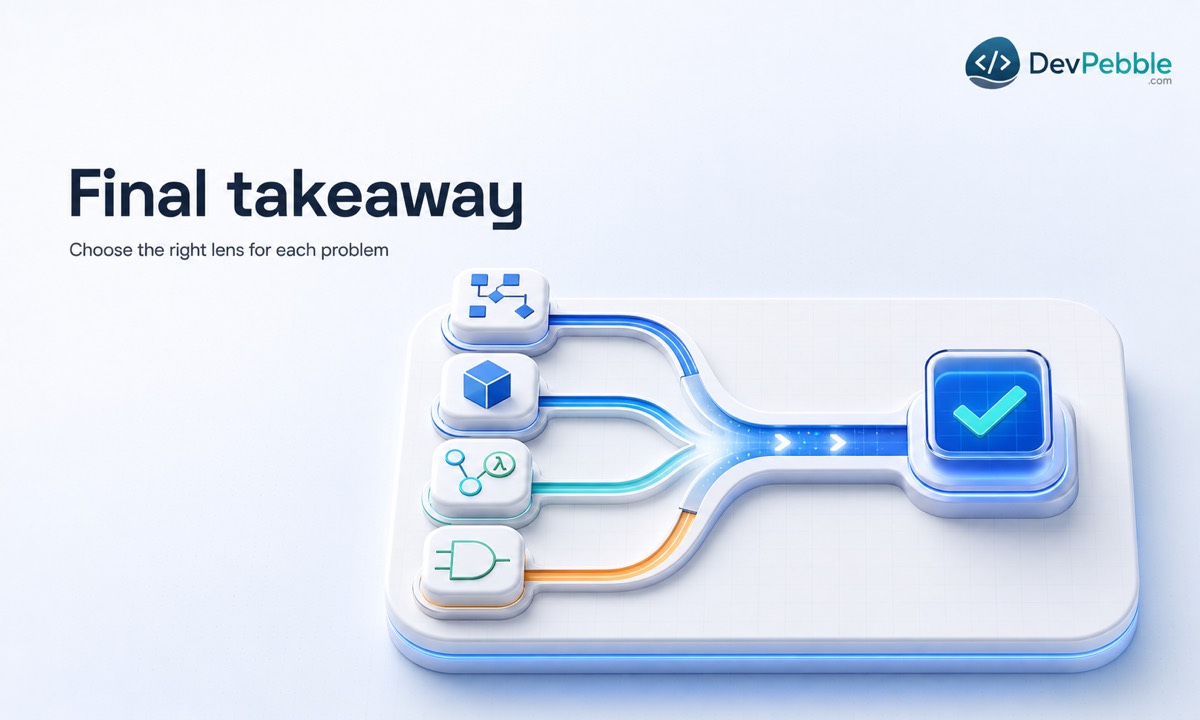
Programming paradigms are not academic trivia. They are the different lenses you use to look at a problem, and each one makes certain solutions obvious and others awkward. Imperative code gives you control, declarative code hides complexity, procedural code keeps simple tasks readable, OOP organizes large systems, and functional code tames state and concurrency.
The developers who write the cleanest code are rarely the ones loyal to a single style. They are the ones who understand several paradigms well enough to pick the right one for the job and to mix them when a project calls for it. Learn the styles, notice which ones your daily languages already support, and start choosing on purpose instead of by habit. That shift alone will make your code easier to write, easier to read, and far easier to live with later.