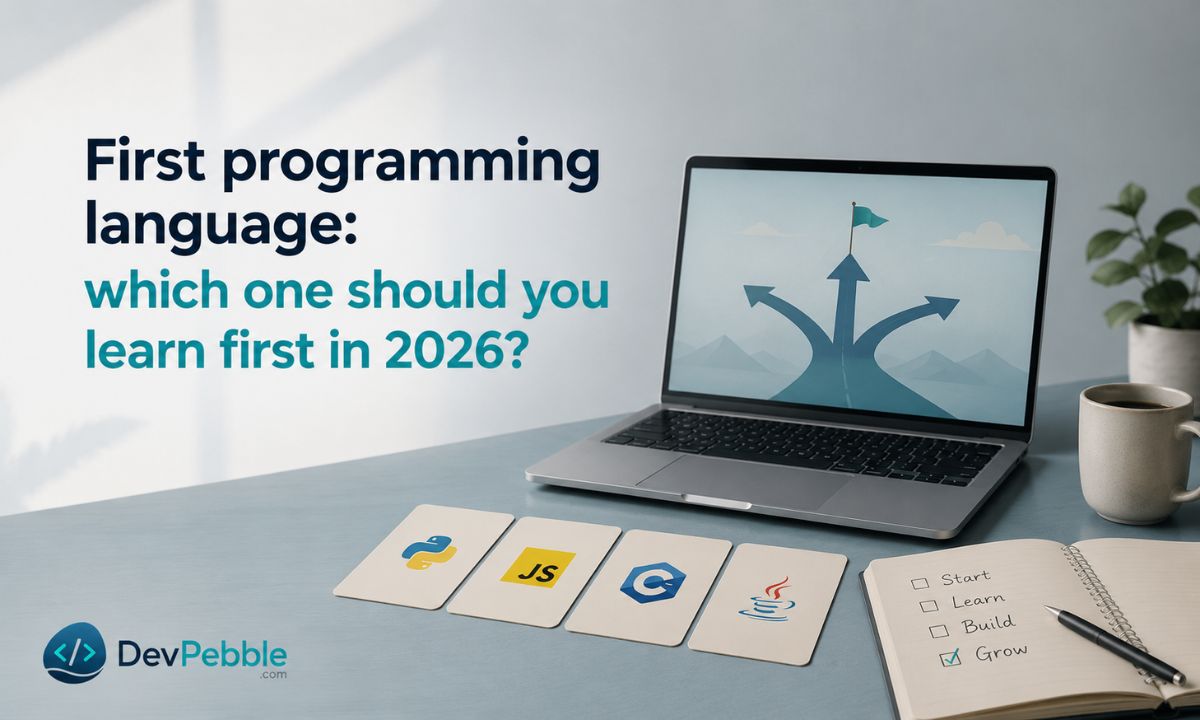
First programming language: which one should you learn first in 2026?
No single best first programming language exists — this guide maps your goal to a sensible first language, weighs Python vs JavaScript, covers when Java, C++, C#, or Swift fit, and the beginner mistakes to avoid.
On this page⌄
- What should your first programming language be?
- How to choose the right first language
- Best first programming language for your goals
- Is Python the best first language for beginners?
- Should JavaScript be your first language?
- Python vs JavaScript for beginners
- When Java, C++, C#, or Swift makes sense as a first language
- Common mistakes to avoid
- How to learn your first language, step by step
- The bottom line
- FAQ
You want to learn to code, and you're already stuck on the first decision: which language to start with. The honest answer is that there's no single best first programming language for everyone. The right one depends on what you want to build, where you'd like to work, and how you learn. Python suits a lot of beginners, but it's the wrong start for someone set on iPhone apps or front-end websites.
The good news: whatever you pick, the fundamentals carry over. Variables, loops, functions, conditionals, and breaking a problem into steps look almost the same everywhere. Learn them once and your second language takes a fraction of the time. So this choice matters less than beginners fear; the point is to make it well enough to start.
What should your first programming language be?
A programming language is a tool, and you pick a tool for the job in front of you, not because it's trending. Popularity alone is a weak reason to choose.
Some languages are friendlier to beginners, though. Starting from zero, you want one that lets you focus on thinking instead of fighting strict syntax or managing memory by hand. That's why Python and JavaScript dominate beginner recommendations in 2026: Python reads almost like plain English, and JavaScript runs in every browser, so you see results the moment you refresh. Neither is automatically right for you, which is what this guide sorts out.
How to choose the right first language
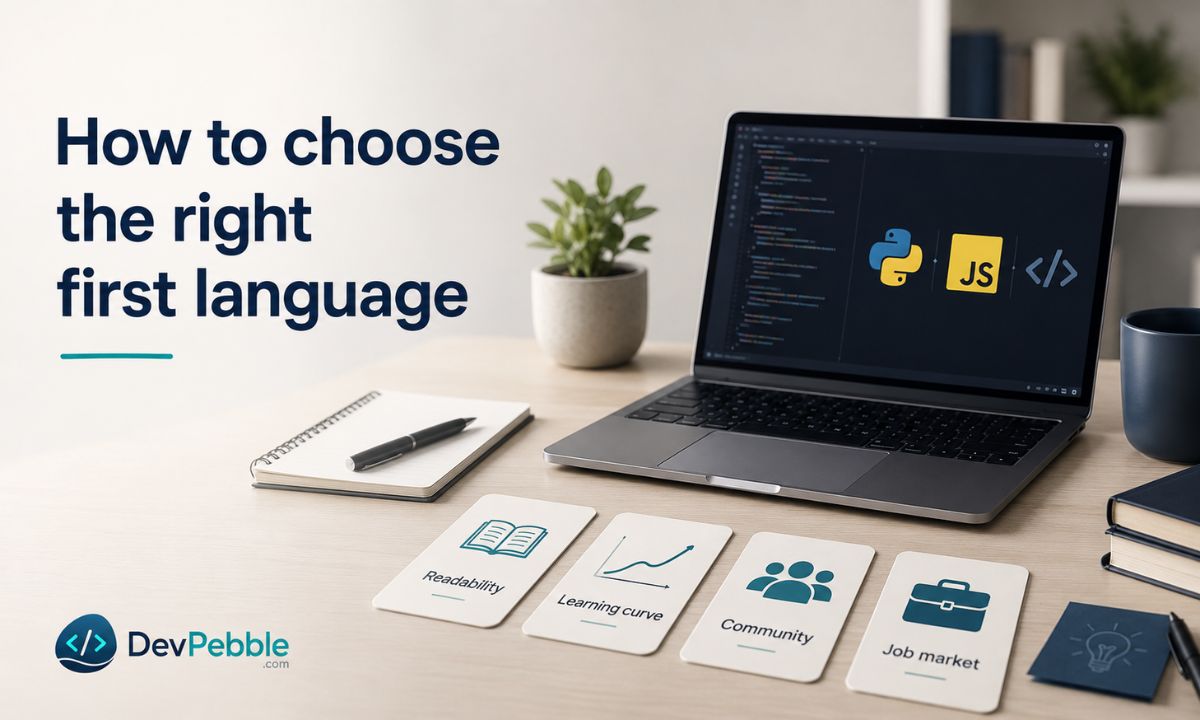
Readability comes first. Clean syntax means you spend your attention on logic, not punctuation, and Python's indentation-based style is the usual example. The learning curve matters almost as much. Some languages make you grasp type declarations or memory allocation before you can write anything useful, while a gentler curve gets you building sooner, and early wins keep beginners going.
Support around the language counts too: clear official docs for when something breaks, and a big community on Stack Overflow, Reddit, and Discord so being stuck lasts an hour, not a week. Free courses (freeCodeCamp, Codecademy, CS50) and error-message quality also vary, and clear errors teach faster than cryptic ones.
If a job is part of the goal, it helps to know what the market uses. In the 2025 Stack Overflow Developer Survey, JavaScript was still the most widely used language among professional developers, while Python rose 7 points year over year to 58% adoption, driven by AI, data, and back-end work.
Best first programming language for your goals
Choosing without a goal is like picking a college major by coin flip. You don't need your future locked down, but a rough direction narrows the field fast. Here's a map from what you want to build to a sensible first language, with the honest catch for each.
| What you want to build | Strong first-language option | Why it fits | The catch |
|---|---|---|---|
| Front-end websites | JavaScript | The only native browser language; frameworks need it | Quirky syntax; heavy tooling once frameworks arrive |
| Full-stack web apps | JavaScript, then TypeScript | One language covers front and back (Node.js) | TypeScript expected before long |
| Back-end and APIs | Python or Node.js | Django/FastAPI and Express are both beginner-friendly | Python can't run in the browser |
| Android apps | Kotlin | Google's preferred Android language, full Jetpack support | Narrow outside the Android/JVM world |
| iPhone and iPad apps | Swift | Apple's official language; clean syntax, good tools | Apple-only; needs a Mac and Xcode |
| Games | C# (Unity) or C++ (Unreal) | Unity with C# is the friendliest route in | C++ is steep; you learn the engine too |
| AI, ML, and data science | Python | PyTorch, TensorFlow, Pandas are all Python-first | Hides low-level detail |
| Systems and embedded | C, C++, or Rust | Direct memory and hardware control | High curve; errors are cryptic early on |
One gap in the table: for cross-platform mobile, Dart with Flutter builds for both iOS and Android from one codebase.
Is Python the best first language for beginners?
Python sits at or near the top of almost every beginner list, and the reasons hold up, even if "best for everyone" oversells it.
The case for it is the lack of friction. Printing text takes one line, print("Hello, world!"), with no semicolons, braces, or type declarations to write first. The forced indentation keeps code tidy. The ecosystem is strong too: one of the largest communities of any language, free courses on Coursera and freeCodeCamp, and a place in university intro courses. The range grows with you, from automation scripts to web back-ends (Django, FastAPI) to data analysis (Pandas, NumPy) and machine learning. Python overtook JavaScript as the most-used language on GitHub in the 2024 Octoverse report and held around 2.6 million monthly contributors in 2025, up 48% year over year, before TypeScript edged past it that August.
The limits are mostly in what Python hides. It abstracts low-level detail, which helps early and becomes a gap if you move toward systems or embedded work and suddenly need the memory and pointers it kept out of sight. It can't build front-end web pages (browsers run JavaScript), it isn't a first-class option for native mobile apps, and for raw-speed workloads like game engines you'll reach for C, C++, or Rust. Python is a strong default, but pick it because it fits your goals, not because a ranking said so.
Should JavaScript be your first language?
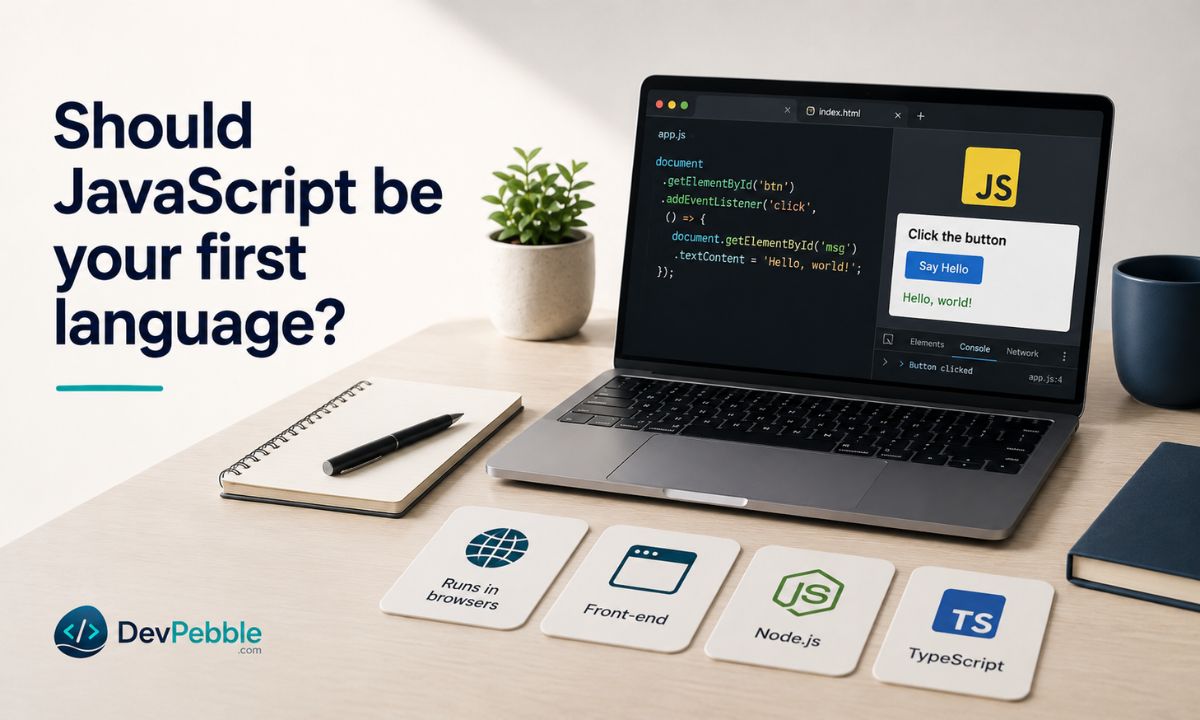
If your goals touch the web at all, JavaScript belongs in the conversation. It's the only language that runs natively in every browser, so the instant you write a script you can open a page and watch it react, which is hard to beat for motivation early on.
One mix-up to clear up first: HTML and CSS aren't programming languages. HTML structures a page, CSS styles it, but neither can do math, make decisions, or store data. JavaScript is what makes a page behave, the menu that opens, the form that flags a bad email, the content that updates without a reload. For front-end work it isn't optional, and every major framework (React, Vue, Svelte) is built on it.
JavaScript also runs on the server through Node.js (and newer options like Deno and Bun), so one language can cover both ends of an app. You'll meet TypeScript fast, too: a version of JavaScript with static typing that catches mistakes before the code runs. It's not usually a first language, but it matters. Per GitHub's Octoverse 2025 report, TypeScript passed both Python and JavaScript to top GitHub in August 2025, with about 2.63 million monthly contributors and 66% year-over-year growth. Most professional JavaScript work has moved that way.
The rough edges are real, though. Built quickly in the early web, JavaScript has quirks (loose type coercion, odd scoping, how this works) that surprise newcomers, and asynchronous code brings in callbacks, promises, and async/await that feel abstract at first. The tooling is heavier than Python's. None of it makes JavaScript a bad first language; these are the bumps you learn to drive over.
Python vs JavaScript for beginners
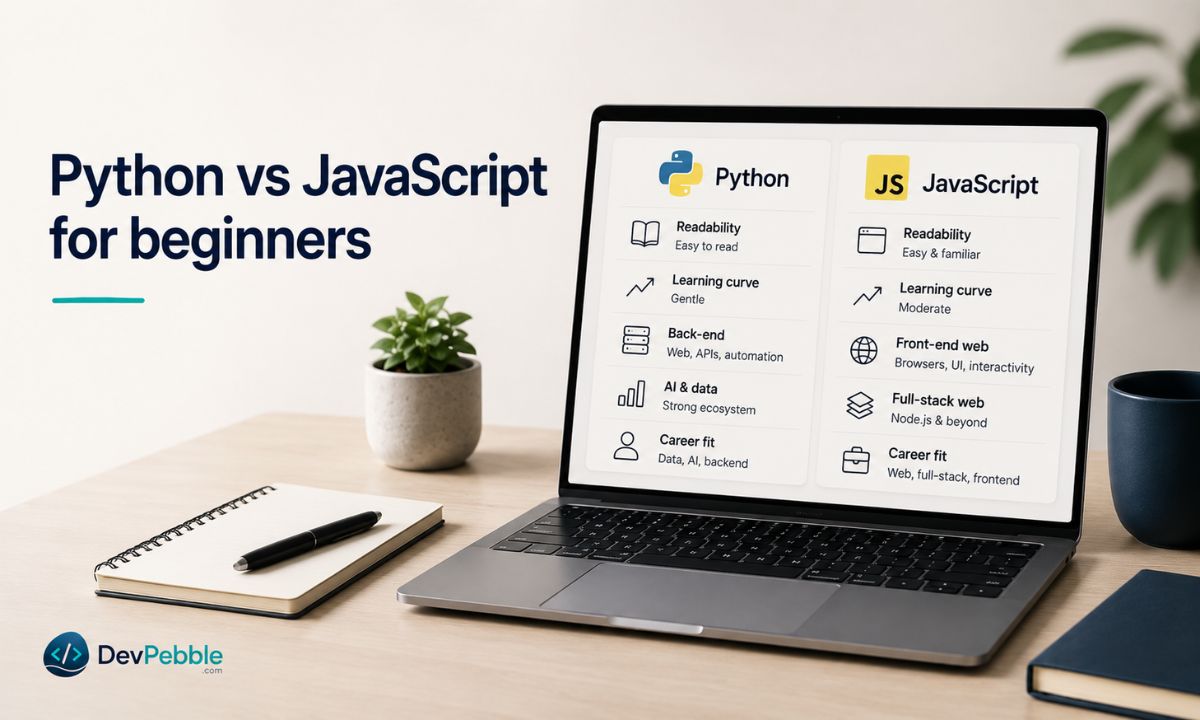
No source that crowns one of these the outright winner is being straight with you. Which one fits comes down to your situation.
| Factor | Python | JavaScript |
|---|---|---|
| Readability | Very clean, English-like | Readable but more symbol-heavy |
| Learning curve | Gentle; clear error messages | Moderate; a few quirks trip people up |
| Front-end web | Not possible | Essential; the browser's only language |
| Back-end web | Excellent (Django, FastAPI) | Strong (Node.js, Express) |
| AI, data, automation | The standard | Limited; Python leads by a wide margin |
| Career fit | Data, AI, back-end | Front-end, full-stack |
Lean Python for data, automation, AI, or back-end work, or if you want the gentlest syntax while the basics sink in. Lean JavaScript to build websites and web apps, especially if freelance web work is the plan. In full-stack development you'll likely use both within a year or two, so start with whichever is closer to what you want to build now.
When Java, C++, C#, or Swift makes sense as a first language
Python and JavaScript are the common picks, not the only sensible ones. For some goals, one of these four is the logical start.
Java still runs much of enterprise software, large back-end systems, and university CS courses, partly because it enforces object-oriented design (code organized into reusable classes and objects) from day one. It's still present in Android, though Google now prefers Kotlin and the modern Android stack is Kotlin-first. The curve is steeper than Python's, with more setup and verbose syntax, but the language isn't hard once the foundations are in. Choose it for a Java course or enterprise work.
C++ powers performance-critical software: game engines like Unreal, embedded systems, graphics, operating-system components, competitive programming. It gives you direct control over memory and how the machine processes data, the things Python hides, which is exactly what makes it hard for beginners. Expect manual memory management, pointers, and compile errors that are tough to read early on. That difficulty reflects the work C++ is built for, and for robotics, engines, or low-level understanding it can be worth the steeper start.
C# is Microsoft's main .NET language, covering enterprise software, Windows apps, web back-ends (ASP.NET Core), and games through Unity. If Unity is the goal, C# is what you'll write, and it feels like a more modern Java. The catch is reach: it's most useful in Microsoft-adjacent and Unity settings, so if neither fits your plan, it's not the strongest first pick.
Swift is Apple's language for iOS, macOS, watchOS, and tvOS, with no real alternative for native Apple apps. Apple has worked to make it approachable (Swift Playgrounds on iPad), and the syntax is clean. But it's narrow by design. For iOS or macOS it's an excellent start; if you're undecided, that narrow scope makes it harder to recommend first.
Common mistakes to avoid
Most beginner setbacks have nothing to do with picking the "wrong" language. They come from habits that slow you down whatever you chose.
The biggest is restlessness with the language itself. Chasing whatever tops a popularity chart, or picking before you've named even a rough goal, lands you somewhere that doesn't match what you want to build. Worse is hopping between languages, or learning two at once: every restart drops you back into the unfamiliar phase, and split attention means you learn neither deeply. Commit to one long enough to finish two or three real projects, then reassess.
Then there's fake progress. Watching tutorials and nodding along feels productive, but the real test is closing the video and building from a blank file. Obsessing over syntax is the same trap: the spelling of a language is the easy part, while breaking a problem into steps is the skill that transfers everywhere. Don't dodge errors either; reading the message, guessing the cause, and testing a fix is one of the most useful habits a developer builds.
AI tools earn their own warning. Copilot, Claude, and the rest can teach you a lot, but pasting in code you don't understand just hides the gap until it resurfaces as a real problem. Read every suggestion and be able to say what each line does.
Finally, ease up on comparisons and the clock. You're not behind the developer with five years on you; measure against last month. One short course makes you literate, not employable. And time spent agonizing over the choice is time not coding, so pick a reasonable option and start.
How to learn your first language, step by step
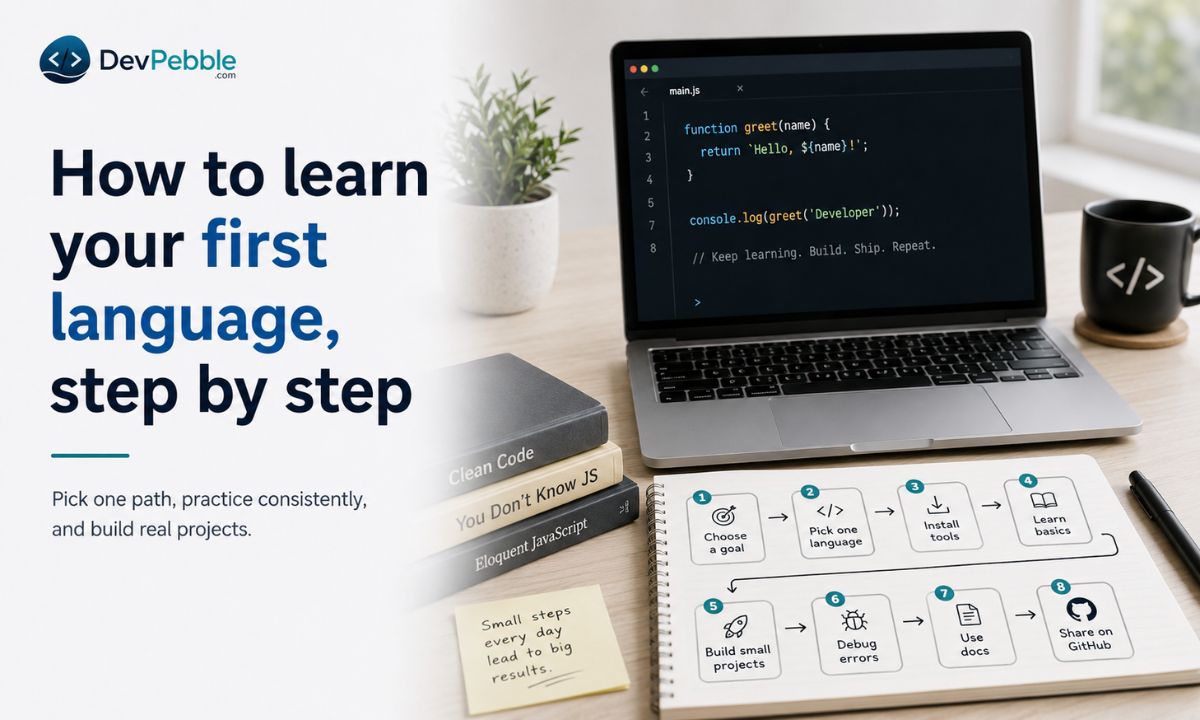
There's no universal timeline; it depends on how often you practice, how hard your projects are, and where you start. A workable sequence:
- Pick one specific goal. Not "learn to code" but "build a web app" or "automate my reports."
- Choose one language that serves it, and leave the decision alone for at least three months.
- Install the official toolchain from the language's own site (python.org, nodejs.org, swift.org) rather than random setup guides.
- Learn the basics: variables, data types, functions, loops, conditionals.
- Do a few small exercises, then build small, complete projects: a calculator, a number-guessing game, a to-do app, a file-renaming script. Finished tiny programs teach more than endless drills.
- Get comfortable reading errors and debugging before reaching for help, and use the official documentation as your first reference.
- Learn basic Git once a project grows past a few files, and push your work to GitHub; three or four finished projects there is a real record of what you can build.
- When you can build without a tutorial open, ask whether your goals actually need a second language. If they do, it'll come far faster than the first.
The bottom line
Your first programming language is one decision among many, and it's reversible. Python is a strong default for automation, data, or AI; JavaScript for the web; Swift and Kotlin for Apple and Android; C# and C++ for games and systems work. None is a wrong answer if it matches your goal. What turns someone into a developer isn't the language, it's being able to take a problem, break it into steps, write code that solves it, and fix what breaks. Whatever you choose, the move is to stop comparing and start building.