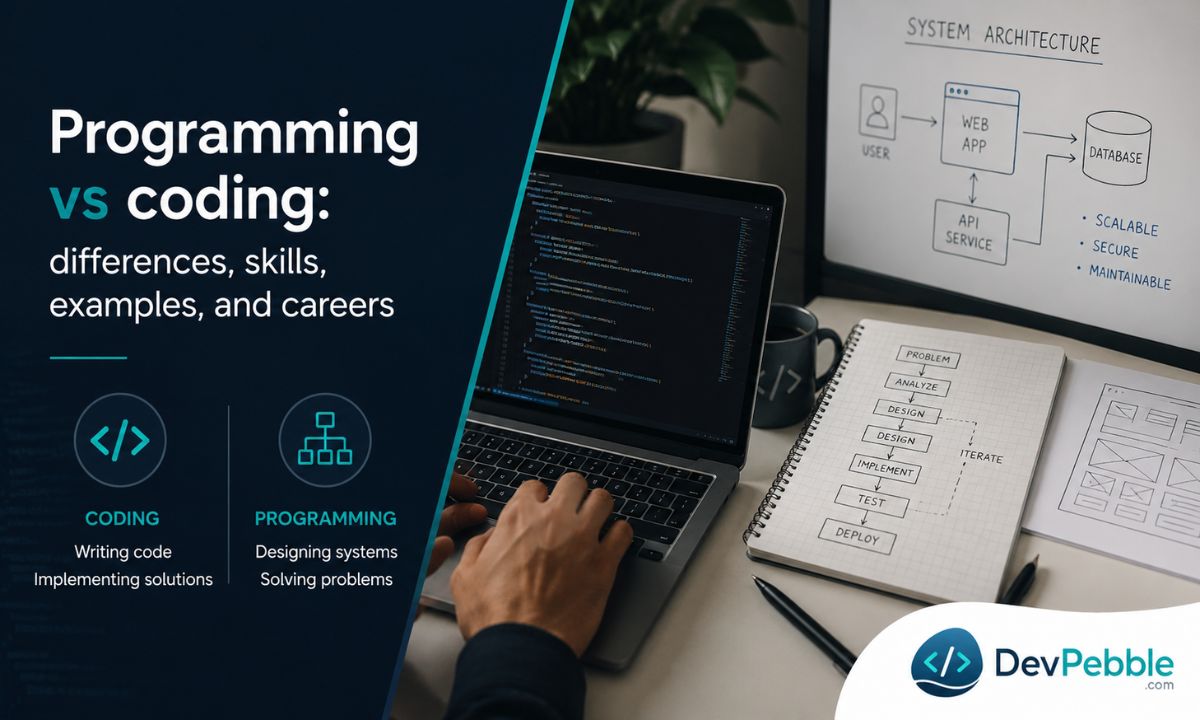
Programming vs coding: differences, skills, examples, and careers
Coding vs programming explained — how the two differ in scope, the skills and tools each demands, a worked login-form example, and what it all means for careers, salaries, and AI.
On this page⌄
- The main difference comes down to scope
- What coding is and what a coder does
- What programming is and what a programmer does
- Coding vs programming, side by side
- How coding and programming work together
- Skills for coding vs programming
- Tools coders and programmers use
- A worked example: the login form
- Should you learn coding or programming first?
- Careers, salaries, and the AI question
- The bottom line
- FAQ
Spend a week reading about tech careers and you'll see "coding" and "programming" used as the same word. They're not, quite. Coding is one slice of programming. Programming is the whole job: planning, testing, debugging, docs, and the part where you keep the thing alive months after launch. The gap says a lot about what software work feels like day to day.
The main difference comes down to scope
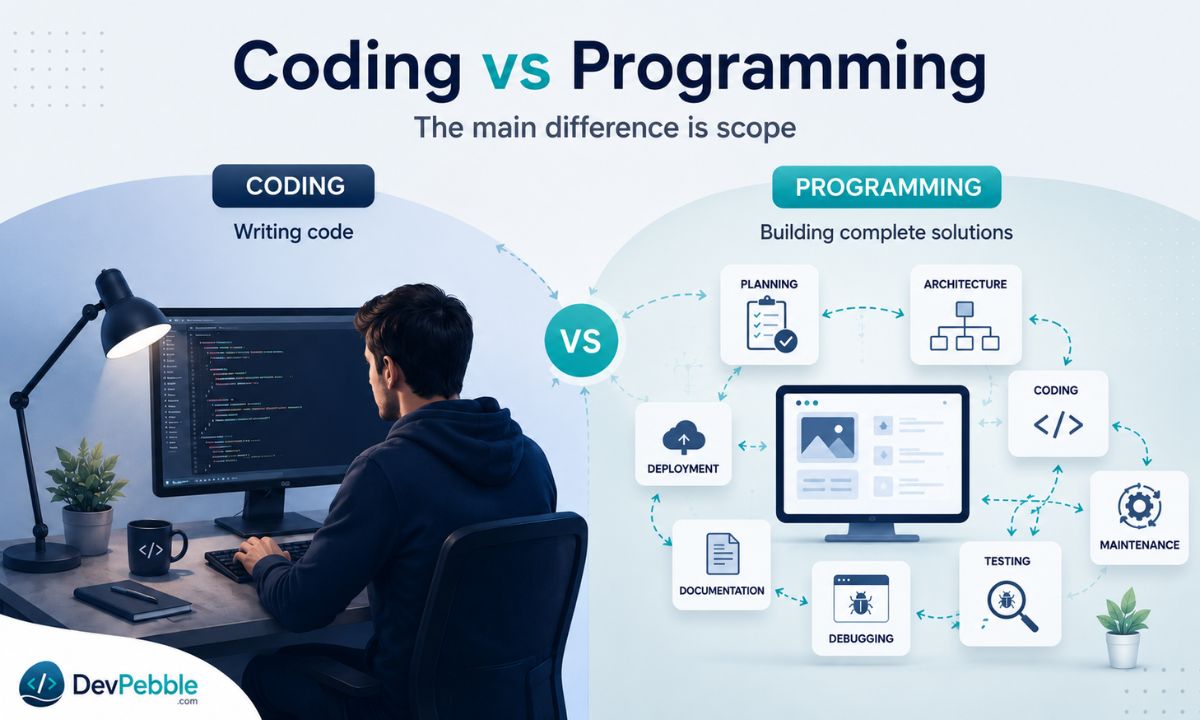
Coding is the narrow task. You take an idea that someone's already worked out and turn it into source code the machine can run, written in a language it understands. Hand a coder a clear spec and the job is to translate it without breaking anything.
Programming wraps around that. A programmer figures out what the code should do in the first place, sketches how the pieces connect, checks the result, hunts down whatever broke, and comes back to it when the requirements change six weeks later. The whole life cycle, from "what are we even building" to "why is this still throwing errors in production," lives under programming.
In real jobs the line is blurry and most people do both, so it's really a question of how much you own, not two separate professions.
What coding is and what a coder does
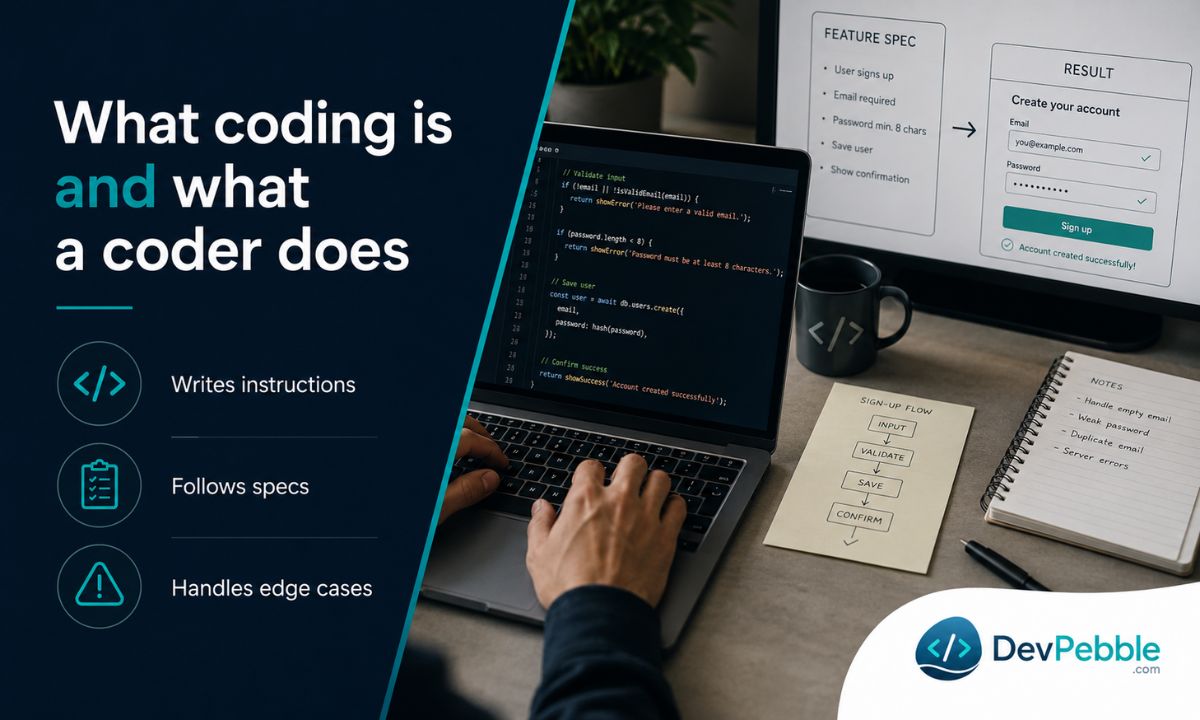
Coding means writing instructions in a language like Python, JavaScript, Java, or C++. Every language has its own syntax, its own grammar rules, and if you break them the computer either does the wrong thing or refuses to run at all.
The work is translation. A coder gets a spec ("when someone submits this form, save it and confirm it") and writes the code that makes it real: capture the input, validate it, drop it in the right database table, show the confirmation. Nobody's asking the coder whether the form should exist. That call got made already. The job is to get it right.
Which is harder than it sounds. Clean code doesn't fall out of the sky. You have to know the syntax cold, plan for the weird inputs (somebody leaves a field blank, somebody types "banana" where a name goes), and write it so the next person can read it without sighing. The scope stays small. Small isn't the same as easy.
What programming is and what a programmer does
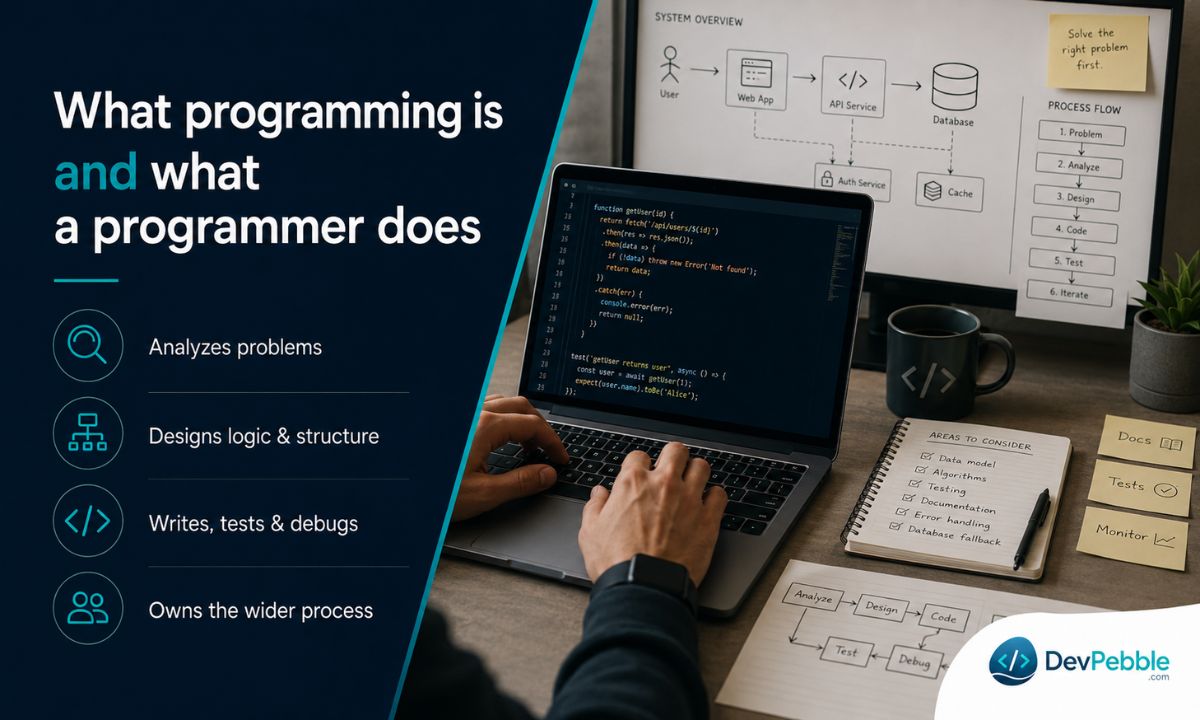
Take coding, then pile on everything around it.
A programmer (plenty of companies just call this person a developer) owns more of the picture. They analyze the problem before a line of code exists. They design the logic and structure. They settle on the algorithms that get the job done without wasting time or memory. Then they write it, test it, debug it, document it, and circle back when the spec shifts.
Same form, bigger questions. Why does it exist? Who's filling it out? What happens to that data in a year? A programmer designs the data model and the error handling, thinks through what happens if the database drops offline mid-request, and writes tests instead of crossing their fingers. Notice how little of that is typing. Most of programming is thinking, then checking your thinking.
And here's the messy part nobody warns you about. "Programmer," "coder," "developer," "software engineer," none of these mean anything fixed. A "coder" at one shop does full-stack work; a "programmer" at another barely leaves one module. The labels drift by country, by company, by whoever wrote the job post. What stays put is the shape underneath: code is one piece of a wider problem-solving habit, and the more of it you own, the more it counts as programming.
Coding vs programming, side by side
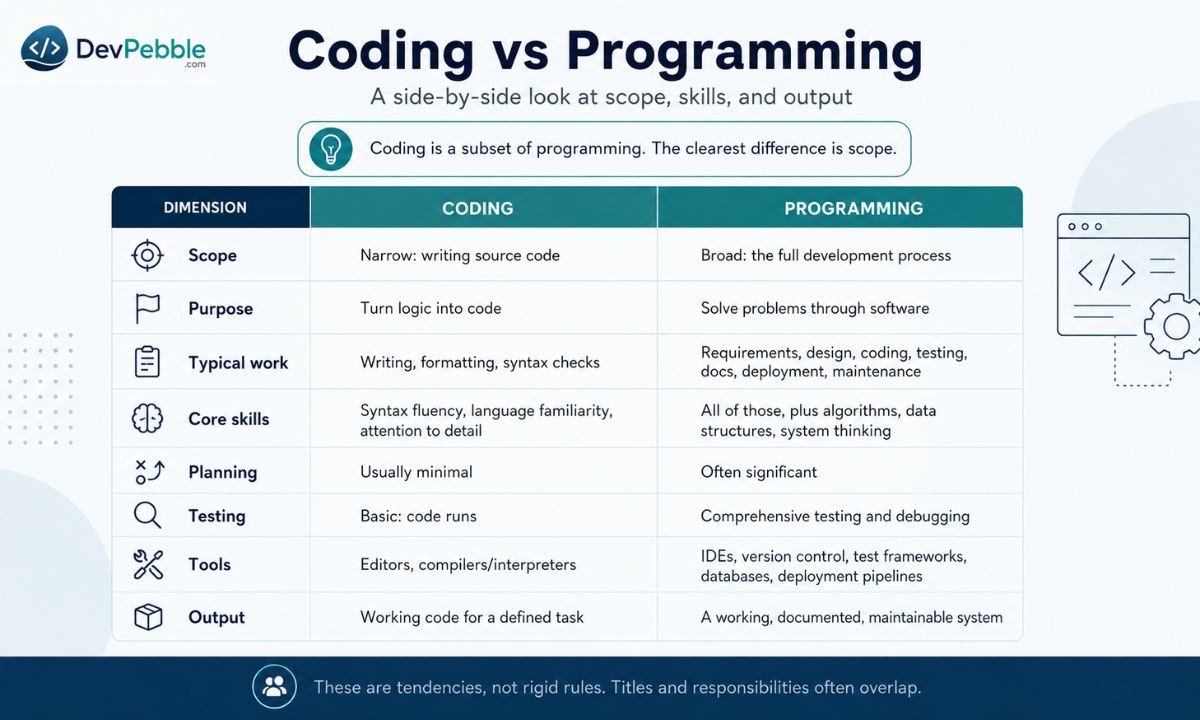
Quick framing before the table: coding is a subset of programming. Every programmer codes. Not every coder does the rest. Scope is the whole difference.
| Dimension | Coding | Programming |
|---|---|---|
| Scope | Narrow: writing source code | Broad: the full development process |
| Purpose | Turn logic or requirements into a language | Solve problems through software, from analysis to delivery |
| Typical work | Writing, formatting, and syntax-checking code | Requirements, design, coding, testing, docs, deployment, maintenance |
| Core skills | Syntax fluency, language familiarity, attention to detail | All of those, plus algorithms, data structures, and system thinking |
| Planning | Usually minimal; follows specs already defined | Often significant; may help define the specs |
| Testing | Basic: checking that code runs | Comprehensive: unit and integration tests, complex debugging |
| Tools | Editors, compilers or interpreters | IDEs, version control, test frameworks, databases, deployment pipelines |
| Output | Working code for a defined task | A working, documented, maintainable system |
Read that as tendencies, not law. The real line bends with team size, company, and title. "Software developer" and "software engineer" blur into each other too, and when there is a difference it usually comes down to seniority, or whether you lean toward architecture or implementation. Nobody is enforcing a standard here.
How coding and programming work together
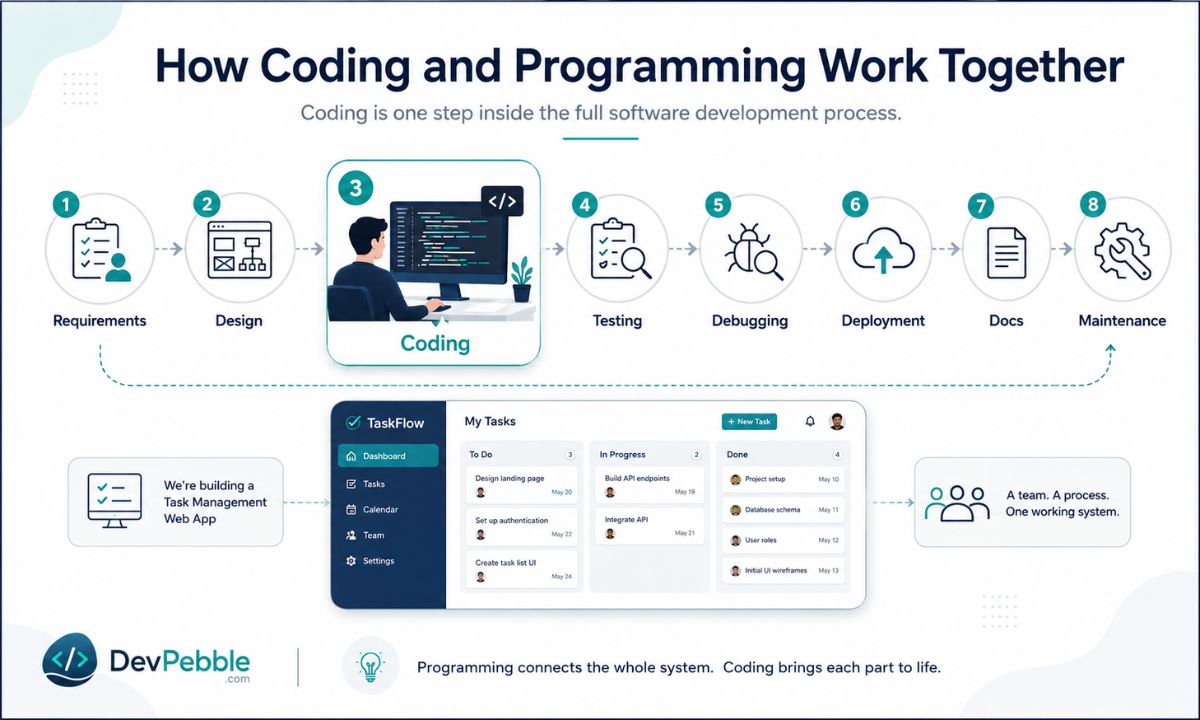
Follow one project and it clicks. Say a small team is building a task-management app. It opens with requirements analysis: somebody works out with the people who'll use it what it has to do and which features matter, before any code exists. Then system design maps the structure, what screens exist, where data lives, how the front end talks to the back end through an API.
Now the coding starts, and a developer writes the login form, the task logic, the queries, the styling. Then testing, then debugging when something breaks, because something always breaks. Then it ships through staging and gets maintained: bug fixes, dependency bumps, new features. Coding sits in the middle of that line. It's the visible part, and still only one part.
Skills for coding vs programming
Coding skills
You need to be fluent in at least one language and know its syntax well enough to write clean, readable code: conditionals, loops, functions, data types. You also need to read an error message without panicking and write code the next person can maintain. Detail matters more here than almost anywhere, because one stray bracket or a typo in a variable name can take the whole thing down. Good coders lean on habits, consistent naming and useful comments, that save them an hour later.
Programming skills
Programmers stack more on top. Algorithm design and data structures means solving a problem efficiently and picking the right container, a list or a dictionary or a tree, for the job. Architecture is how the parts fit at scale, and how to keep software from rotting into a mess nobody wants to touch. Requirements analysis is figuring out what to build, not just how. Testing and QA means writing tests that mean something and reading what they tell you, since the programmer owns whether the whole thing is correct. And you want a feel for operations: how code gets from your laptop to production, and what blows up on the way.
Shared skills
Both come down to problem-solving, chopping something big into something you can hold in your head, plus plain logical thinking. And almost any job needs you to talk about your work clearly. The explaining turns out to be half the job, even when it doesn't feel like it.
Tools coders and programmers use
The toolkits overlap a lot. What changes is how deep you go into each one.
Everyone writes in a code editor or an IDE. An editor like Visual Studio Code gives you syntax highlighting, file management, and extensions. An IDE goes further, bundling in a debugger, a compiler or interpreter, and project tooling; IntelliJ IDEA is the usual pick for Java and Kotlin. Most developers bounce between the two.
How your code runs depends on the language. Compiled languages such as C, C++, and Java get translated into machine instructions by a compiler before they run. Interpreted ones like Python and JavaScript get executed line by line at runtime, and a few split the difference. It matters more than you'd guess the first time you're stuck debugging.
Version control isn't optional in a real job, and Git won that fight. It records every change, lets people work on separate branches without trampling each other, and merges it all back. GitHub and the rest host your repositories and add pull requests and code review. Even working alone, it's the cheapest insurance you'll buy against your own mistakes.
For the rest, debuggers let you freeze a program mid-run, inspect variables, and step through the logic, and most IDEs ship with one. Testing frameworks like Jest or pytest run your automated checks and catch what you broke. Past that you'll touch databases, package managers like npm and pip, command-line tools, and frameworks so you're not starting from zero.
A worked example: the login form
Definitions wear thin fast, so picture a login form. The coding is the visible craft. Write the HTML for the fields, style it with CSS, wire up the button so it sends the data on click. Hand a coder a clear spec and that front end comes together cleanly.
The programming happens before and underneath. How does authentication work? How are passwords stored, hashed rather than plain text? What happens after a failed attempt? How long does a session last? You need both layers for the form to work and not leak. Even a calculator splits the same way: writing result = a + b is coding, while deciding what counts as valid input and what to do when someone types "five" instead of 5 is programming.
Should you learn coding or programming first?
Together. You learn them together. Coding fundamentals are the door you walk through, and nobody studies system architecture before they know what a variable is.
A path that works: start with the dull but necessary basics of how a computer runs instructions and what files and processes even are. Then pick one beginner-friendly language and stop second-guessing. Python is great for data, automation, and scripting. JavaScript is the obvious start for the web. Swift or Kotlin for phones. Java and C# turn up everywhere in enterprise and games. Either way, any of them teaches the same core ideas.
From there, nail the building blocks, since variables, types, conditionals, loops, and functions show up in every program. Build tiny things, a to-do list, a temperature converter, a dumb little quiz. Small projects are good at exposing what you only thought you understood. Get comfortable debugging early, and use Git even when it's only you. Then come data structures and algorithms, roughly where "following tutorials" turns into "designing your own solution." Add tests and a couple of design patterns and you've quietly crossed into programming. None of this is a straight line; you'll circle back constantly, and that's how it goes.
Careers, salaries, and the AI question
The skills open a lot of doors. "Coder" is rarely a real job title, though some places hire people purely to knock out well-defined tasks. "Computer programmer" is a recognized category, usually maintaining code in an existing codebase. "Software developer" is the title you'll see most, and it tends to mean more responsibility: design calls, working across teams, owning a feature from idea to launch. Web developers build for the browser; mobile developers for iOS and Android. "Software engineer" often means the same thing, sometimes with extra weight on scale and system design. QA automation engineers build the test systems that keep it all from falling apart. These roles blur in practice, and at a small company one person plays half of them at once.
On money, the numbers below are U.S. figures from the Bureau of Labor Statistics Occupational Outlook Handbook, May 2024 data, still the current release. Software developers had a median wage of $133,080, and the broader group BLS counts them with, developers plus QA analysts and testers, is projected to grow 15 percent from 2024 to 2034, which it calls much faster than average. Computer programmers sat at $98,670, but employment in that category is projected to fall 6 percent over the same stretch, which tracks with the shift toward roles that fold design and product thinking into the coding. Web developers came in at $90,930. These swing hard on location, experience, specialty, and industry, and the San Francisco, New York, and Seattle hubs pay above the median.
Then there's AI, the question most people came here for. Code completion, automated testing, and AI-assisted debugging are changing how the work gets done, and yes, a chunk of the rote implementation can be handed off now. But the data doesn't back the "it's coming for the jobs" panic. That 15 percent growth projection was published well into the AI era, not before it. The stuff AI is best at is the repetitive, well-specified code that makes up a small fraction of most real jobs. Working out requirements, designing a system, chasing a bug that makes no sense, keeping something reliable under load, that part still runs on human judgment.
The salary and projection figures are U.S. data from May 2024 and are worth a re-check before June 2027.
The bottom line
It comes back to scope. Coding is writing instructions in a language, the concrete skill at the center of it all. Programming is the wider craft around it: understand the problem, design something, write it, test it, keep it alive. Neither word has a clean universal meaning, and real jobs mix them constantly anyway.
If you're at the start, just begin coding. Pick a language, build small stuff, keep at it. The programming instinct grows on its own once you're in the work. Web, mobile, data, engineering, whatever you're chasing, the base doesn't change: think clearly and keep shipping code that works.