What is procedural programming? Definition, examples, and key features
What is procedural programming? A beginner-friendly guide to the paradigm's definition, how it works, key features, a worked C example, procedural vs OOP and functional programming, common languages, pros and cons, and whether it's still used in 2026.
On this page⌄
- What is procedural programming?
- How procedural programming works
- Key features of procedural programming
- Common procedural programming languages
- Procedural programming in C: a worked example
- Core concepts every beginner should know
- Advantages of procedural programming
- Disadvantages of procedural programming
- Best practices for writing procedural code
- Procedural vs object-oriented programming
- Procedural vs functional programming
- Is procedural programming still used today?
- Conclusion
- FAQ
Make a cup of tea and you already understand procedural programming. You boil the water, add the tea, let it steep, then pour, in that order. Skip a step or swap two around and you get something worse. Procedural programming works the same way: you hand the computer a list of instructions and it runs them one at a time, top to bottom, until the job is done.
It's one of the oldest programming paradigms and still one of the first that most people learn. If you're trying to understand what procedural programming is, how it actually works, and whether it's still worth knowing in an era of object-oriented and functional code, this guide covers all of it, with a real C example and honest pros and cons.
What is procedural programming?
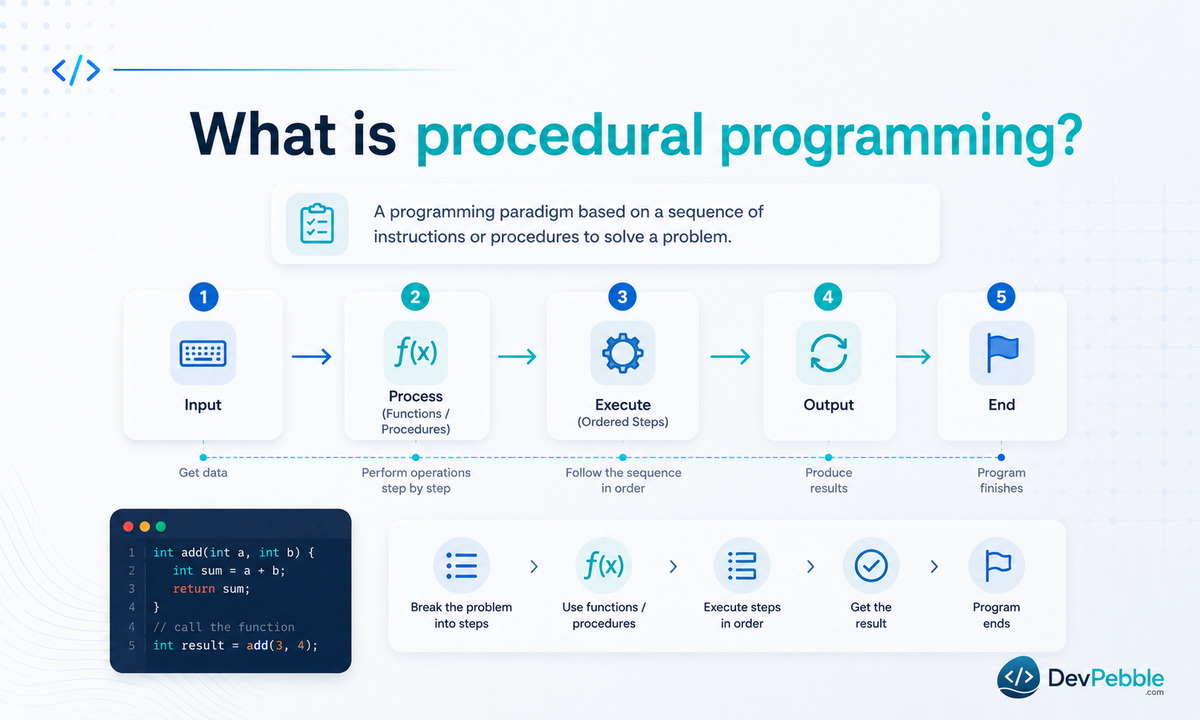
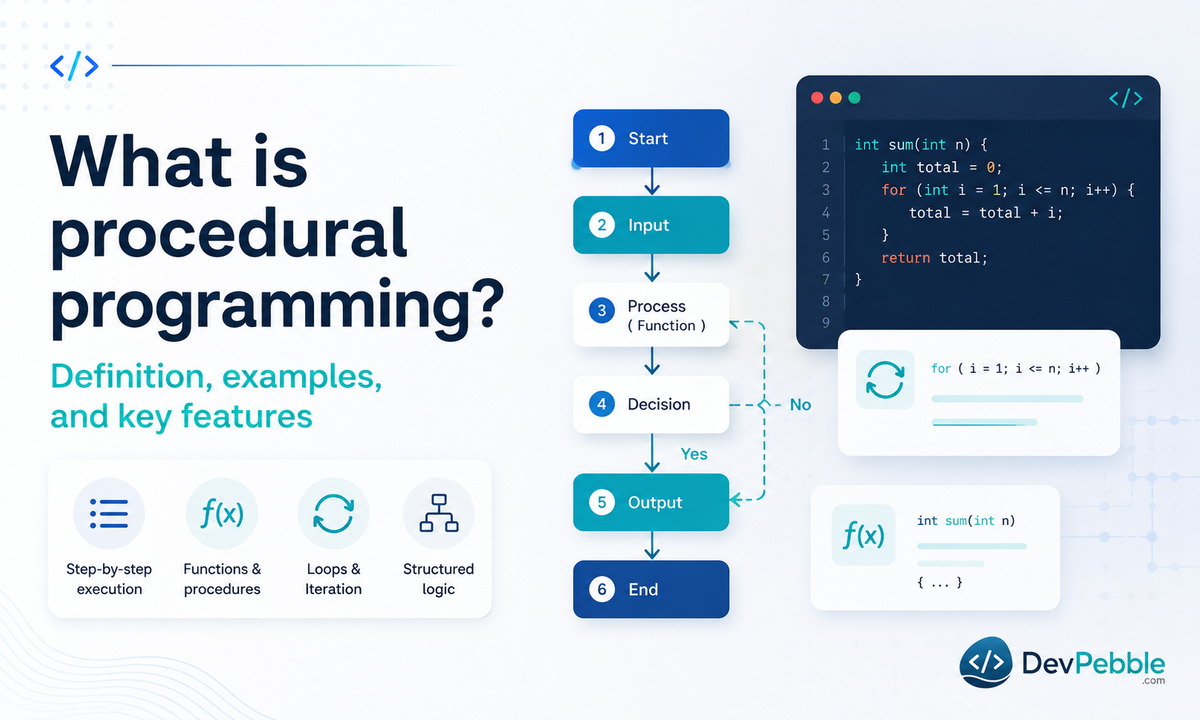
Procedural programming is a paradigm where a program is written as a sequence of step-by-step instructions, grouped into procedures, functions, or subroutines that run in a set order to complete a task.
In plainer terms, you tell the computer exactly what to do and in what order, from the first line to the last. Each step usually depends on the one before it, the same way a checklist does.
It belongs to the broader family of imperative programming, which is any style where you spell out the exact steps the machine should take. It's also closely tied to structured programming, since both favor clear, organized logic over code that jumps around unpredictably. The shared goal is to break a big problem into smaller steps a computer can follow without getting confused.
How procedural programming works
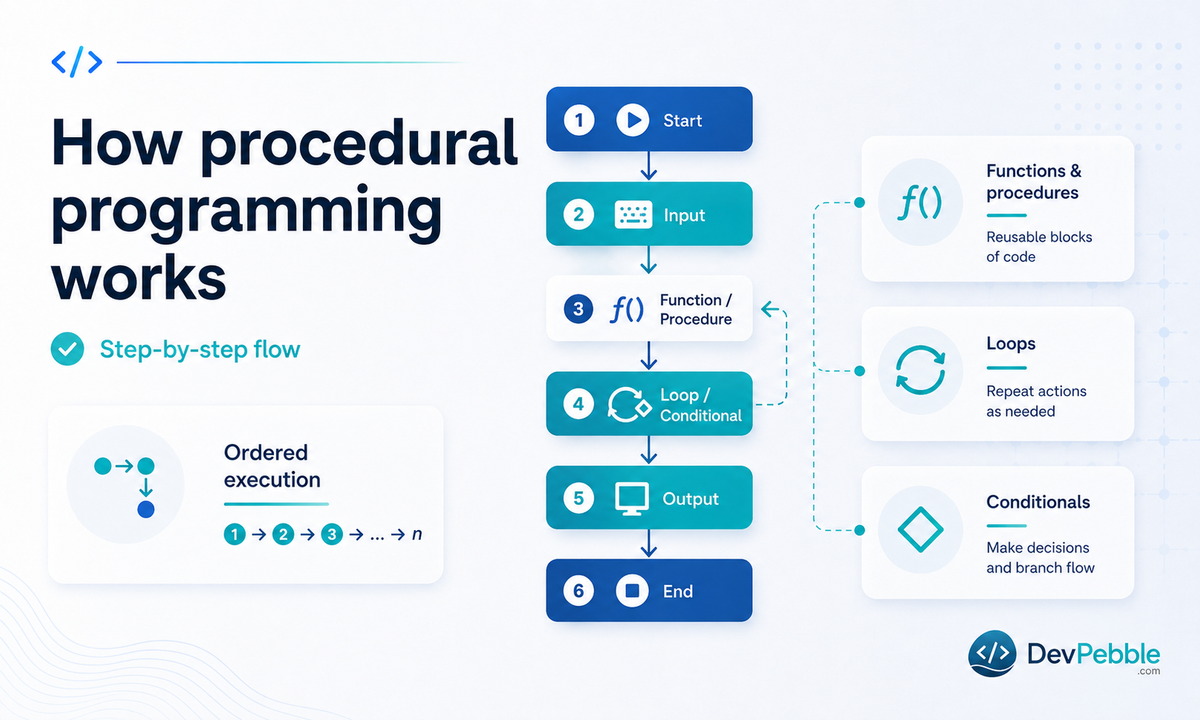
A procedural program runs from top to bottom, executing one line after another unless you tell it otherwise. The computer doesn't guess the next move; it follows the order you laid out.
Take a small program that finds the area of a rectangle. It might:
- Ask for the length
- Ask for the width
- Multiply the two values
- Show the result
Each step needs the previous one to finish first. That predictable, linear flow is a big part of why procedural code is easy to learn and easy to debug: when something breaks, you can trace the execution line by line.
Functions, procedures, and subroutines
Once a program grows past a few dozen lines, writing everything in one long block gets messy. That's where functions, procedures, and subroutines come in. People use those three words almost interchangeably, and they point to the same idea: a named block of code that does one job and can be called whenever you need it.
Say you calculate rectangle area in five different places. Instead of copying the math five times, you write one calculateArea() function and call it wherever it's needed. Write it once, reuse it everywhere.
Control flow: loops and conditionals
Not every program runs in a straight line. Sometimes it has to repeat an action or make a decision, and that's handled by control flow, mainly loops and conditional statements.
Loops repeat a block of instructions, so printing the numbers 1 to 10 takes a couple of lines instead of ten separate print statements. Conditionals (if-else logic) let the program pick a path based on a condition, like checking whether a number is even before deciding what to do with it. Together they give procedural programs enough flexibility to handle real logic, not just a fixed script.
Key features of procedural programming
Top-down design
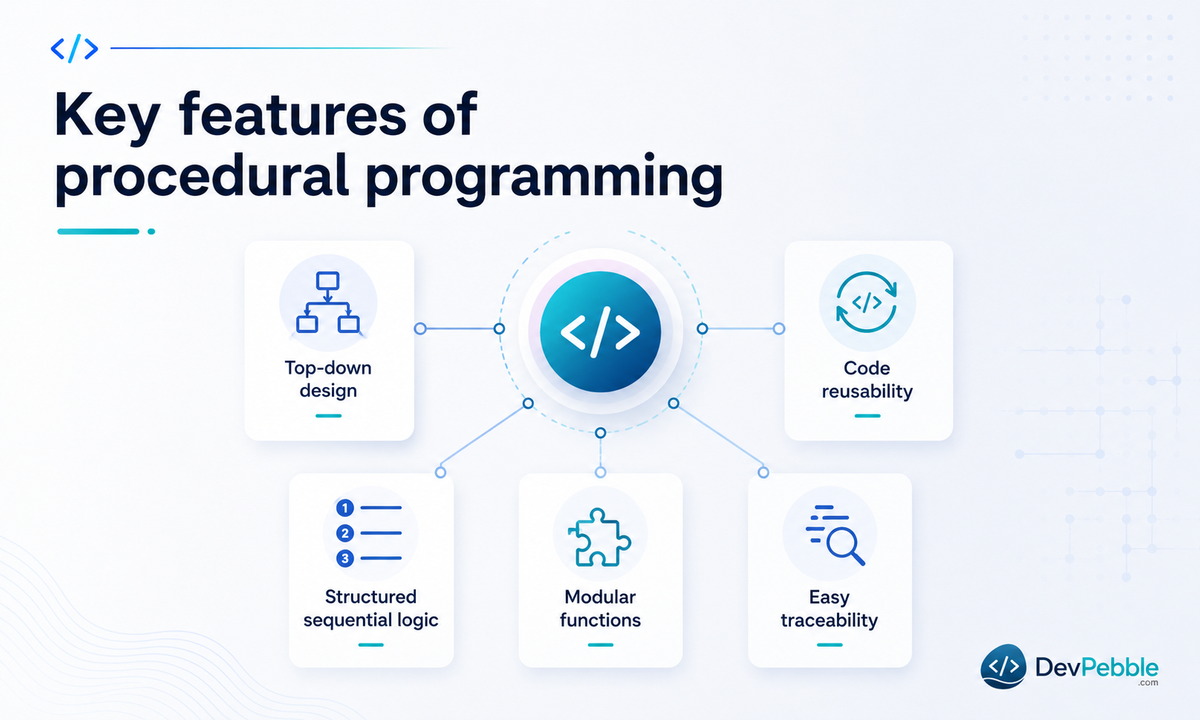
Procedural programming usually follows a top-down approach: you take one large problem and break it into smaller sub-problems, then solve each with its own procedure or function. Planning this way keeps you working on small, focused pieces instead of one intimidating wall of code.
Code reusability
Reusability is one of the paradigm's most practical wins. Once a function is written and tested, you can call it anywhere without rewriting the logic. That saves time and cuts down on bugs, because you're leaning on one tested piece of code instead of five copies that can quietly drift out of sync.
Structured, sequential logic
Instructions are organized in a clear, predictable order, and control flow tools keep that order readable. The payoff shows up months later, when you (or someone else) open the file and can actually follow what it does.
Common procedural programming languages
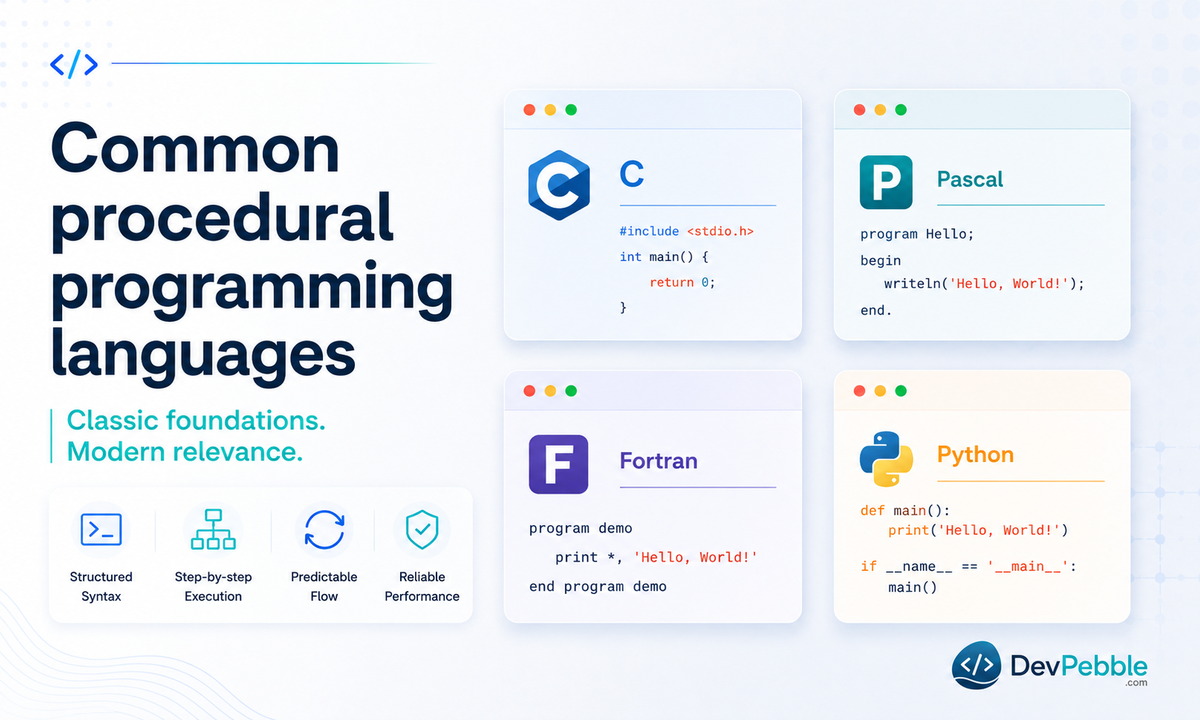
Procedural programming isn't only theory. It's the backbone of some of the most influential languages ever written, and it still shapes how people use modern ones.
C
C is usually the first language people name here. It appeared in the early 1970s, built around the idea of writing programs as functions that call each other in a clear order. It has aged remarkably well: on the TIOBE Index for June 2026, C sits at number two, behind only Python. Most of that staying power comes from systems work, operating systems, device drivers, and embedded hardware, where its close-to-the-metal control still matters.
Pascal, Fortran, and other early languages
Before C caught on, Pascal and Fortran were already using procedural ideas. Pascal was designed to teach structured programming to students; Fortran was built for scientific and mathematical work using clear, sequential logic. Older languages like COBOL, ALGOL, and BASIC leaned on the same principles. All of them helped cement the idea that splitting a program into procedures makes it easier to write and maintain.
Procedural style in modern languages
Here's what surprises a lot of beginners: procedural programming isn't stuck in the past. Python, JavaScript, and PHP all support multiple paradigms, and you can write any of them procedurally. A Python script that defines a few functions and calls them in order, with no classes or objects in sight, is procedural code running in a thoroughly modern setting. That flexibility is why procedural thinking never really goes out of fashion.
Procedural programming in C: a worked example
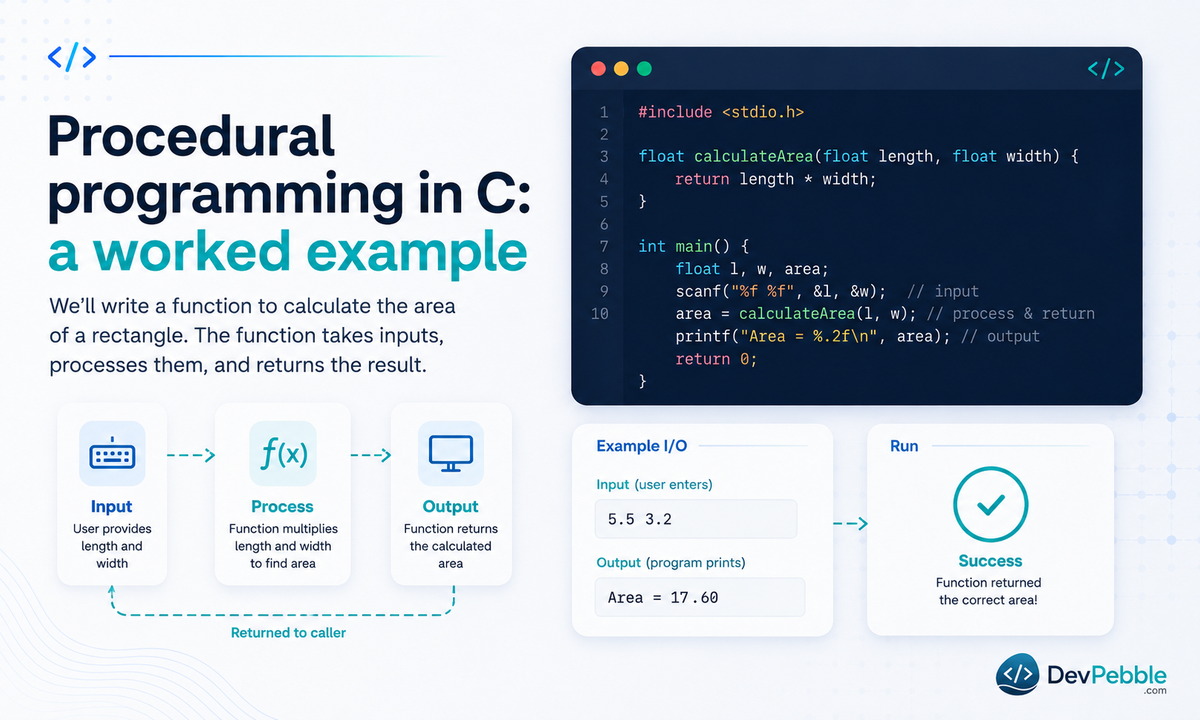
C is a good place to see the paradigm clearly because it's built entirely around functions, sequential execution, and control flow, with no built-in classes or objects (that's what C++ later added on top of C). Every C program is basically a set of functions calling one another, starting from main().
Here's a beginner-friendly program that calculates the area of a rectangle:
#include <stdio.h>

// Function to calculate area
int calculateArea(int length, int width) {
    return length * width;
}

int main() {
    int length = 10;
    int width = 5;
    int area;

    area = calculateArea(length, width);

    printf("The area of the rectangle is: %d\n", area);

    return 0;
}
Walking through it:
calculateArea()is defined to take a length and a width and return their product.- Execution starts in
main(), which is where every C program begins. lengthandwidthare set to 10 and 5.calculateArea(length, width)is called, passing those values in.- The returned value is stored in
area. printf()prints the result.
Every step runs in a clear, traceable order. That's procedural programming in miniature.
Most procedural C programs share a similar shape: include the libraries you need (like stdio.h), declare the functions that do the work, define main() to control the flow, call those functions from main(), and return a value to signal the program finished. Keeping each function responsible for one clear task is what makes this structure easy to debug.
Core concepts every beginner should know
Variables and data types
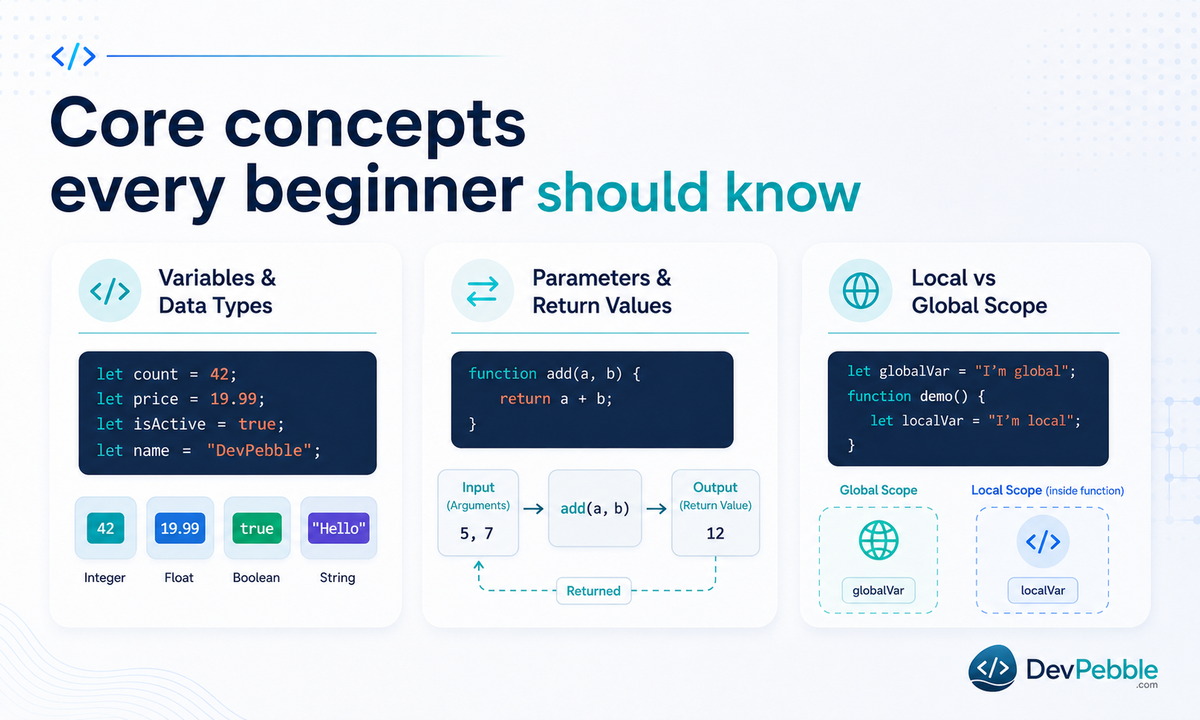
Every procedural program uses variables to store data and data types to say what kind of data each one holds, such as integers, decimals, characters, or text. Getting comfortable with data types early saves you from classic bugs, like trying to do math on something the program is treating as text.
Parameters and return values
Functions get genuinely useful once they can take input and hand back output. Parameters let you pass data into a function; return values let it send a result back to wherever it was called. That's exactly what happened above: length and width went in as parameters, and the area came back as a return value.
Local vs global scope
Variables live within a certain scope. A local variable is created inside a function and only exists while that function runs. A global variable can be reached from anywhere in the program. Globals are convenient, but leaning on them too heavily tends to produce messy, hard-to-trace code, which is why experienced developers use them sparingly. More on that in the pitfalls below.
Advantages of procedural programming
It's easy to learn
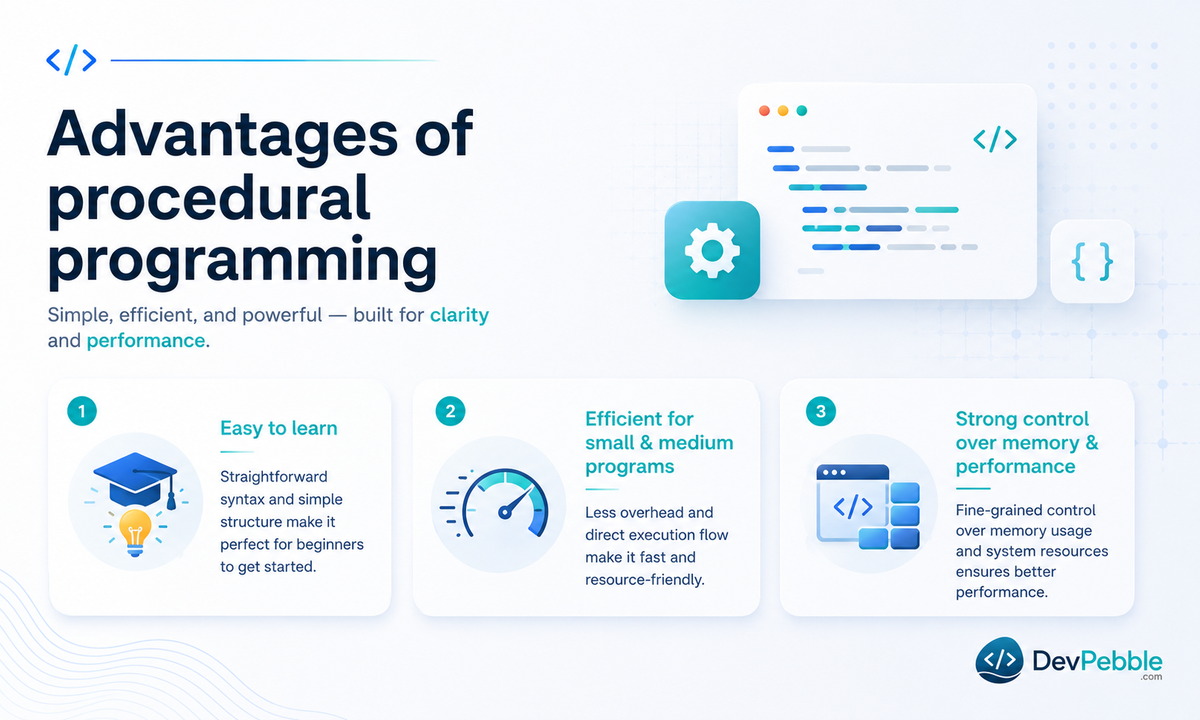
Procedural programming is usually the first paradigm taught, and for good reason. Its step-by-step logic matches how people naturally solve problems, so you can get comfortable with variables, functions, and control flow before taking on the heavier ideas in object-oriented or functional programming.
It's efficient for small and medium programs
For short scripts, automation tasks, and simple tools, a procedural approach often gets the job done faster and with less ceremony. If you just need to process a file or automate something repetitive, spinning up a full object-oriented structure is usually overkill.
It gives tight control over memory and performance
Because languages like C sit close to the hardware, they offer fine control over memory and performance. That's a big reason procedural code still runs the systems where every byte and cycle counts: embedded devices, operating systems, and other performance-sensitive software.
Disadvantages of procedural programming
It struggles with large, complex applications
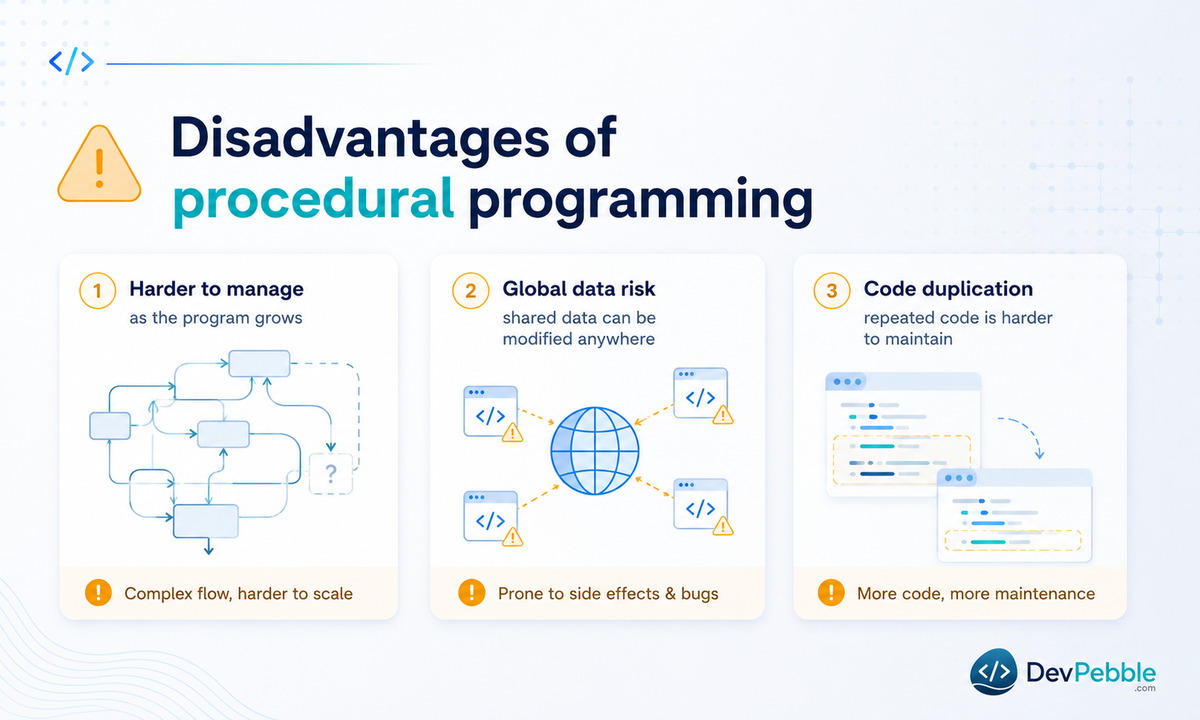
As software grows, a long chain of function calls gets harder to manage. Big systems with many interacting parts usually benefit from organizing code around data and behavior together, which is what object-oriented and modular designs do better.
Global variables create risk
Because procedural code often shares data through global variables, it can run into maintenance and security headaches. Any function can change a global, which makes it harder to track where and when your data actually changed. There's a related point worth flagging: memory-managed languages like C put safety in the programmer's hands, and mistakes there cause real problems. That concern has gone mainstream. In 2026, U.S. agencies including CISA and the FBI urged developers of critical software to move away from memory-unsafe languages like C and C++ toward safer alternatives. It doesn't make C obsolete, but it's worth knowing where the risks live.
Duplication creeps in without discipline
Even though functions exist to prevent it, procedural codebases can still end up with the same logic copied across files. Functions help, but larger projects need real discipline and modular habits to stay clean.
Best practices for writing procedural code
Keep functions short and focused
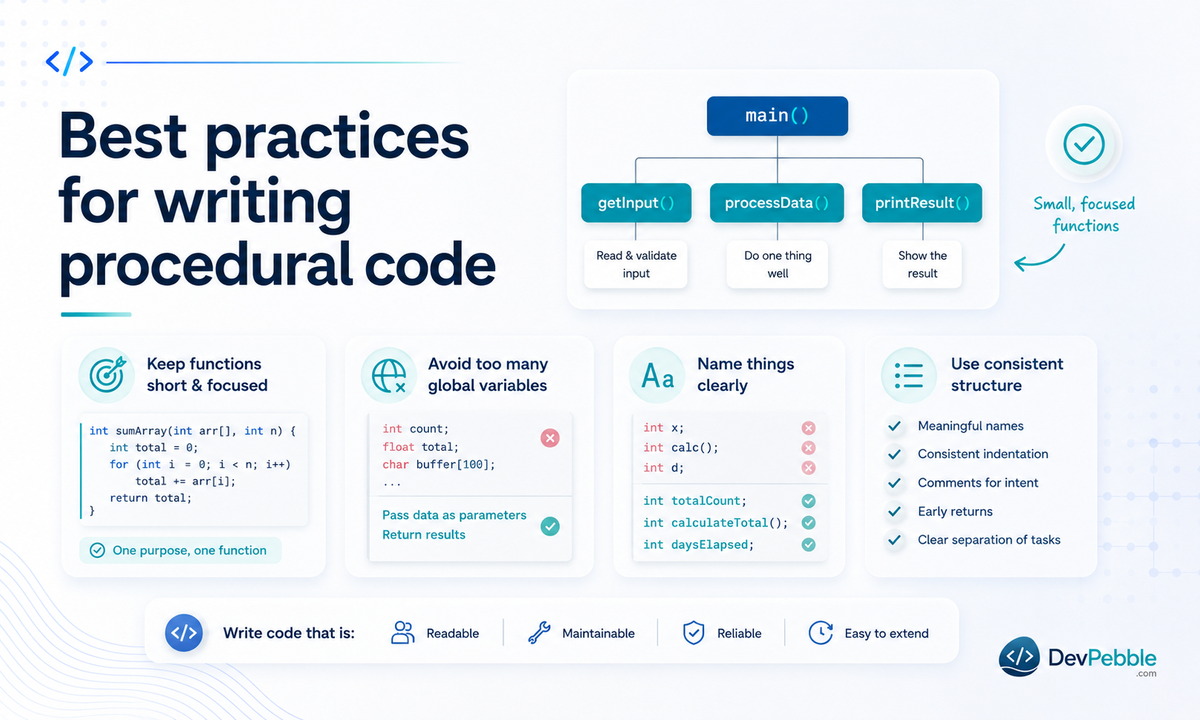
A good rule: each function should do one thing well. Short, single-purpose functions are easier to test, debug, and reuse.
Go easy on global variables
The fewer globals you have, the fewer surprises. Where you can, pass data through parameters instead of relying on shared state.
Name things clearly and comment the why
Since procedural code leans on function calls and sequence, clear names do a lot of heavy lifting. A function called calculateArea() tells the next developer (often future you) what it does at a glance. Save comments for the reasoning the code itself can't show.
Procedural vs object-oriented programming
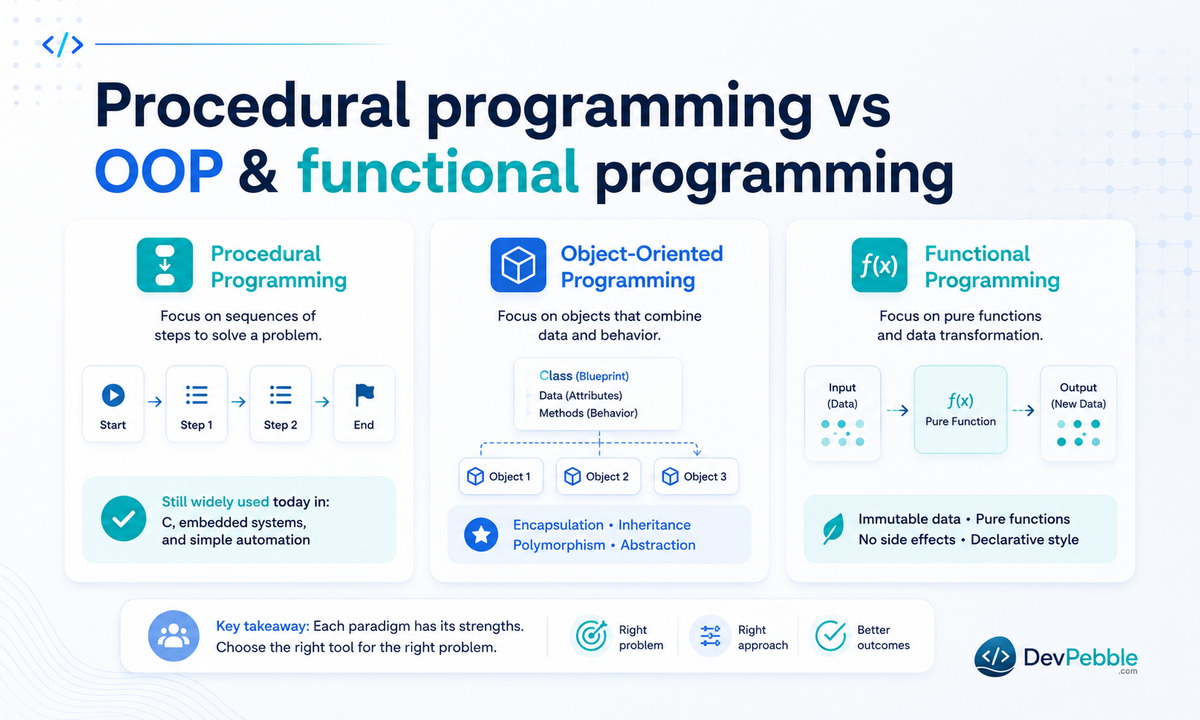
The clearest way to place procedural programming is next to the paradigm it's most often compared with: object-oriented programming, or OOP.
The core difference is how each one organizes data and functions. Procedural programming keeps data and functions separate and focuses on a sequence of steps that act on that data. OOP bundles data and the functions that work on it together into objects and classes, modeling the program around real-world entities instead of a straight line of instructions.
| Aspect | Procedural programming | Object-oriented programming | |---|---|---| | Structure | Step-by-step functions | Objects and classes | | Data handling | Data and functions are separate | Data and functions are bundled together | | Best for | Small to medium programs | Large, complex applications | | Reusability | Through functions | Through objects, inheritance, and classes | | Example languages | C, Pascal, Fortran | Java, C++, Python (OOP style) |
Reach for procedural code when the task is straightforward and doesn't involve modeling complex relationships: small scripts, automation, learning exercises, or performance-focused programs where speed beats scalability. Reach for OOP as things scale up, like a large web app or a system with many user types and behaviors, where organizing code around objects makes it easier to extend and maintain.
Procedural vs functional programming
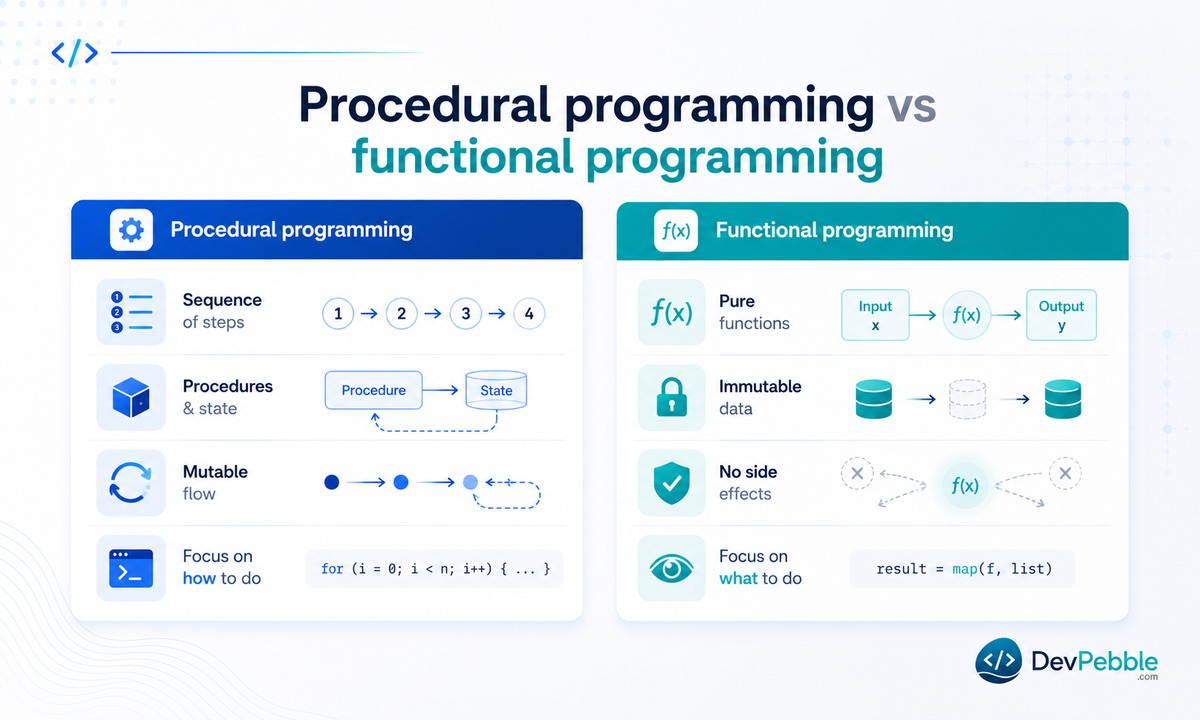
Functional programming is the other comparison worth making, especially as it keeps gaining ground.
Procedural code runs through a sequence of instructions and often changes data as it goes, using variables you can update along the way. Functional programming leans on immutability, meaning data isn't changed once it's created, and on pure functions that return the same output for the same input with no side effects.
Put simply: procedural programming says "do this, then do that," while functional programming says "here's a function that turns input into output without touching anything else."
Procedural stays a solid fit for tasks that naturally follow a sequence, like calculations, simple automation, or teaching the basics. Functional programming shines with data transformations, parallel processing, and anywhere predictable, side-effect-free code pays off, which is common in data engineering and modern JavaScript. Neither is better overall. They suit different problems, and plenty of developers mix them depending on the job.
Is procedural programming still used today?
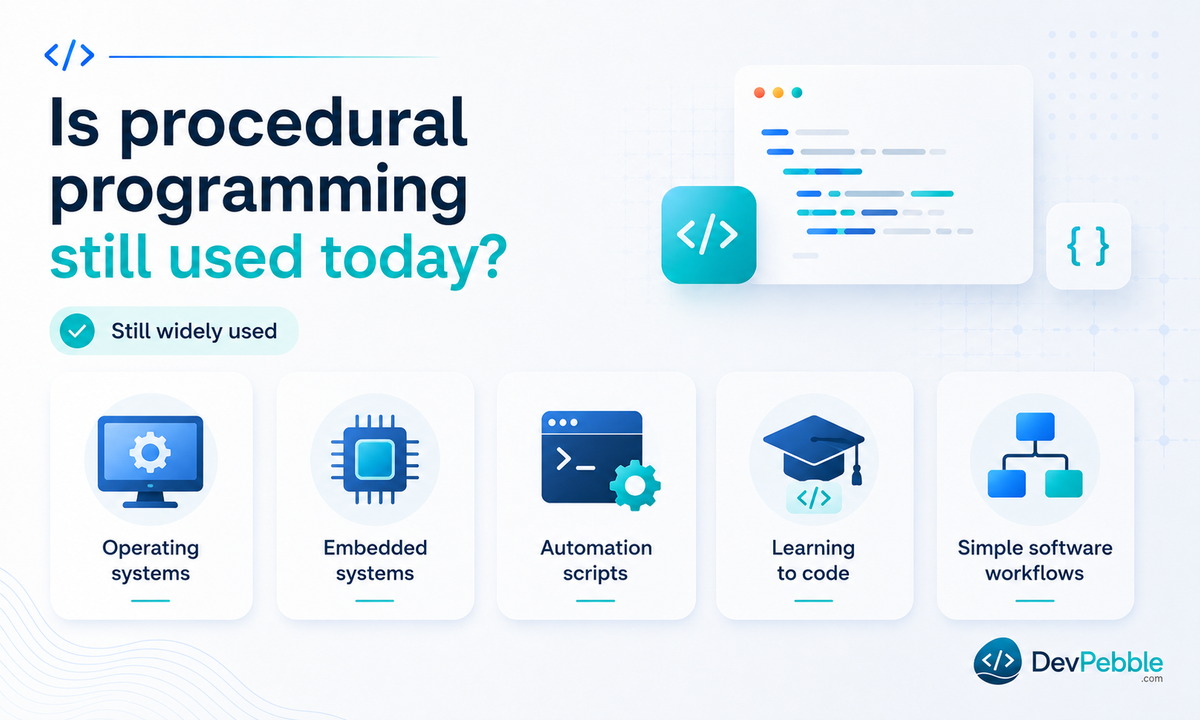
Short answer: yes, and widely. For all its age, procedural programming is still doing real work:
- C for operating systems, drivers, and embedded devices
- Embedded systems where performance and low memory use are non-negotiable
- Automation scripts written procedurally in Python or PHP
- Classrooms, where beginners learn core logic before advanced paradigms
- Simple software workflows that don't need complex data modeling
Even inside projects built with object-oriented or functional languages, small procedural scripts often handle the quick, straightforward tasks in the background.
Beginners still start here for the same reason they always have: procedural programming teaches the fundamentals (variables, functions, loops, and conditionals) without the extra weight of classes, objects, and inheritance. Once those click, moving to OOP or functional programming is easier, because the underlying logic of control flow and structured thinking carries straight over.
Conclusion
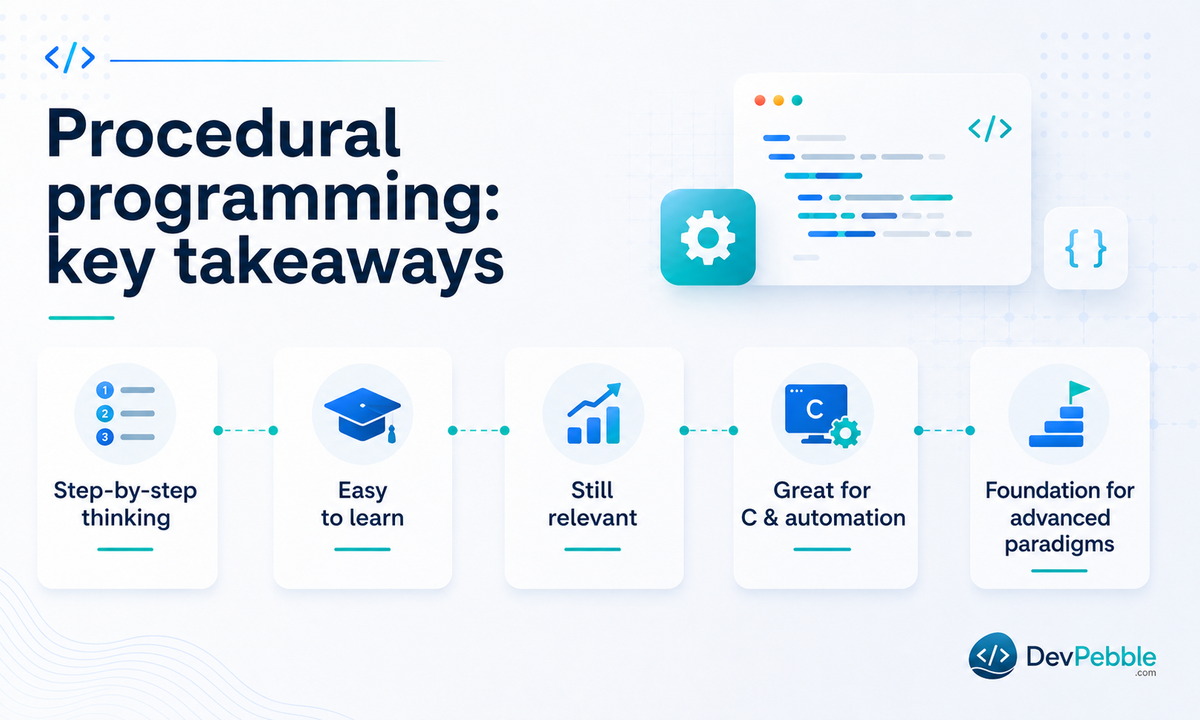
Procedural programming is old, but "old" and "outdated" aren't the same thing. It teaches you to think in clear, ordered steps, and that mental model carries into every paradigm you learn next. It still powers operating systems, embedded devices, and countless small scripts, and it's still where most people write their first working program. Whether you're learning to code, automating a boring task, or writing performance-critical C, thinking one careful step at a time remains a reliable way to solve a problem.