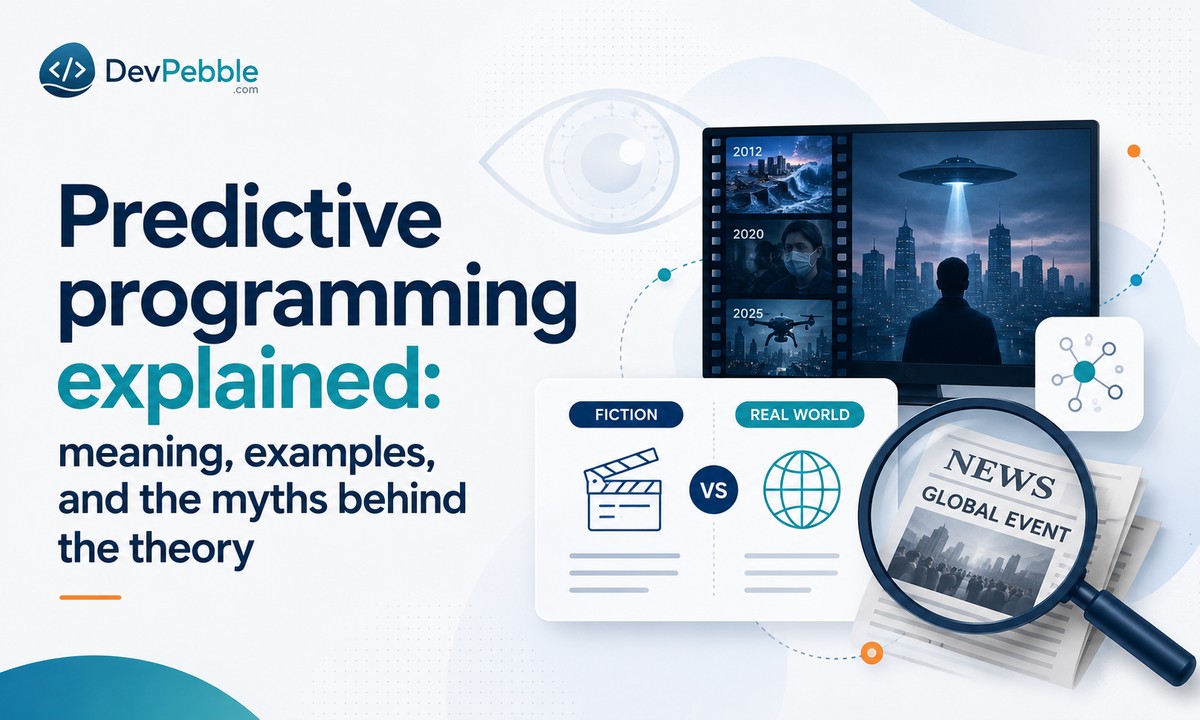
Predictive programming explained: meaning, examples, and the myths behind the theory
What is predictive programming? A clear guide to the theory's meaning, the examples people cite most (The Simpsons, Contagion, dystopian films), the psychology that makes it feel convincing, and a checklist to test any "prediction" claim.
On this page⌄
- What is predictive programming?
- Predictive programming vs. foreshadowing, coincidence, and forecasting
- Why movies and TV get pulled into these claims
- Popular examples people connect to predictive programming
- Is predictive programming real, or just a conspiracy theory?
- The psychology behind the belief
- Media influence vs. deliberate conditioning
- How to evaluate a predictive programming claim
- Common myths worth clearing up
- Final thoughts
- FAQ
You have probably seen it: a clip from an old movie or cartoon paired with a recent news headline, captioned with something like "they told us this would happen." That pairing usually gets filed under predictive programming, a phrase that circulates constantly in conspiracy theory spaces whenever fiction seems to line up with reality.
So what does predictive programming really mean, where did the idea come from, and does any of it hold up? This guide walks through the definition, the examples people cite most often, the psychology that makes the theory feel convincing, and a simple checklist you can use the next time a "prediction" clip lands in your feed. No prior knowledge needed.
What is predictive programming?
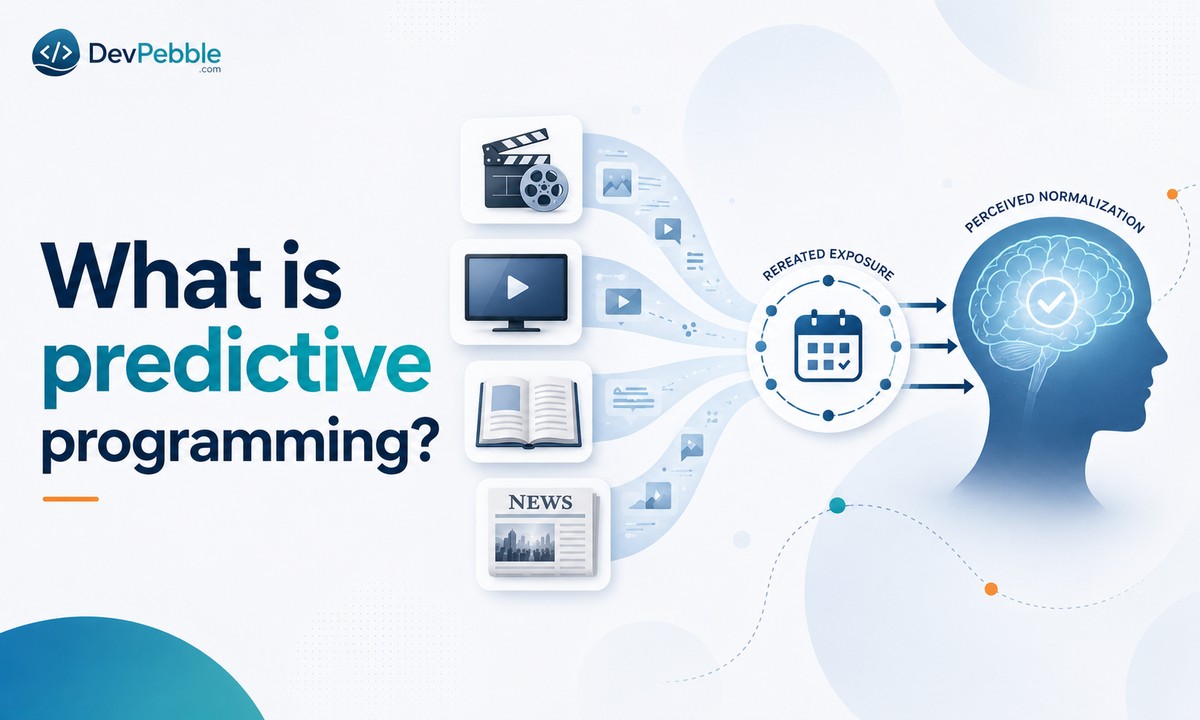
Predictive programming is a theory, not a documented fact. It claims that films, TV shows, books, and news media are seeded with hints about future events so the public grows used to those events in advance and reacts with less shock or resistance when they arrive.
The argument goes that repeated exposure to a theme or image works as a form of quiet conditioning. Show an idea in fiction often enough, the reasoning says, and it feels familiar rather than alarming when it turns up in real life.
Worth being clear on one thing early. This is a fringe idea, not something backed by scientific consensus. Media researchers and psychologists generally do not treat it as a real, measurable phenomenon. It is still worth understanding, because the term comes up a lot and it helps to know what people mean when they use it.
Where the term comes from
The phrase was coined by Alan Watt, a conspiracy theorist who described it as psychological conditioning delivered through media to get the public comfortable with changes planned by those in power. Later figures like Alex Jones and David Icke helped push the idea into wider circulation.
From there it spread the way most viral ideas do, through forums, YouTube, and social feeds where people post side-by-side comparisons of decades-old scenes and current events. A short clip claiming a hidden prediction is easy to share and tends to travel fast, even when the connection is loose or only obvious in hindsight. Short-form video has made these posts even more common, since dramatic claims perform well with recommendation algorithms.
Predictive programming vs. foreshadowing, coincidence, and forecasting
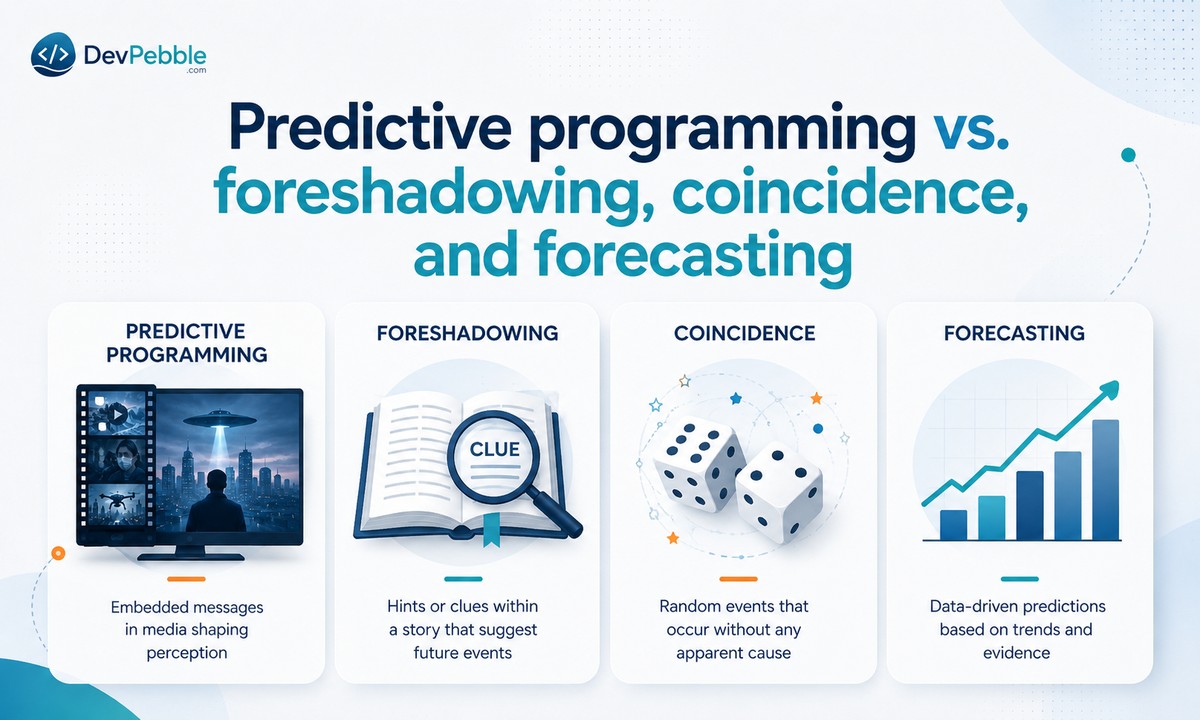
A lot of the confusion here comes from mixing up four very different things.
How fiction imagines the future
Science fiction and dystopian stories have always tried to picture what comes next. Writers look at where technology, politics, and culture are already heading, then push those trends forward on the page. When a story gets something right, it is usually an educated guess that paid off, not secret knowledge. That is the opposite of what predictive programming claims, which is deliberate intent to shape how the public behaves.
When a match is just coincidence
Not every eerie overlap means something. Thousands of movies, shows, and books come out every year, so some of them lining up with later events is close to inevitable. One striking match is not a plan. A pattern might be worth a second look, but noticing a resemblance and proving intent are two different jobs.
Why some fiction feels prophetic
Then there is plain trend forecasting, which writers and researchers do on purpose. Study current science, economics, and technology, extrapolate carefully, and a story can look remarkably accurate once that future arrives. A pandemic film feeling prescient after 2020 is a case of research paying off, not evidence of a script written by insiders.
Why movies and TV get pulled into these claims

Film and television are the usual targets, and it is not hard to see why. They are visual, memorable, and watched by millions, so a single frame can be screenshotted and dropped next to a news photo in seconds. A resemblance you can see feels more convincing than one you have to explain, even though a visual match proves nothing on its own.
Symbolism adds another layer. Writers and directors lean on metaphor and visual motifs to comment on war, technology, and power. When something similar later happens in the real world, that symbolism gets reread as a literal forecast, even though it started as commentary or satire.
Certain genres show up again and again: dystopian fiction, science fiction, and political satire, since they already deal with surveillance, pandemics, and social collapse. Animation and satire get cited a lot too, partly because they can touch sensitive subjects more freely than a straight drama. None of that is mysterious. Those genres exist to ask "what if," which naturally raises the odds of overlapping with something that eventually happens.
Popular examples people connect to predictive programming
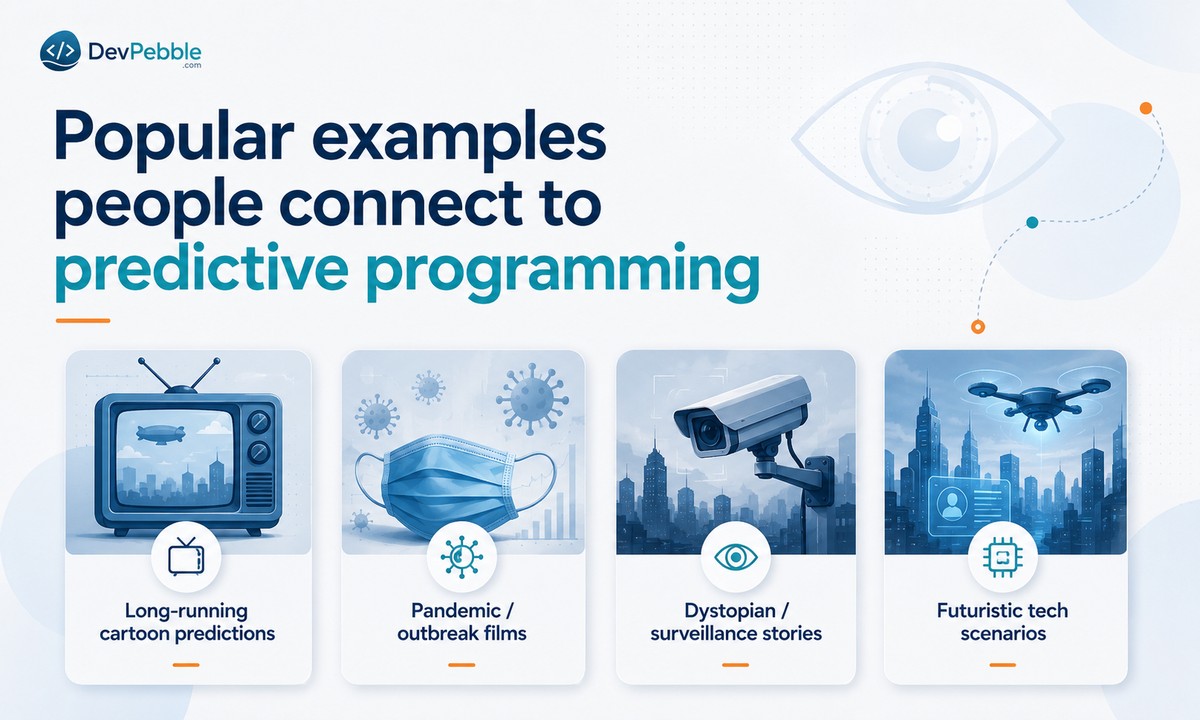
The most-shared examples tend to be the most dramatic. A pre-2001 TV pilot showing a plane flown into a skyscraper, a cartoon gag that resembles a later event, an outbreak movie that arrives before a real one. Laid out side by side, they look uncanny. Looked at individually, most have simpler explanations. A few of the usual suspects are worth walking through.
The Simpsons
No list like this is complete without The Simpsons. The show has run since 1989, reaching its 37th season, with more than 800 episodes aired. That is thousands of jokes, background gags, and throwaway scenes touching nearly every subject you can name.
When a few of those moments loosely match a later headline, it feels striking. Mostly it is math. Produce that much material over that many years and some overlap with the future is expected, not spooky. There is a memory effect too. People share the handful of scenes that seem to hit and quietly forget the thousands that went nowhere. The writers have said many of these bits were satire aimed at trends already visible at the time, not glimpses of what was coming.
Contagion and pandemic movies
Outbreak films like Contagion get held up as eerie predictions after real health crises. But virologists and public health experts warned about pandemic risk for decades before any of these movies existed. Filmmakers in this genre usually consult scientists and real epidemiological data to make the story land, so when a fictional outbreak resembles a real one, that is good research showing, not a leaked plan.
Dystopian films about surveillance and technology
Dystopian stories keep circling surveillance, artificial intelligence, and social control, which is exactly why they get pulled into these conversations. They are built on a single question: if this trend keeps going, where does it end? As facial recognition and AI systems have spread, some of those fictional scenarios have started to feel close to home. That is writers paying attention to where things were already going, not prophecy.
Is predictive programming real, or just a conspiracy theory?
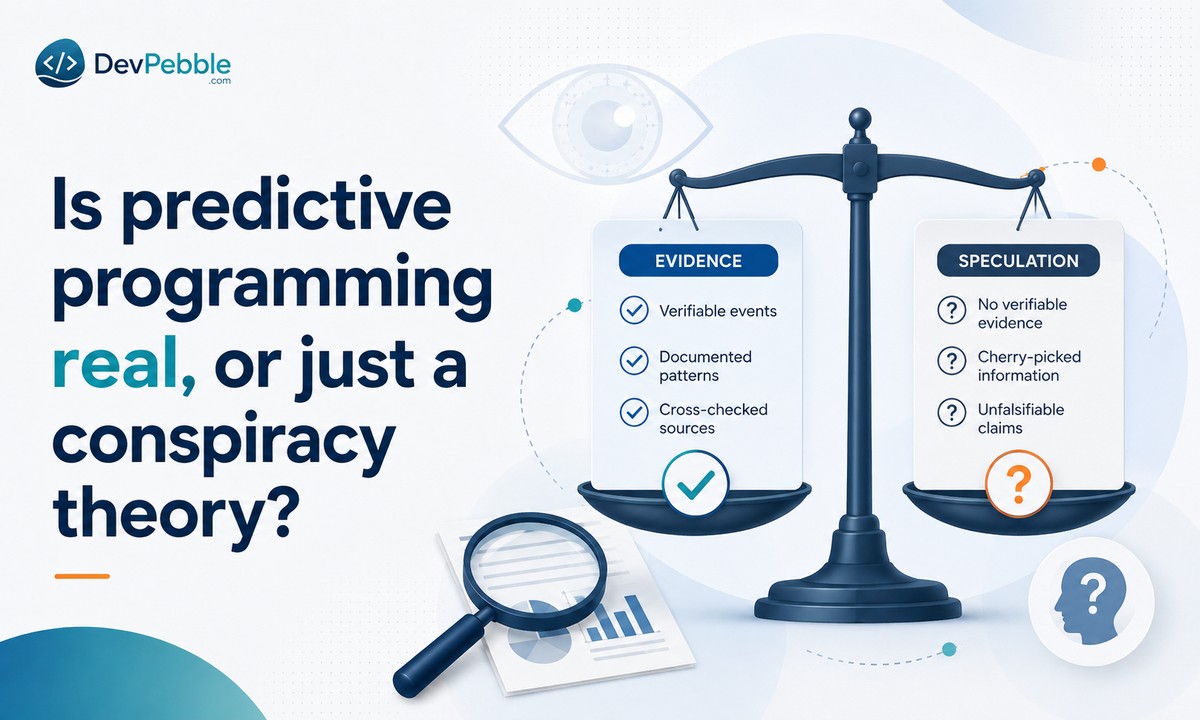
Here is the honest answer. The core claim is that media is deliberately used to condition the public into accepting planned events, usually at the direction of governments or some powerful group controlling what gets made. That is a big claim, and big claims need strong evidence. So far there is no verified document, leaked plan, or credible investigation showing that films and shows are coordinated for this purpose.
Part of why it is so hard to settle is that the theory runs on interpretation. A scene can be read a dozen ways, and once a real event happens, it becomes easy to look back and make older content "fit." That is the reverse of how evidence normally works. Researchers look for consistent, verifiable proof before drawing a conclusion, not after the fact. Without that, predictive programming stays a matter of belief rather than established fact.
The psychology behind the belief
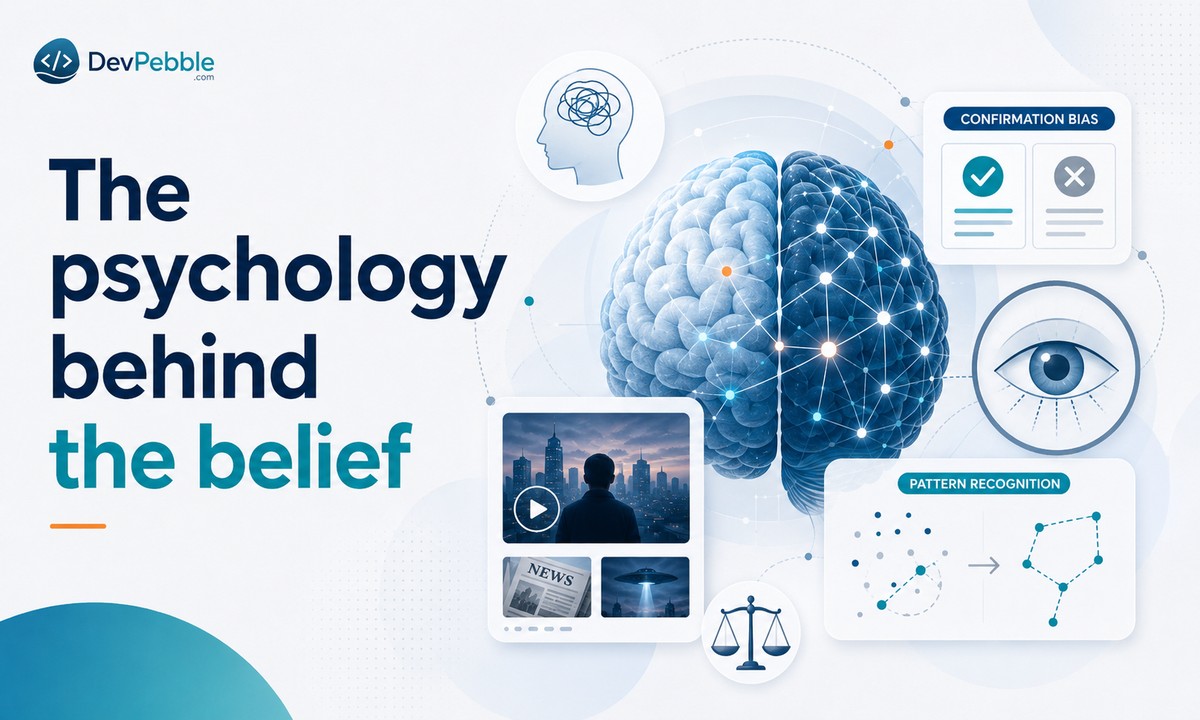
The interesting question is not really whether the theory is true. It is why it feels so true to so many people. Most of that comes down to how our brains handle patterns and uncertainty.
Pattern recognition and confirmation bias
Human brains are built to find patterns, even in noise. That instinct kept our ancestors alive, but it also makes us link things that are not connected. Psychologists have a name for seeing meaningful patterns in random data: apophenia.
Confirmation bias stacks on top. Once you suspect a theory might be right, you start noticing everything that supports it and skimming past everything that does not. That is not a flaw unique to conspiracy believers. Everyone does it.
Hindsight bias and the comfort of a plan
There is also hindsight bias, the quirk of mind that makes an event feel predictable only after you already know how it turned out. Combine that with the emotional pull of a big, frightening event, and a strange comfort appears. Believing a pandemic or a market crash was planned and hinted at in advance can feel easier to sit with than accepting that a lot of the world is simply chaotic and unplanned. That need for order is a big part of why theories like this keep their grip.
Why hits get noticed and misses vanish
For every "prediction" that seems to land, there are countless scenes and storylines that never came true. The misses get no attention because they make terrible content. So the hits pile up in public view while the misses disappear, leaving the false impression that fiction forecasts reality far more often than it does.
Media influence vs. deliberate conditioning
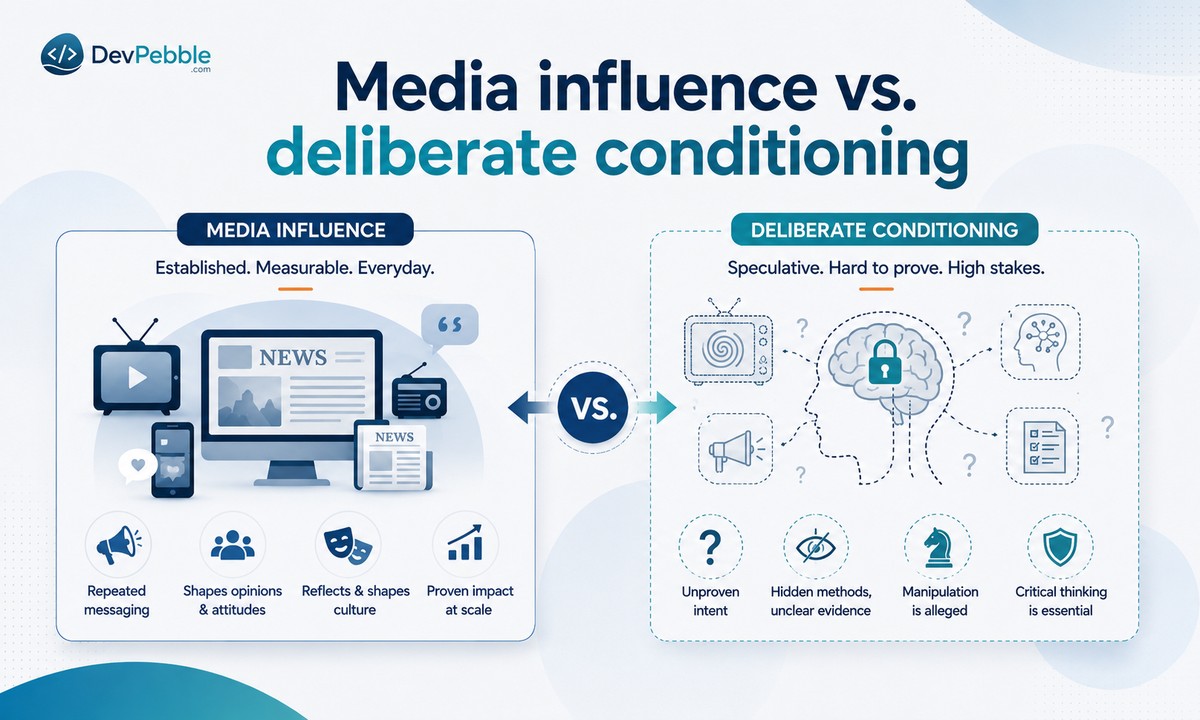
It is well established that movies and TV can shape opinion, normalize behavior, and change how people think about social issues. Media studies has documented this for decades. There is even a name for a related effect: cultivation theory, the idea that heavy, repeated exposure to certain themes gradually shifts how viewers perceive the real world.
That is not the same as the predictive programming claim. Broad cultural influence through storytelling is well supported. A secret, coordinated agenda to prepare the public for specific planned events is not. When distrust of institutions or fear of technology shows up across many shows at once, the simplest read is that media reflects and reinforces ideas already moving through the culture, a feedback loop rather than a forecast.
Online communities can blur this line further. Algorithms reward content that sparks a strong reaction, and a clip "revealing" a hidden prediction does that better than a careful explanation. Join a group built around these theories and you get a steady stream of new examples plus encouragement to read all media through that lens. Repetition alone can make an idea feel more credible, even when no new evidence has turned up.
How to evaluate a predictive programming claim
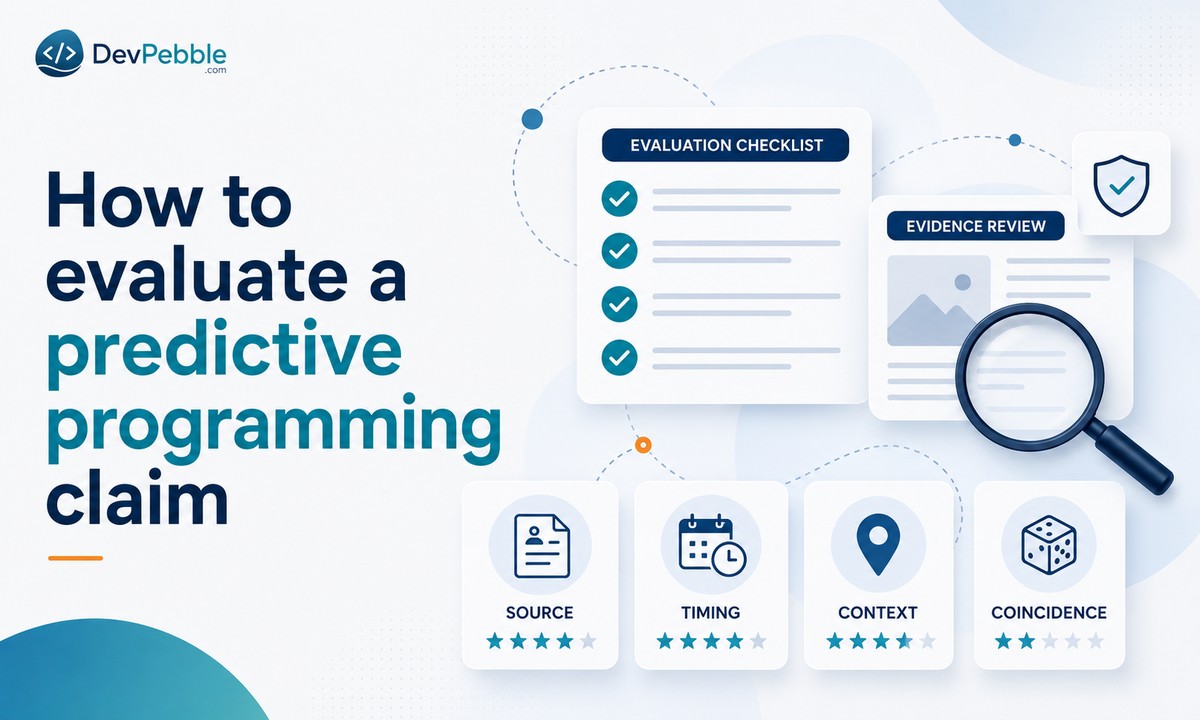
You do not need to be a researcher to pressure-test a viral clip. A few habits catch most of the weak ones.
Get specific about what was supposedly predicted. Vague matches like "a disease" or "a disaster" fit almost anything. A strong claim points to something precise.
Check the date, context, and original source. Confirm when the scene first aired and watch it in full, not as a trimmed snippet. Clips get cut and reordered to look more dramatic than the original.
Weigh simpler explanations first. Research, an informed guess, satire, or plain coincidence explain the overwhelming majority of these cases more reliably than a secret plan ever could.
A quick checklist
Run any "prediction" through these seven questions:
- What exactly was predicted?
- Was it specific or vague?
- Was the clip shown in full context?
- Has the release date been verified?
- Is there a simpler explanation?
- Are the failed predictions being ignored?
- Is the source credible?
If a claim struggles against these, it is almost certainly closer to coincidence than evidence.
Common myths worth clearing up
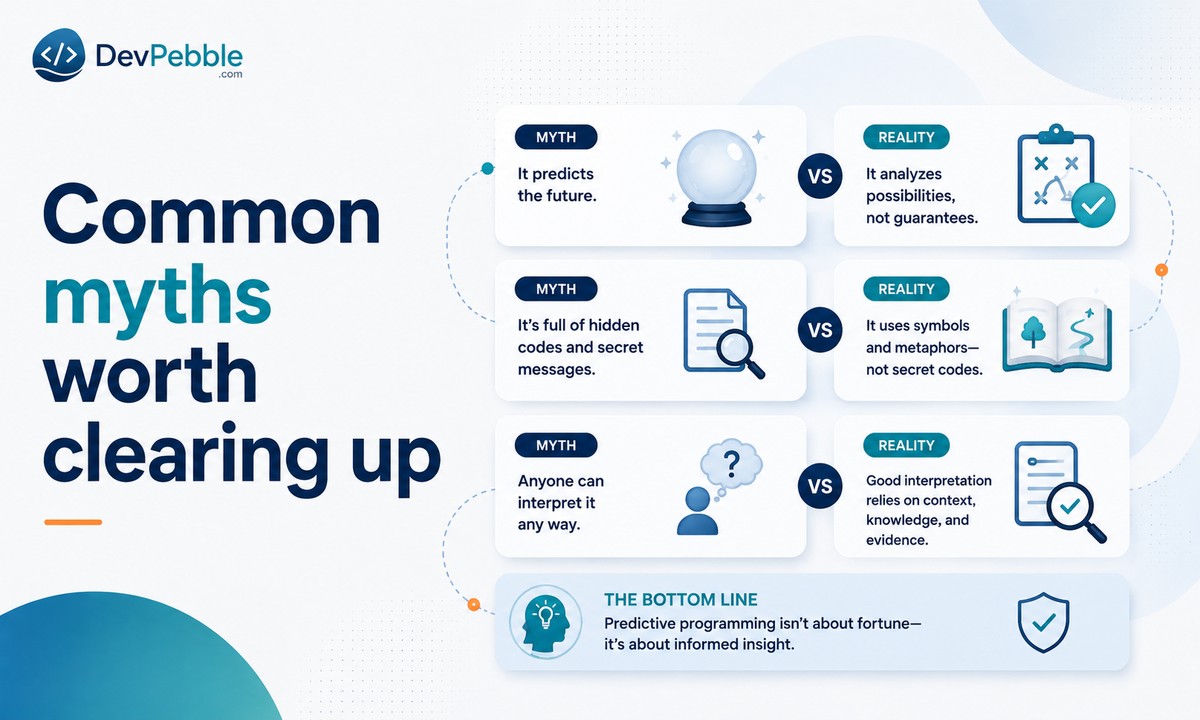
Myth one: every accurate fictional detail was planned. Fiction gets things right because writers study real trends. A correct detail is far more often good research than secret foresight.
Myth two: symbolism proves a hidden message. Metaphor and symbolism usually serve the story or the theme. Using them to comment on real issues is ordinary craft, not evidence of manipulation.
The payoff of thinking this through is sharper media literacy. Picking these claims apart teaches you how stories get built and why certain themes keep resurfacing. The risk runs the other way. Accept claims without checking them and you drift toward misinformation, where every coincidence looks like a plan and real patterns get lost among the imagined ones.
Final thoughts

Predictive programming stays popular because it scratches a real itch: the wish for a hidden order behind frightening, random events. But nearly every claim rests on interpretation, coincidence, and selective memory rather than confirmed evidence.
That does not make the topic a waste of time. Picking these claims apart is good practice on its own. The habit that matters is not deciding once and for all whether the theory is true. It is checking the source, watching the full context, and asking whether a simpler explanation fits. That kind of media literacy pays off far beyond this one strange corner of the internet.