Basic programming language: complete beginner guide for 2026
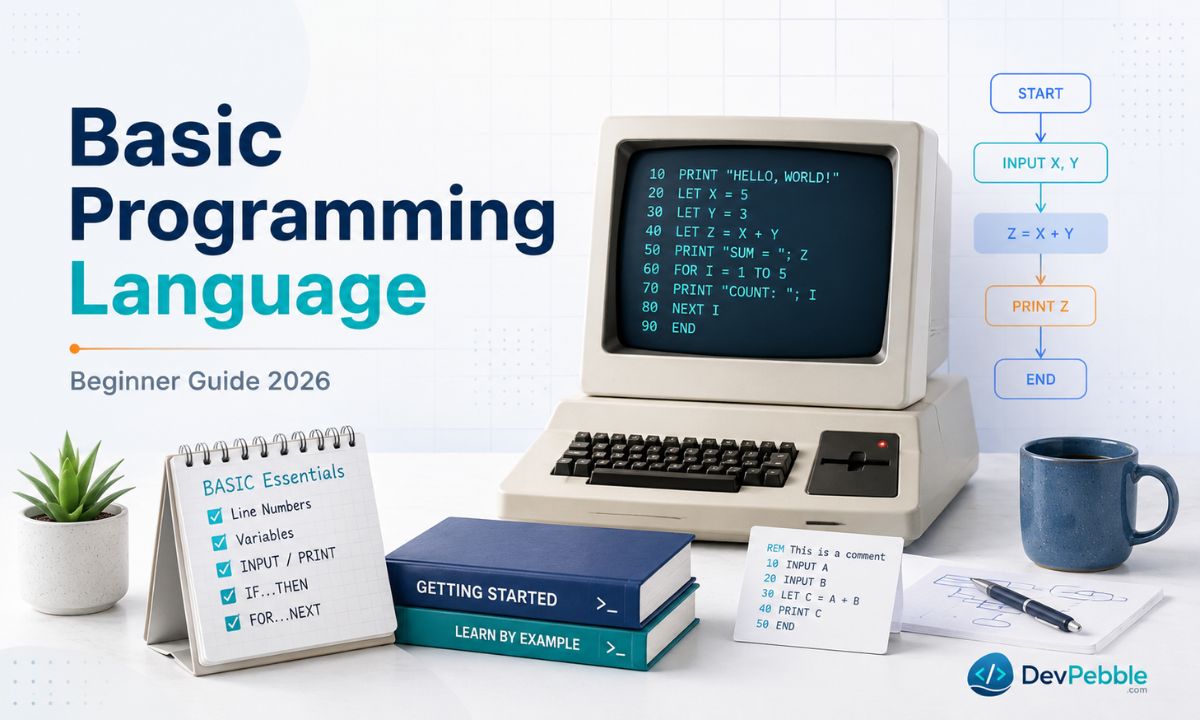
What is the basic programming language? This complete beginner guide explains BASIC — what it is, why it was created, how it works, its syntax and core commands, where it's still used in 2026, and whether it's worth learning today.
On this page⌄
Search for "basic programming language" and you land in a small naming trap. The phrase can mean two different things: simple, entry-level coding, or BASIC, an actual language with a real history. This guide is about the second one, though the two ideas are tangled together for a good reason. BASIC was built to be the simplest possible way into programming, so for millions of people, the basic programming language quite literally was their first taste of code.
Here you will find what BASIC is, why it was created, how it works, what its syntax looks like, where it still shows up in 2026, and whether it is worth your time today.
What is the BASIC programming language?
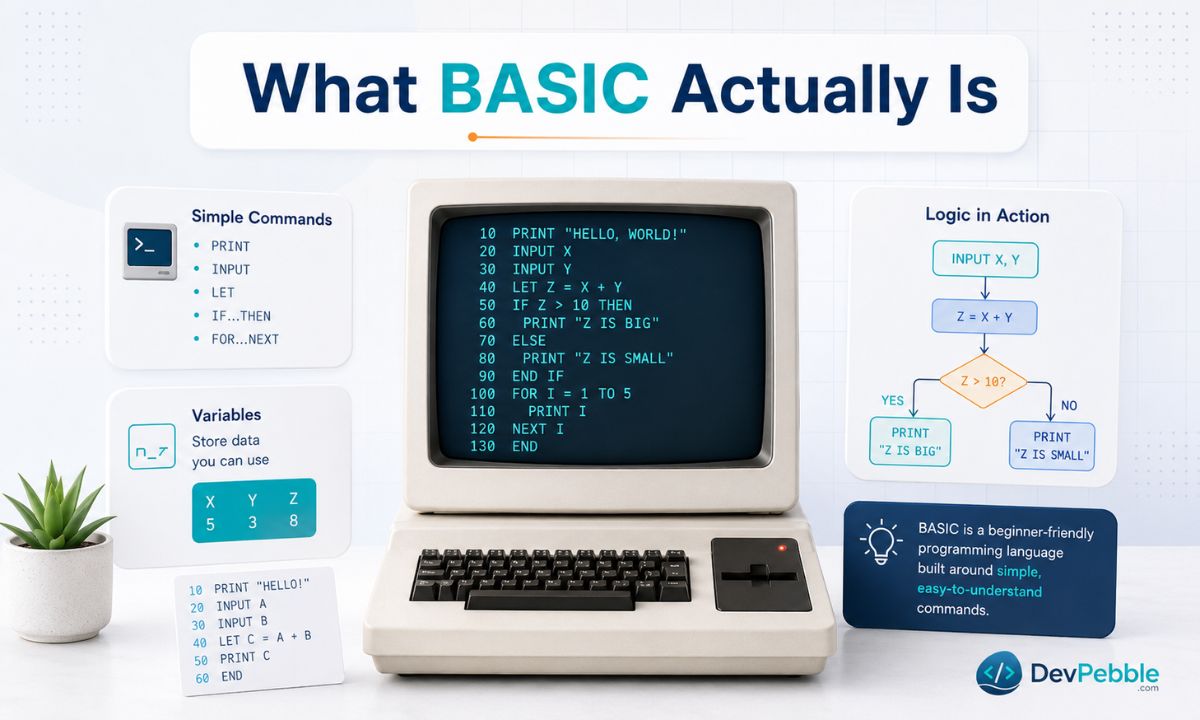
BASIC stands for Beginner's All-purpose Symbolic Instruction Code. It is a high-level language first built in the 1960s at Dartmouth College, and the name was a promise: anyone could learn it, not just mathematicians or engineers.
The whole design points at one thing, which is readability. Commands are plain English words like PRINT, INPUT, IF, THEN, and GOTO, so the code reads almost like instructions you would give a person. That matters more than it sounds. A beginner can look at a BASIC program and roughly follow what it does without knowing a single rule yet.
One distinction is worth nailing down early, because it trips people up. When someone says "basic programming," they usually mean fundamental coding skills in general. BASIC the language is a specific thing with its own syntax and rules. Same word, two meanings. For a lot of people who grew up with home computers like the Commodore 64, the Apple II, or the ZX Spectrum in the 1970s and 1980s, BASIC was the first and sometimes only language they ever touched.
Why BASIC was created
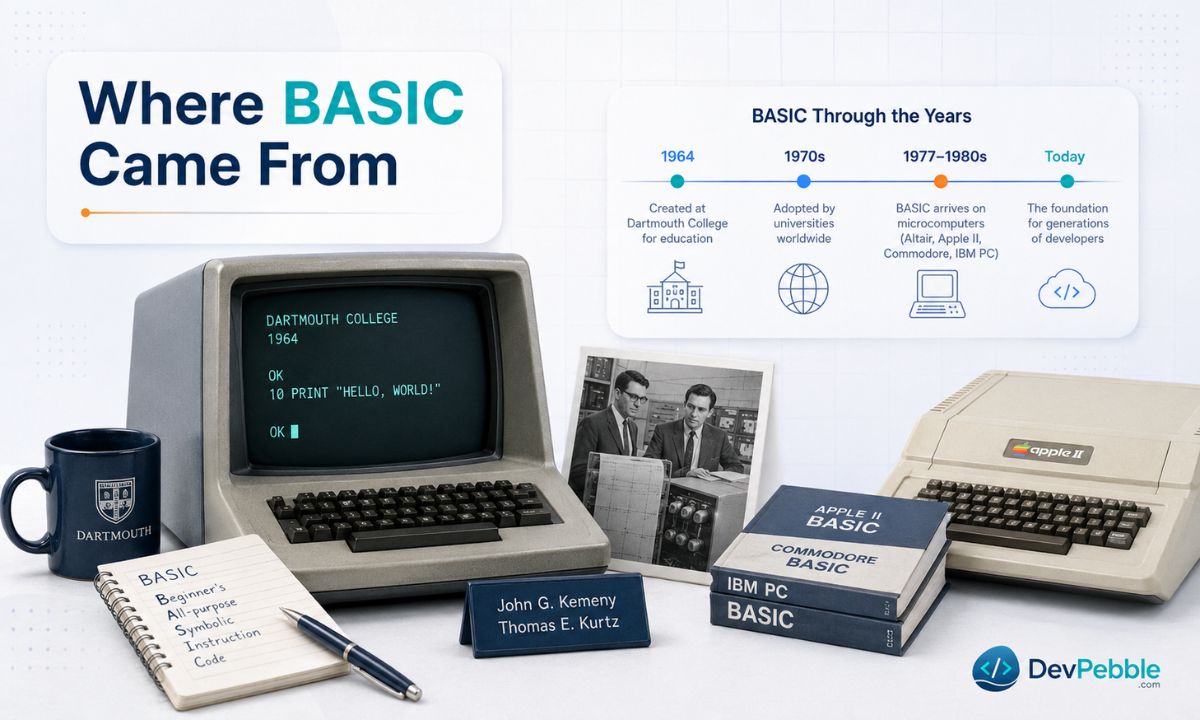
In the early 1960s, computers were powerful but miserable to use. Programming meant deep technical knowledge, and the machines mostly belonged to scientists and researchers. If you were a regular student, you had almost no way in.
That changed in 1964, when John G. Kemeny and Thomas E. Kurtz, two professors at Dartmouth College, built BASIC. Their aim was plain: make computing reachable for everyone, especially the liberal arts students who had no maths or engineering background at all.
So BASIC was designed for learning first and serious work second. It cut out complexity, gave fast feedback, and made mistakes easy to fix. Compare that to FORTRAN or assembly, which were built for speed and precision rather than comfort. BASIC was never meant to run operating systems or huge programs. It was meant to teach people how to think through a problem step by step.
That choice mattered far beyond one campus. When affordable home computers arrived in the 1970s and 1980s, BASIC was often built right in, sometimes loading the moment you switched the machine on. For a couple of decades, it was simply where people started.
How BASIC works
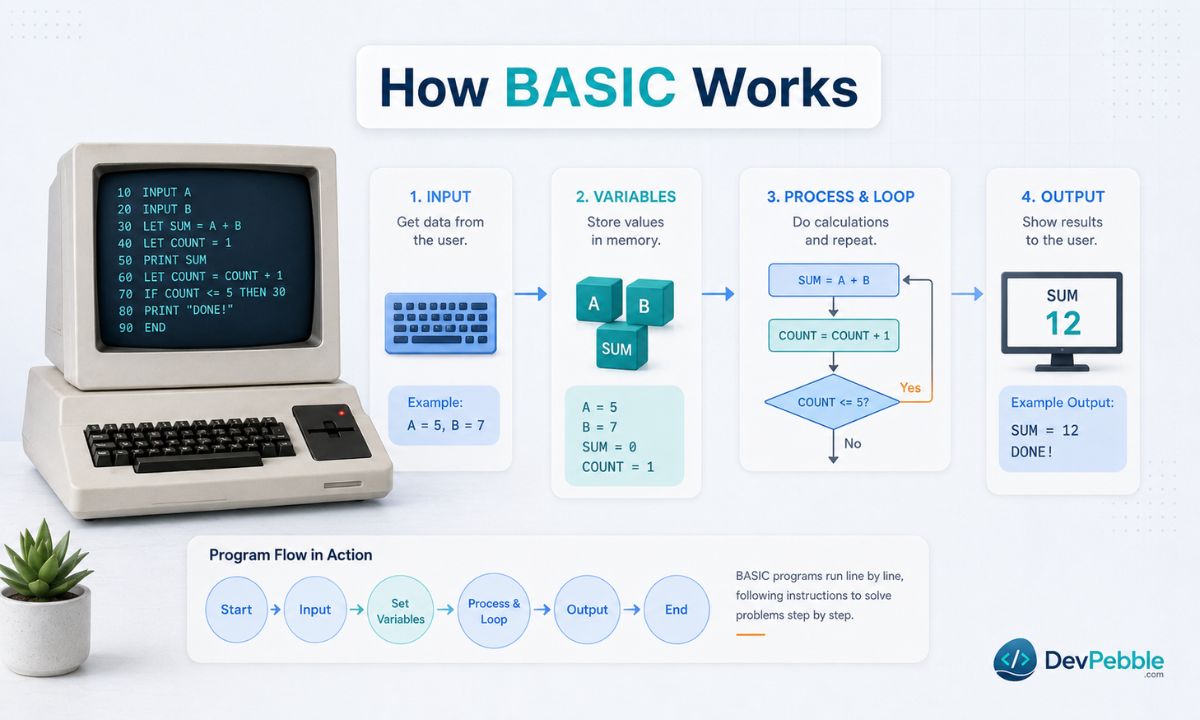
BASIC is much simpler under the hood than most modern languages, and that simplicity is the whole point.
In older versions, you wrote a program one line at a time, and each line got a number. The computer ran them in order, lowest number first. Here is the classic shape of it:
10 PRINT "Hello, World!"
20 INPUT "What is your name? ", N$
30 PRINT "Nice to meet you, "; N$
40 END
The machine reads line 10, then 20, then 30, and so on. Beginners could literally see the order things happened in, which made the flow of a program obvious in a way that is hard to recreate today.
BASIC is also interpreted, meaning the code runs line by line as it goes rather than being compiled into machine code first. That makes it slower than compiled languages. It also means you can write three lines, run them, and see the result immediately. For someone learning, that tight loop of write, run, and see is worth a lot.
The pieces you work with are few. Variables hold data, whether numbers or text. PRINT puts something on screen. INPUT waits for the user to type. IF and THEN make a decision. FOR and NEXT repeat a block a set number of times. GOTO jumps straight to a line number, which is handy and also the source of plenty of trouble, as we will get to. That short list is enough to build small games, calculators, and quizzes. You are writing working programs on day one, not in week three.
BASIC syntax and core commands
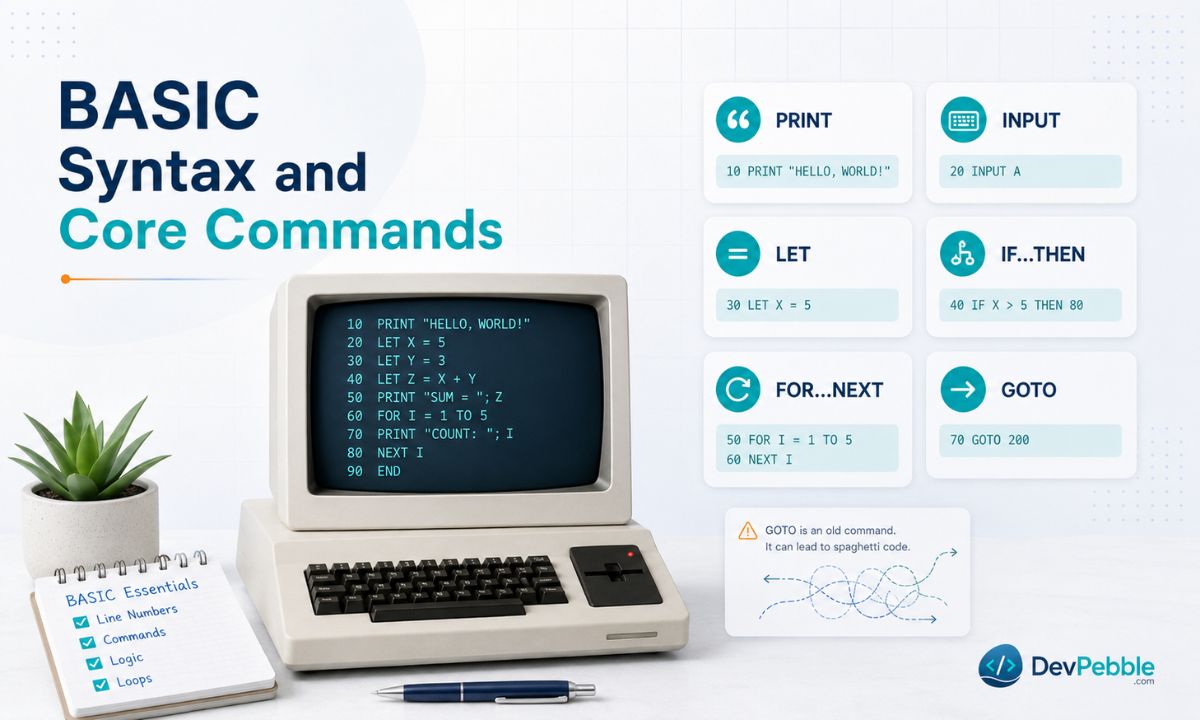
Syntax is just the grammar of a language: break the rules and the computer stops understanding you. Part of why BASIC caught on is that its grammar is forgiving. In C or Java, one missing semicolon can kill a program. BASIC is far more relaxed, and the words are words rather than symbols.
The smallest possible program is one line:
PRINT "Hello, World!"
No brackets, no imports, no function wrapper. It prints the text. Done. For a first-ever line of code, that directness is hard to beat.
A slightly fuller example shows the common commands together:
10 LET score = 100
20 PRINT "Your score is: "; score
30 IF score > 50 THEN PRINT "You passed!"
40 END
A handful of commands cover most of what a beginner needs. PRINT shows output. INPUT pauses and stores whatever the user types in a variable. LET assigns a value, though in many modern dialects the word LET is optional. IF and THEN run something only when a condition holds. FOR and NEXT loop a fixed number of times:
FOR i = 1 TO 5
  PRINT "Line "; i
NEXT i
Then there is GOTO, which deserves a word of caution. It jumps the program to a specific line, and early BASIC leaned on it heavily. The problem is that heavy GOTO use makes a program jump around unpredictably, the kind of mess people came to call spaghetti code. Structured programming later replaced it with cleaner tools like loops and functions. It is worth knowing what GOTO does and why it existed, but most modern BASIC dialects nudge you away from it.
One more thing to keep in mind: BASIC is not one fixed language. The original Dartmouth BASIC differs from later versions. QBASIC, which shipped with MS-DOS in the early 1990s, added more structure and dropped the requirement for line numbers. Visual Basic, from Microsoft, went much further toward modern object-oriented programming. GW-BASIC, BBC BASIC, and FreeBASIC each have their own quirks too. If you are following a tutorial, check which dialect it uses so your code matches what the interpreter expects.
Why BASIC is still worth learning
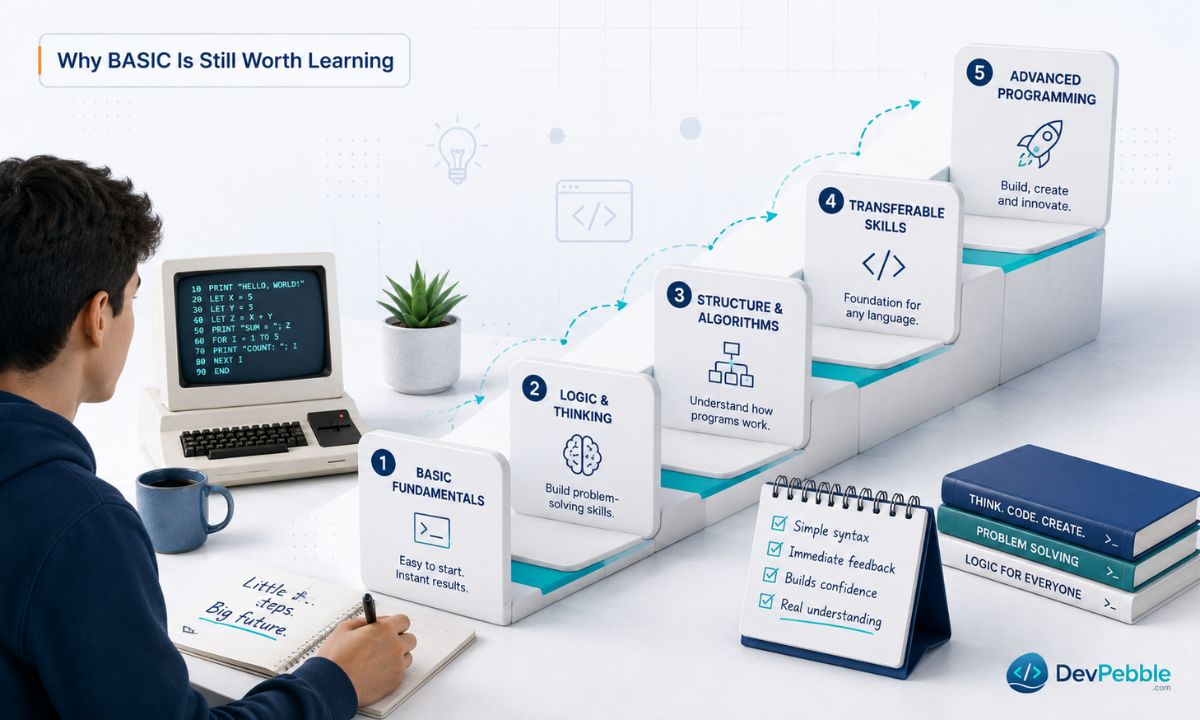
Is there real value in learning BASIC in 2026, when polished beginner options are everywhere? It depends on what you want, but the case is stronger than you might guess.
It teaches logic with nothing in the way. BASIC drops frameworks, libraries, and object-oriented patterns and leaves the core ideas: variables, conditions, loops, and input and output. Learn those here and they carry over to any language you pick up next.
It also lowers the fear barrier, which is no small thing. Confusing syntax is one of the top reasons people quit coding early. Plain-English commands and instant feedback make BASIC one of the gentlest possible starts. If Python or JavaScript already left you feeling lost, a short detour through BASIC can rebuild some confidence.
There is a history angle too. Knowing where programming came from helps you understand why modern languages made the choices they did. And there is the retro scene: an active community still programs on classic machines like the Commodore 64, BBC Micro, and ZX Spectrum, all of which ran BASIC, and emulators put that within reach of anyone. Modern dialects keep the door open as well. FreeBASIC and QB64, now maintained as QB64 Phoenix Edition, still run on current systems and can compile real standalone programs, so you get BASIC's simplicity on hardware that still exists.
This is not about shipping a production app or landing a developer job. It is about seeing the foundations of code as clearly as possible, and that stays useful at any point in the journey.
The limits of BASIC
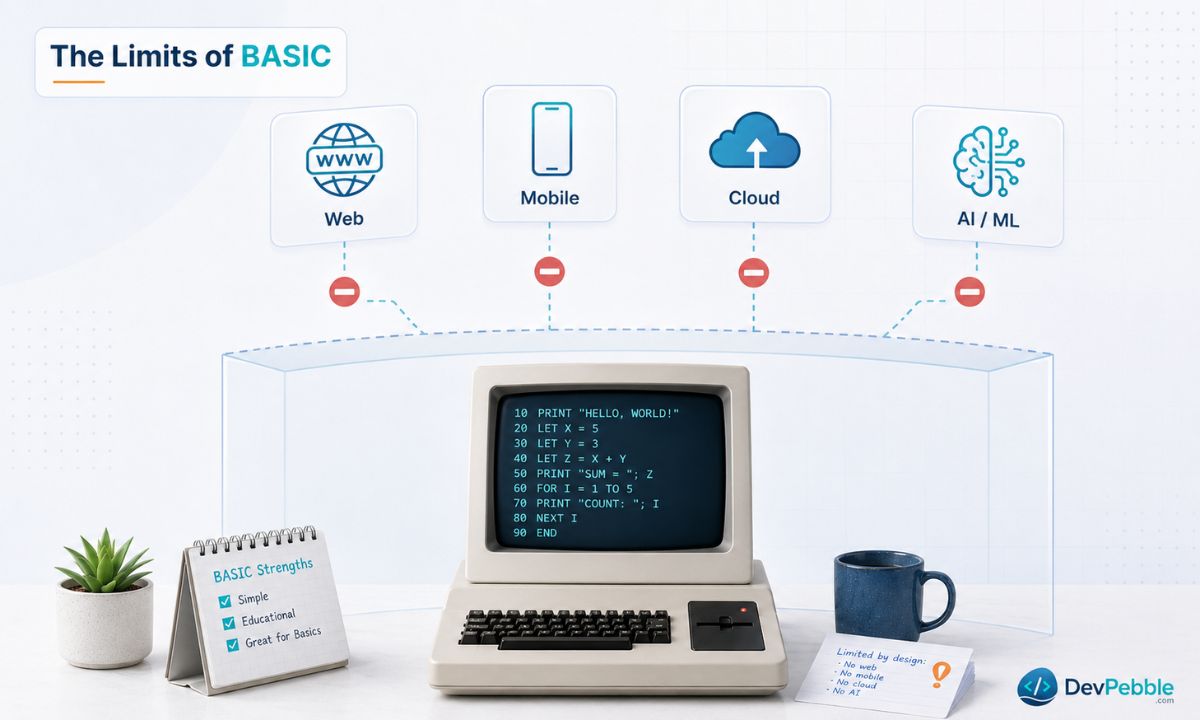
BASIC has earned its place in history, but it comes with real trade-offs, and they matter if you are deciding where to spend your time.
Old habits stick. Classic BASIC encouraged a style, heavy on GOTO and line numbers, that modern developers actively avoid. Learn only that style and you will have some unlearning to do before clean, structured code feels natural.
It was also built for a different era. There is no native support for web apps, mobile, cloud services, APIs, or machine learning. If any of those is your goal, BASIC alone will not carry you there.
The fragmentation can confuse beginners as well. With no single version, code that runs in QBASIC may not run in FreeBASIC or QB64, and bouncing between dialects without guidance gets frustrating fast.
And the job market is thin. Python, JavaScript, Java, and C# dominate hiring in 2026, and employers almost never ask for BASIC. The skills you build in it will not translate into a coding career without a lot more learning on top. None of this makes BASIC useless. It just gives it a specific lane.
BASIC vs modern programming languages
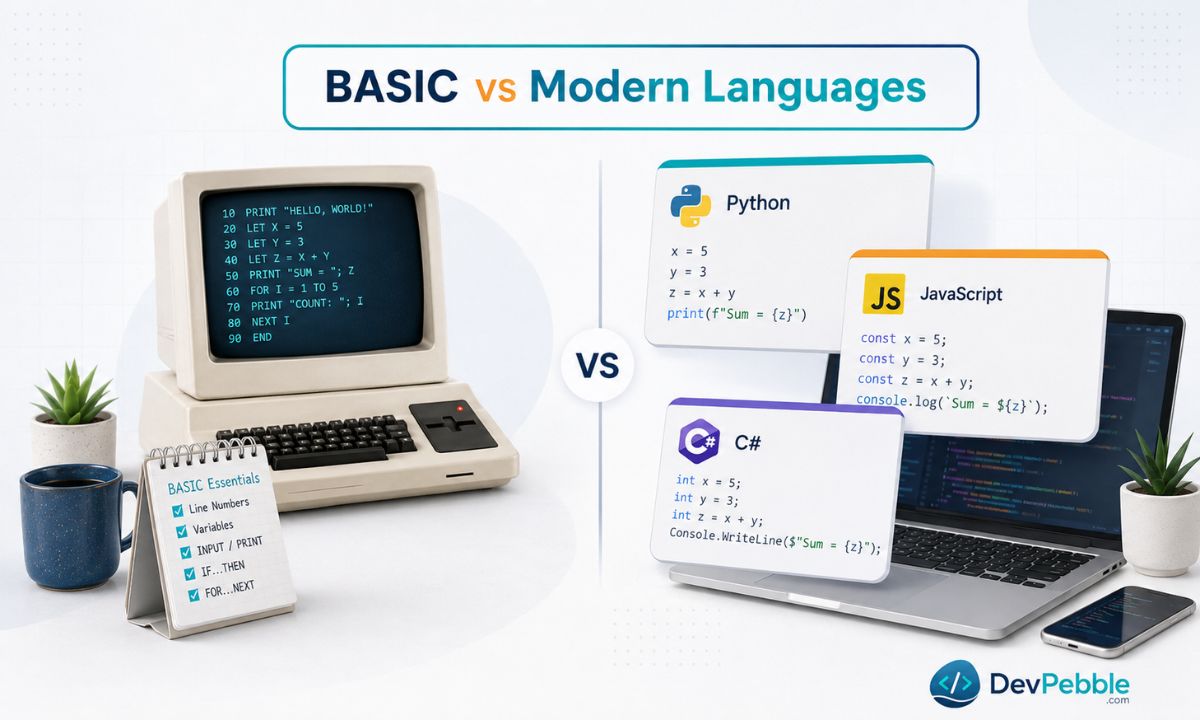
Lining BASIC up against today's languages makes its strengths and gaps easy to see.
Against Python, the most recommended beginner language in 2026, the comparison is close in spirit. Python has clean, readable syntax that feels almost as approachable as BASIC, but it is also a full working language used in data science, AI, automation, and the web. If you want to learn logic and then put it to use, Python is the stronger first pick. That said, BASIC is arguably even simpler for the very first steps, since it drops things Python still asks of you, like indentation rules and importing modules.
Against JavaScript, there is barely a contest, because they live in different worlds. JavaScript runs the web, and if you want to build sites or web apps, it is unavoidable. BASIC has no real role there.
Against C# and Visual Basic, the picture is about the Microsoft ecosystem. Visual Basic grew out of BASIC and is tied to .NET, so if you maintain older Windows software, some familiarity can still help. But Microsoft declared Visual Basic feature complete in 2020, which means it gets maintenance and security updates but no new language features. C# is where the investment goes now, and new learners in that ecosystem are better off starting there.
The honest summary: for careers and real software, modern languages win in nearly every category. BASIC holds its own when the goal is learning logic without distraction, exploring computing history, or working on retro and educational projects where simplicity is the whole point.
Is BASIC still used in 2026?
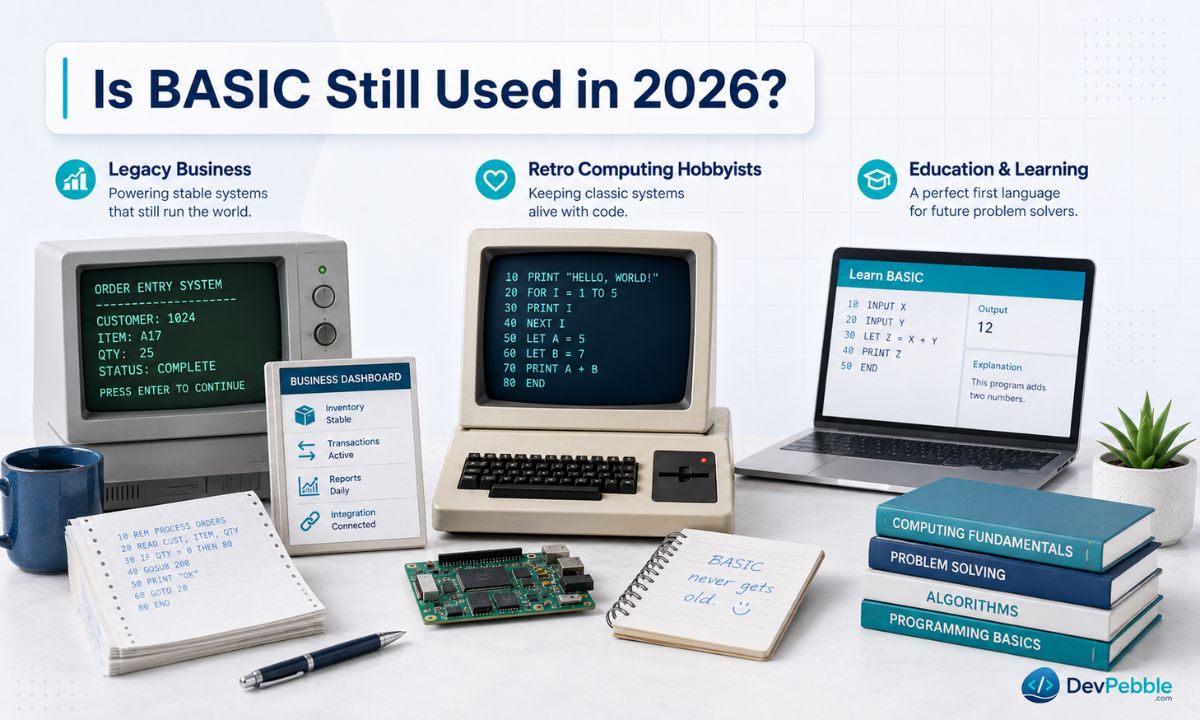
Short answer: not much, but not gone either.
It is not a serious choice for new software. You will not find it behind web apps, mobile platforms, or enterprise systems today. The professional world moved on long ago.
It does survive in specific corners. Visual Basic and VB.NET still turn up in legacy business systems, especially in companies that built internal tools decades ago and never fully migrated. Some of those systems still run, and someone occasionally has to keep them alive. In the hobbyist and retro world, BASIC is in good health, with active communities around the Commodore 64, ZX Spectrum, and BBC Micro, plus emulators that make it all easy to run. QB64 Phoenix Edition and FreeBASIC have small but committed user bases writing new programs for fun and teaching. And in education, BASIC dialects still show up in some introductory courses as a stepping stone before students move to bigger languages.
One practical note: tooling changes constantly. If you settle on a particular dialect or tutorial, check current documentation and community forums to confirm it is still maintained.
Should beginners learn BASIC today?
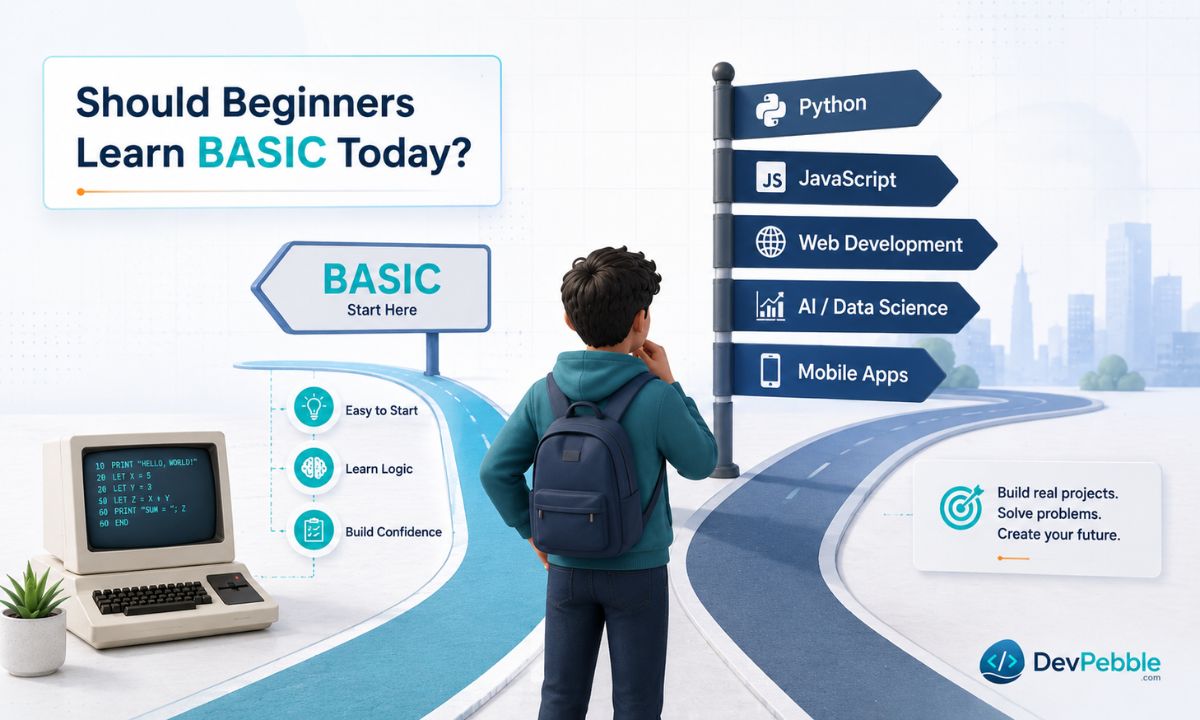
It comes down to what you want out of programming.
If you are a complete beginner who finds modern languages intimidating and just wants to understand what coding even is, BASIC is a fine starting point. It removes the clutter, gives fast results, and teaches the core ideas in the clearest setting you will find.
If you are aiming for a career in software, data, or web development, your time is better spent starting with Python or JavaScript. Both are beginner-friendly in their own right and both connect straight to real jobs. Learning BASIC first would not hurt, but it adds a step most career-focused beginners can skip.
If you are headed into Windows or enterprise work and might touch older Microsoft systems, a little Visual Basic could help in specific situations, though C# is the better long-term bet.
And if you love computing history, enjoy retro programming, or just want to feel what learning to code was like for millions of people decades ago, BASIC is a lovely choice. There is a real satisfaction in writing a working program in the language that helped open computing up to the world.
The bottom line
BASIC, short for Beginner's All-purpose Symbolic Instruction Code, is one of the most important languages in computing history. It brought a whole generation into programming and shaped what beginner-friendly code still looks like.
The basic programming language is not the force it once was, but it still earns its keep for understanding foundations, exploring history, and enjoying retro projects. If you want the most approachable on-ramp to programming logic, BASIC is a fine place to begin. If you want to build for the modern world, follow it with Python, JavaScript, or whatever fits your goal.