Functional programming languages: a complete beginner-friendly guide
A beginner-friendly guide to functional programming languages — what they are, how they work, their key features, functional vs OOP, real-world uses, and how to choose between Haskell, Elixir, Scala, F#, Clojure, and Elm in 2026.
On this page⌄
- What are functional programming languages?
- How functional programming works
- Key features of functional languages
- Functional vs object-oriented programming
- Why developers choose functional programming
- The trade-offs
- Where functional programming shows up in the real world
- Choosing a functional language for your goals
- Conclusion
- FAQ
Functional programming languages come up a lot in modern software development, usually with a mix of admiration and a little mystery attached. So what does it really mean to write code in a functional style, and why are so many developers reaching for it in 2026?
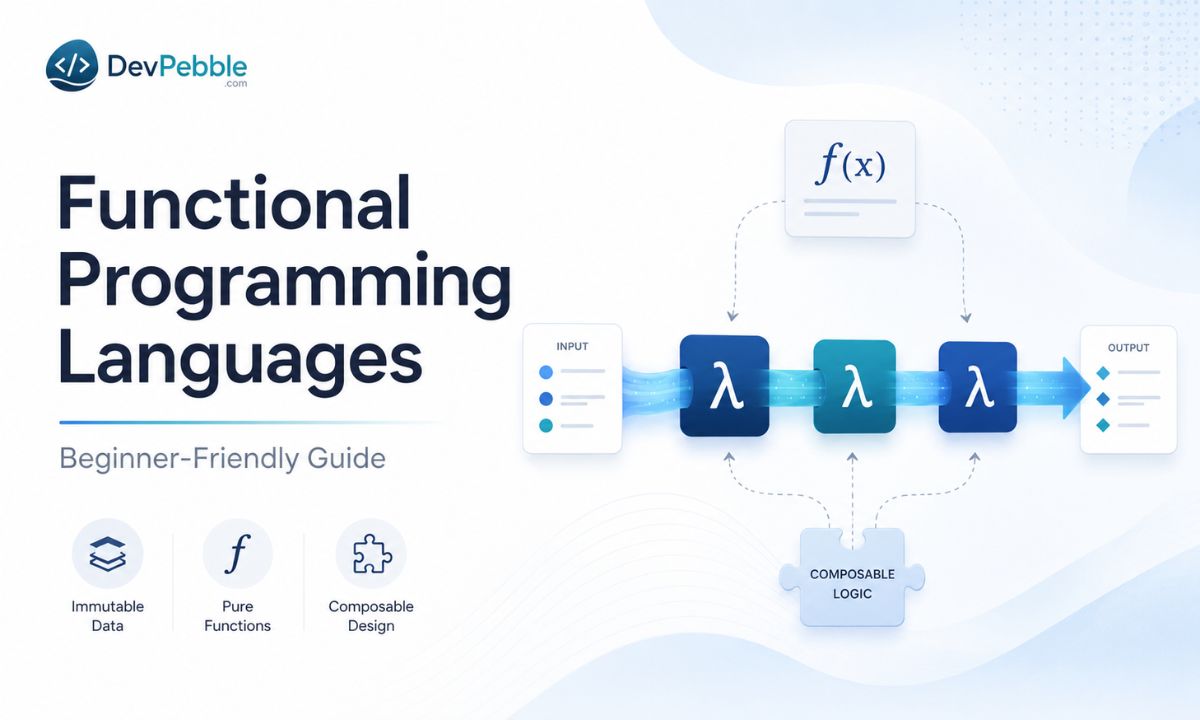
At its simplest, functional programming is a way of building software around pure functions and immutable data, structured so the same inputs always produce the same outputs. Instead of telling the computer how to change things step by step, you describe what you want computed. The payoff is code that is easier to test, reason about, and maintain over time.
This guide walks through the whole picture: what these languages are, how they work, where they fit, and which one to pick depending on what you want to build. No prior functional experience required.
What are functional programming languages?
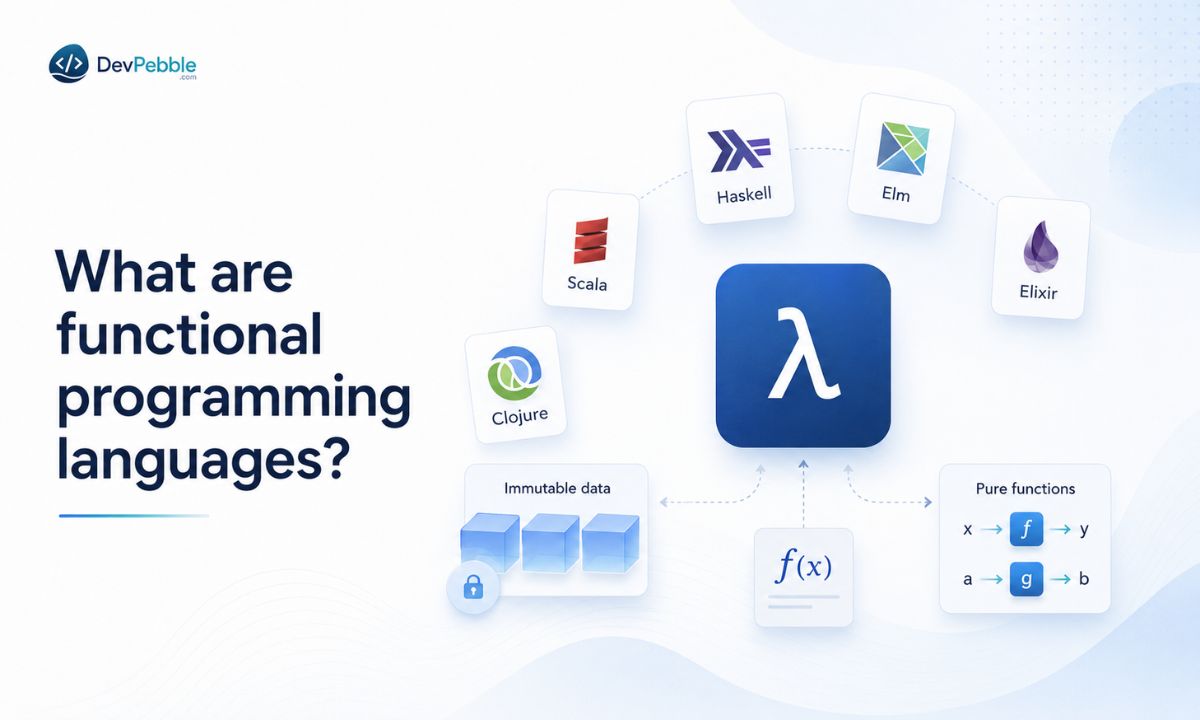
Functional programming is a programming paradigm, which is just a fancy word for a style of writing code. It treats computation as the evaluation of functions and avoids changing state or mutating data along the way.
A language counts as functional when it supports and encourages that style natively. In practice that means strong support for first-class functions (functions you can pass around like any other value), immutable data, and clean ways to combine small pieces of logic.
There is a useful distinction worth making early. Functional programming as a style is not the same as a functional programming language. You can write functional-style code in Python or JavaScript, both multi-paradigm languages. But languages like Haskell, Elm, and Erlang are built around functional principles from the ground up. They make the functional approach the default rather than an option you opt into.
A few of the better-known functional languages:
- Haskell is purely functional, with a powerful static type system. Long popular in academia, increasingly used in industry.
- Lisp and Clojure: Lisp dates to the late 1950s, which makes it one of the oldest languages still in use. Clojure is its modern JVM-based descendant, built with concurrency in mind.
- Scala blends functional and object-oriented programming on the Java Virtual Machine.
- Erlang and Elixir target fault-tolerant, concurrent systems. Elixir is the friendlier modern layer on top of Erlang's runtime.
- F# is Microsoft's functional-first language for .NET.
- OCaml is a fast, statically typed language used in finance and compiler work.
- Elm is a beginner-friendly functional language aimed at building web front ends.
They differ in syntax and use case, but they all rest on the same idea: let functions do the heavy lifting.
How functional programming works
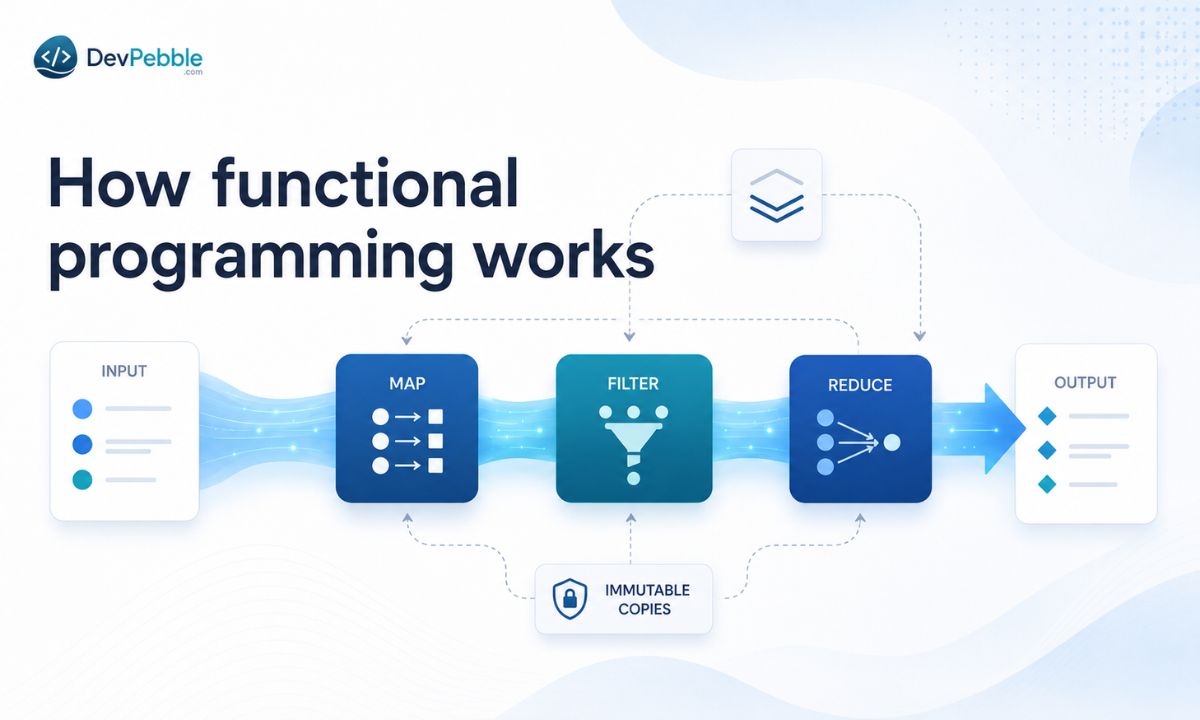
The easiest way to picture functional programming is a recipe that never spoils its ingredients.
Say you are baking bread. Following the same recipe with the same ingredients gives you the exact same loaf every time. The recipe does not quietly rummage through a different drawer or use up something from another part of the kitchen. Inputs go in, a predictable output comes out, and nothing else changes.
In code, that breaks down into a few ideas. Functions are the main building block: instead of long sequences of commands that change things, you write functions that take inputs and return outputs. A well-behaved function does not reach outside itself to modify a variable, a database, or something on the screen. And data is not modified in place. Rather than editing an existing list, you produce a new one with the change applied. That property is called immutability, and it heads off a whole category of hard-to-trace bugs.
When a function always returns the same output for the same input, it is called a pure function, and pure functions are what make testing painless. The opposite is a function with side effects: it writes to a log, makes a network call, or changes a variable somewhere else. Functional programming does not ban side effects, since almost every real program needs them, but it keeps them isolated and explicit instead of scattered everywhere.
Key features of functional languages
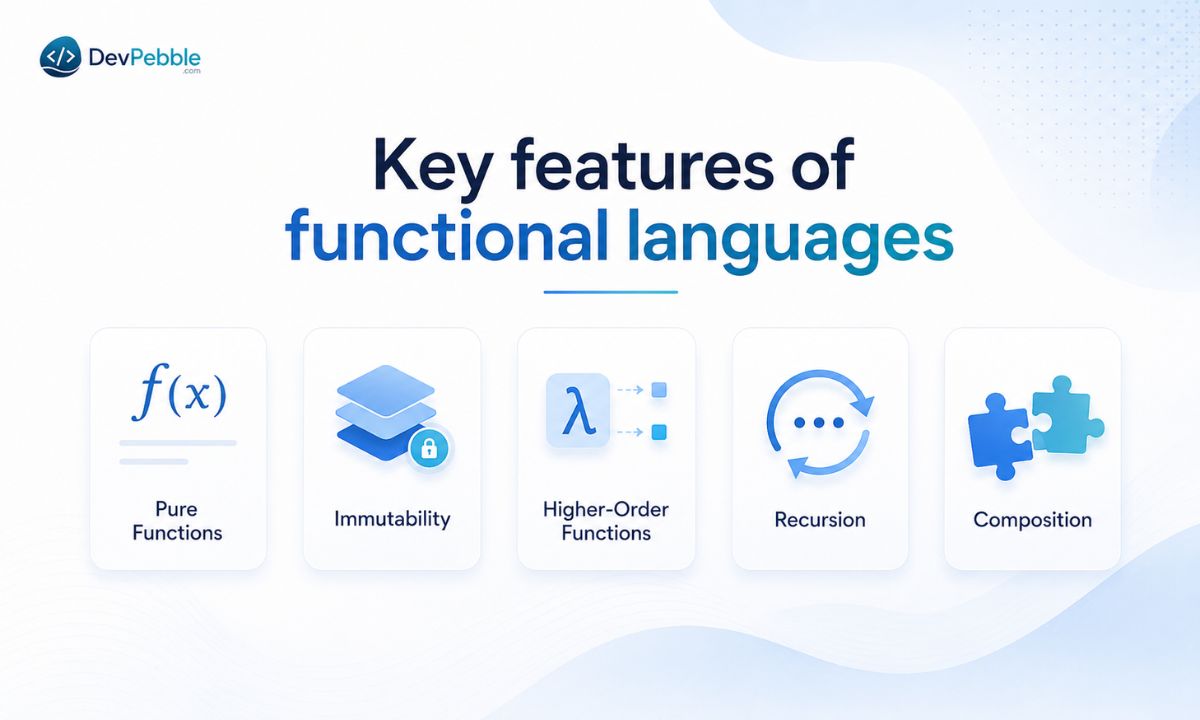
Beyond pure functions and immutability, functional languages share a toolkit that makes them expressive and safe.
Higher-order functions take other functions as arguments or return them as results, which is how you build flexible, reusable logic. The classic examples are map, filter, and reduce. Because mutating a loop counter goes against the grain, recursion tends to replace traditional loops: a function calls itself on a smaller version of the problem until it hits a base case. Function composition lets you snap small, single-purpose functions together to build bigger behavior, like building blocks.
Many functional languages also offer pattern matching, which inspects the shape of a data structure and branches on it. It reads far more cleanly than a long ladder of if/else statements. Some languages, Haskell most prominently, use lazy evaluation, computing a value only when it is needed, which even makes it possible to work with infinite data structures.
Then there are the type systems. Haskell, Elm, F#, and OCaml lean on strong static typing that catches a surprising number of errors at compile time, before your code ever runs. Together, these features support a declarative style: you describe what should happen rather than spelling out every step of how, which usually leaves you with shorter code that stays close to the problem you are solving.
Functional vs object-oriented programming
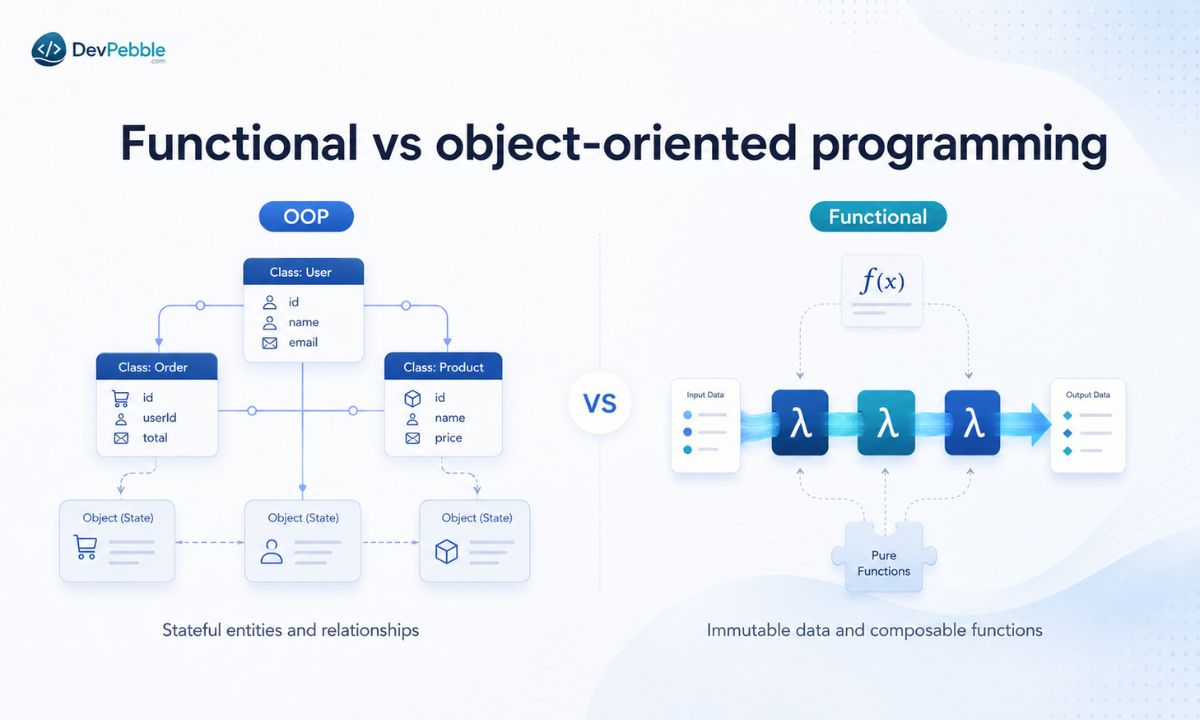
The two paradigms most developers compare are functional programming and object-oriented programming (OOP). Knowing when to reach for each is a practical skill worth having.
OOP organizes code around objects: structures that bundle data together with the methods that act on it. An OOP program models the world as a collection of objects, each holding internal state that can change over time. Functional programming organizes code around data transformation instead. Rather than objects with mutable state, you have functions that take immutable data in and return new data out. The emphasis moves from things that do stuff to transformations that produce results.
Those differences are concrete. OOP usually lets you modify an object directly, while functional code treats data as immutable, which makes the flow of data through a program much easier to trace. In OOP, behavior lives inside objects and is tightly bound to its data; in functional code, functions stand alone and can be composed, reused, and tested in isolation.
Functional code tends to win with heavy data transformation, complex pipelines, concurrency, or anything that needs rigorous testing, because fewer side effects mean fewer surprises. OOP can feel more natural when you are modeling real-world entities with evolving state, like user accounts, game characters, or UI components, and large teams with established OOP codebases benefit from the structure classes provide.
In practice, the strongest developers rarely think in terms of one or the other. Most modern languages support both, and good codebases mix them on purpose: functional techniques for data and logic, object-oriented structures for modeling entities and large systems.
Why developers choose functional programming
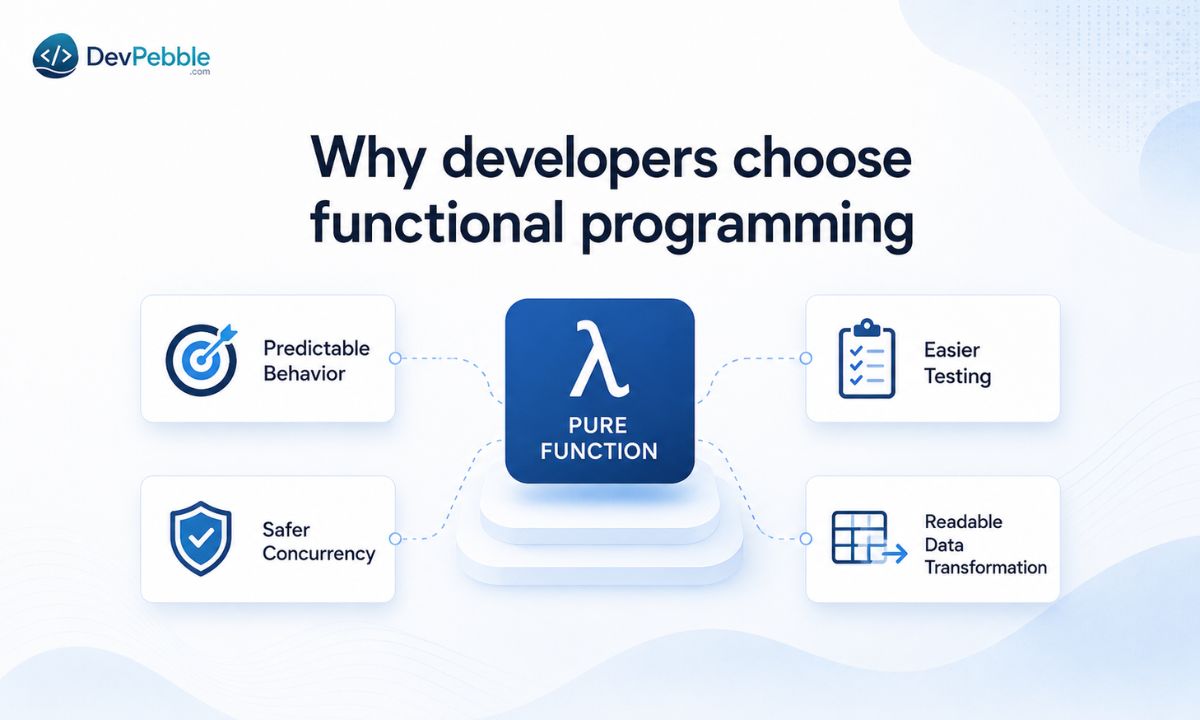
Functional programming has grown in popularity for practical reasons, not just academic ones.
The headline benefit is predictability. When functions are pure and data is immutable, you can read a function in isolation and trust it does exactly what it says, with no hidden dependencies or mysterious state changes elsewhere. That directly reduces bugs, because a large share of real-world bugs come from shared mutable state: one part of a program quietly changing data another part was relying on. Immutability closes that door.
Testing gets simpler too: a pure function takes a known input and returns a known output, so there is nothing to mock and no environment to set up. Concurrency benefits for a related reason, since data that cannot change is safe to share across threads without locks or race conditions, a natural fit for parallel and distributed work. And when the job is to reshape data by filtering, mapping, or aggregating, declarative code is usually more readable than the imperative equivalent.
These same properties, correctness and reliability under load, are why functional techniques show up in backend APIs, distributed systems, financial software, data engineering, and the data pipelines that feed AI workflows.
The trade-offs
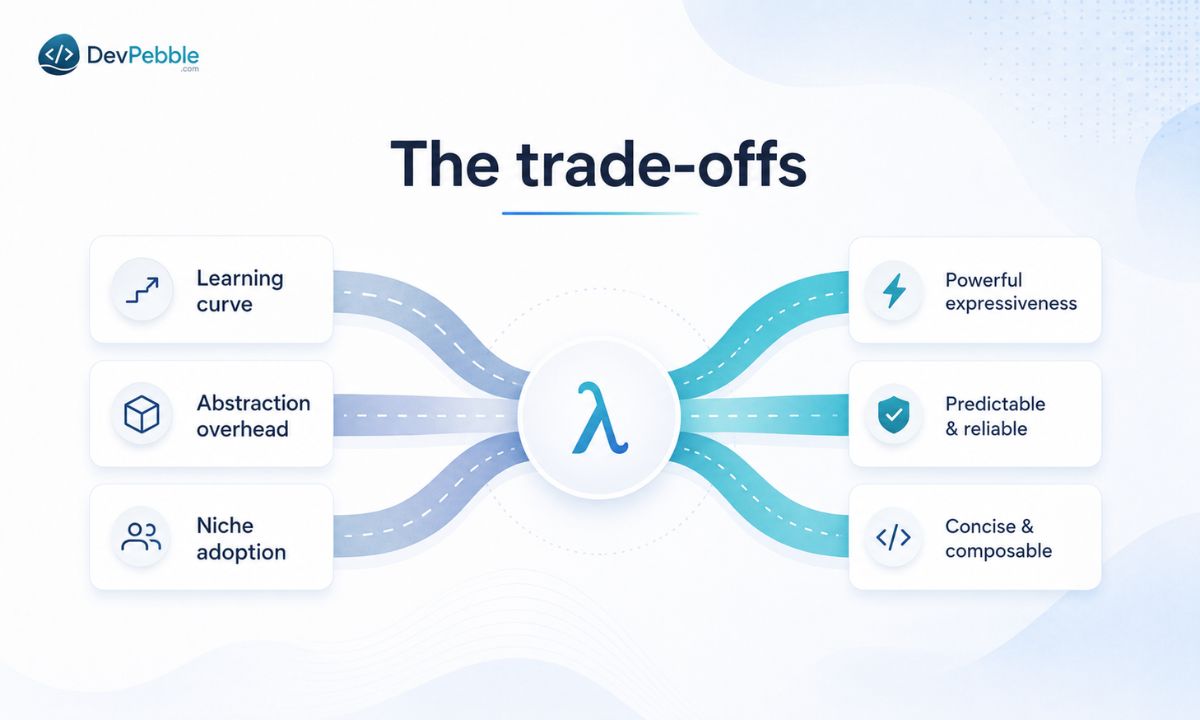
None of this comes for free.
The biggest hurdle is the learning curve. Functional programming asks you to think differently, especially coming from an imperative or object-oriented background, and concepts like higher-order functions, recursion, and monads take a while to feel natural. Some of the more powerful ideas, function composition, currying, lazy evaluation, can seem abstract and disconnected from real problems when you first meet them. Recursion in particular rewards careful thinking about base cases and stack depth, and the advanced type systems that help so much add their own complexity early on.
There is also a reality check worth stating plainly: functional programming is not the default across the industry. Plenty of jobs and codebases are built on object-oriented or imperative foundations, and pure functional languages cluster in niches like finance, distributed systems, and research. Finally, the expressive power cuts both ways. Code written to be maximally clever and concise can become hard to follow for anyone who did not write it.
Where functional programming shows up in the real world
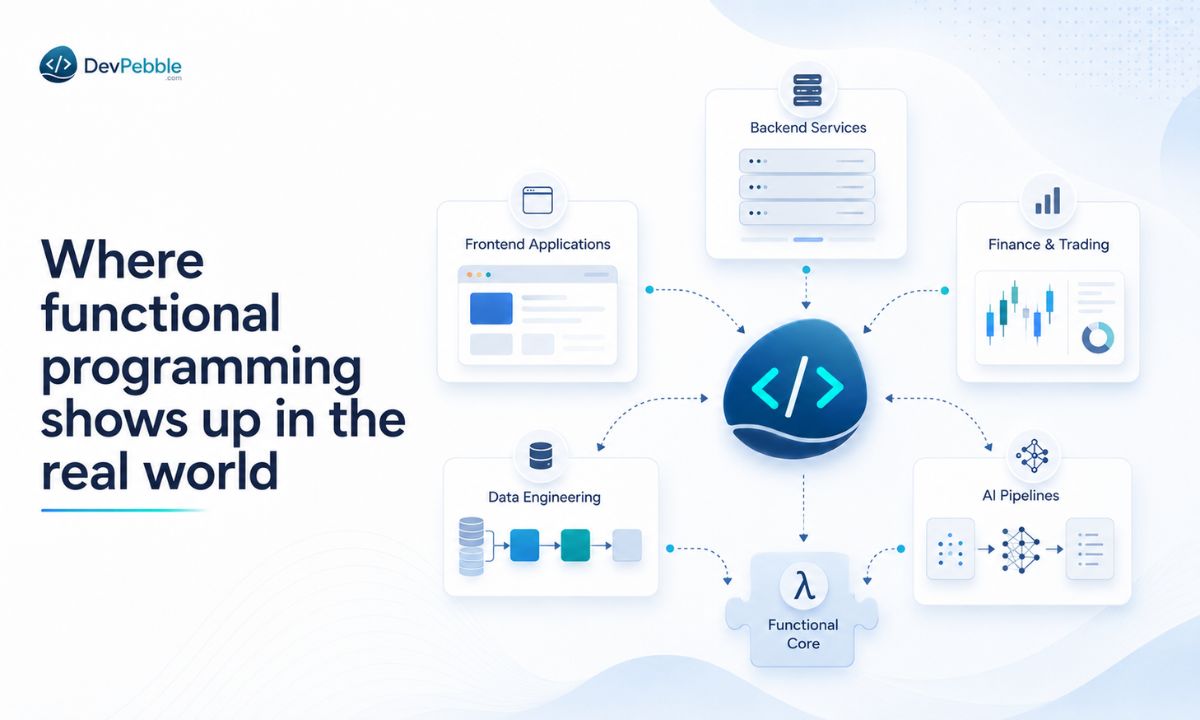
Functional programming is not a classroom curiosity. It runs real software at serious scale.
On the web, the front end has several functional options. Elm compiles to JavaScript and is known for having essentially no runtime exceptions in practice, thanks to its strict compiler. ClojureScript brings Clojure to the browser, and Scala.js compiles Scala to JavaScript. Even if you work mostly in plain JavaScript, the core ideas of modern front-end frameworks (pure components, immutable state, declarative rendering) are functional at heart.
On the backend, languages like Elixir, Erlang, Scala, Clojure, and F# do their best work. Applications built on Elixir and the Phoenix framework handle huge numbers of simultaneous connections, riding on Erlang's concurrency model and its "let it crash" approach to fault tolerance. That same model is why chat platforms, notification services, and other real-time systems gravitate toward it, and why companies including Discord, Pinterest, and Adobe use Elixir in production.
Finance has leaned on functional languages for years. OCaml and Haskell turn up in trading systems and financial modeling, where strong type systems guard against the subtle calculation bug that can cost real money. OCaml also has a long track record in compilers and developer tooling, partly because its type system maps neatly onto the recursive, tree-shaped data compilers manipulate.
Data work is maybe the most natural fit of all. Pipelines are fundamentally about transformation, taking data in one shape and producing another, which lines up exactly with composable functions and immutable structures. Scala is a mainstay of the data engineering world, largely through Apache Spark. AI and machine learning are an interesting edge case. Most of it happens in Python, which is not functional, but functional thinking (pure transformation steps, no hidden state, clean pipelines) improves the testability of preprocessing and feature engineering, and some teams run functional languages at the infrastructure layer feeding model training.
Choosing a functional language for your goals
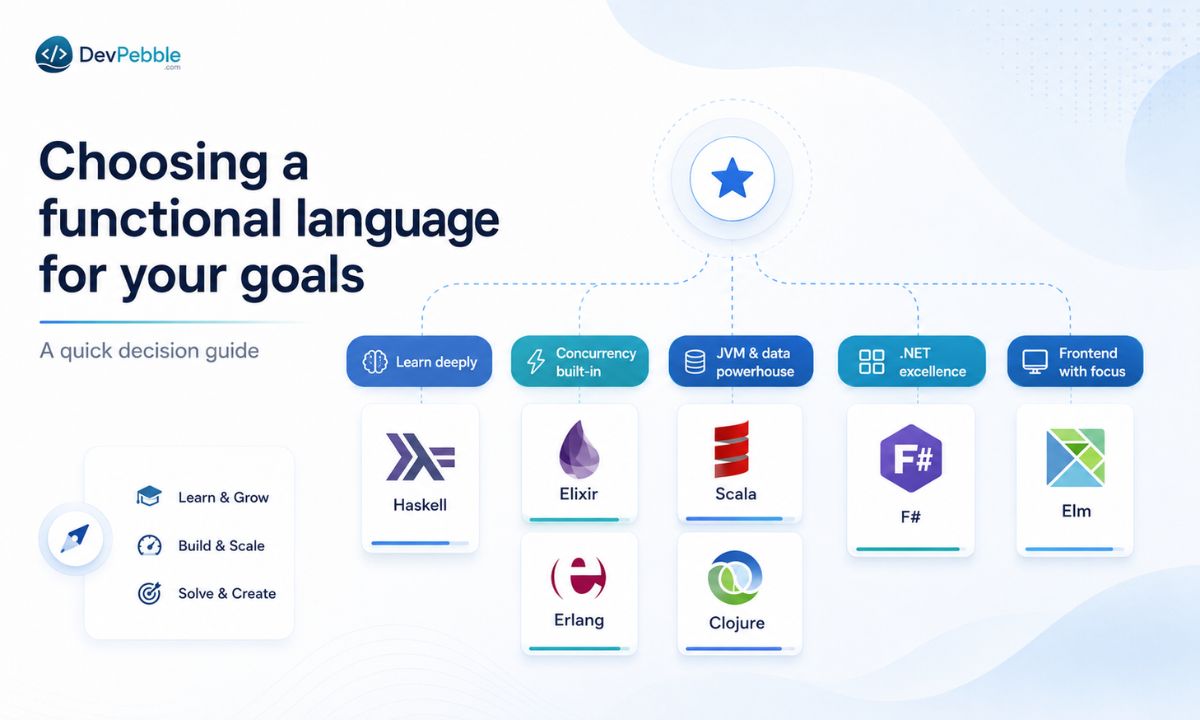
There is no single best functional language, only the best one for what you are trying to do. A few clear paths:
Choose Haskell if your goal is to understand the paradigm deeply. It enforces purity and immutability at the language level, has a steep learning curve, and tends to change how people think about code in every language afterward.
Choose Elixir or Erlang for systems that have to stay up under pressure: high concurrency, fault tolerance, real-time features, APIs under heavy load. Erlang was built for telecom infrastructure where downtime was not an option, and Elixir wraps that runtime in friendlier syntax with an active community.
Choose Scala if you live in the JVM ecosystem, build data pipelines, or want to blend functional and object-oriented styles in one production-grade language. It is widely used in data engineering and backend work.
Choose F# if you are in the .NET world and want a functional-first language that integrates cleanly with Microsoft tooling. It is increasingly used in finance and data science.
Choose Clojure if the Lisp tradition appeals to you and you want a dynamic, flexible language on the JVM with a thoughtful approach to concurrency and immutable data.
Choose Elm if you are focused on front-end development and want a guided, beginner-friendly introduction to functional thinking, with helpful errors and strong guarantees.
And if you would rather not switch paradigms at all, JavaScript, Python, Kotlin, Swift, and Rust have all absorbed serious functional features. If you already use one, you are closer to functional programming than you think, and learning the concepts properly will sharpen how you use them.
That raises the obvious beginner question: is functional programming a reasonable place to start? Mostly yes, though the language matters. The concepts are very learnable, and some people find that thinking functionally early builds better habits than starting with mutable, stateful code. Haskell teaches the paradigm best but can feel unforgiving as a first language; gentler on-ramps include Elm, Elixir, or the functional features already in JavaScript and Python. Whatever you pick, focus on the ideas first: pure functions, immutable data, map, filter, reduce, and thinking recursively. They transfer to every functional language you will ever touch.
Conclusion
Functional programming offers a different, and often better, way to think about software. By centering pure functions, immutable data, and declarative logic, it produces code that is predictable, easy to test, and resilient as complexity grows. Whether you are drawn to Haskell for its rigor, Elixir for its concurrency, or Elm for its gentle on-ramp, the underlying ideas carry across all of them.
The point is not to use functional programming for everything. It is to understand what it offers and reach for it when it fits. Start with the concepts, pick a language that matches your goals, and build from there. The habits you pick up pay off well beyond the functional projects themselves; they sharpen how you write code everywhere.