What is functional programming? A beginner-friendly guide
What is functional programming? A beginner-friendly guide to the paradigm — pure functions, immutability, higher-order functions, functional vs object-oriented and imperative programming, popular functional languages, real-world uses, and whether to learn it.
On this page⌄
- What is functional programming?
- Core principles
- A simple example
- Functional programming vs object-oriented programming
- Functional programming vs imperative programming
- Benefits
- Trade-offs and disadvantages
- Popular functional programming languages
- Can you use functional programming in JavaScript, Python, and Java?
- Real-world uses
- Common terms explained
- Is functional programming hard to learn, and should you learn it?
- Conclusion
- FAQ
Functional programming turns up everywhere: job listings, tutorials, code reviews, that one coworker who swears by it. What it rarely gets is a plain explanation. So if you have read the phrase and quietly wondered "okay, but what is functional programming, actually?", you are in the right place.
The short version: it is a style of writing code built around functions that take input and return output without secretly changing anything else along the way. That single rule sounds minor, but it shapes almost everything about how these programs are built. You do not need any coding background to follow along.
What is functional programming?
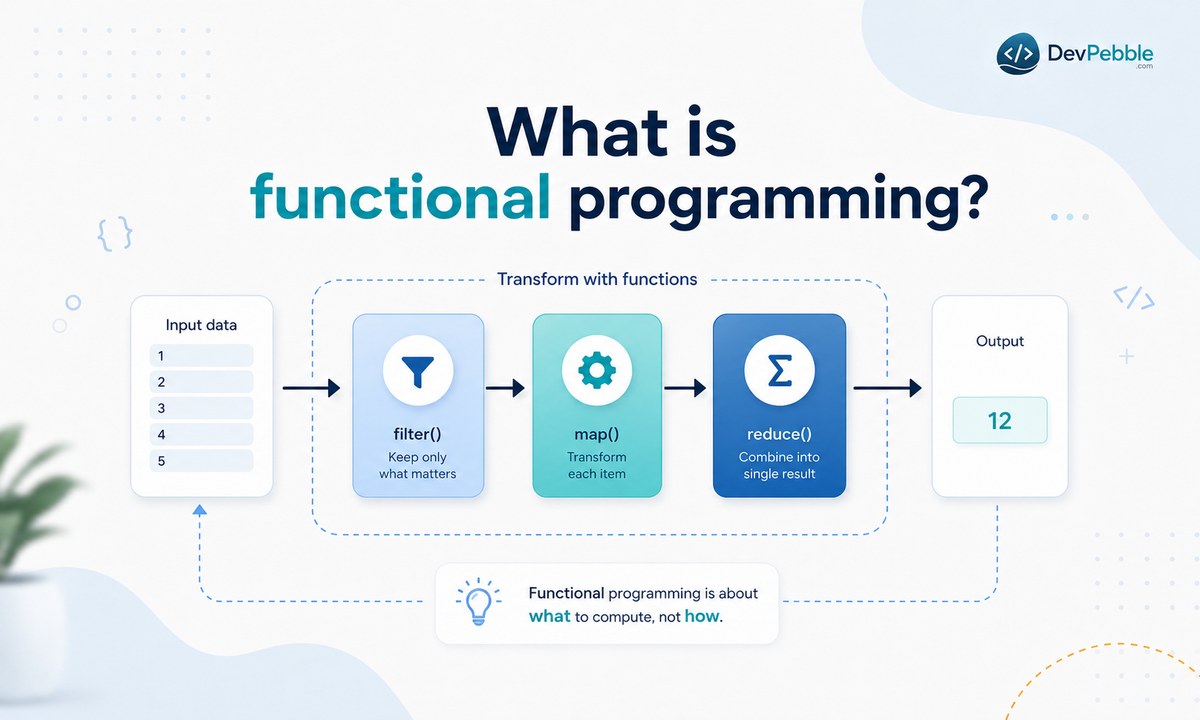
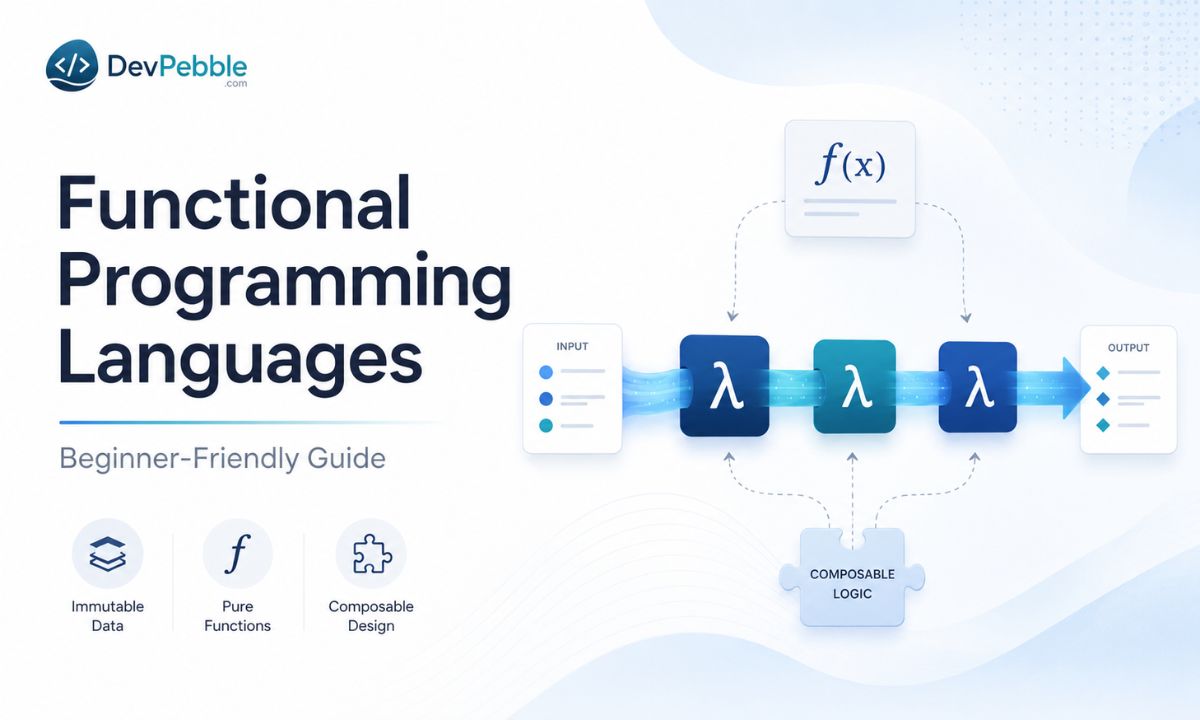
Functional programming is a paradigm, a way of organizing code. Instead of handing the computer a long checklist of steps to run in order, you describe what you want by combining small, self-contained pieces of logic called functions. Think of a paradigm as a philosophy for structuring software. This one has caught on as systems grow more tangled and developers need code that is easier to test, debug, and maintain.
A cleaner definition to hang onto: you build programs by combining functions that transform data, rather than by issuing a sequence of commands that change things one step at a time.
An analogy helps. Say you are making a smoothie. The step-by-step mindset goes: turn on the blender, add the banana and milk, blend, pour. The order matters a lot. The functional mindset is about transformations instead: fruit becomes puree, puree becomes smoothie, smoothie becomes a poured drink. Each stage takes an input and produces a new output without altering what you started with.
Thinking in transformations, not steps
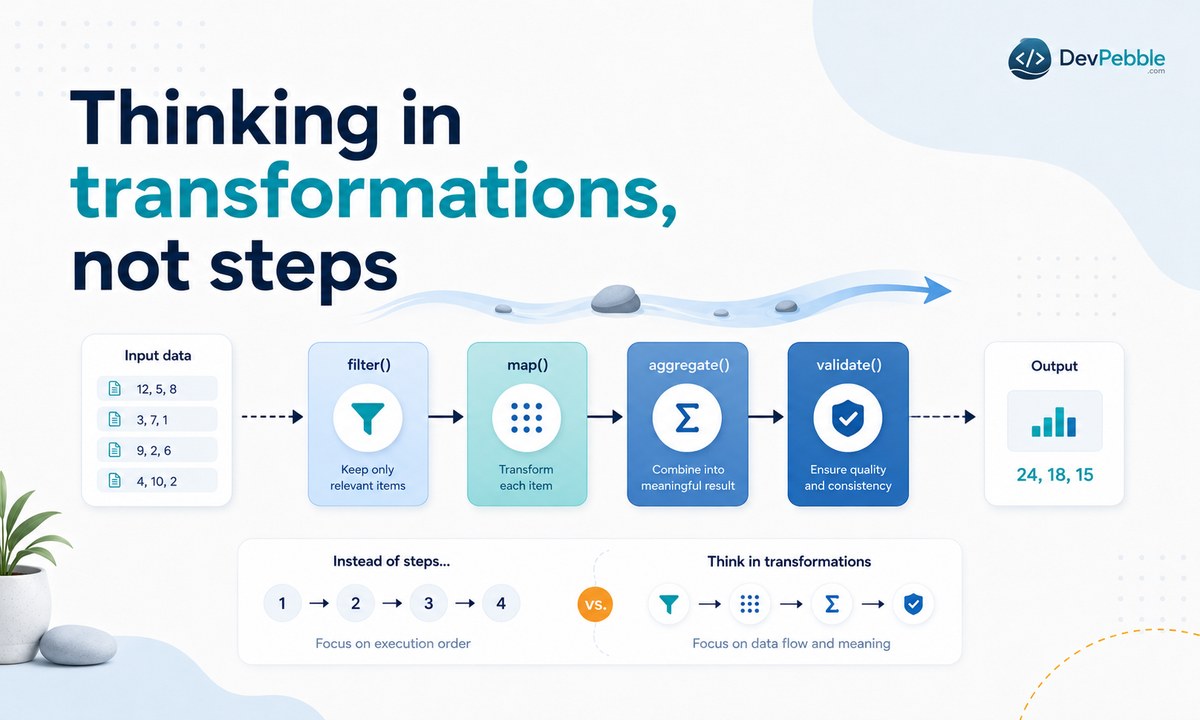
Traditional coding reads like a set of orders: do this, then do that, update this value, check this condition. That is the imperative style, because you spell out every move. The functional style leans the other way, toward declarative code, where you describe the result you want and let functions handle the transformation.
Picture a list of numbers you want to double. An imperative approach loops through and updates each number one at a time. A functional approach passes the whole list to a function that returns a new list of doubled numbers, leaving the original untouched. That points to another key idea, immutability: once data is created, you do not change it; you produce new data from the old.
Functions are the foundation everything else is built on: each takes an input, follows clear rules, and returns an output, with nothing sneaky in between. That predictability is what makes the whole style easier to reason about.
Core principles
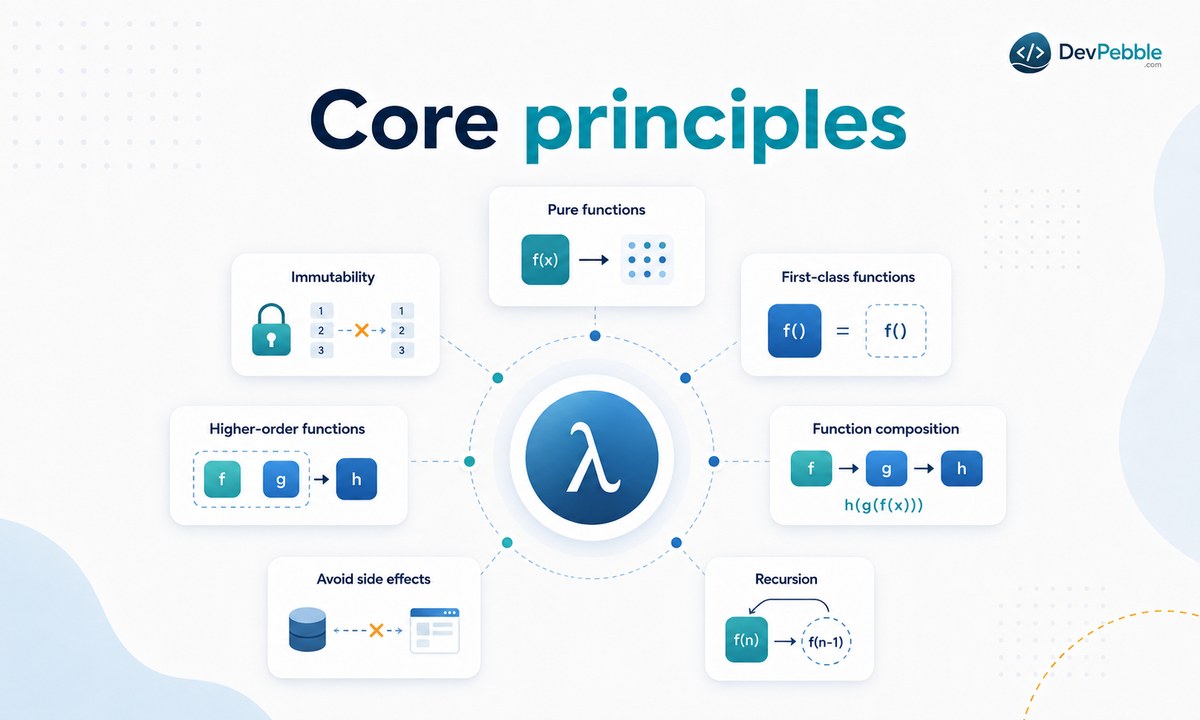
A handful of ideas hold this paradigm together, and they show up no matter which language you write in.
Pure functions
A pure function always returns the same output for the same input, and touches nothing outside itself. A function that adds two numbers is pure: it does not check the clock, read a file, or quietly edit some variable elsewhere. Give it 2 and 3, you get 5, every time. When a bug appears, you know where to look, since it does not depend on hidden state elsewhere.
Immutability
Immutability means data cannot be changed once created. Instead of editing existing data, you build new data from it. Think of editing a photo non-destructively: you save a new copy and the original stays safe. This heads off a whole category of bugs in bigger applications, where different parts of the code might otherwise fight over the same data.
First-class functions
Here a function is just another value, like a number or a string. In practice, you can store one in a variable, pass it as an argument, or return it from another function, which is a big part of what makes the style so expressive.
Higher-order functions
Once functions are values, you can write higher-order functions: ones that take other functions as input or return one as output. A common example takes a list plus another function, then applies that function to every item. Rather than rewriting the same loop for each task, you write one flexible function and swap in whatever you need.
Function composition
Composition means snapping small functions together to build something bigger. Instead of one giant do-everything function, you write several focused ones and connect them like blocks. Say one trims extra spaces and another lowercases text; composition chains them into a single "clean, then lowercase" process without touching either one. The payoff is code that stays modular and easier to maintain.
Avoiding side effects
A side effect is anything a function does beyond returning a value: changing a global variable, writing to a file, updating a database. The functional style tries to avoid side effects, or at least fence them off clearly. This is not a ban. Real software has to save files and hit the network; the idea is to keep those actions separate and clearly marked, so the parts that just transform data stay clean and testable.
Recursion instead of loops
Imperative code usually repeats work with a loop, like a "for" or "while". Functional code often reaches for recursion, where a function solves a problem by calling itself on a smaller version of that problem until it hits a base case. Recursion is not exclusive to this paradigm, but it fits the style. One practical caution: deep recursion can exhaust memory in languages that lack tail-call optimization, so plenty of real code still uses built-in helpers like map and filter rather than hand-rolled recursion.
A simple example
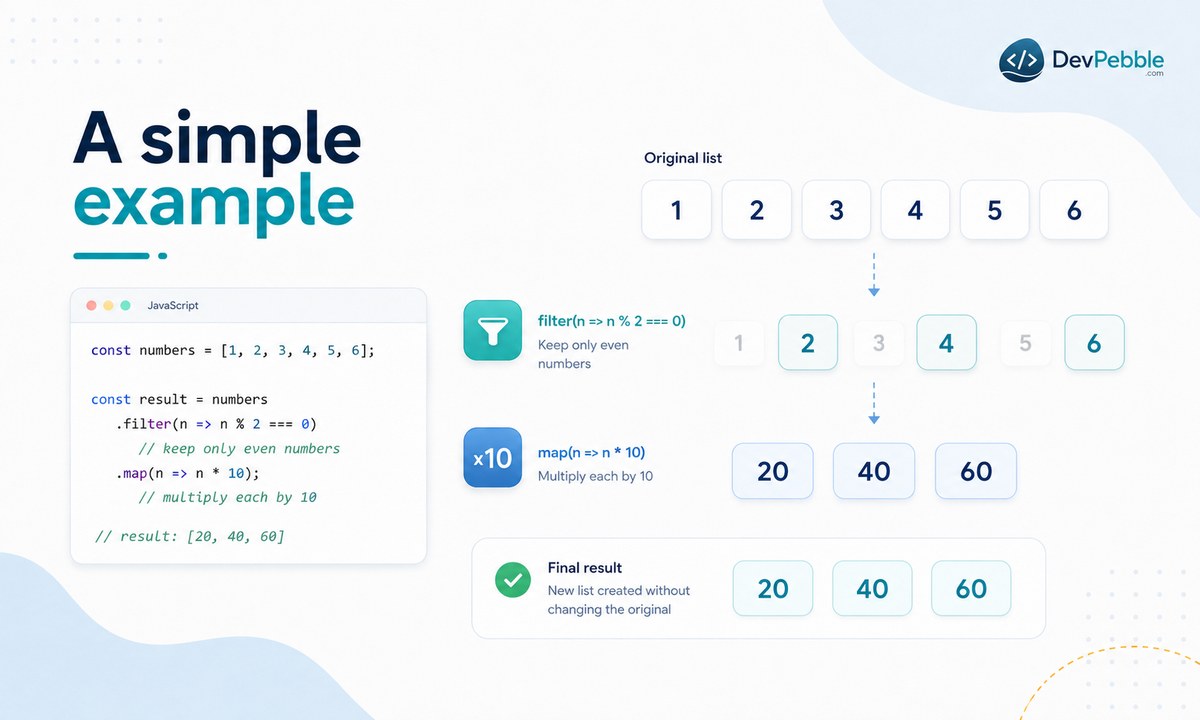
Enough theory. Say you have a list of numbers, and you want only the even ones, doubled.
const numbers = [1, 2, 3, 4, 5, 6];

const result = numbers
  .filter(num => num % 2 === 0)
  .map(num => num * 2);

console.log(result); // [4, 8, 12]
Both filter and map are higher-order functions. Neither one touches the original numbers list. Each step transforms the data into a new result and passes it along.
Now the same job written imperatively:
const numbers = [1, 2, 3, 4, 5, 6];
let result = [];

for (let i = 0; i < numbers.length; i++) {
  if (numbers[i] % 2 === 0) {
    result.push(numbers[i] * 2);
  }
}
Same output, different path. The imperative version manages a loop, a counter, and an array it mutates as it goes. The functional version just describes what should happen to the data. Neither is wrong; knowing both makes you a better programmer.
Functional programming vs object-oriented programming
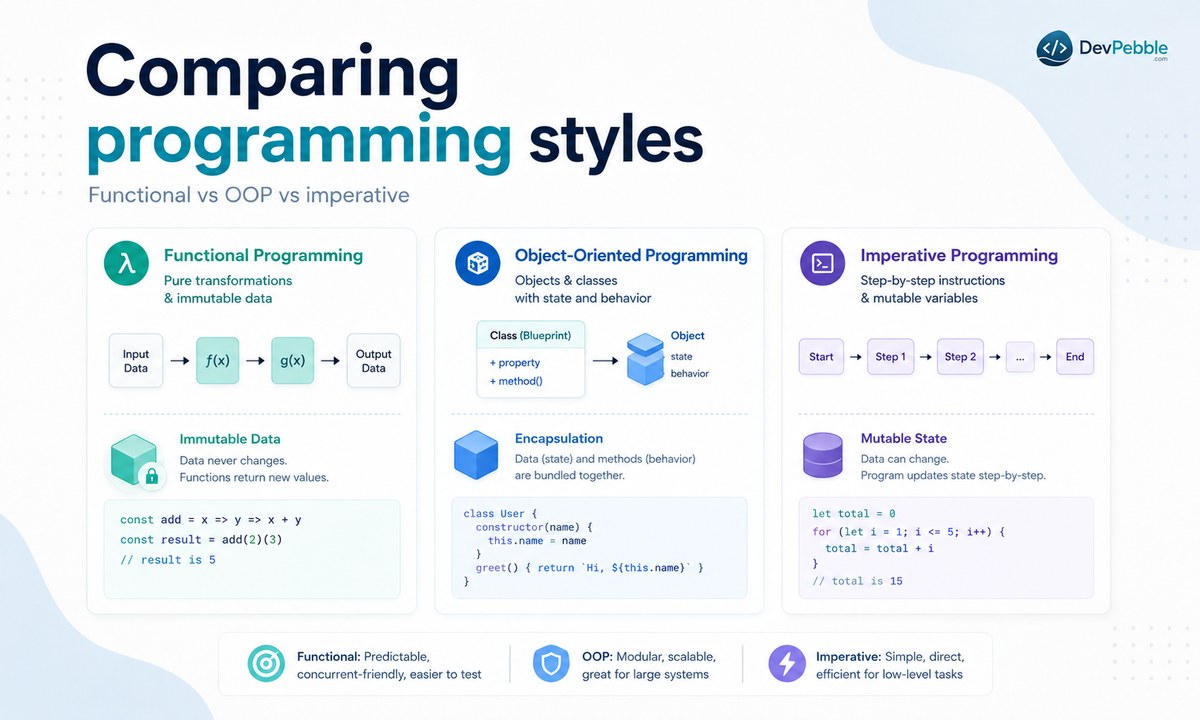
Object-oriented programming, or OOP, is the other major paradigm most beginners meet early, which makes it worth a direct comparison.
Key differences
In OOP, code is organized around objects that bundle data with the methods that act on it. In functional programming, code is organized around functions that transform data, which is usually kept separate and immutable. State is the other big split. OOP often lets objects change their own internal state over time, while the functional style avoids changing state directly, preferring new data over updated data.
When functional programming fits better
It tends to earn its keep with heavy data transformation, complex business logic, or anywhere predictable code and easy testing matter. It also suits systems juggling many operations at once, since avoiding shared, changing state removes a whole class of concurrency bugs.
When object-oriented programming fits better
OOP feels natural when you model real-world things with clear identities and behaviors, like a user account, a shopping cart, or a game character. In large systems, that can make the structure easier for a team to reason about. Most codebases mix both rather than picking a side.
Functional programming vs imperative programming
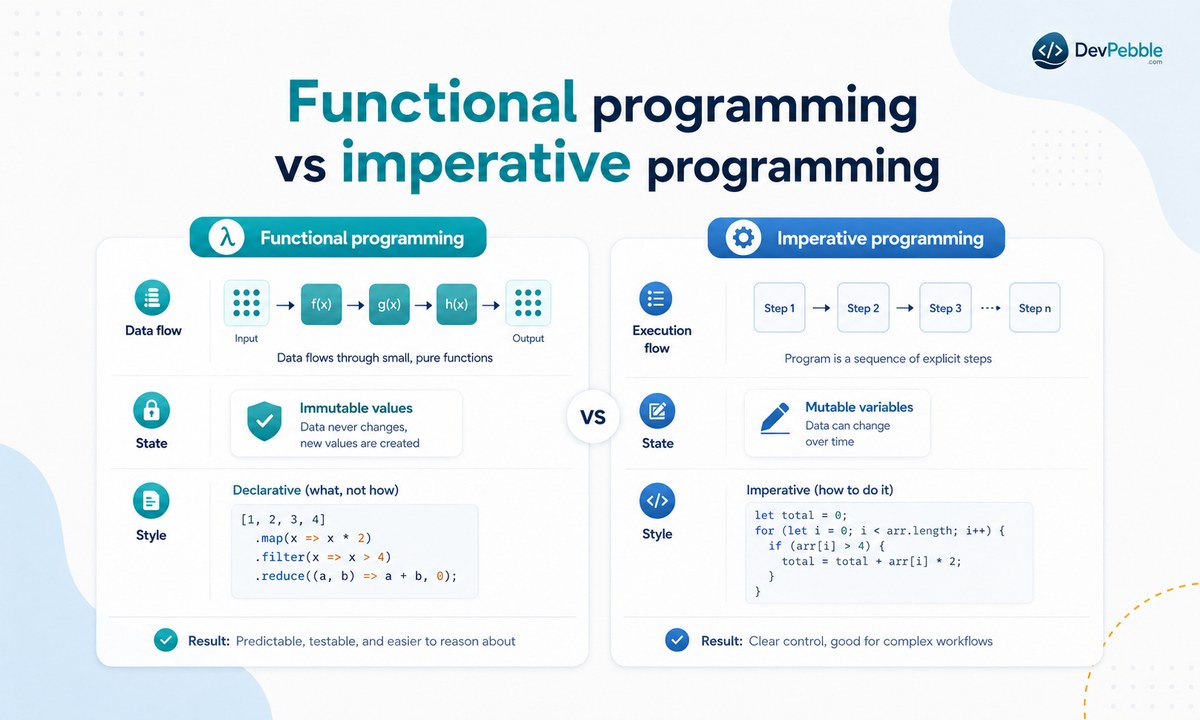
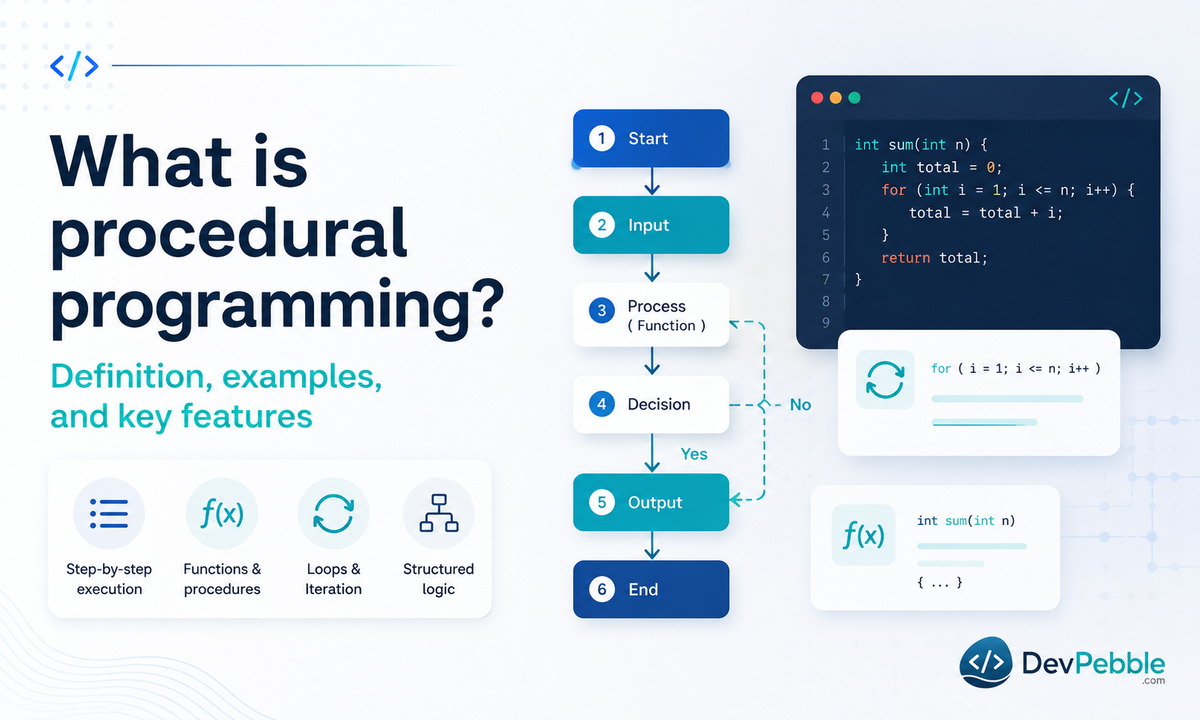
Imperative programming focuses on how to do something, spelling out each step and often mutating variables. The functional style, one flavor of the broader declarative approach, focuses on what result you want and lets functions handle the steps. Many languages support both, so you can pick whichever fits the problem.
Benefits
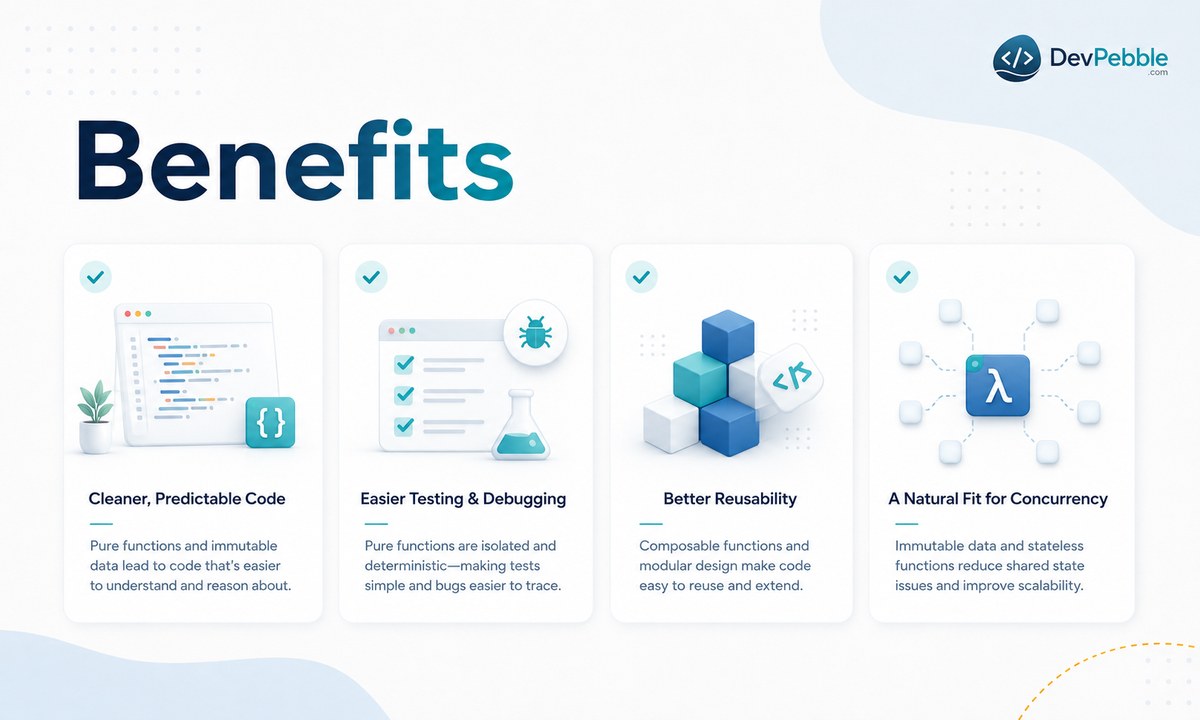
So why do developers reach for this style? A few practical reasons stand out.
Cleaner, more predictable code
Because pure functions behave the same way for the same input, code is easier to read and trust, and you spend less time hunting for some unexpected change buried three files away.
Easier testing and debugging
Predictable code is testable code. Since pure functions do not depend on outside state, you can test them in isolation: feed in inputs, check the outputs.
Better reusability
Small, focused functions travel well. Because they do not lean on external state, you can reuse them across a program, or even different projects, without side effects.
A natural fit for concurrency
Modern apps constantly do many things at once. By steering away from shared, changing state, functional programming sidesteps a notorious source of concurrency bugs: two processes updating the same data at once.
Trade-offs and disadvantages
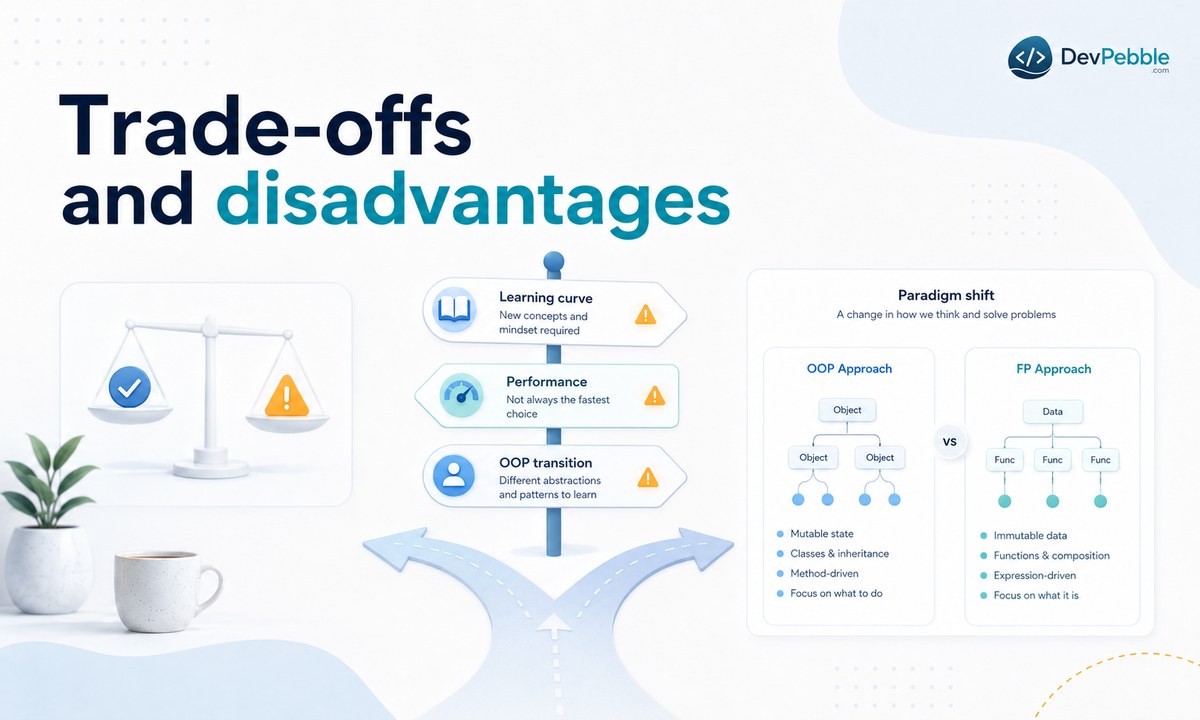
To keep this honest, functional programming is not the automatic best choice for every project.
A steeper learning curve
This style asks for new mental habits, especially if you come from a traditional background. Immutability, recursion, and composition can feel foreign at first, and that is normal.
Performance considerations
Creating new data instead of modifying it in place can use more memory or processing power. Modern languages and compilers optimize much of this away, but it is worth keeping in mind for performance-sensitive work.
Harder if you come from OOP
If you learned to code by thinking in objects and state, this can feel like unlearning familiar reflexes. Thinking in transformations takes practice, and feeling a little lost early on is expected.
Popular functional programming languages
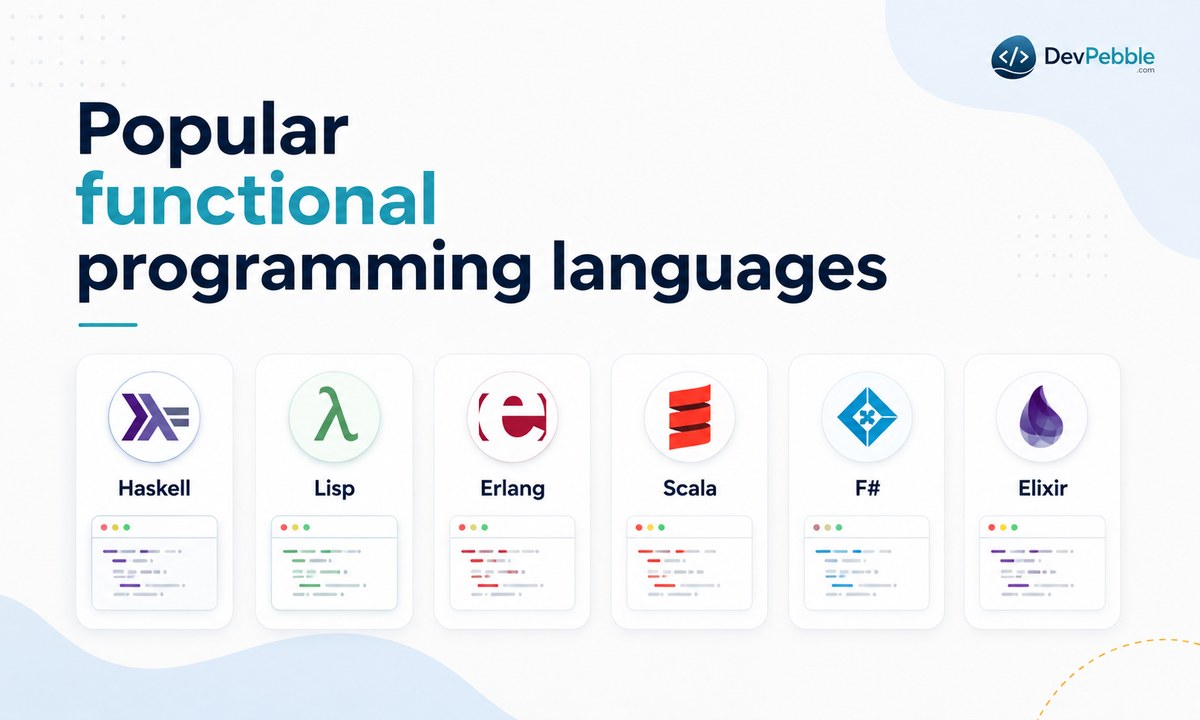
Some languages are built around functional principles, while others simply support them. Here are the ones you will hear about most.
Haskell
Haskell is the gold standard of purely functional languages. It enforces immutability and pure functions strictly, which makes it a favorite in academia and fields that need highly reliable, mathematically sound code.
Lisp
Lisp is one of the oldest programming languages still in use, dating to the late 1950s, and it laid much of the groundwork for the paradigm. Its list-and-function syntax influenced a long line of languages, and dialects like Clojure and Scheme keep it alive today.
Erlang
Erlang was built at Ericsson for reliable, distributed telecom systems that essentially cannot go down. Its functional core plus strong concurrency support suits high-availability software. WhatsApp famously ran its backend on Erlang while scaling to hundreds of millions of users.
Scala
Scala runs on the Java Virtual Machine and blends functional programming with OOP. That mix suits teams who want functional benefits without walking away from familiar object-oriented structure.
F#
F# is a functional-first language in the .NET ecosystem. It shows up in data analysis, financial modeling, and other places where predictable, testable code matters.
Elixir
Elixir runs on Erlang's BEAM virtual machine and inherits its strengths for scalable, fault-tolerant systems, wrapped in friendlier syntax and tooling. Discord, for instance, leans on Elixir to handle millions of concurrent users.
Can you use functional programming in JavaScript, Python, and Java?
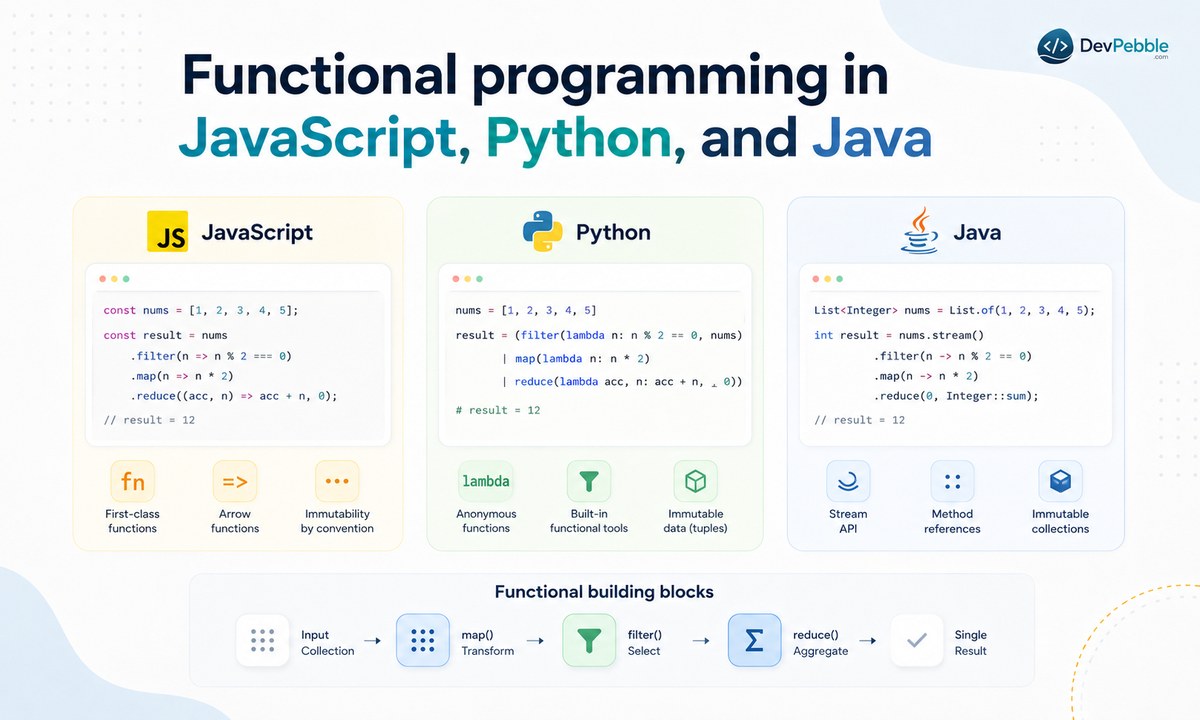
You do not need a purely functional language to get real value from these ideas; plenty of mainstream languages support functional techniques alongside their main style.
JavaScript
JavaScript has first-class functions, higher-order functions, and array methods like map, filter, and reduce built in, which makes functional techniques common in web development. React, one of the most widely used front-end libraries, pushes developers toward pure components and immutable data because it makes complex interfaces easier to reason about.
Python
Python includes tools like map(), filter(), and lambda functions, though it is not purely functional. Most Python developers blend functional and imperative code depending on the task.
Java
Since Java 8, released in 2014, the language has supported lambda expressions and functional interfaces. That let developers write more functional-style code inside a language that is still, at its foundation, object-oriented.
Real-world uses
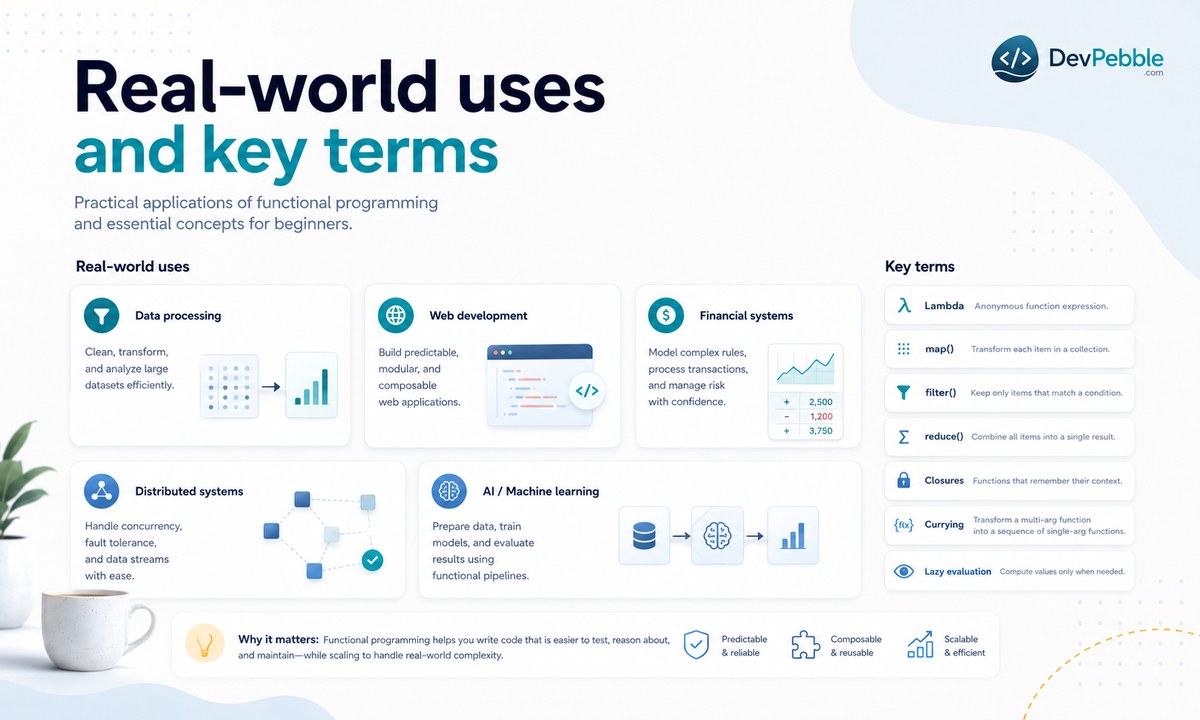
This is not just classroom material. Functional ideas show up across modern software.
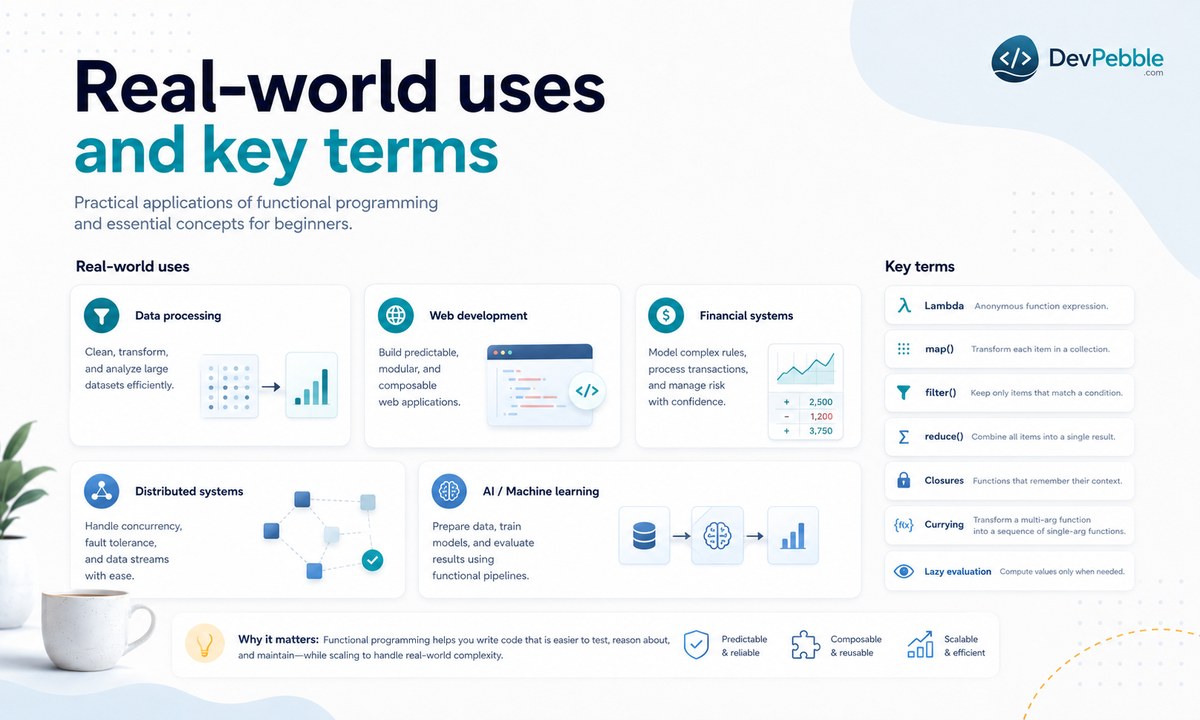
Data processing
Transforming, filtering, and aggregating large datasets maps cleanly onto the focus on data transformation, which is why the style is common in data pipelines and analytics tools.
Web development
Front-end frameworks increasingly borrow functional concepts for state management. Tools like Redux model state changes as pure functions, so predictable, immutable data helps avoid tricky bugs in complex interfaces.
Financial systems
Financial software needs predictable, testable code because mistakes are expensive, so the emphasis on pure functions makes the style appealing here.
Distributed systems
Languages like Erlang and Elixir run distributed systems where many processes execute at once, and avoiding shared, changing state cuts down on bugs that are miserable to track there.
AI and machine learning workflows
AI work usually chains data transformations together: clean the data, extract features, feed it to a model. That pipeline fits a functional approach naturally, even when the wider project is not.
Common terms explained
A few terms you will bump into as you keep learning.
Lambda functions
A lambda is a small, unnamed function, handy for short one-off tasks where defining a full named function would be overkill.
Map, filter, and reduce
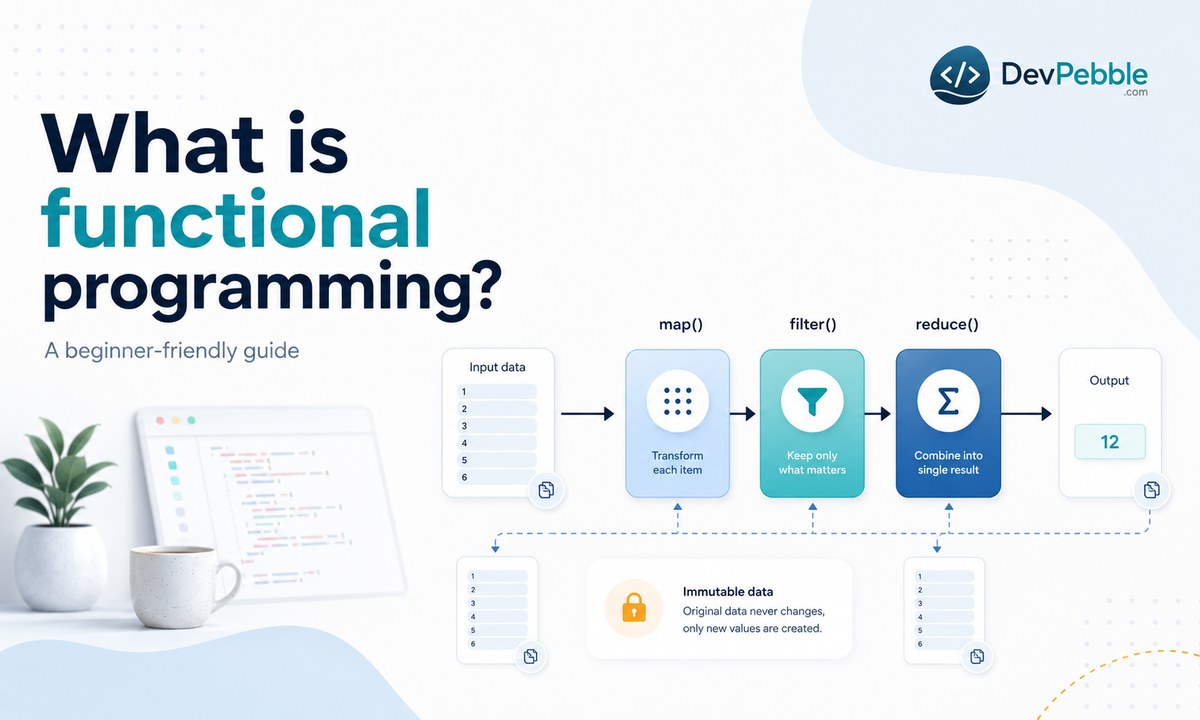
The workhorse higher-order functions. Map transforms each item in a list, filter keeps only items that meet a condition, and reduce combines items into a single result, like a total.
Closures
A closure is a function that remembers the environment it was created in, even after that environment has finished running, so it can carry data along with it.
Currying
Currying turns a function that takes several arguments into a chain of functions that each take one argument at a time, which makes functions more flexible and easier to reuse.
Lazy evaluation
Lazy evaluation delays computing a value until it is actually needed, improving performance by skipping unnecessary work with large or complex data.
Is functional programming hard to learn, and should you learn it?
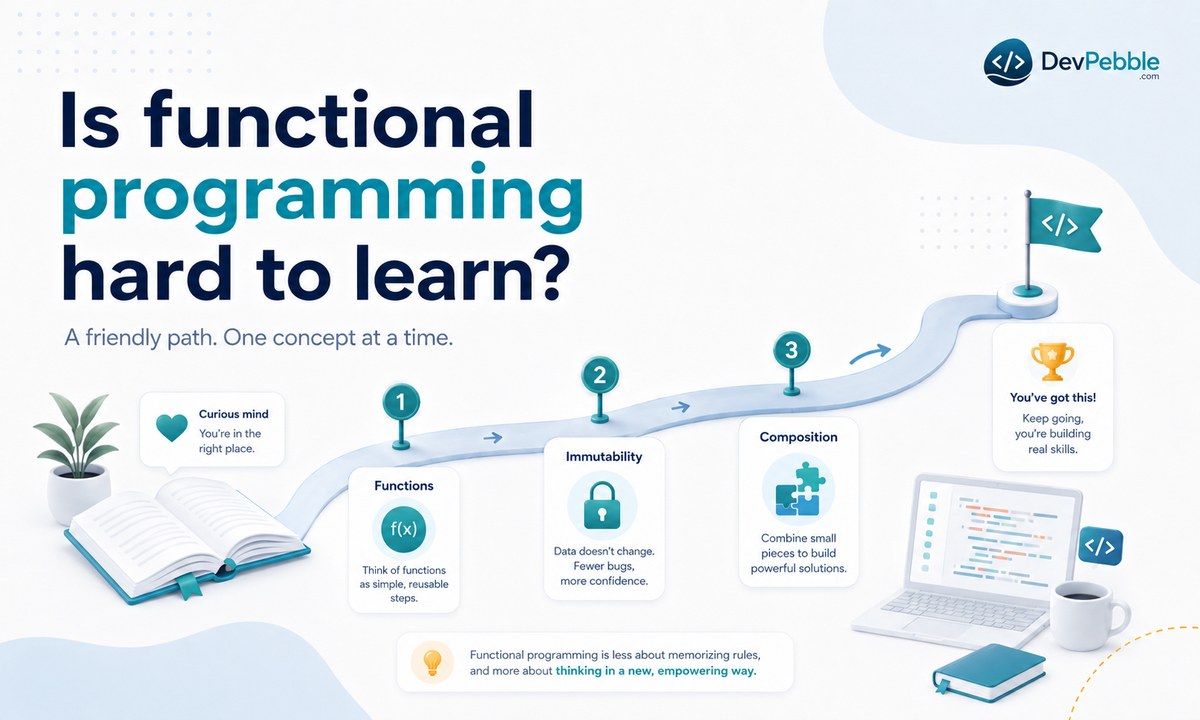
There is a learning curve, especially coming from imperative or object-oriented habits. But most people find that once a couple of core ideas click, usually pure functions and immutability, the rest starts falling into place.
Whether to learn it is easier: for most developers, yes, at least the fundamentals. If you build software involving data processing, concurrent systems, or business logic that has to stay predictable, these ideas pay off. The best on-ramp is a language you already use: reach for map, filter, and reduce in JavaScript or Python, keep your functions pure where you can, and avoid mutating data.
Conclusion
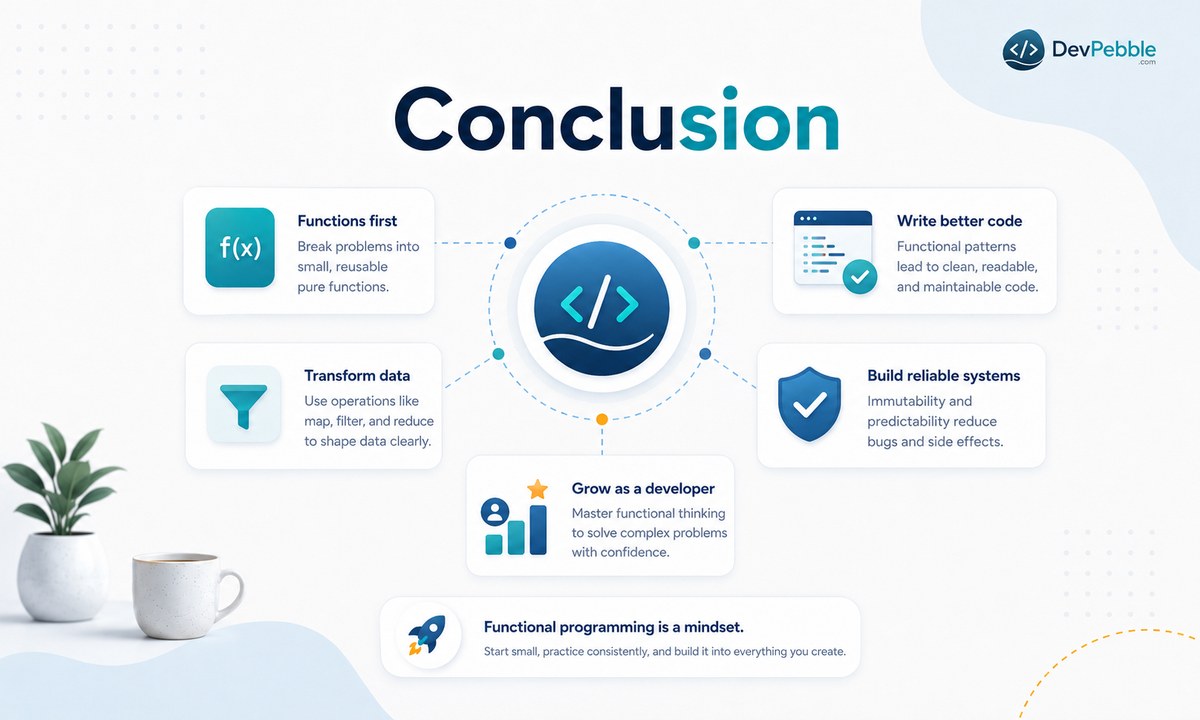
So, what is functional programming? It is a practical way to write software that transforms data through clear, predictable functions instead of long chains of changing instructions. It will not replace every other style, and it does not need to. What it gives you is a reliable tool for making certain problems, especially around data processing, testing, and concurrent systems, much easier to manage. Whether you pick up a purely functional language or apply these ideas in a mainstream one, it is a solid step toward becoming a stronger developer.