Functional programming in Python: concepts, tools, and practical examples
Functional programming in Python explained: pure functions, immutability, map, filter, comprehensions, itertools, functools, a data pipeline, and trade-offs.
On this page⌄
- What is functional programming in Python?
- Is Python a functional programming language?
- How does functional programming work in Python?
- Which Python tools support functional programming?
- How do you build a functional data pipeline in Python?
- When are comprehensions or loops better than functional helpers?
- What are the benefits of functional programming in Python?
- What are the limitations and risks?
- When should you use functional style, and when should you avoid it?
- What are the best practices for Pythonic functional code?
- What should you learn next?
- Final thoughts
- FAQ
Functional programming in Python means building your code from small functions that take explicit inputs, return explicit outputs, and avoid changing anything outside themselves. Instead of looping over data and mutating variables as you go, you describe the transformation and let Python's iterators, comprehensions, and standard library carry the data through it. Python supports this style without forcing it on you.
This guide covers the core ideas, the language and standard-library tools that implement them, a working pipeline you can run, and the trade-offs that tell you when a functional approach helps and when a loop or a class is the better call. You need basic Python syntax and no prior functional-programming background.
What is functional programming in Python?
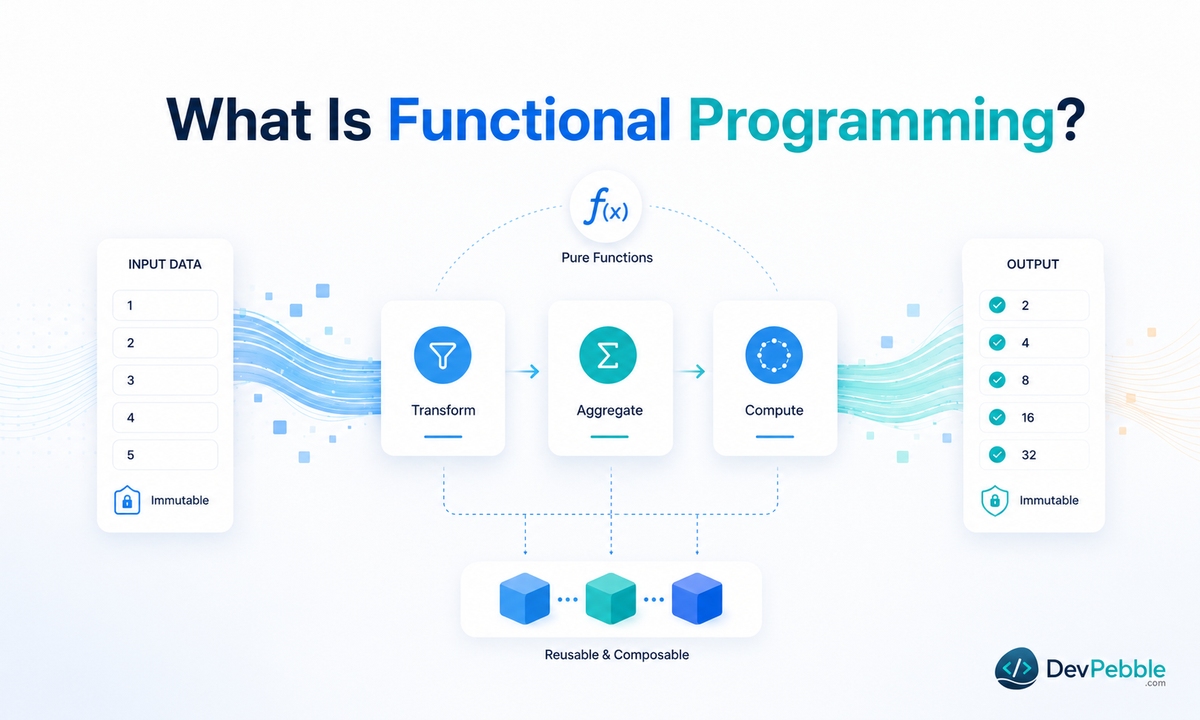
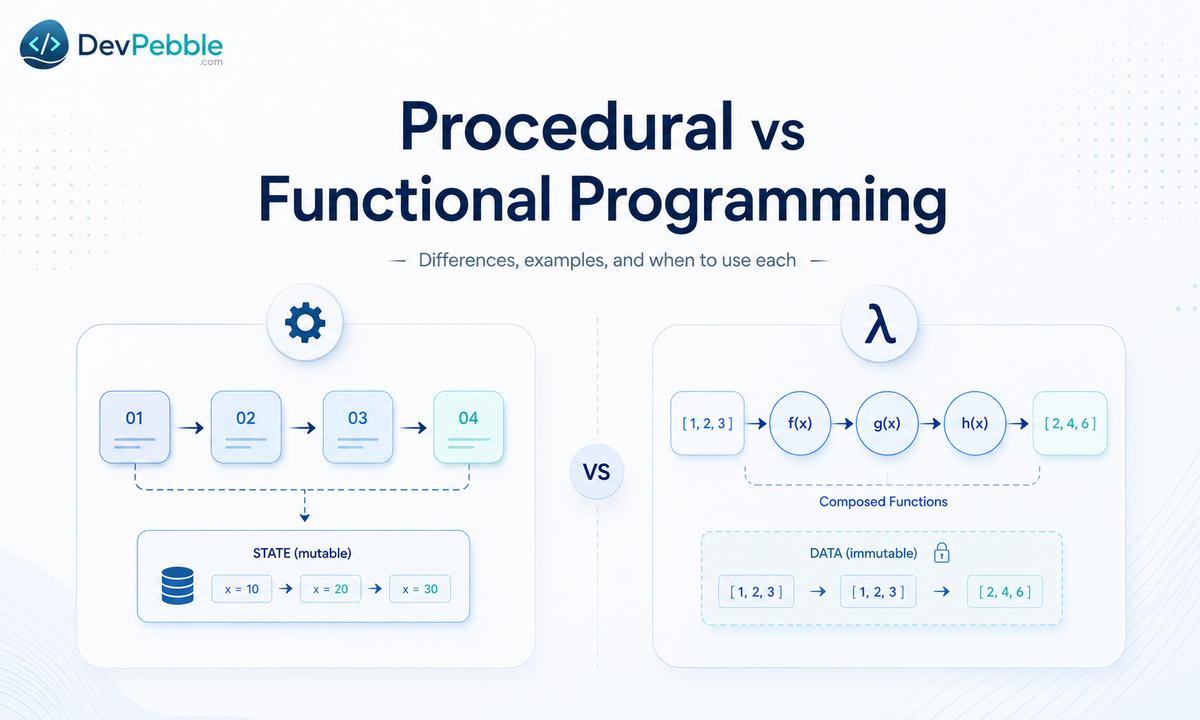
Functional programming in Python is a style rather than a strict mode. You write small functions whose output depends only on their explicit input, pass data through those functions instead of mutating shared state, and treat functions as ordinary values you can store and pass around. Python's Functional Programming HOWTO presents it as one approach among several the language supports, alongside procedural and object-oriented code.
What makes a Python function pure?
A pure function passes two tests. Called with the same arguments it always returns the same result, and calling it changes nothing outside its return value: no printed text, no mutated argument, no altered global. def tax(amount, rate): return amount * rate is pure. Add a line that writes to a log file or reads today's date and it stops being pure, even though it still looks almost identical on the surface.
How does immutability change data flow?
Functional-style code builds a new value instead of editing an existing one in place. Python does not enforce this. Tuples, strings, and numbers are immutable, while lists, dicts, and sets are mutable and can be changed by any function that holds a reference to them. Choosing immutability is a design decision you make, not a guarantee the language hands you.
What are first-class and higher-order functions?
In Python, functions are objects. You can assign one to a variable, drop it in a list, pass it as an argument, or return it from another function. A higher-order function is simply one that takes or returns a callable. That single idea is the machinery behind map(), decorators, and functools.partial().
Is Python a functional programming language?
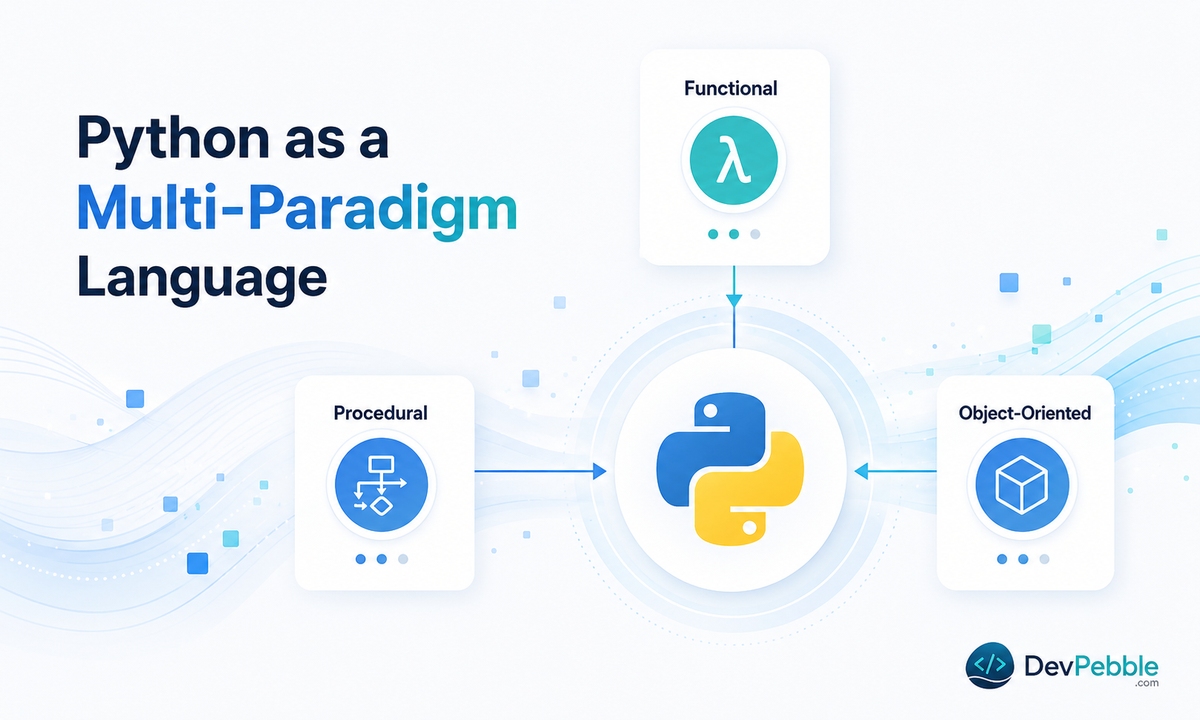
Not purely. Python is multi-paradigm: it supports functional techniques such as first-class functions, comprehensions, map(), filter(), and lazy iterators without requiring or enforcing them. Its documentation groups Python with languages like Lisp and C++, where procedural, object-oriented, and functional code live together in the same program.
Why is Python described as multi-paradigm?
One Python application might use objects for stateful domain models, plain procedural code for orchestration, and pure functions for the calculations. The paradigms are tools you combine, not exclusive labels for a whole codebase. The functional HOWTO gives this exact picture: a GUI written in an object-oriented style, with the processing logic underneath handled procedurally or functionally.
How does Python differ from a pure functional language?
Python allows ordinary assignment and mutation, permits I/O anywhere in a program, and keeps lambda limited to a single expression. It also does not optimize away deep recursion. CPython enforces a default recursion limit, which you can read with sys.getrecursionlimit(). Python 3.14 added an internal tail-call interpreter, but that is a C-level dispatch optimization: it speeds up how CPython runs bytecode and does not eliminate tail calls in your own Python functions. The official 3.14 notes say as much directly, and deeply recursive Python code can still raise RecursionError. Pure functional languages tend to optimize or lean on recursion rather than discouraging it.
| Characteristic | Python | Pure functional language | |---|---|---| | Purity | Optional | Enforced or strongly encouraged | | Mutation | Common and supported | Usually restricted | | Functions | First-class | First-class | | Side effects | Direct and ordinary | Often isolated explicitly | | Recursion | Supported, but stack-limited | Commonly optimized or emphasized | | Programming model | Multi-paradigm | Functional-first |
How does functional programming work in Python?
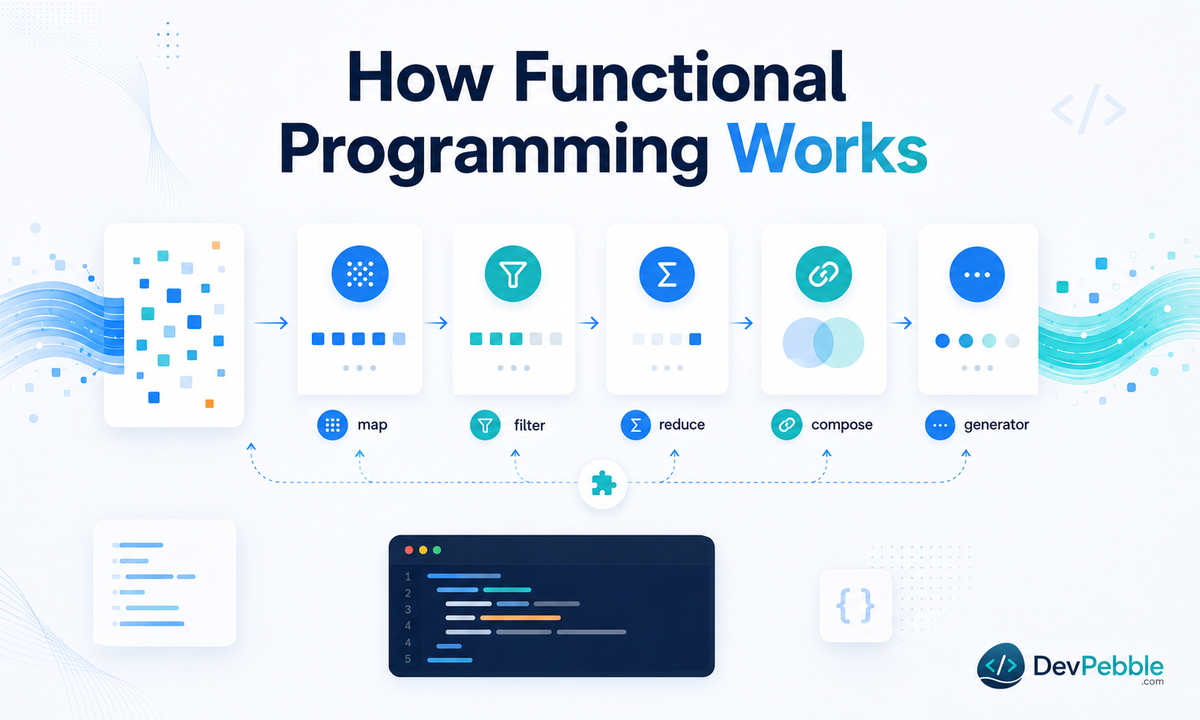
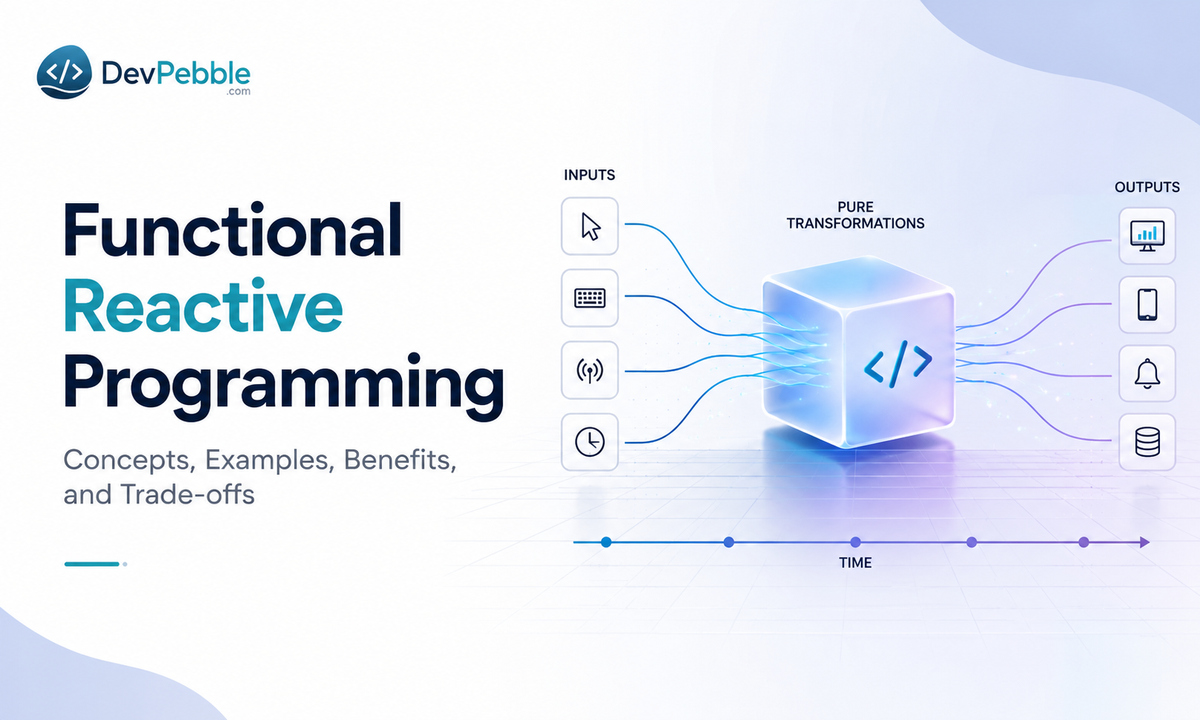
Functional-style Python moves data through stages. You take an iterable, transform each item, filter down to the ones that matter, and combine what is left into a result, while keeping side effects like printing or writing files at the edges of the program rather than inside the transformation. This transform, filter, aggregate pattern covers most everyday functional code.
How do transform, filter, and aggregate stages work?
Transformation changes each item, usually a comprehension or map() applied across every element. Filtering keeps only the items that satisfy a predicate, a conditional comprehension or filter(). Aggregation reduces a collection to a single value, normally with sum(), min(), max(), any(), or all(), with functools.reduce() held back for combinations those built-ins do not cover. Doubling prices is transformation, keeping only in-stock items is filtering, and totaling what remains is aggregation. Three responsibilities, three small functions, rather than one dense expression.
Why do iterators and generator expressions matter?
An iterator hands you one value at a time, and a generator expression computes each value only when something asks for it instead of building the whole result upfront. That laziness keeps memory low for large or endless streams, but it comes with a catch: once an iterator is consumed it is exhausted, and iterating it again gives you nothing. A list comprehension, [x for x in data], builds the full list immediately. The generator form, (x for x in data), returns an iterator. Same syntax, different behavior, different memory profile.
How do composition, closures, and partial application work?
These are three related but distinct ideas. Composition chains functions so one's output feeds the next one's input. A closure is a function that remembers variables from the scope where it was defined, which lets you build a configured callable. Partial application pre-fills some of a function's arguments to produce a specialized version, usually through functools.partial() in Python. functools.partial(log, subsystem="server") fixes one argument and returns a ready-to-call function, with no closure or class needed to get the same effect.
Which Python tools support functional programming?
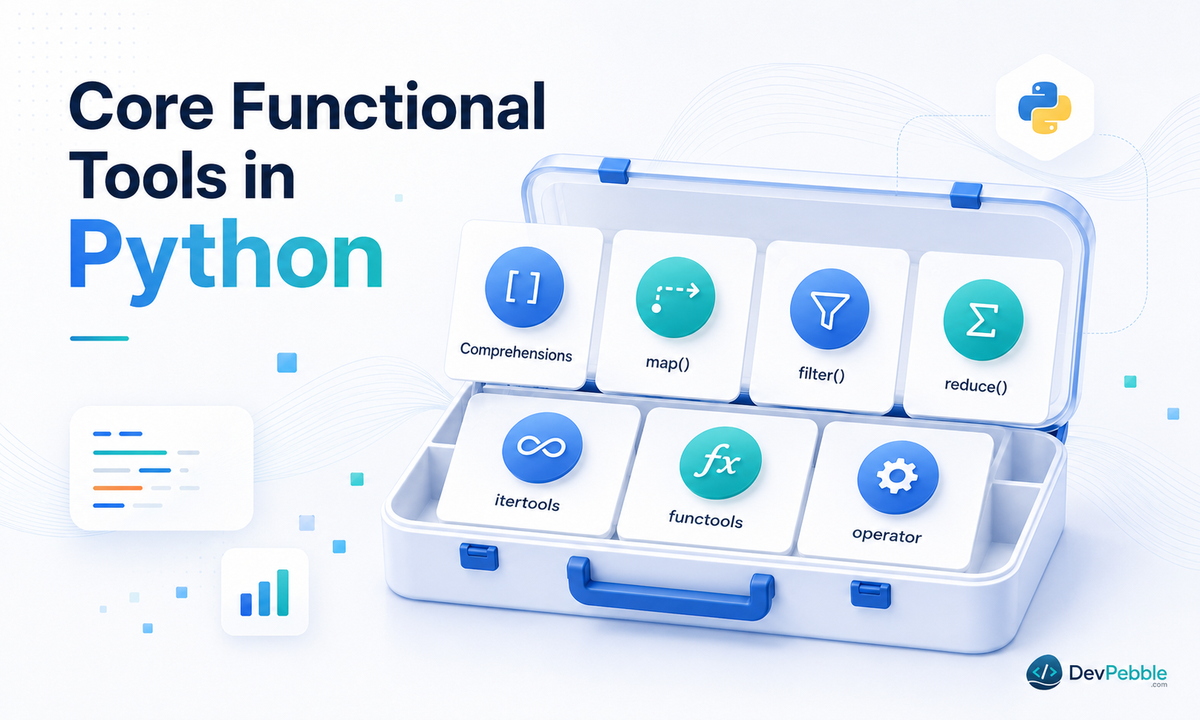
Python's functional toolkit splits into three groups: built-in syntax such as comprehensions and generator expressions, built-in functions such as map(), filter(), sum(), and sorted(), and standard-library modules, mainly itertools, functools, and operator. The right tool is whichever expresses the transformation most clearly, not whichever looks the most functional.
Should you use comprehensions, map(), or filter()?
Reach for a comprehension when the operation is a simple expression or condition, map() when you already have a named function to apply, and filter() when you already have a named predicate. All three express the same transformation, so the choice comes down to what a reader parses fastest.
A list comprehension states the transformation and the result shape in one line: [order["price"] * order["qty"] for order in orders]. That is usually the most readable option for straightforward cases. Swap the brackets for parentheses and you get a generator expression, (order["price"] * order["qty"] for order in orders), which defers the computation. The deferral matters once the pipeline feeds a large or one-time consumer like sum().
map(str.strip, fields) reads cleanly because str.strip is already a named, well-understood callable, whereas map(lambda s: s.strip(), fields) adds nothing but an extra layer of indirection. filter(in_stock, orders) is clear when in_stock is a named predicate. Just remember that filter() returns an iterator, so wrap it in list() if you need to inspect or reuse the results more than once.
What should reduce() and the aggregate built-ins be used for?
Reach for a purpose-built aggregate first. sum(), min(), max(), any(), and all() cover most real reductions, they read as intent rather than mechanism, and because they run in C they are usually faster than a hand-rolled equivalent. Use functools.reduce() only for a genuinely custom cumulative combination that no built-in already expresses.
functools.reduce(lambda acc, x: acc | x.tags, records, set()) is a reasonable use, since merging sets has no dedicated built-in. functools.reduce(operator.add, prices, 0) is not; it is sum(prices) with extra steps. sorted() and zip() are not reductions, but they belong in the same toolbox. sorted(orders, key=operator.itemgetter("region")) and zip(regions, totals) are both lazy-friendly, non-mutating ways to rearrange or pair data before it reaches an aggregate step.
How do itertools, functools, and operator help?
itertools builds and combines lazy iterators, functools works with higher-order functions and callable wrappers, and operator turns Python's operators and attribute or item access into plain callables you can pass around instead of writing a one-line lambda.
From itertools, chain(east_orders, west_orders), islice(stream, 100), and groupby(orders, key=operator.itemgetter("region")) let you compose pipelines without materializing intermediate lists. From functools, beyond reduce(), partial() specializes a callable and lru_cache() memoizes a deterministic function's results. Python 3.14 also added functools.Placeholder, a sentinel that reserves a positional slot in partial(), so you can pre-fill an argument that is not the first parameter and supply the earlier ones when you call it. From operator, itemgetter("price") and attrgetter("id") replace throwaway lambda row: row["price"] functions, and they are what sorted() and groupby() usually take as a key.
How do you type higher-order functions?
Annotate a callable parameter or return value with Callable[[InputType], OutputType], imported from collections.abc. For example, def apply(fn: Callable[[int], int], value: int) -> int: documents the expected signature. The typing documentation notes that callables can be annotated with collections.abc.Callable or the deprecated typing.Callable, and new code should use the former. For callbacks with keyword-only arguments or other shapes that Callable[[...], ...] cannot express, define a Protocol with a __call__ method instead. That is an advanced option, not something a beginner pipeline usually needs.
How do you build a functional data pipeline in Python?
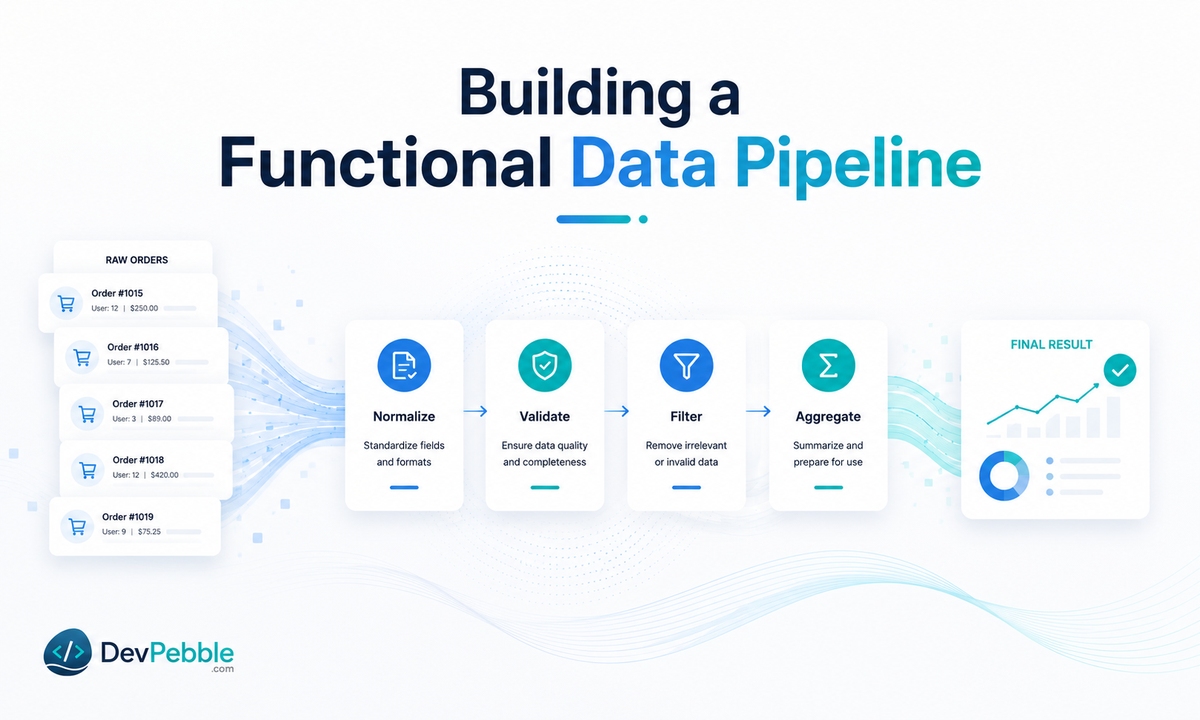
The example below cleans a batch of order records, drops the invalid ones, computes a line total for each valid order, and reports total revenue, all without changing the original data. Each stage does one job, takes explicit input, and returns a value, so you can test or reuse any stage on its own.
What data and requirements does the example use?
Each order is a dictionary with price, qty, status, and region keys. Some records have inconsistent casing in status or a non-positive price. The pipeline should normalize those fields, drop anything that still is not a valid, priced order, and return one number: total revenue from the valid orders.
How do you build the pipeline step by step?
Each stage below has one responsibility, takes explicit input, and returns a value. No stage touches the original orders list.
- Define an explicit input contract.
orders = [
    {"price": 19.99, "qty": 2, "status": "Valid", "region": "west"},
    {"price": -5.00, "qty": 1, "status": "valid", "region": "east"},
    {"price": 9.50, "qty": 3, "status": "CANCELLED", "region": "west"},
]
- Write a pure normalization function.
def normalize(order):
    return {**order, "status": order["status"].strip().lower()}
- Write a predicate for valid orders.
def is_valid(order):
    return order["status"] == "valid" and order["price"] > 0
- Filter and transform the records.
normalized = (normalize(o) for o in orders)
valid_orders = filter(is_valid, normalized)
line_totals = (o["price"] * o["qty"] for o in valid_orders)
- Aggregate with a purpose-built function.
total_revenue = sum(line_totals)
- Test every stage independently.
assert normalize({"price": 1, "qty": 1, "status": " Valid ", "region": "x"})["status"] == "valid"
assert is_valid({"price": 5, "qty": 1, "status": "valid", "region": "x"})
assert orders[0]["status"] == "Valid"  # original input untouched
On this input the pipeline returns 39.98, since only the first order survives normalization and validation. To prove the source data is left alone, snapshot it first and compare afterward: original = deepcopy(orders), then assert orders == original once the pipeline has run.
How does the functional version compare with an imperative loop?
A single for loop with an if and a running total does the same job in fewer lines, and a newcomer may find it easier to trace top to bottom. The staged version earns its keep once you need to reuse is_valid elsewhere, test normalization on its own, or slot in another stage without rewriting the whole block.
When are comprehensions or loops better than functional helpers?
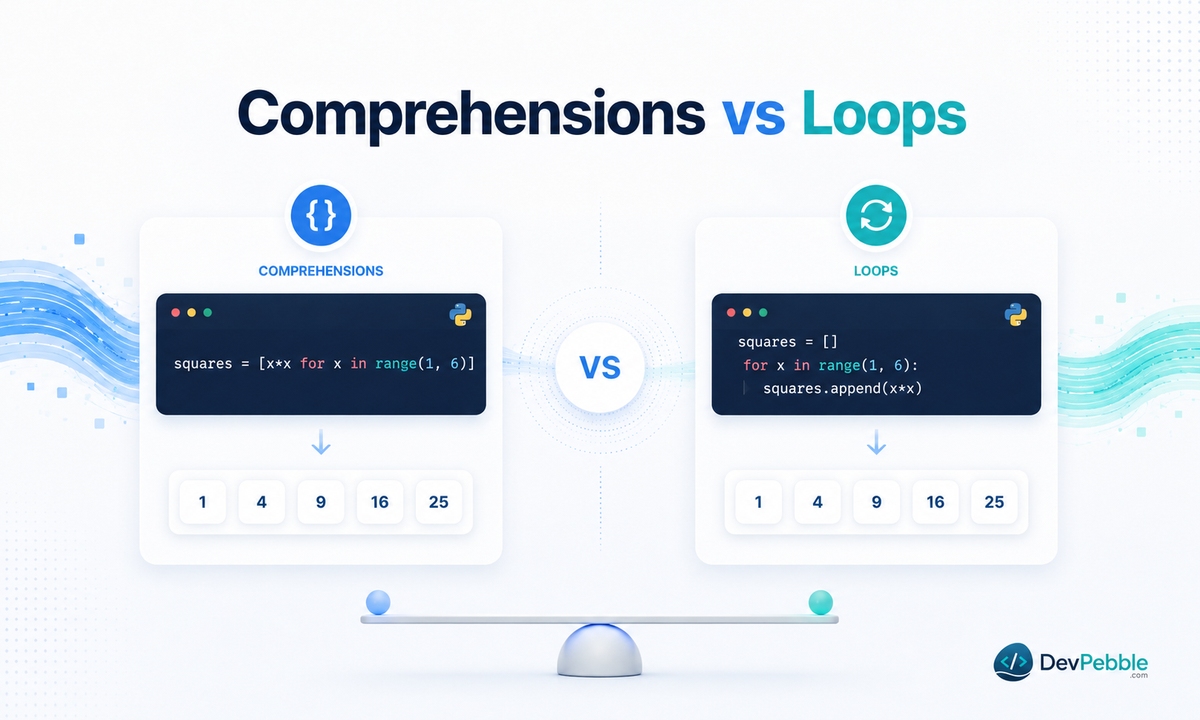
A comprehension usually wins for one simple transformation. A generator expression wins when the result feeds a single consumer lazily. A plain loop wins whenever you need branching, exception handling, early exit, or more than one side effect per iteration, none of which a comprehension or a map()/filter() chain expresses cleanly. Keep map() and filter() for the cases where a named callable makes the intent clearer than an inline expression would.
| Need | Prefer |
|---|---|
| Build a list with one simple expression | List comprehension |
| Stream values to a single consumer | Generator expression |
| Apply an existing function lazily | map() |
| Select with an existing predicate lazily | filter() |
| Perform a recognized aggregate | sum(), any(), all(), min(), or max() |
| Handle branches, exceptions, or early exits | Explicit loop |
| Combine iterators without materializing them | itertools |
| Create a specialized callable | functools.partial() |
What are the benefits of functional programming in Python?
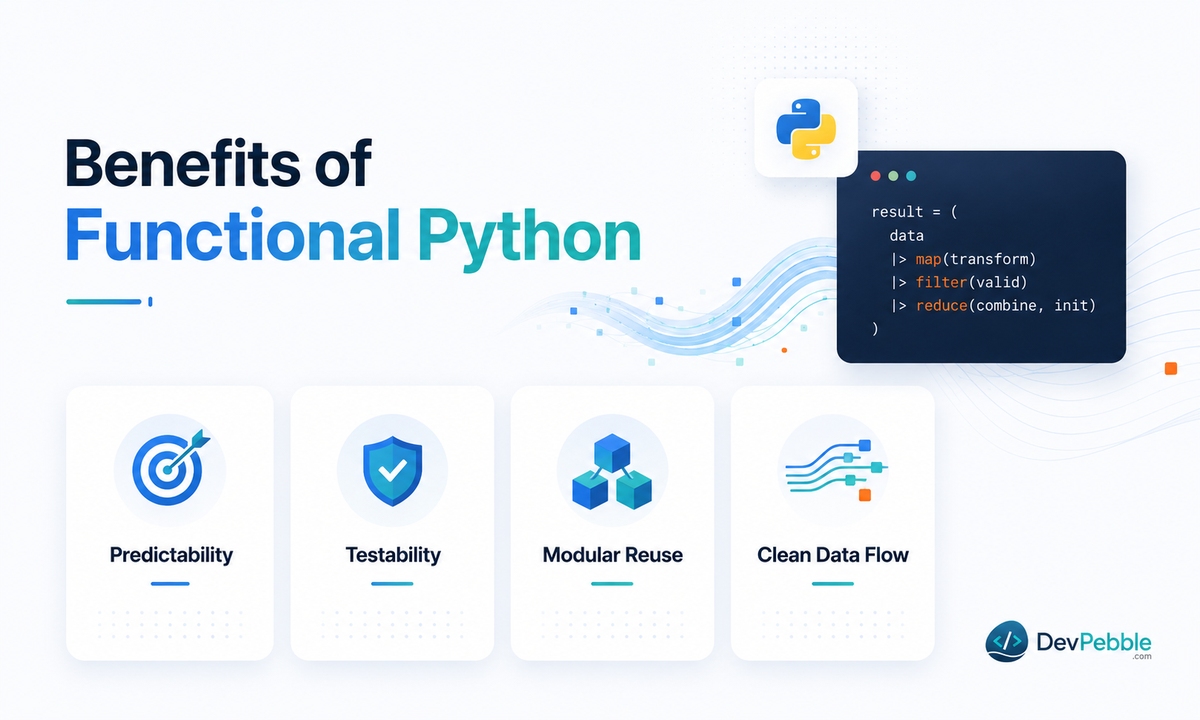
Used well, functional techniques improve predictability, modularity, and reuse. Functions with clear inputs and outputs are easier to isolate, test, and recombine. They do not automatically make code faster, safer, or bug-free. The gains come from discipline, not from syntax.
Why are pure functions easier to test and debug?
A function with explicit inputs and no hidden dependencies needs no setup beyond its arguments, so a failing test points straight at the function responsible. This does not remove the need for integration tests around the impure edges of a system, the database calls, network requests, and file I/O where most real bugs still hide.
How does composition improve reuse?
Small functions with matching input and output types can be recombined into new pipelines without rewriting logic. The risk runs the other way too. Split a task into too many one-line wrappers and you can bury a simple operation under several layers of indirection, trading one kind of complexity for another.
What are the limitations and risks?
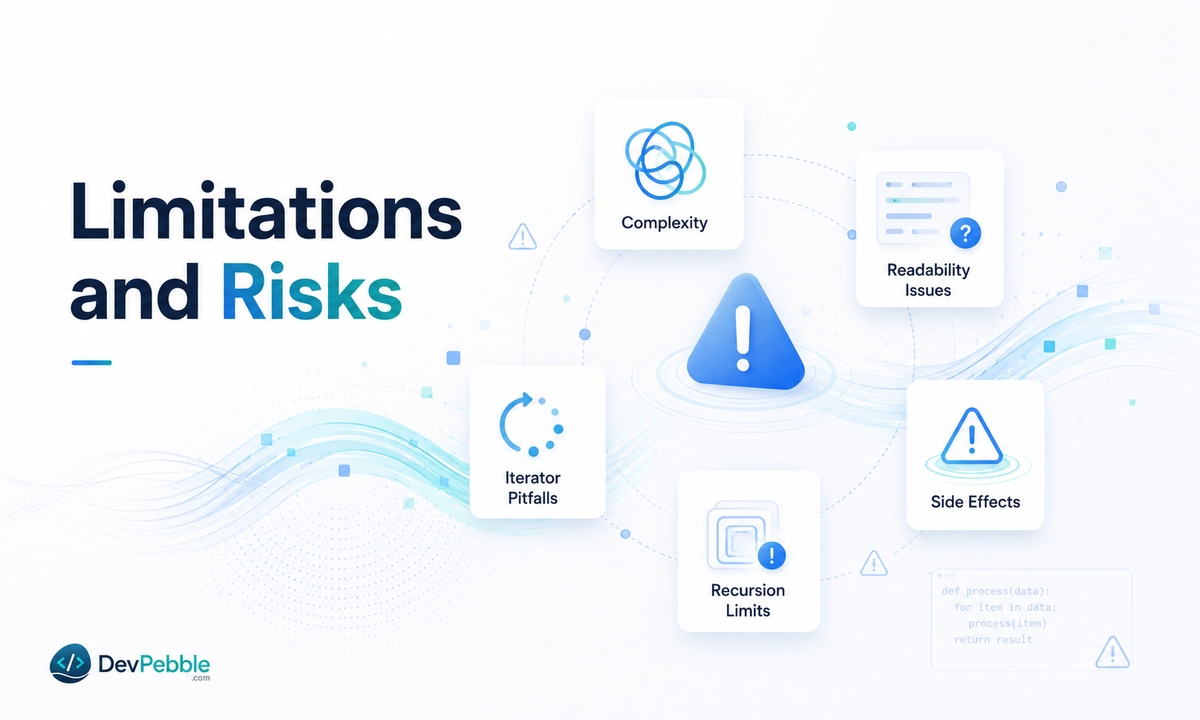
Functional-looking code is not automatically clearer, faster, or more Pythonic. The main risks are compressed expressions that hide behavior, iterators consumed when you did not expect it, and abstractions that make a simple operation harder to follow than a plain loop would be.
When does functional code hurt readability?
A chain of nested lambdas, an accumulator whose shape is not obvious from its name, or a reduce() call doing three things at once are all signs to stop and refactor. Replacing reduce(lambda acc, x: {**acc, x["id"]: x}, records, {}) with a named index_by_id() function, or a small loop, usually costs nothing and saves a reader real time.
Can functional-style Python still mutate data or cause side effects?
Yes. Nothing about map() or a comprehension stops the function you pass in from mutating an argument, appending to a list defined outside its scope, or writing to a file. map(lambda o: o.update(status="processed") or o, orders) mutates every order in place while looking like a harmless transformation. Syntax does not create purity. Behavior does.
What recursion and performance pitfalls matter?
CPython enforces a recursion limit, 1,000 frames by default and adjustable with sys.setrecursionlimit(), and it does not eliminate tail calls in your own Python functions. A deeply recursive parser or tree walk can raise RecursionError where an equivalent loop would not. Do not assume a generator or a functional pipeline beats a loop on speed. Measure the real workload with timeit, and check peak memory with tracemalloc if memory is the constraint that matters.
When should you use functional style, and when should you avoid it?
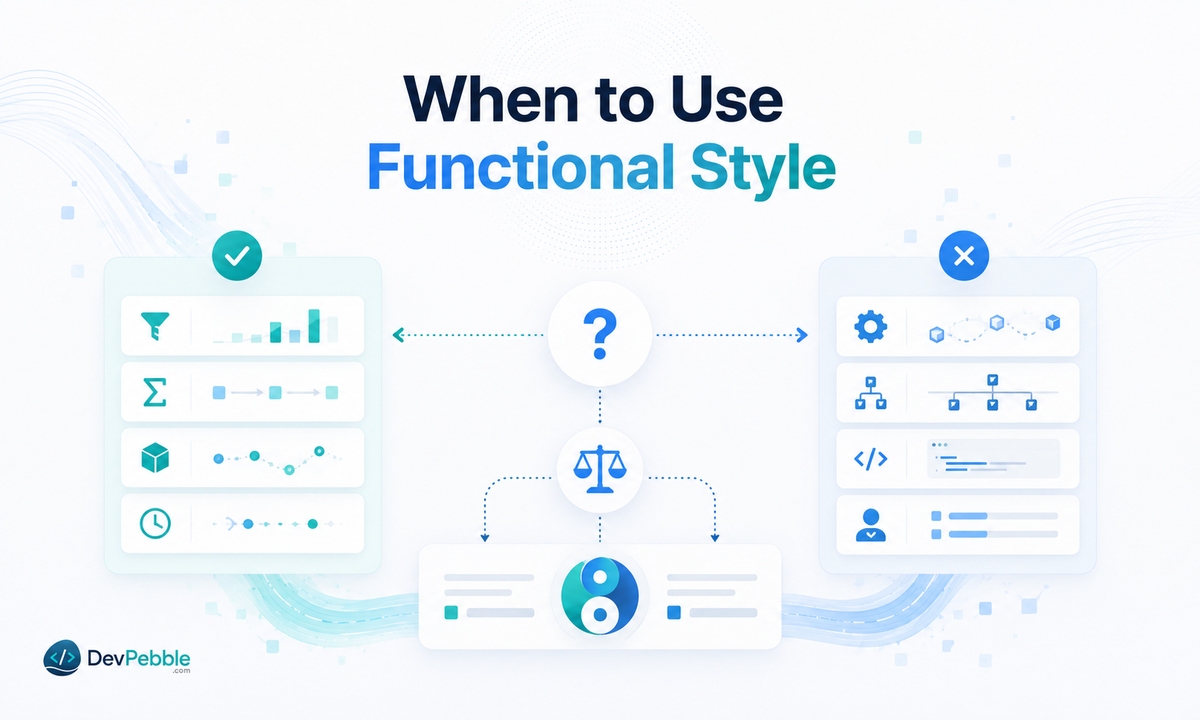
Favor functional patterns for problems where the output follows predictably from the input. Favor loops, objects, or a hybrid design once the problem is really about managing change over time.
Which problems fit functional-style Python well?
Parsing, validation, pricing and other calculations, text normalization, and analytics or ETL-style pipelines all fit. Each step has a clear contract, and the whole job is a chain of transformations from input to output.
When is a hybrid, procedural, or object-oriented design better?
GUI state, game entities, database transactions, long-lived resources, and workflows with many early exits are usually clearer as objects or explicit procedural code, because the point of that code is coordinating change rather than avoiding it. Most real programs mix both: a functional core that does the calculations, wrapped in an imperative shell that handles input, output, and side effects.
What are the best practices for Pythonic functional code?
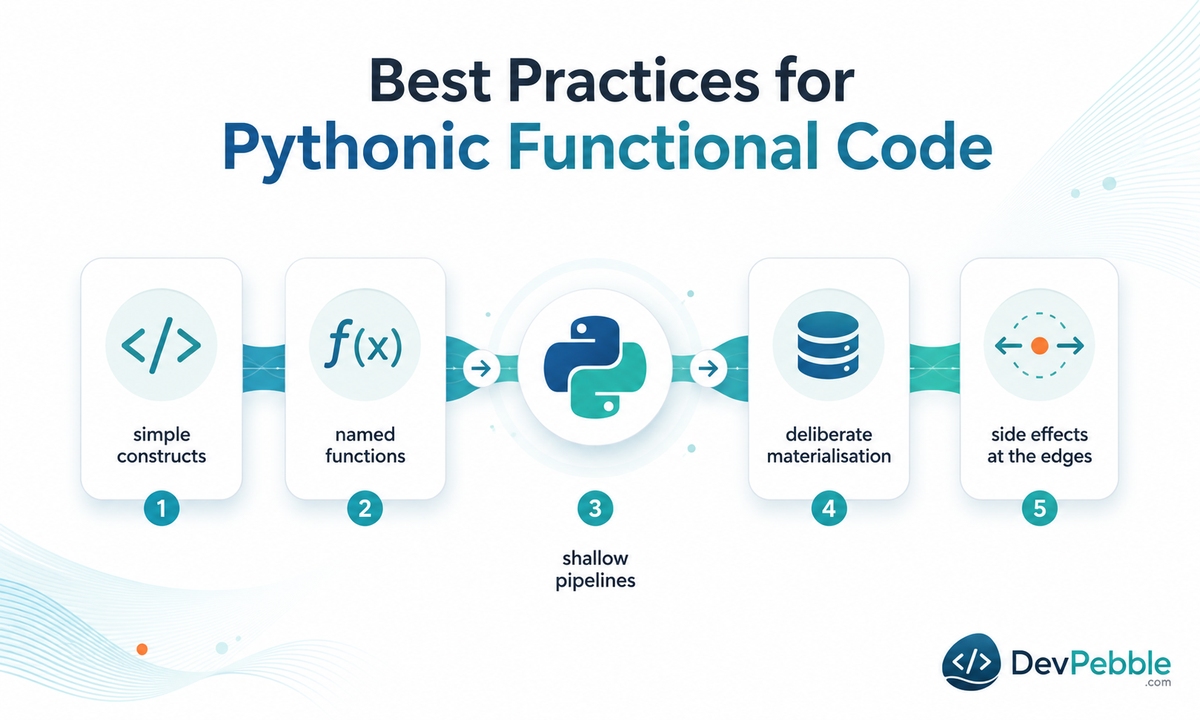
Pythonic functional code borrows the useful principles, small functions, explicit data flow, and minimal mutation, without forcing Haskell-style purity onto ordinary Python.
What rules keep functional Python readable?
- Choose the simplest construct that expresses the transformation.
- Name non-trivial predicates and accumulators instead of leaving them anonymous.
- Prefer a comprehension to
map(lambda ...)for simple cases. - Prefer a built-in aggregate to
reduce()unless nothing else fits. - Keep pipelines shallow and materialize results at deliberate points.
- Keep I/O and mutation at the edges of the program, not buried in a pure-looking callback.
What should you learn next?
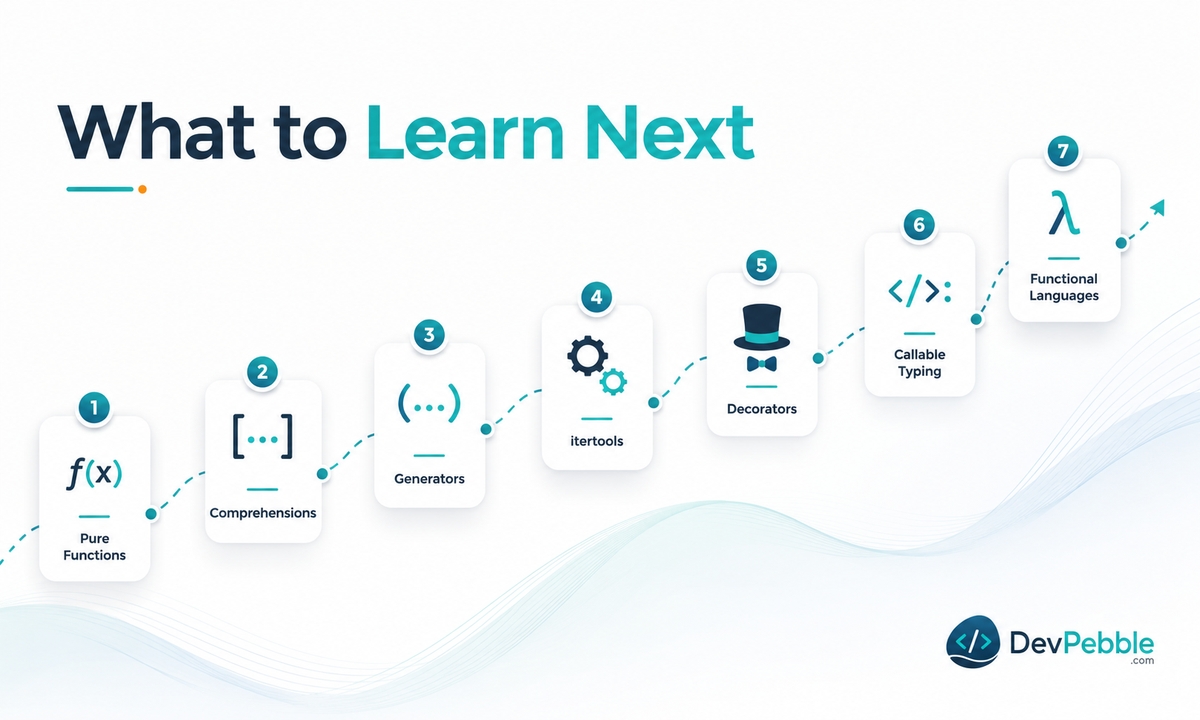
Practice pure functions and comprehensions first, then generators and itertools, then decorators and callable typing. If you want to see the paradigm pushed further, Haskell, F#, OCaml, or Elixir are worth a look, not as a replacement for Python but as a way to see functional ideas without Python's procedural and object-oriented options mixed in.
Final thoughts
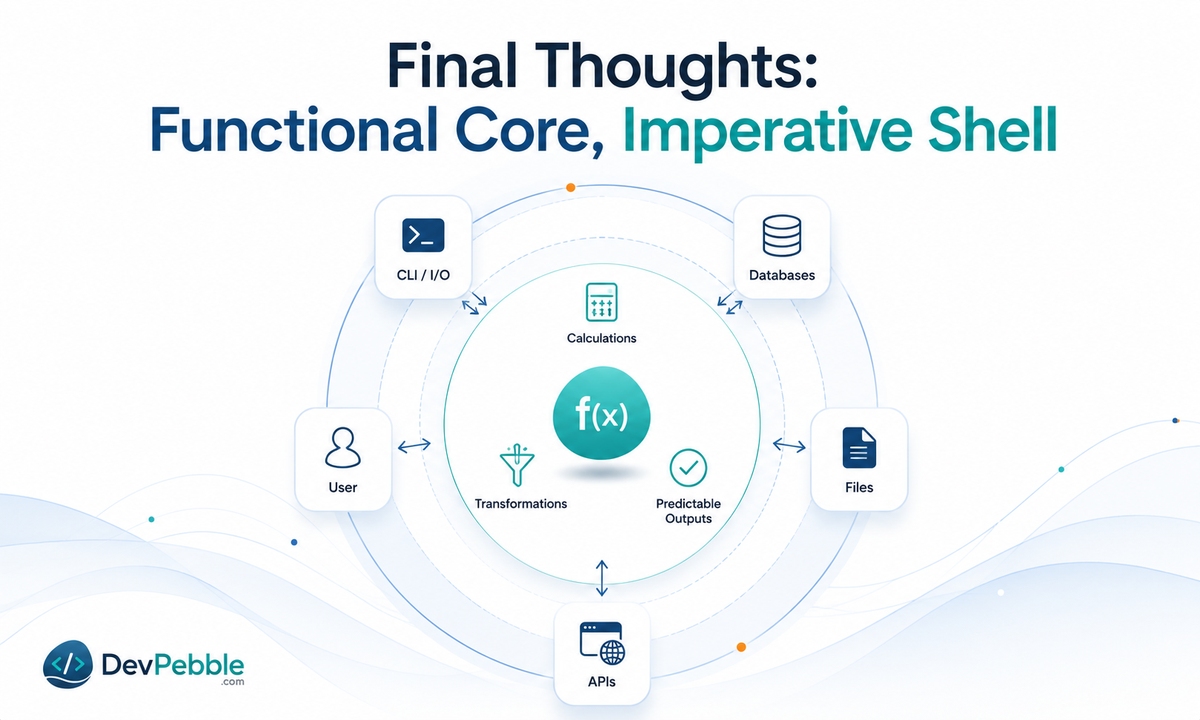
Functional programming in Python works best as a set of tools, not a philosophy to adopt wholesale. Pure functions, comprehensions, map(), filter(), and the itertools, functools, and operator trio earn their place when a transformation has a clear input and output, and parsing, validation, calculations, and data pipelines are the natural fit. Loops, classes, and mutable state earn theirs whenever the problem is really about managing change: GUIs, transactions, long-lived resources, workflows with many exits. Most working Python ends up combining both, often as a functional core wrapped in an imperative shell. Start small. Write one pure function, one comprehension, one named predicate, and judge the result by whether it is easier to read and test than what it replaced, not by how functional it looks.