Functional Programming vs OOP: Differences, Trade-Offs, and When to Use Each
Functional programming vs OOP compared across state, testing, concurrency, and performance, with the same JavaScript example both ways and when to use each.
On this page⌄
- Functional Programming vs OOP: What Is the Difference?
- What Is Functional Programming?
- What Is Object-Oriented Programming?
- Are Functional Programming and OOP Mutually Exclusive?
- Functional Programming vs OOP: Key Differences at a Glance
- How Do State, Control Flow, and Side Effects Differ?
- How Do They Affect Testing, Concurrency, and Performance?
- The Same Task in Functional and Object-Oriented Styles
- Benefits and Drawbacks of Functional Programming and OOP
- When Should You Use Functional Programming, OOP, or Both?
- How Should You Choose a Paradigm for Your Next Project?
- Common Misconceptions and Edge Cases
- Conclusion
- FAQ
Functional programming organizes software around functions that transform values, usually limiting mutation and uncontrolled side effects. Object-oriented programming organizes software around objects that expose behavior and manage state behind interfaces. Neither is universally better, and most real applications combine them. The right choice depends on how a system's state changes, what its ecosystem expects, and what the team can maintain.
This guide compares the two styles across state, testing, concurrency, and performance, works the same problem both ways in JavaScript, and closes with a practical framework for choosing functional programming, OOP, or a hybrid.
Functional Programming vs OOP: What Is the Difference?
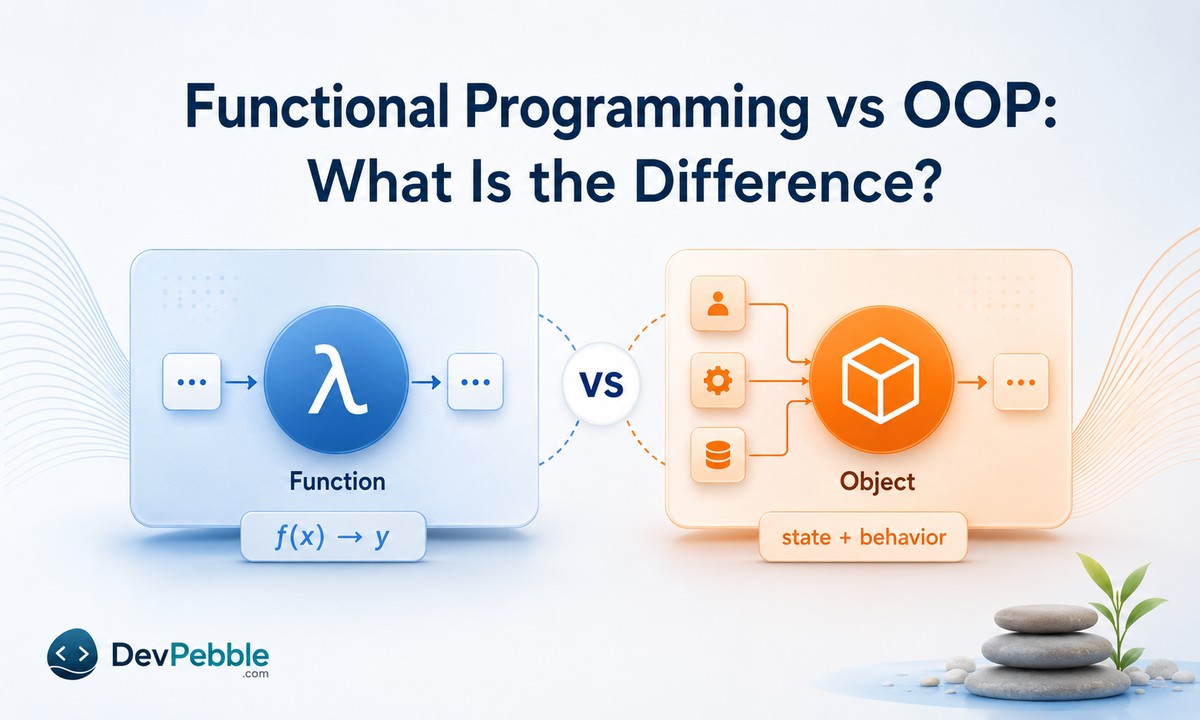
Functional programming primarily organizes code as functions that transform values. Object-oriented programming primarily organizes code as objects that bundle state with the behavior acting on it. These are design approaches rather than mutually exclusive language categories, and a single codebase can use both.
The practical differences show up in four places:
- Primary abstraction. Functional programming centers on functions and the values they produce. OOP centers on objects and the interfaces they expose.
- State handling. Functional code typically passes state explicitly between functions. OOP typically has objects own or reference their state internally.
- Behavior placement. Functional code applies operations to data. OOP attaches methods to the data they act on.
- Reuse. Functional programming favors composing small functions. OOP favors interfaces, polymorphism, and sometimes inheritance.
Neither approach guarantees better code by itself. Implementation quality matters more than the paradigm label.
What Is Functional Programming?
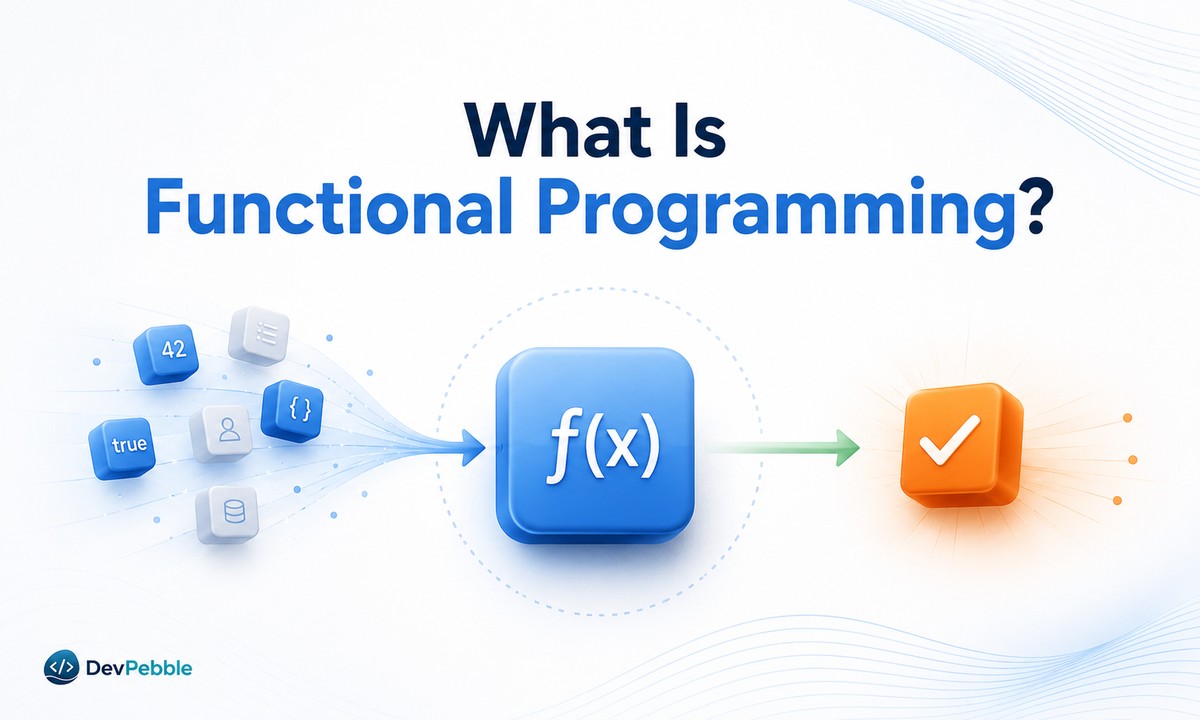
Functional programming builds behavior by applying and composing functions that take explicit inputs and return explicit outputs, often limiting mutation and side effects along the way. Not every functional language or program is purely functional. Purity and immutability are tools applied in degrees, not absolute requirements.
Pure Functions and Controlled Side Effects
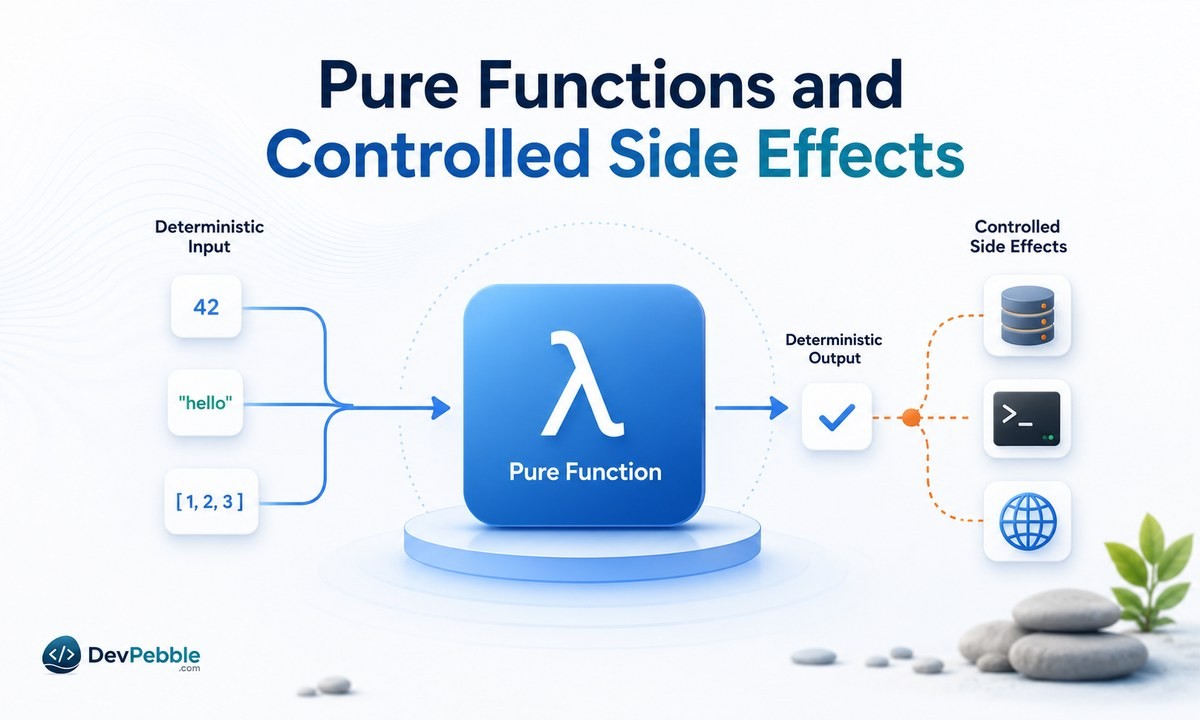
A pure function produces its result entirely from its explicit inputs and causes no observable external change. Microsoft's F# documentation defines purity the same way: a pure function returns the same value for the same arguments and has no side effects (Microsoft Learn).
Real applications still need input and output, database writes, and network calls. The goal is not to eliminate effects but to isolate them from deterministic logic, an arrangement sometimes called a functional core with an effectful shell. A related property is referential transparency: if an expression can be replaced by its computed value without changing what the program does, it is referentially transparent, as the same F# documentation explains. Typical effects that belong at the edges include storage, network calls, timers, randomness, logging, and user interfaces.
Immutability, Values, and Data Flow
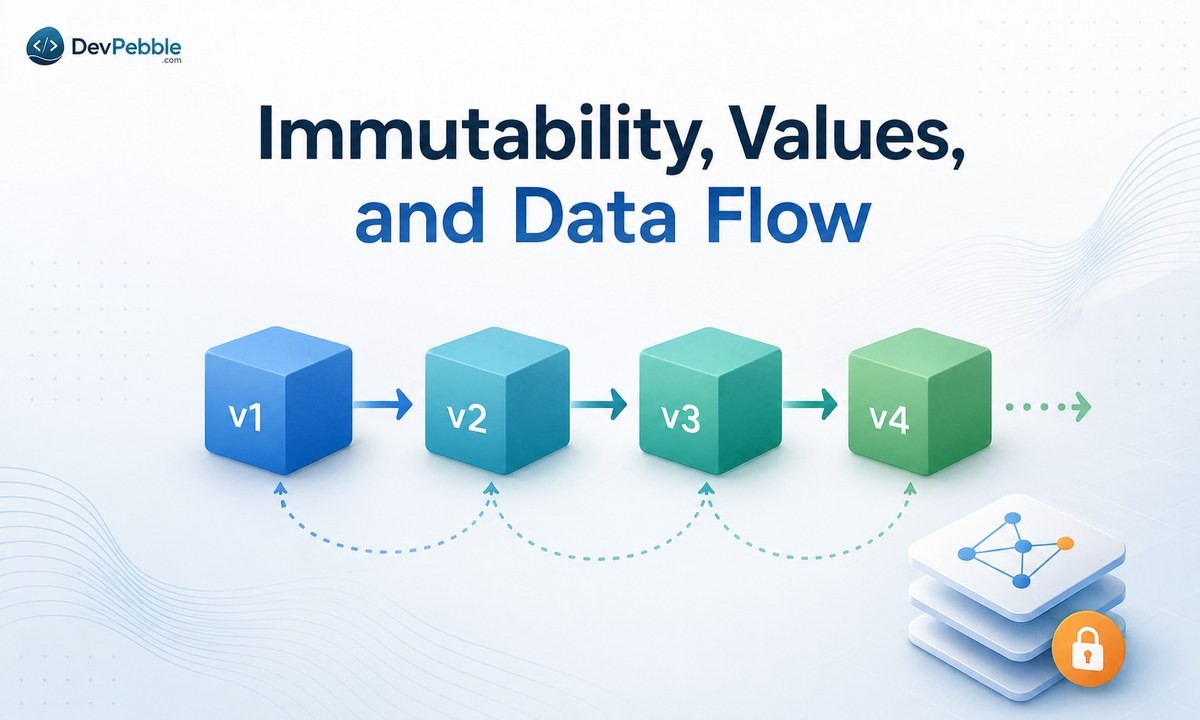
Functional-style code commonly produces a new value instead of changing an existing one in place. The application still evolves over time. The difference is that each transition is explicit, and persistent data structures let new versions share unchanged internal structure rather than copying everything.
Clojure's documentation describes this directly: a value does not change, so producing new values from old ones needs to be efficient, which persistent data structures make possible without full copies (Clojure). Immutability does not mean code refuses mutation everywhere. F#, for example, is immutable by default but lets you mutate a value when you explicitly mark it as mutable, which is useful for performance-sensitive internals kept behind a stable interface.
First-Class Functions, Higher-Order Functions, and Composition
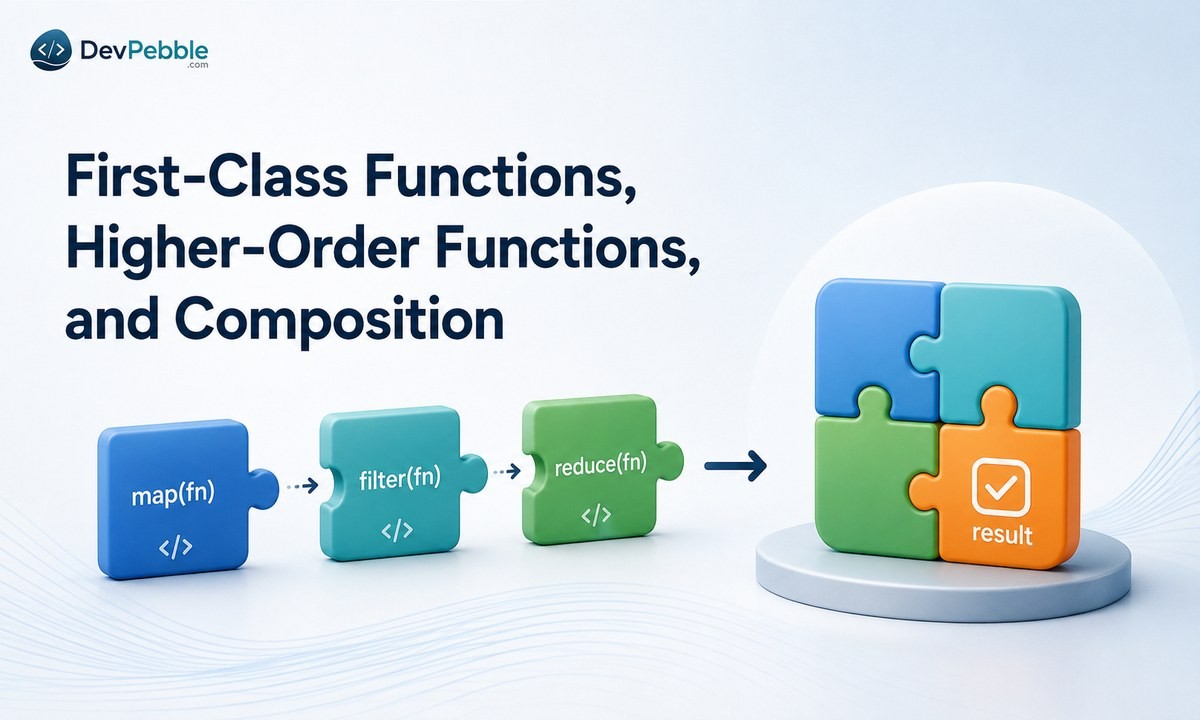
A first-class function can be stored, passed, or returned like any other value. A higher-order function accepts or returns functions, with map, filter, and callbacks as familiar examples. Composition builds larger operations from smaller functions, which allows reuse without a class hierarchy.
The two terms are related but not identical. First-class describes what functions are in the language. Higher-order describes what a specific function does with other functions. When composing functions, prefer named intermediate functions over dense nested expressions, since readability usually matters more than terseness.
What Is Object-Oriented Programming?
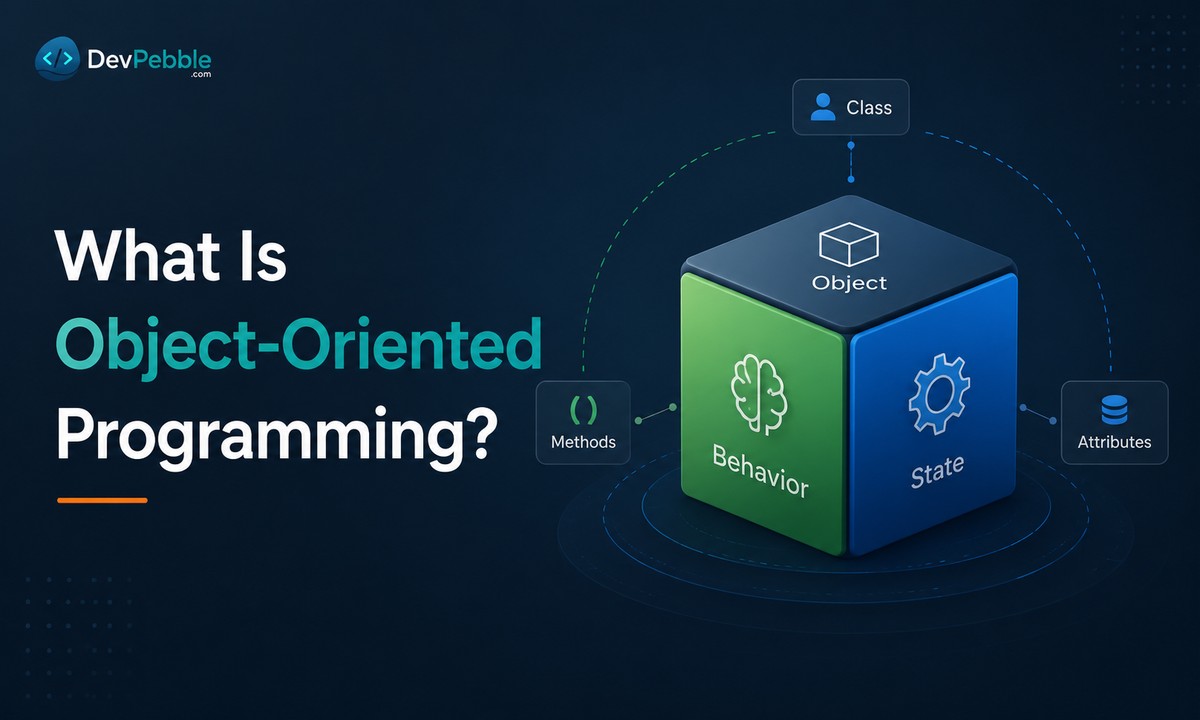
Object-oriented programming models software through objects that expose behavior and manage data through defined boundaries. Classes and inheritance are common mechanisms, but encapsulation, interfaces, and object collaboration matter more than forcing every concept into a class hierarchy.
Objects, Classes, and Encapsulation

An object has an identity, holds or references state, and exposes behavior through methods or another interface. Oracle's Java documentation frames this classically: an object stores its state in fields and exposes its behavior through methods, and those methods are the primary way objects communicate (Oracle). MDN describes JavaScript classes in the same spirit, as templates for creating objects that encapsulate data together with code to work on that data (MDN).
A class commonly defines how similar objects are created, while encapsulation limits direct access to implementation details. Consider an order object: its state might be its line items and a status, and its behavior might be adding items or calculating a total. Callers should depend on the object's published interface rather than its internal fields, so the implementation can change without breaking calling code.
Inheritance, Polymorphism, and Composition
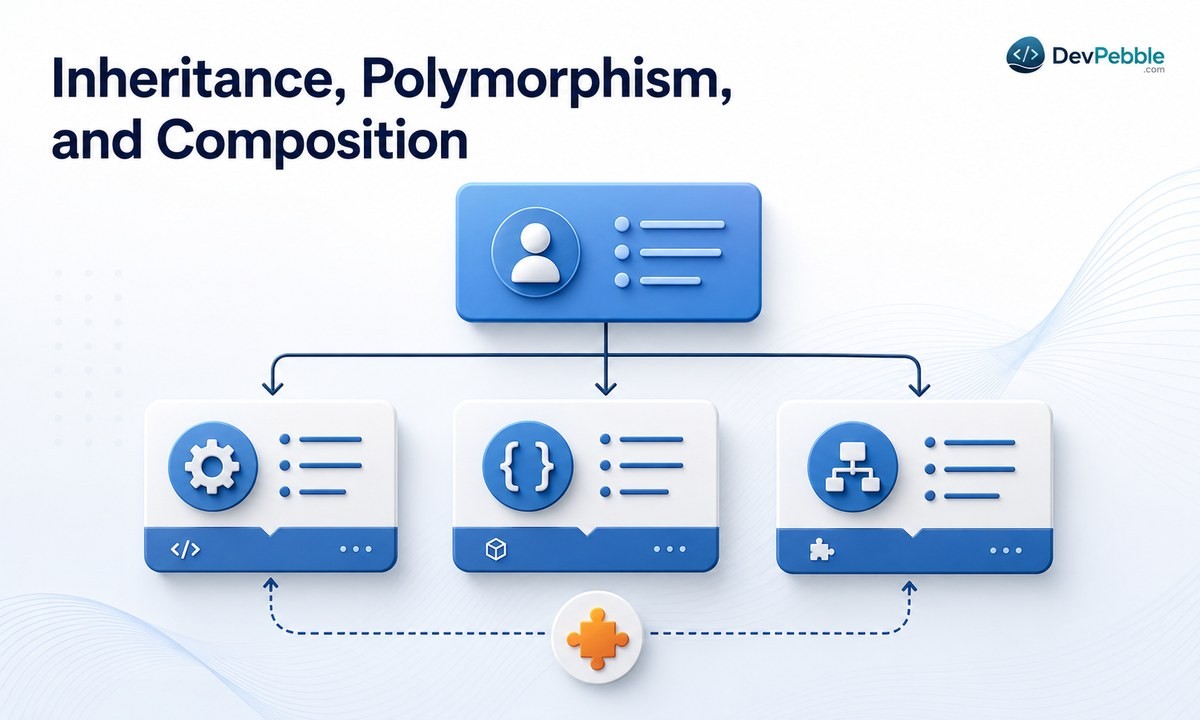
Inheritance lets one type derive behavior from another. Polymorphism lets multiple implementations satisfy a shared contract. Object composition assembles behavior from collaborating components. Modern OOP treats inheritance as one option among several, not its defining requirement.
Inheritance is useful for genuine "is-a" relationships, though deep hierarchies create tight coupling between parent and child types. Polymorphism works through a shared contract that lets callers swap implementations without changing calling code, which is the basis for testable, extensible designs. Object composition builds objects from smaller collaborating objects, a "has-a" relationship that often ages better than a deep inheritance chain.
Are Functional Programming and OOP Mutually Exclusive?

They are not. Many languages support functions as values alongside objects and classes, and production systems often run functional transformations inside object-oriented modules or wrap objects around a functional core at infrastructure boundaries. Scala's documentation is explicit about this, describing the language as a fusion of object-oriented and functional programming in a statically typed setting, so developers can write in either style or blend both (Scala). Paradigm is a property of how code is organized, not a fixed category a language forces on every program.
Functional Programming vs OOP: Key Differences at a Glance
The clearest comparison is not "functions versus classes." It is how each style represents state, locates behavior, controls effects, supports extension, and communicates intent. The table below describes tendencies within each paradigm, not fixed rules. A well-written OOP method can be pure, and a functional pipeline can still touch a database.
| Dimension | Functional-leaning design | Object-oriented-leaning design | |---|---|---| | Primary unit | Functions and values | Objects and interfaces | | State | Passed explicitly; often immutable | Owned or referenced by objects; mutable or immutable | | Behavior | Applied to values | Exposed by objects | | Side effects | Isolated or controlled | Commonly performed through methods or services | | Reuse | Function composition, higher-order functions | Composition, interfaces, polymorphism, inheritance | | Extension | Add new operations over existing data | Add new implementations behind existing contracts | | Testing | Input/output tests suit pure logic | Tests exercise object behavior and state transitions | | Concurrency | Immutable values reduce shared-mutation risk | Requires disciplined ownership or synchronization | | Performance | May allocate more; can enable parallel evaluation | In-place mutation can reduce allocations; dispatch has its own cost | | Typical fit | Transformations, rules, pipelines, calculations | Stateful entities, component boundaries, framework contracts |
Two caveats matter more than the table itself. Language choice and paradigm choice are separate decisions, and a system rarely sits entirely on one side. Most codebases mix both, module by module.
How Do State, Control Flow, and Side Effects Differ?
Functional code tends to make state transitions explicit by passing values through functions, while object-oriented code tends to place state transitions behind object methods. Both can isolate side effects, use immutable values, and read declaratively. The real difference is emphasis and where the transition happens, not which approach is disciplined.
State Management: Values Versus Identities
Functional code commonly transforms an old value into a new one. An object can preserve its identity while its internal state changes underneath it. Neither approach removes state from the application. Each one decides where state lives and how a change becomes observable to the rest of the system.
A value transformation reads as oldState → transition(input) → newState, where the calling code now holds the new value and nothing else changed. A stateful object reads as object.command(input), where the object keeps the same identity but revises its internal state, and callers still refer to the same object afterward. Clojure's separation of identity from value captures this distinction well.
Control Flow and Side-Effect Placement
Functional code often expresses a result as composed transformations, while object-oriented code often expresses behavior as commands sent to objects. This is a tendency, not a rule. Object methods can be pure, and functions can contain imperative loops and side effects.
A transformation pipeline names its operations in reading order, such as validate → price → tax → format, with each step's output feeding the next. A command-oriented interaction checks an invariant before changing state, such as rejecting a negative quantity before it is added to an order. What matters for maintainability is that effects stay visible at architectural boundaries rather than hiding inside either style.
How Do They Affect Testing, Concurrency, and Performance?
Functional techniques can simplify tests and concurrent reasoning when logic is pure and values are immutable. OOP can provide strong boundaries around stateful behavior through well-defined interfaces. Neither paradigm guarantees testability, scalability, or speed on its own. Implementation details and workload characteristics dominate the outcome far more than the paradigm label.
Testing and Debugging
Pure functions are usually straightforward to test, because assertions compare explicit inputs against outputs with no setup beyond the arguments themselves. Stateful objects can be just as testable when dependencies and transitions are controlled, though their tests may need fixtures, mocks, or a specific call order.
A pure input/output test takes one function, a fixed input, and an expected result. A stateful behavior test arranges the object's starting state, executes a command, then inspects the resulting state or any emitted event. Both shapes are reliable; they simply set up differently.
Concurrency and Shared State
Immutable values cannot be changed by another thread once shared, which removes an entire class of synchronization bugs. Applications still need coordination for databases, queues, caches, and other genuinely changing resources. Immutability narrows where coordination is required rather than erasing the need for it.
- Immutable values eliminate shared-mutation races by construction.
- Concurrency safety still requires explicit coordination wherever real state changes.
- Message-passing and actor models offer a related, paradigm-independent way to manage shared state.
Runtime Performance and Memory Trade-Offs
Neither paradigm is inherently faster. Immutable transformations can add allocation pressure. In-place mutation can reduce copying but risks subtle bugs. Object dispatch and indirection carry their own cost. Algorithm choice, data structures, compiler behavior, and the actual workload determine measured performance far more than paradigm does.
A comparative study of Rosetta Code solutions by Sebastian Nanz and Carlo A. Furia, presented at the 2015 International Conference on Software Engineering, analyzed 7,087 programs across 745 tasks in eight languages spanning procedural, object-oriented, functional, and scripting paradigms (arXiv). It found real differences in conciseness and runtime behavior, including that functional and scripting languages were more concise than procedural and object-oriented ones. Because language, typing, and implementation choices are entangled with paradigm in that dataset, the study cannot isolate paradigm alone as the cause. Treat any performance claim as workload-specific until you have measured your own code.
The Same Task in Functional and Object-Oriented Styles
Both versions below solve identical requirements in the same JavaScript runtime. Given order line items, a discount rate, and a tax rate, each computes the total. Same inputs, same expected output. The comparison is about organization and state handling, not which version runs faster.
Functional Version: Transform an Immutable Order Value
The order is data. Small functions calculate the subtotal, apply the discount, then apply tax, each returning a new value rather than changing the original order object.
const order = Object.freeze({
  items: [
    { name: "Keyboard", price: 45, qty: 2 },
    { name: "Mouse", price: 20, qty: 1 },
  ],
  discountRate: 0.10,
  taxRate: 0.08,
});
const calculateSubtotal = (items) =>
  items.reduce((sum, item) => sum + item.price * item.qty, 0);

const applyDiscount = (subtotal, rate) => subtotal - subtotal * rate;

const calculateTax = (amount, rate) => amount * rate;

function calculateTotal(order) {
  const subtotal = calculateSubtotal(order.items);
  const discounted = applyDiscount(subtotal, order.discountRate);
  return discounted + calculateTax(discounted, order.taxRate);
}

calculateTotal(order); // 106.92
OOP Version: Let an Order Object Manage Its Rules
Order data and pricing behavior sit behind an Order interface. Methods maintain valid state and calculate totals, and callers interact with the object instead of reaching into its internal representation.
class Order {
  #items = [];
  #discountRate;
  #taxRate;

  constructor(discountRate, taxRate) {
    this.#discountRate = discountRate;
    this.#taxRate = taxRate;
  }

  addItem(name, price, qty) {
    this.#items.push({ name, price, qty });
  }

  subtotal() {
    return this.#items.reduce((sum, i) => sum + i.price * i.qty, 0);
  }

  total() {
    const discounted = this.subtotal() * (1 - this.#discountRate);
    return discounted * (1 + this.#taxRate);
  }
}

const order = new Order(0.10, 0.08);
order.addItem("Keyboard", 45, 2);
order.addItem("Mouse", 20, 1);
order.total(); // 106.92
What the Example Shows, and What It Does Not
Both implementations are clear, testable, and produce the same result. The example shows where state, validation, and extension points live, and nothing more. Adding a loyalty discount touches a new function in the functional version and a new method in the OOP version. Adding a subscription-order variant changes the data shape and pipeline in one, and the class hierarchy or composition in the other. Neither outcome proves that one style scales better across a whole codebase.
Benefits and Drawbacks of Functional Programming and OOP
Each paradigm concentrates complexity in a different place. Functional programming emphasizes explicit transformations and controlled effects. OOP emphasizes state ownership and behavioral boundaries. Either can become difficult to work with when applied dogmatically instead of as a set of tools suited to the problem.
Functional Programming Benefits and Risks
Functional techniques tend to improve local reasoning, composability, repeatable testing, and safe sharing of immutable values across threads. The costs are real too: unfamiliar abstractions for teams new to the style, allocation pressure from repeated transformations, effects that are harder to model, and code that can turn overly abstract or terse when composition is chased for its own sake.
Object-Oriented Programming Benefits and Risks
OOP creates clear boundaries around stateful domain behavior and fits naturally with class- and interface-oriented frameworks and libraries. Its risks are the mirror image: hidden state changes that are hard to trace, inheritance hierarchies that couple unrelated concerns, object graphs that grow tightly interdependent, and classes that quietly accumulate too many responsibilities over time.
When Should You Use Functional Programming, OOP, or Both?
Selection should follow the problem's dominant state, change pattern, ecosystem, and ownership requirements. Use functional programming where transformations and deterministic rules dominate, OOP where long-lived identities and interfaces dominate, and a hybrid when a single system genuinely needs both, which describes most systems.
Lean Toward Functional Programming When…
- The core problem is transforming data, such as pricing rules, validation, or parsing.
- Calculations need to compose into pipelines or be shared safely across threads.
- Correctness matters more than the convenience of in-place mutation.
- The system still relies on effectful infrastructure around that pure core.
Lean Toward OOP When…
- Software revolves around long-lived, stateful entities with a lifecycle.
- Multiple interchangeable implementations must satisfy one shared contract.
- A framework or library already expects objects and interfaces.
- Object composition and immutable value objects can contain the usual OOP risks.
Use a Hybrid When the System Has Both Calculations and Stateful Boundaries
A common pattern places deterministic business rules in pure functions and keeps databases, queues, user interfaces, and external APIs behind objects or modules. Another option is to let immutable value objects live inside an otherwise object-oriented service architecture. The functional core holds calculations, validation, and decisions, the parts worth testing exhaustively with input/output tests. The effectful boundary holds databases, network calls, the clock, randomness, logging, and user interaction, the parts that need mocking or integration tests. Choose the style by module rather than as a project-wide ideology.
How Should You Choose a Paradigm for Your Next Project?
Assess change patterns, state ownership, ecosystem constraints, team fluency, and a measured prototype before committing. Make the decision at the module or subsystem level rather than for the whole codebase at once, since different parts of a system often have genuinely different needs. A repeatable process helps:
- Identify whether the system changes mainly by adding new operations or new entity variants.
- Map every source of state, identity, I/O, and shared mutation in the system.
- Record framework, runtime, interoperability, and deployment constraints that limit your options.
- Assess what the team can read, test, debug, and maintain, not just write quickly.
- Prototype the riskiest workflow both ways, then compare tests, change impact, and behavior under a realistic workload.
Common Misconceptions and Edge Cases
Most functional-versus-OOP arguments rely on false binaries. Functional systems manage state and effects too, and OOP systems can use immutable objects and pure methods. Neither style automatically produces declarative, concurrent, maintainable, or fast software just because of its label. Five claims are worth correcting directly:
- "Functional programming has no state." It represents state as a sequence of values instead of in-place changes.
- "OOP requires mutable objects." Immutable value objects are a valid and common OOP design.
- "OOP means inheritance." Composition and interfaces are equally valid and often preferable.
- "Functional programming is automatically parallel or faster." Immutability helps concurrency but does not guarantee speed.
- "A language forces one paradigm." Most mainstream languages support functions, objects, or both.
Conclusion
Functional programming and OOP solve the same underlying problem, organizing behavior and state, from different starting points. Functional programming starts with transformations and explicit values. OOP starts with objects and the boundaries they enforce. Neither wins on testing, concurrency, or performance by default. Each shifts complexity somewhere else and rewards disciplined use.
For most real systems, the practical answer is not a single paradigm. It is choosing per module: pure functions for deterministic rules and calculations, objects or services for stateful boundaries and framework integration. Start from your system's actual state, change pattern, and team fluency, prototype the riskiest part both ways, and let that evidence decide the mix rather than paradigm loyalty.