Imperative Programming Explained: How It Works, With Examples
Imperative programming explained — how it works, its core building blocks, imperative vs declarative code, popular languages, examples, and where it still runs.
On this page⌄
- What is imperative programming?
- How imperative programming works: the core building blocks
- Imperative vs declarative programming: what's the difference?
- Popular imperative programming languages
- Imperative programming examples you can follow
- Advantages and disadvantages of imperative programming
- Where imperative programming runs in the real world
- Conclusion
- FAQ
Every app you open runs on a list of instructions telling the computer what to do and in what order. That approach has a name, imperative programming, and it has quietly powered software since the first machines switched on. Plenty of developers write imperative code every day without asking why it behaves the way it does. Words like state, control flow, and mutable variable get thrown around in tutorials and rarely explained properly. This guide covers what it actually is, how it runs, how it differs from declarative code, the languages built on it, and where it still does the heavy lifting, with real code you can follow throughout.
What is imperative programming?
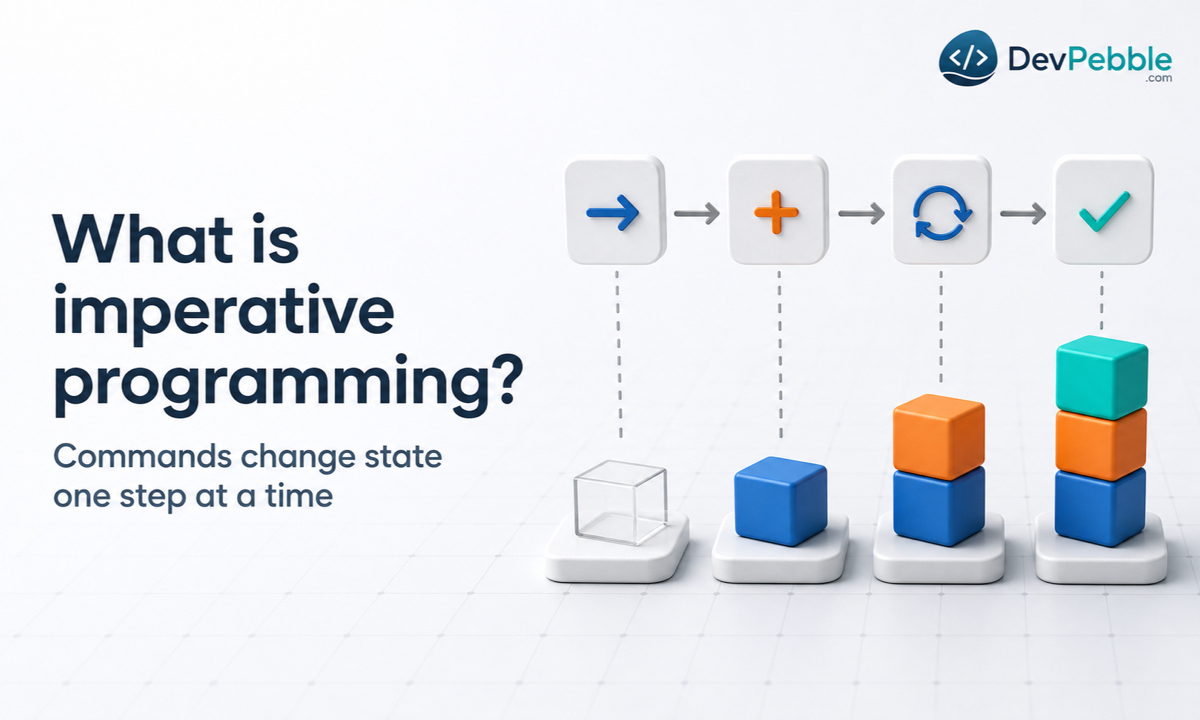
Imperative programming is a paradigm where you write code as a sequence of explicit commands that change a program's state one step at a time. Instead of describing the result you want, you spell out the exact path to reach it: set this variable, check that condition, repeat this loop, move on.
The name comes from "imperative" in the grammatical sense, as in giving orders. "Add 5 to x." "Loop while y is less than 10." "Print the result." Each statement is a command, run in the order you wrote it, unless a loop or a conditional redirects that order. That's different from how people describe outcomes to each other. If you ask a colleague for the top five customers by revenue, you describe the outcome, not how to sort the data. That's closer to declarative programming, the style SQL and HTML use. Imperative code wants the how spelled out: open the file, read each row, compare the value, keep a running list, sort it, print the top five.
Part of why this style stuck around is architectural. Most computers still run on something close to the von Neumann model, where a processor fetches an instruction, runs it, and moves to the next one in sequence. Machine code is imperative at its core, and early languages like Fortran and COBOL mirrored that directly in the 1950s. C followed in the 1970s and became the template most system-level languages still borrow from.
A simple example makes it clear. To sum the numbers from 1 to 10 imperatively, you'd write:
total = 0
for i in range(1, 11):
    total = total + i
print(total)
Nothing here describes "the sum of 1 to 10" as a concept the way a formula would. The code walks through it: start at zero, add one, add two, then check the total once the loop finishes. total changes ten separate times before anything prints. That mutation, a variable holding one value and then another as execution proceeds, is the heartbeat of imperative code.
An ATM withdrawal is the same idea at human scale: read the card, check the PIN, ask for an amount, check the balance, check for cash, dispense the notes, update the balance, print a receipt. Skip a step or run two out of order, and you get a security hole or a machine handing out money it can't account for. Order isn't a suggestion here; it's the whole point.
How imperative programming works: the core building blocks
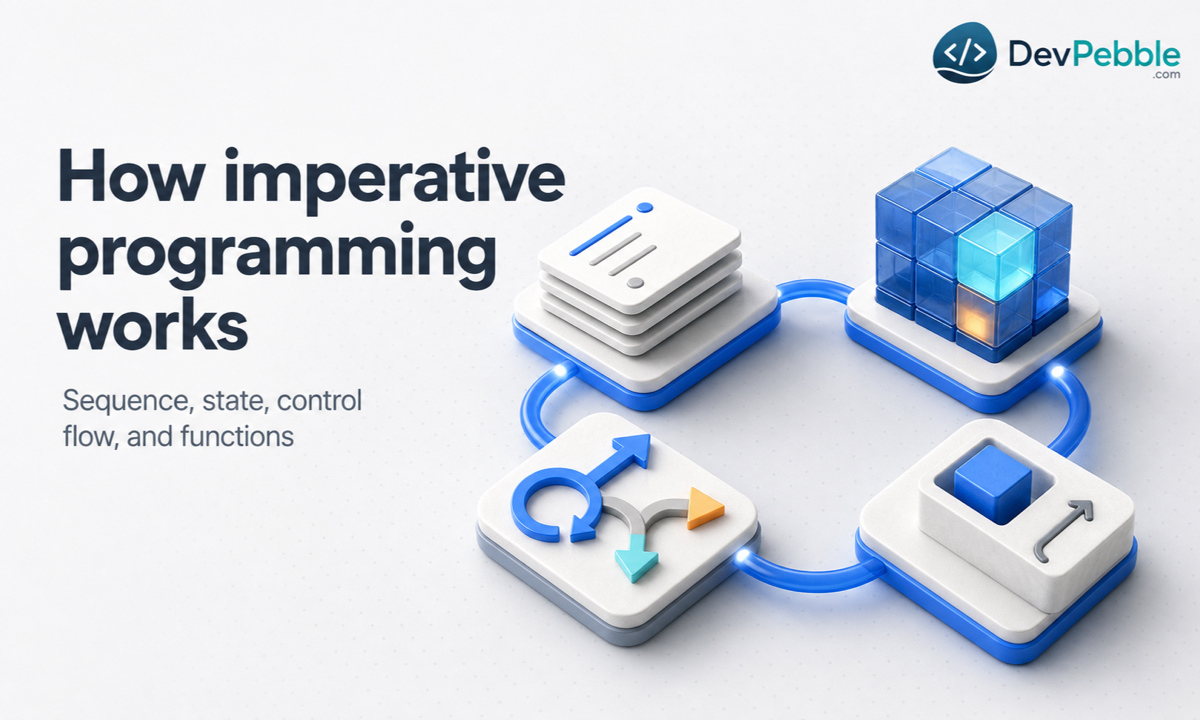
Every imperative language rests on the same handful of ideas. Once you can spot them, reading unfamiliar code gets a lot less intimidating.
Sequential execution
Statements run top to bottom in the order they're written, unless something tells the program otherwise. Swap two lines and you can completely change what the program does, because each line assumes the state left by the one before it. Try to read a variable before it's assigned, and the code fails, precisely because sequence isn't optional.
State and mutable variables
A variable in imperative code isn't a fixed label for a value. It's a labeled box in memory that can be emptied and refilled while the program runs. Write age = 25 and the computer stores 25 at a location tagged age; write age = 26 a moment later and the same location holds a different value. That's unlike algebra, where x = 5 states a permanent equality. In imperative code, assignment is an action.
This mutable state lets a program track a score or accumulate a result. It's also the source of most bugs in large systems, since a variable's value depends on everything that happened before the line you're reading. Variables have scope too: one declared inside a function is usually local and vanishes when the function returns, while a global is visible everywhere. Leaning on globals invites trouble, because any function can change them, so developers keep variables as local as they can.
Control flow: loops and conditionals
Loops and conditionals redirect that sequential execution. A for loop handles a known number of repetitions; a while loop repeats as long as a condition stays true; a do-while loop runs its block once before checking. Two keywords add finer control: break exits a loop the moment you've found what you need, and continue skips to the next pass.
Watching state build across a loop is the clearest way to see this. Here's a factorial:
result = 1
for i in range(1, 6):
    result = result * i
print(result)
| Iteration | i | result after multiplication | |---|---|---| | 1 | 1 | 1 | | 2 | 2 | 2 | | 3 | 3 | 6 | | 4 | 4 | 24 | | 5 | 5 | 120 |
result doesn't jump to 120. It climbs there through five changes, each depending on the value left by the last.
Conditionals decide which lines run at all. if, else if, and else cover the basics; a switch (or match in Python 3.10 and later) handles many values of one variable more cleanly than a long else if chain; and a ternary compresses a choice into a line, like status = "adult" if age >= 18 else "minor". Older languages also had goto, which let execution jump anywhere. That fell out of favor after Edsger Dijkstra's 1968 argument that it made code far harder to reason about, and structured control flow became the norm soon after.
Procedures, functions, and side effects
Writing everything as one long sequence stops scaling fast, so imperative languages group related statements into named, reusable blocks called functions. Write a validate_input() function once and call it wherever you need it. This is where procedural programming comes from: imperative code organized around functions rather than one giant script.
Functions often produce side effects, meaning changes to something outside the function itself, like updating a global, writing to a file, or modifying a database record. That's normal, and it's exactly what functional programming tries to minimize by favoring pure functions that return the same output for the same input. Languages like C and C++ push control further down, letting you claim memory with malloc() and release it with free(). That has sharp edges: forget to free memory and you get a leak, free it too early and you get a crash. Java, C#, and Python handle this automatically through garbage collection, trading some control for safety.
Imperative vs declarative programming: what's the difference?
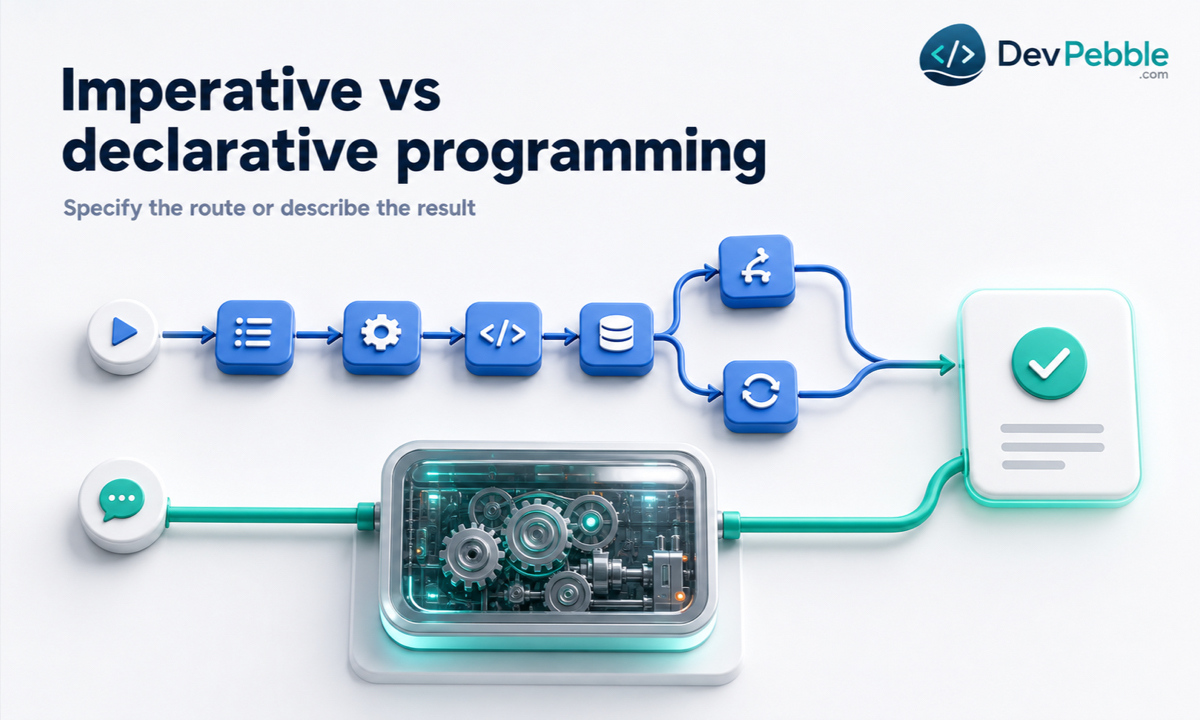
Ask a database admin for customers who spent over $500 last month and they'll write one line: SELECT * FROM customers WHERE total_spent > 500;. Ask someone coding it by hand and they'll reach for a loop: open the records, check each total, build a list of anyone over the threshold. Both land on the same answer. The gap between them is the gap between declarative and imperative programming.
Declarative code describes the destination and trusts something else to plan the route. SQL states what data is wanted, not how to scan the table; the query planner handles that. HTML works the same way. Imperative code insists on the route itself, and front-end web development shows the contrast well. Manipulating the DOM directly is a textbook imperative task:
const heading = document.createElement("h1");
heading.textContent = "Welcome";
document.body.appendChild(heading);
Every line is a command: create this element, set this property, attach it here. React lets you describe the UI as a function of state instead, and the library works out which DOM operations are needed:
function Greeting() {
  return <h1>Welcome</h1>;
}
React's version is easier to read, but it isn't magic. Underneath, it runs an imperative diffing algorithm that compares the new UI to the old one and calculates exactly which nodes to change. That's the pattern worth remembering: nearly every declarative tool, whether a SQL engine, a CSS renderer, or a UI framework, has an imperative engine doing the actual work underneath.
| Aspect | Imperative | Declarative | |---|---|---| | Focus | How to do it | What result is wanted | | State | Mutable, changes over time | Often hidden or avoided | | Typical use | C, Java, standard Python loops | SQL, HTML, Python comprehensions | | Debugging | Step through state changes | Trust the underlying engine |
So which should you reach for? Imperative code earns its keep when you need fine control over performance, memory, or an algorithm's behavior, like writing a device driver or optimizing a hot loop. Declarative code wins when the engine is already optimized and you'd rather state intent than manage execution. Most applications use both: declarative markup and queries wrapped around an imperative core that runs the logic.
Popular imperative programming languages
C, C++, Java, Python, JavaScript, C#, and Go are the languages most developers reach for when writing imperative code. Each has its own history and its own sweet spot.
C (1972, Dennis Ritchie at Bell Labs) gets about as close to the hardware as you can without dropping into assembly, with direct memory control through pointers and almost no runtime overhead. That's why the Linux kernel, the Windows NT kernel, and most embedded firmware are still written in C. C++ built object-oriented features on top of C in the mid-1980s while keeping the low-level control, and it powers most game engines, high-frequency trading, and heavy desktop software like Adobe's tools.
Java (1995) promised write-once, run-anywhere through the Java Virtual Machine, and that portability plus automatic memory management made it the default for enterprise banking, e-commerce backends, and the original Android apps. Python (1991) is often a beginner's first language because its syntax reads close to plain English; it's imperative at its core but supports declarative shortcuts like list comprehensions, and it now runs much of the world's automation and machine learning work.
JavaScript (1995) is the only language that runs natively in every browser. Its imperative side handles DOM manipulation and events, while methods like .map and .filter allow a declarative style, and Node.js extended that foundation to the server. C# (2000) anchors Microsoft's .NET platform and, through Unity, much of game development. Go (2009) was built to keep imperative code simple and fast to compile while baking in concurrency, which is why Docker and Kubernetes are written largely in it.
| Language | First released | Known for | |---|---|---| | C | 1972 | Operating systems, embedded firmware | | C++ | mid-1980s | Game engines, high-performance software | | Java | 1995 | Enterprise systems, Android (originally) | | Python | 1991 | Automation, data science, readability | | JavaScript | 1995 | Browsers, web front ends, Node.js backends | | C# | 2000 | .NET applications, Unity game development | | Go | 2009 | Cloud infrastructure, concurrent systems |
The older languages explain why imperative code looks the way it does. Fortran (1957) and COBOL (1959) were among the first high-level imperative languages, and COBOL still runs inside a startling amount of financial infrastructure. Pascal and BASIC introduced generations of students to structured programming through the 1960s and 1970s before C took over that role.
Imperative programming examples you can follow
Reading about loops only gets you halfway. The rest comes from working through code line by line. These three build on each other.
FizzBuzz
Print 1 to 20, but print "Fizz" for multiples of 3, "Buzz" for multiples of 5, and "FizzBuzz" for multiples of both.
for number in range(1, 21):
    if number % 15 == 0:
        print("FizzBuzz")
    elif number % 3 == 0:
        print("Fizz")
    elif number % 5 == 0:
        print("Buzz")
    else:
        print(number)
The order of the checks is the whole trick. The program tests divisibility by 15 first, because any number divisible by both 3 and 5 is divisible by 15, so checking that case first stops it from printing "Fizz" and "Buzz" separately. Rearrange the conditions and the output breaks.
A temperature converter
This adds functions and return values, the core of writing reusable code instead of one long script.
def celsius_to_fahrenheit(celsius):
    fahrenheit = (celsius * 9/5) + 32
    return fahrenheit

print(celsius_to_fahrenheit(0))    # 32.0
print(celsius_to_fahrenheit(100))  # 212.0
print(celsius_to_fahrenheit(37))   # 98.6
The function takes one input, runs a fixed sequence of arithmetic, stores the result in a local variable, and hands it back. Nothing branches or repeats, but it's still fully imperative, and fahrenheit exists only while the function runs. It's the pattern behind every weather app quietly converting temperatures.
A simple bank account simulator
This pulls state, functions, and conditionals into something closer to real software.
balance = 100

def deposit(amount):
    global balance
    balance = balance + amount
    print(f"Deposited {amount}. New balance: {balance}")

def withdraw(amount):
    global balance
    if amount > balance:
        print("Insufficient funds.")
    else:
        balance = balance - amount
        print(f"Withdrew {amount}. New balance: {balance}")

deposit(50)
withdraw(30)
withdraw(1000)
Running it lifts the balance to 150 after the deposit, drops it to 120 after the first withdrawal, and prints "Insufficient funds" when the third call tries to pull more than the account holds. The functions don't return anything; they modify shared state and print a message, which is a side effect in plain sight. Small as it is, this uses every idea covered so far.
Advantages and disadvantages of imperative programming

Every strength here comes with a matching trade-off.
The biggest advantage is fine-grained control. Because you dictate the exact sequence of operations, you can tune code down to individual memory allocations and CPU cycles, which is why firmware in a pacemaker or airbag controller is written imperatively: every instruction's timing needs to be predictable enough to certify. That same transparency makes debugging intuitive, since state changes happen in a traceable order you can step through. And because the paradigm mirrors how people work through tasks, it's usually the gentlest starting point for beginners.
The weaknesses trace back to the feature that makes it powerful: shared mutable state. Once concurrency enters the picture, that state becomes a liability. Picture two threads updating the same balance at once. Without careful synchronization, both can read the old value before either writes the new one, and one update vanishes. These race conditions are among the hardest bugs to reproduce, and they exist precisely because any part of an imperative program can change a shared variable at any time. Testing suffers for the same reason: a function that touches external state doesn't guarantee the same output for the same input. Imperative code also tends to be more verbose than a declarative equivalent, and without garbage collection, manual memory management opens the door to leaks and crashes.
| Advantages | Disadvantages | |---|---| | Precise control over memory and execution order | Mutable state can cause race conditions in concurrent code | | Easy to trace and debug step by step | Harder to test when functions depend on external state | | Matches how most people think through tasks | More verbose than declarative code for data transformations | | Strong potential for direct performance tuning | Manual memory management invites leaks in unmanaged languages | | Supported across nearly every major language | Large codebases can grow tangled without discipline |
None of this makes imperative programming a poor choice. It rewards discipline. Clear variable scoping, minimal shared state, and enough structure to keep step-by-step logic organized are what separate clean imperative code from the tangled kind everyone eventually meets.
Where imperative programming runs in the real world

It's worth seeing where imperative code runs right now, usually inside systems people rely on without thinking about the code underneath.
Operating systems are the clearest case. The Linux kernel, which powers most of the world's servers and every Android phone, is written almost entirely in C, because managing hardware and memory directly demands exact, step-by-step control. That's shifting at the edges: at the 2025 Kernel Maintainers Summit, Rust was declared a permanent, non-experimental part of the kernel, and Android devices on the 6.12 kernel already ship a Rust-written memory module in production (LWN). The balance is still lopsided, though. As of April 2025 the kernel held roughly 34 million lines of C against about 25,000 lines of Rust (The New Stack). C isn't going anywhere; Rust is joining it for new, safety-sensitive drivers.
Web browsers run on it too. Chrome's V8 engine, which executes the JavaScript behind most sites you visit, is written in C++, so the declarative experience on the surface sits on millions of lines of imperative code running instructions in sequence.
Financial systems lean on it at both extremes. A striking amount of core banking still runs on COBOL, a language from 1959, because rewriting decades of tested logic carries more risk than maintaining it. It's not a footnote: COBOL still handles roughly 95% of ATM transactions, about 80% of in-person card payments, and around 43% of banking systems, supporting an estimated $3 trillion in daily commerce (BizTech Magazine). At the other end of the same industry, high-frequency trading firms write execution engines in C++ for microsecond control that only a low-level language delivers reliably.
Embedded and safety-critical systems demand the same predictability. Firmware in car airbags, insulin pumps, and pacemakers is written in C, where there's no room for a garbage collector pausing at an unpredictable moment. NASA's Mars rovers run flight software largely in C for the same reason, and much climate modeling still runs on decades-old Fortran whose numerical routines were validated too thoroughly to be worth rewriting. Closer to home, game engines like Unreal (C++) and Unity (C#) need frame-by-frame control many times a second, and countless small Python scripts quietly handle reports and data pipelines inside companies of every size.
Taken together, these aren't relics waiting to be replaced. Imperative programming is the layer doing the actual work underneath a huge share of the software the modern world runs on, from the phone in your pocket to the systems tracking a rover on Mars.
Conclusion
Imperative programming comes down to one idea: telling a computer exactly what to do, one instruction at a time, while tracking how its state changes along the way. That idea shows up in a beginner's first for loop and in the C running inside an aircraft's flight controls. We've covered what the paradigm is, the building blocks that define it, how it compares to declarative code, the languages built on it, and where it still runs.
None of this makes it something to move past once you learn a "better" paradigm. It's the foundation most other paradigms build on. Get comfortable with sequential execution, mutable state, and control flow, and every concept you learn afterward tends to click into place faster.