Functional reactive programming: concepts, examples, benefits, and trade-offs
Functional reactive programming explained: signals and events, a live-search example, FRP vs reactive programming and Reactive Streams, and its trade-offs.
On this page⌄
- What is functional reactive programming?
- How does functional reactive programming work?
- A functional reactive programming example: a live search interface
- FRP vs reactive programming, Reactive Streams, and the observer pattern
- When should you use functional reactive programming?
- What are the benefits of FRP?
- What are the limitations and risks of FRP?
- How do you evaluate and adopt FRP?
- Is FRP worth adopting?
- FAQ
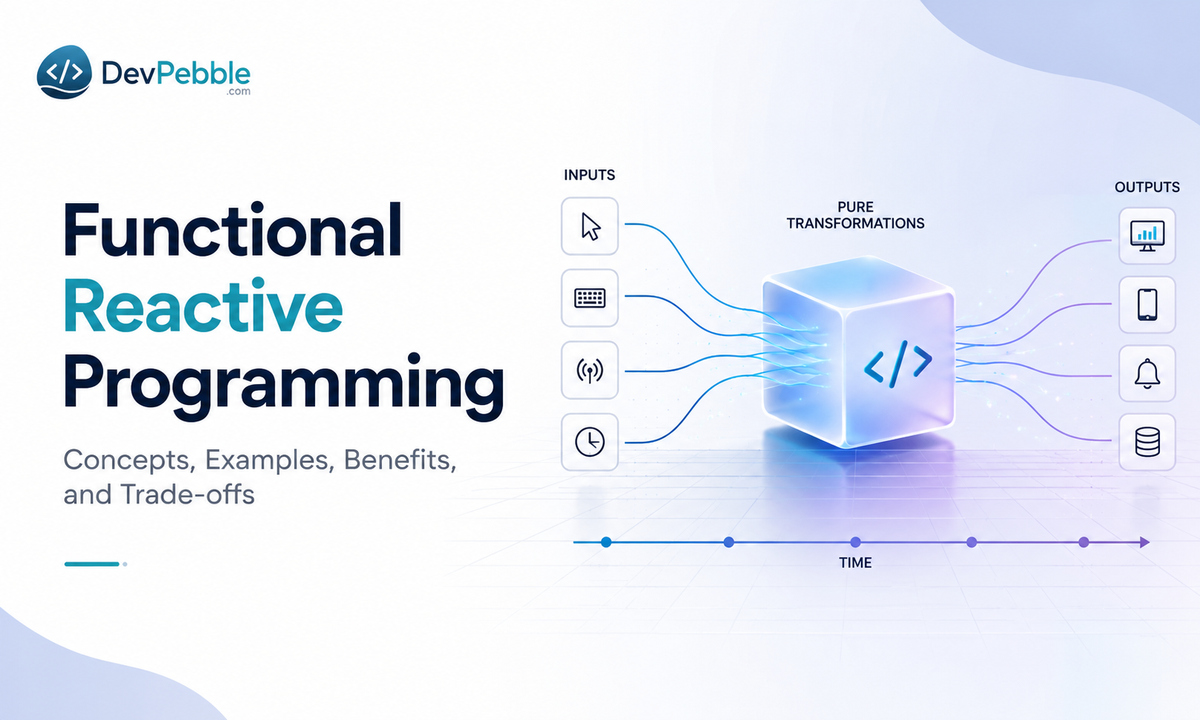
Functional reactive programming (FRP) describes software as relationships among values that change over time, called signals or behaviors, plus the discrete events that occur along the way. Dependent values then update automatically instead of being pushed around by hand-written callbacks. The same three letters are also used loosely for functional composition over observable streams, which is related but not identical.
This guide covers the mechanism, a worked example, how FRP compares with reactive programming and Reactive Streams, where it fits, and what it costs. Where precision matters, "classic FRP" means the signal-and-event model and "Rx-style reactive programming" means the observable-stream model.
What is functional reactive programming?
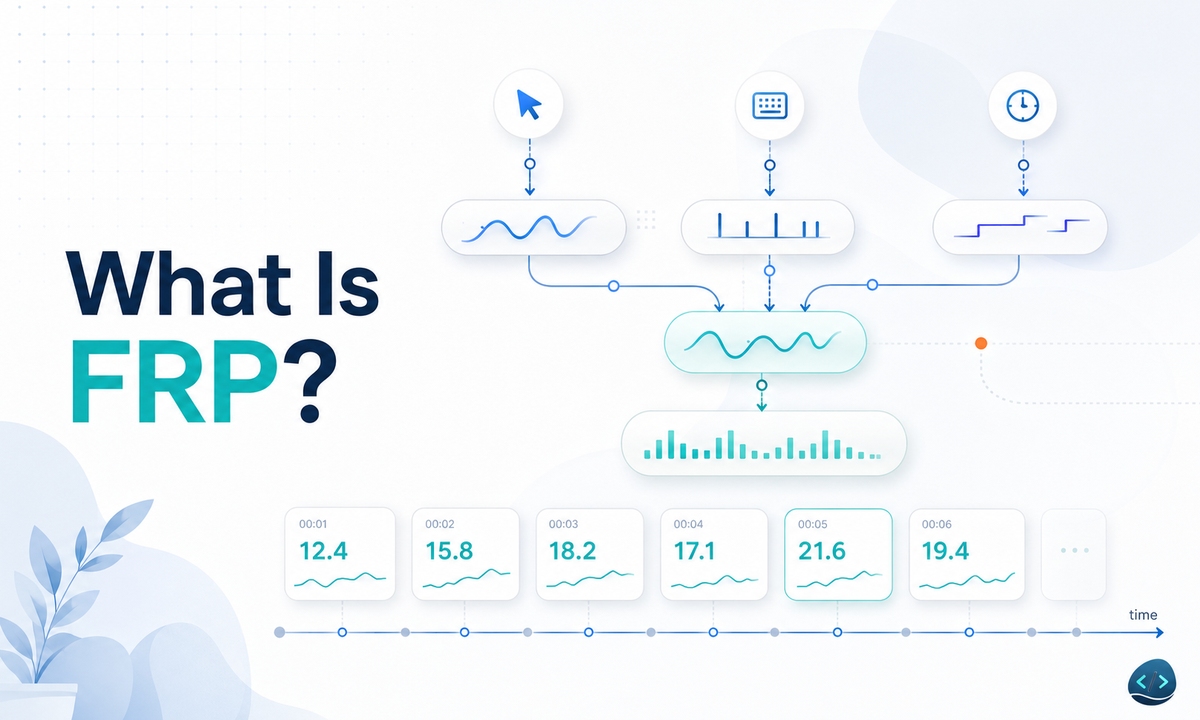
FRP defines program behavior through signals that vary over time, discrete events, and pure functions that build new signals from existing ones, with a runtime propagating changes automatically. Implementations differ enough that the term should not be flattened into "calling map on an asynchronous stream," which describes one branch of the idea rather than the whole of it.
The approach came out of research on declarative interactive animation. Elliott and Hudak's ICFP 1997 paper Functional Reactive Animation introduced Fran, built on behaviors, which the paper describes as "time-varying, reactive values", and on events that carry information when they occur. The concern was modeling relationships across time rather than synchronizing mutable state by hand. "Functional" here points at composition and controlled effects, not lambda syntax. FRP is a family of formulations rather than one API, which is why two libraries can both claim the label and still make different promises.
A plain-English definition of FRP
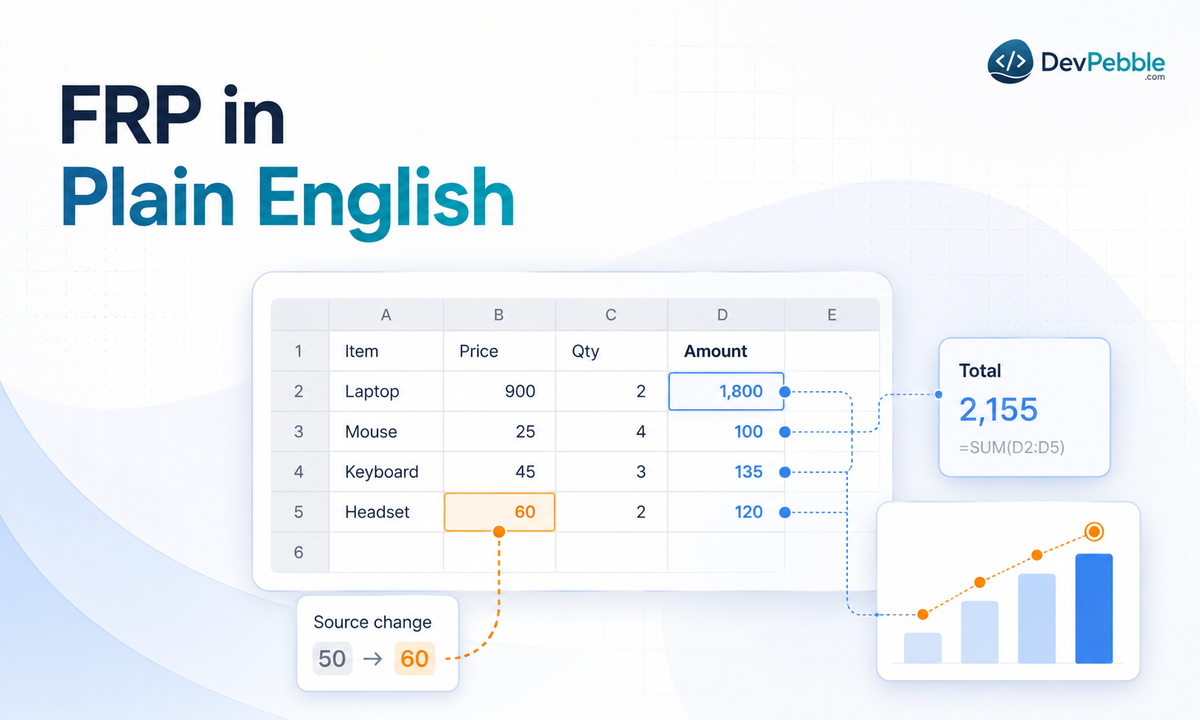
Think of a spreadsheet. Change one cell and every formula depending on it recalculates, without anyone retyping the dependent cells. FRP applies that idea to program state: source values change over time, pure functions derive new values from them, and the runtime recomputes only what the change actually affects.
Discrete occurrences such as clicks, messages, and completed requests are usually modeled as events, which are distinct from signals that always have a current value. Effects such as network calls and rendering stay at defined boundaries, so the reactive logic itself stays pure:
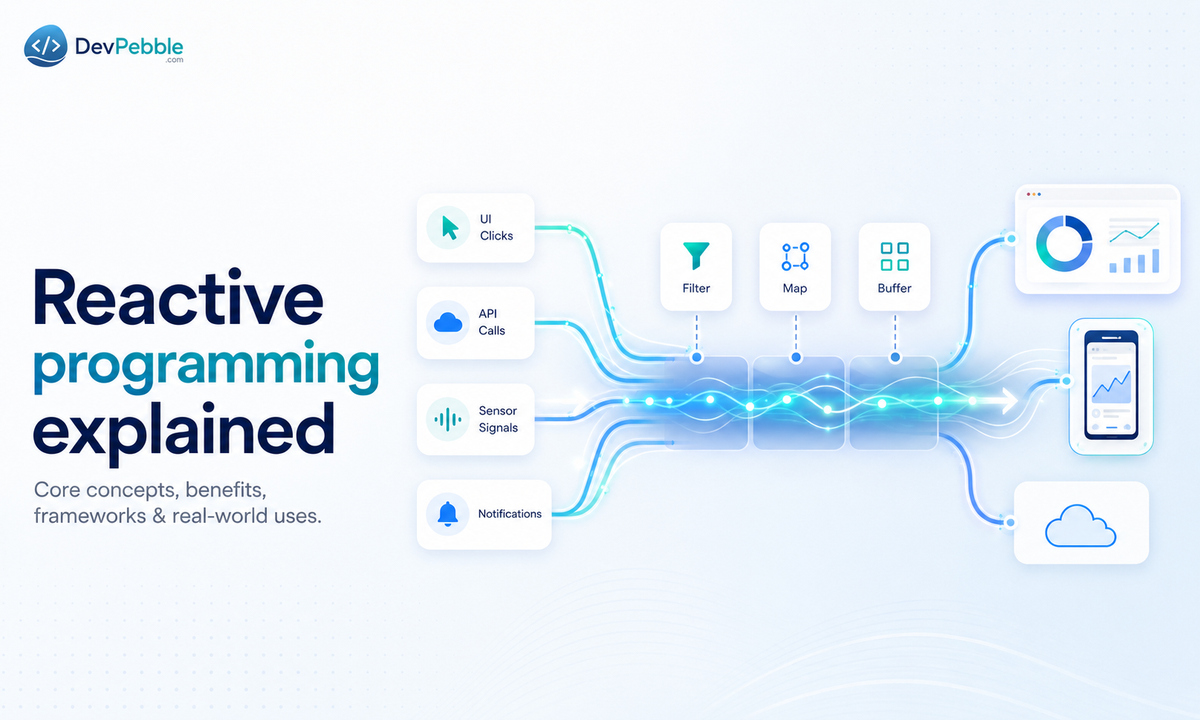
inputs over time -> pure transformations -> derived outputs over time
Why "functional reactive programming" has two meanings
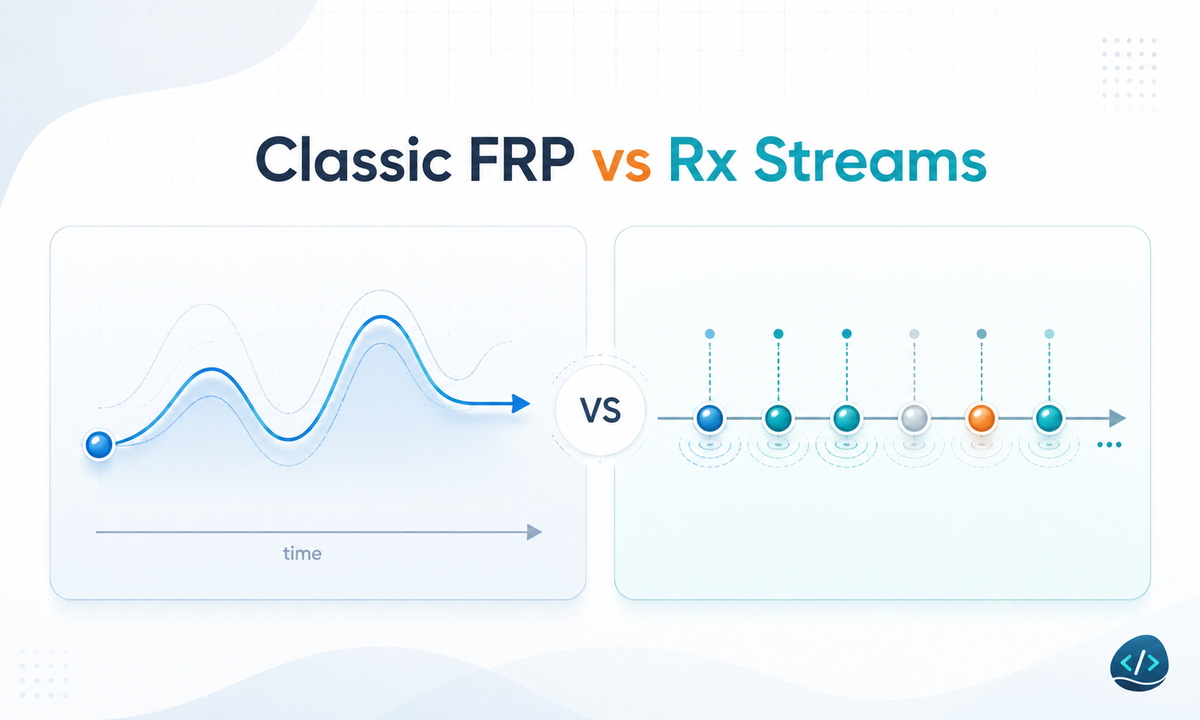
Classic FRP gives time a first-class semantic role through signals and events. Industry usage often applies the label to functional composition over observable event streams, as in Rx-style libraries, which overlaps in spirit without sharing the original model's formal guarantees. In ReactiveX, an observer subscribes to an Observable, and the real power comes from operators that transform and combine the sequences it emits. A map or filter pipeline is not classic FRP just because it reacts to something.
| Model | Core vocabulary | What it treats as primary | | --- | --- | --- | | Classic FRP | Signals or behaviors, events, switching, time | Values and the relationships between them across time | | Rx-style observable streams | Observables, subscriptions, operators, error and completion channels | Sequences of emitted items and how they compose |
How does functional reactive programming work?
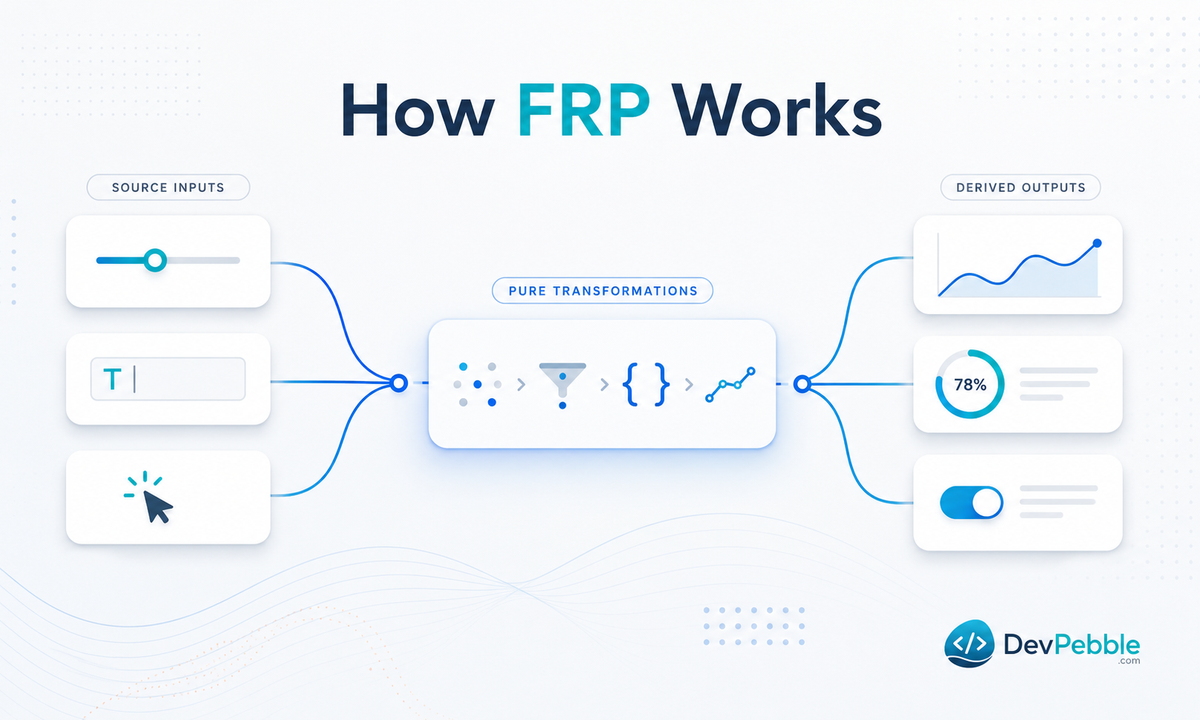
An FRP program builds a network of dependencies. Source values change or events occur, the runtime evaluates every transformation that depends on them, and updated outputs appear at the edges. Whether that happens by pushing changes forward, pulling values on demand, or sampling on a clock is an implementation decision, not something the term settles for you.
Every formulation separates source inputs, which are raw data from users, devices, or services, from derived values produced by pure transformations. Some treat time as conceptually continuous even when the runtime advances in discrete steps. Glitch-free, deterministic updating is a design goal in some systems rather than a property of FRP as such: the 2013 ACM Computing Surveys survey of reactive programming classifies languages along axes that include the evaluation model and glitch avoidance, precisely because they vary.
Behaviors and signals model values over time
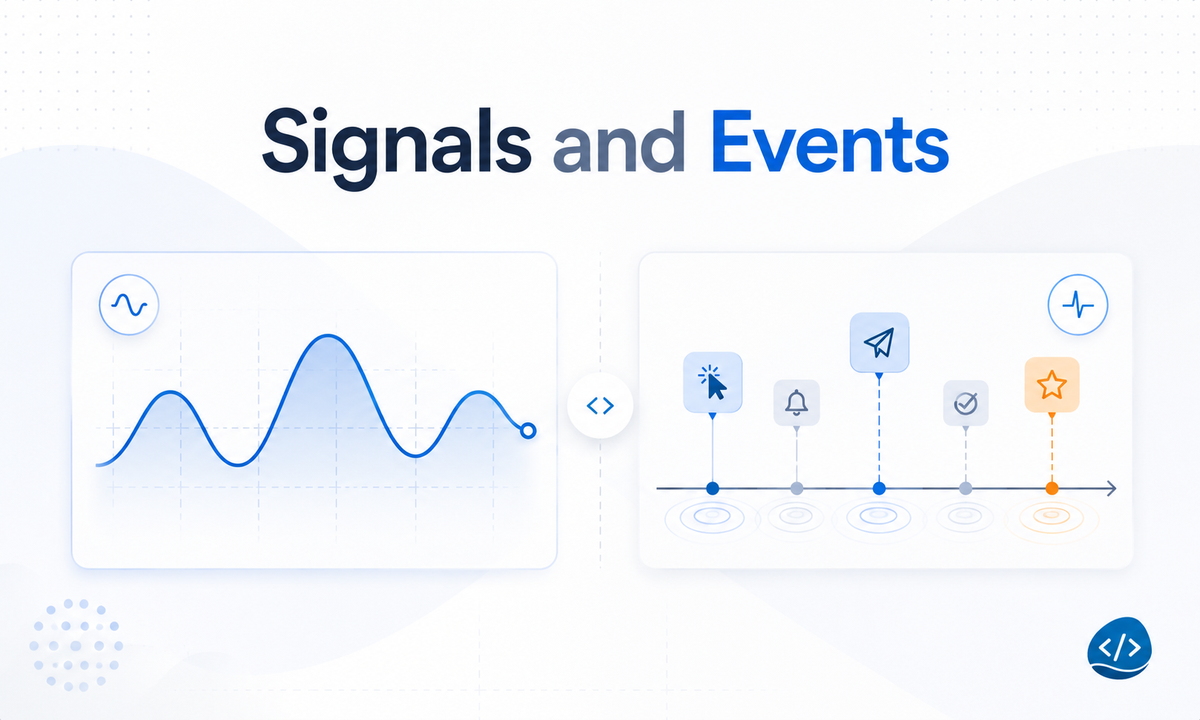
A signal, also called a behavior, is a value whose meaning includes how it varies over time, unlike a conventional variable that only holds its latest state. Pointer position, elapsed time, temperature, and form validity are typical examples. Yampa's documentation treats a signal as, conceptually, a function from time to a value, and a signal function as a pure transformation from a time-varying input into a time-varying output.
Derived signals express stable relationships instead of one-off assignments:
| Source signal | Transformation | Derived signal | | --- | --- | --- | | Unit price and quantity | Multiply | Order total | | Pointer position | Distance from target | Hover proximity | | Search text | Validation function | Query-valid state |
Three roles recur in that table. Source signals enter from users, devices, clocks, services, or application state. Derived signals are defined as functions of one or more other signals. Signal functions are the reusable transformations in between. In practice, implementations calculate samples on demand rather than materializing an infinite object.
Events represent occurrences and enable switching
An event has no value at every moment. It occurs at particular times and may carry data: a click, an incoming message, a completed request. Yampa models an event as a value that may or may not occur, in contrast with something like a mouse position, which is always defined. A signal answers "what is the value now?" An event answers "what just happened?"
Events do three jobs worth naming. Accumulation turns a sequence of occurrences into changing state, such as a click count. Snapshotting reads a signal's value at the moment an event fires. Switching replaces one behavior or subnetwork with another once an event arrives. Two events landing in the same step need an explicit rule, since "at the same time" is otherwise ambiguous.
Push, pull, sampling, and dependency propagation
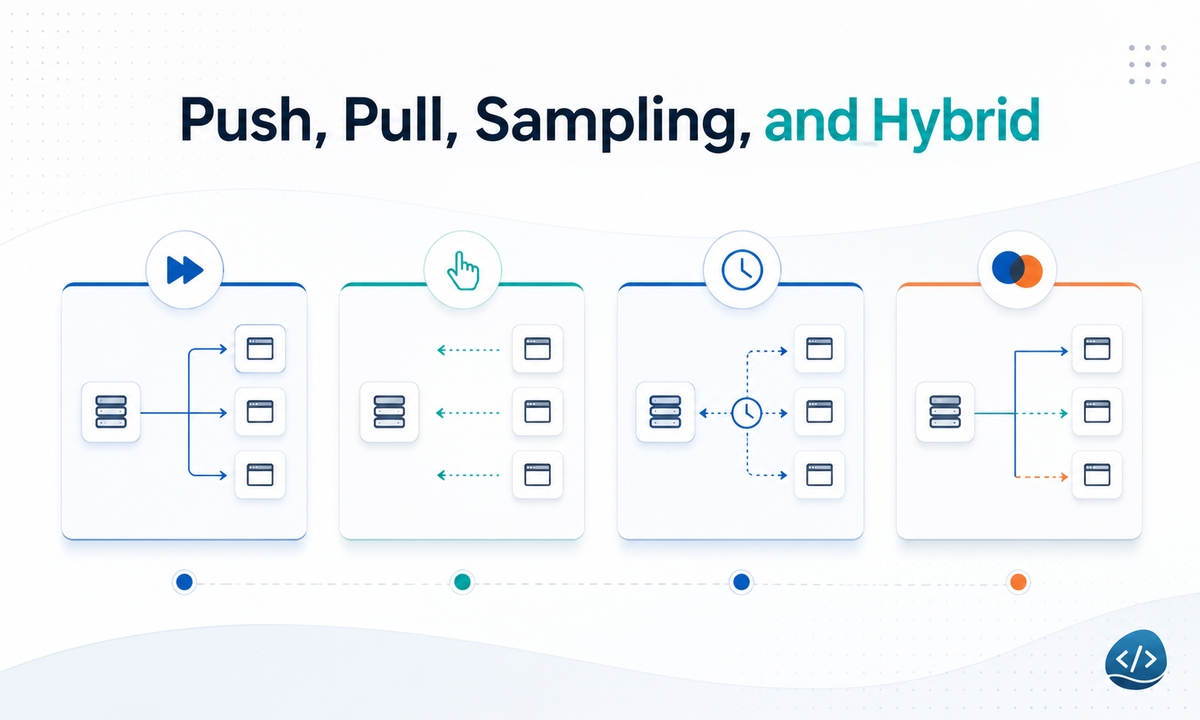
FRP semantics say what values mean. A runtime still needs a strategy for computing them, and the survey cited above separates push-based evaluation, pull-based evaluation, and hybrids that aim for the low latency of the first with the demand-driven flexibility of the second.
| Strategy | How updates happen | Trade-off | | --- | --- | --- | | Push | A source change propagates to dependents as soon as it happens | Low latency, more exposure to redundant or inconsistent intermediate updates | | Pull | Values are recomputed when an output is demanded | Avoids unrequested work, can add latency at the point of demand | | Sampling | The network is evaluated on a clock or frame cycle | Predictable cadence for animation and control, may coalesce fast changes | | Hybrid | Push for events, pull or sampling for continuous values | Fewer wasted recomputations, more moving parts to reason about |
Yampa takes the sampled route. It is a Haskell language for deterministic hybrid systems mixing discrete and continuous time, and its execution functions advance a signal function one cycle at a time with an explicit time delta rather than evaluating a continuous function of time.
A functional reactive programming example: a live search interface
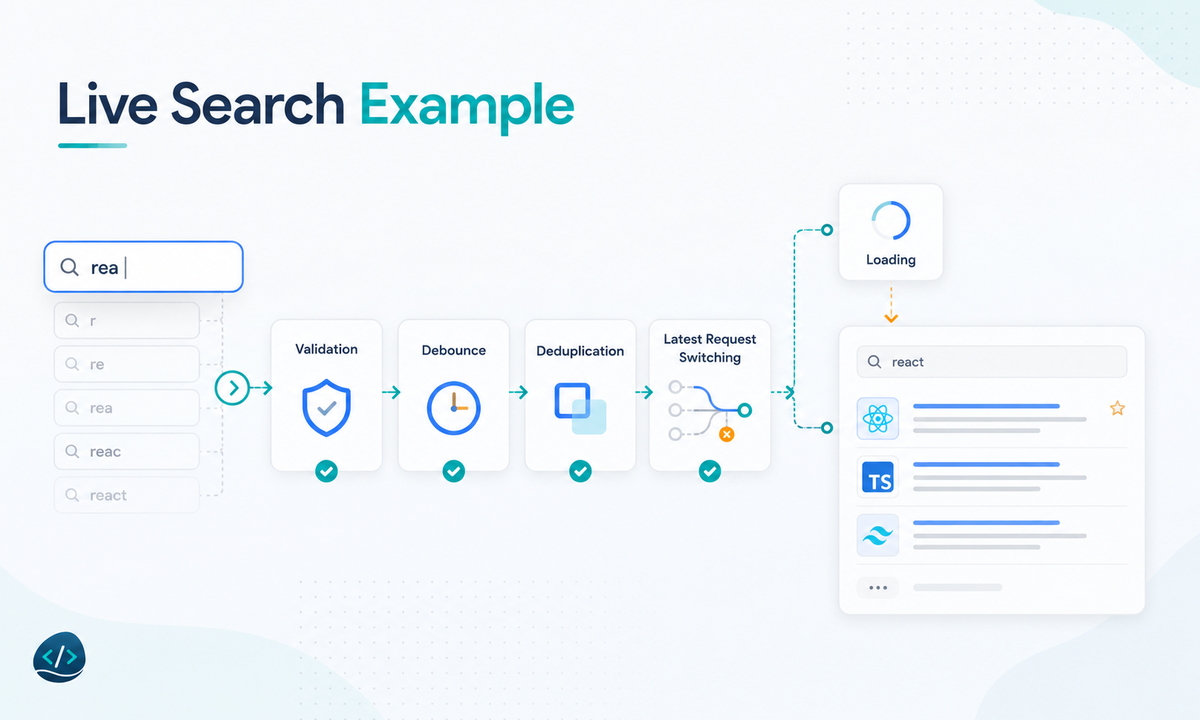
Live search is a useful test case. As the user types, a short pause should trigger a request, a slow or duplicate request should not overwrite newer results, and loading, error, and result states have to agree with each other. Nothing about it is exotic, which is the point. The coordination problem is ordinary, and it is exactly where callback code starts to rot.
The imperative callback version
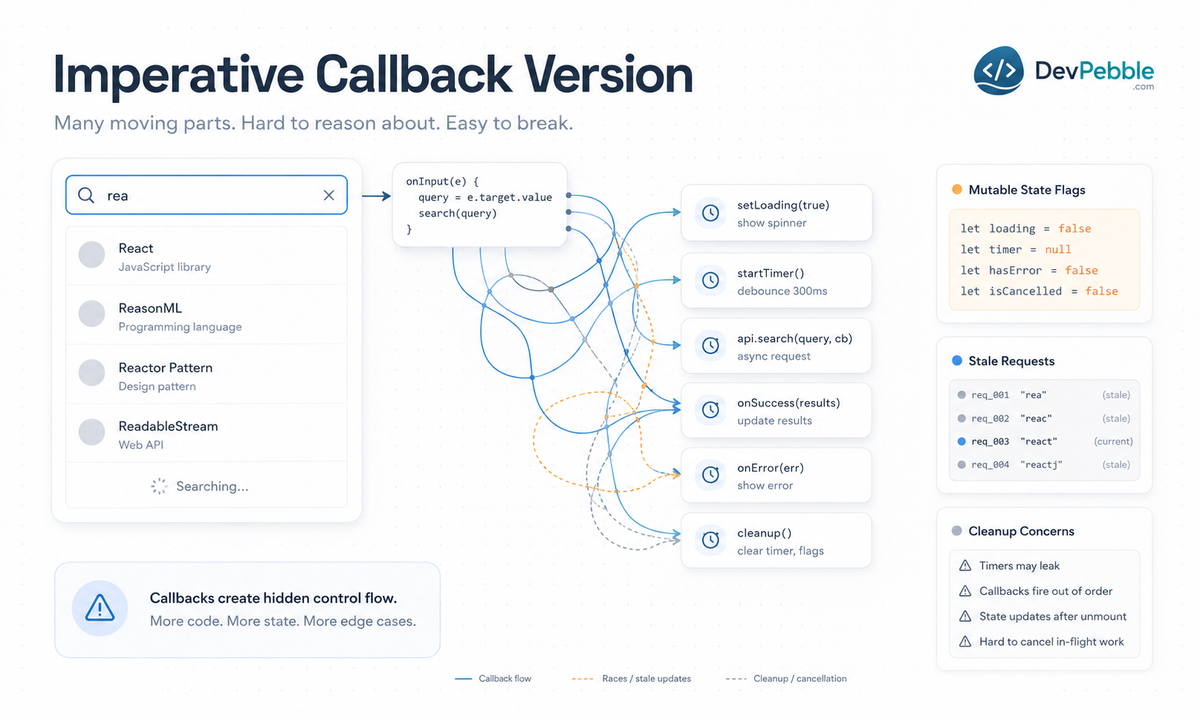
A callback implementation attaches a keystroke listener that mutates a shared text variable, resets a debounce timer, and fires a request when the timer elapses. It works. It also makes one developer personally responsible for:
- updating a mutable variable from the keystroke handler
- resetting a timer on every keystroke to implement the pause
- tagging each request so a late response can be discarded once a newer one has started
- setting and clearing loading, error, and result flags from several code paths
- clearing timers and aborting in-flight requests on unmount or navigation
Reactor's introduction to reactive programming makes the general version of the complaint: callbacks compose badly, and nesting them for anything non-trivial produces the callback-hell pattern it walks through in detail.
The FRP dataflow version
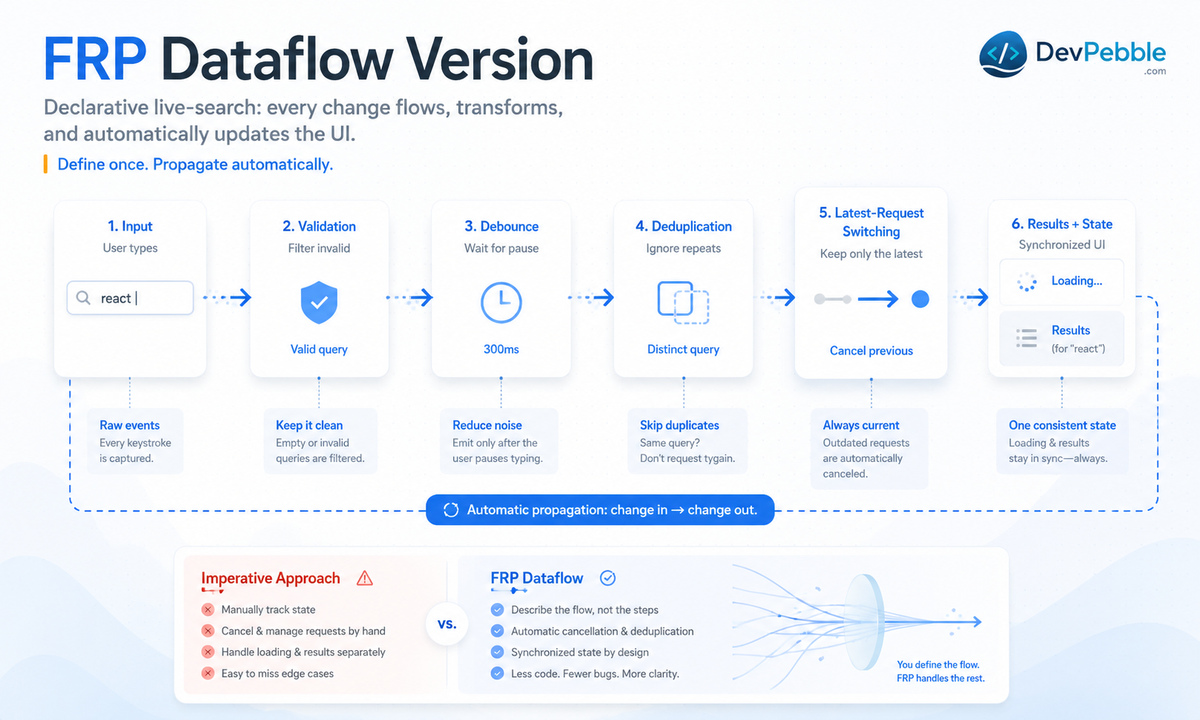
The FRP version treats search text, request state, and results as connected signals and events rather than callbacks mutating shared variables. The program declares how each value derives from the others, then lets the runtime propagate updates and discard stale work.
- Treat the text field's input as a signal, or as an event stream of keystrokes.
- Normalize and validate the text.
- Wait for a quiet interval. ReactiveX's Debounce operator states the rule exactly: emit an item only once a given timespan has passed without another emission.
- Drop consecutive duplicate queries so an unchanged query does not fire twice.
- Map each accepted query to a request.
- Switch to the latest request and abandon any earlier one still pending. ReactiveX's Switch operator describes the generic behavior: it unsubscribes from the previously emitted observable as soon as a new one arrives, so items from the old one are dropped.
- Derive loading, error, empty, and result views from the current request state.
- Perform the HTTP call and the rendering at the effect boundary, outside the pure transformations.
Three layers fall out of that sequence. The input layer carries search text, elapsed time, and network completion events. The transformation layer holds validation, deduplication, debouncing, request selection, and derived view state. The effect layer performs the request, logging, analytics, and rendering.
What the example shows and what it does not
It shows declarative dependency modeling. Stale results stop appearing because "the latest request" is defined as a relationship, not tracked with a manual flag that someone has to remember to clear. It does not show that every FRP implementation produces less code, runs faster, or debugs more easily than the callback version. That depends on the library and the problem, and the honest way to find out is to build the feature both ways and compare.
FRP vs reactive programming, Reactive Streams, and the observer pattern
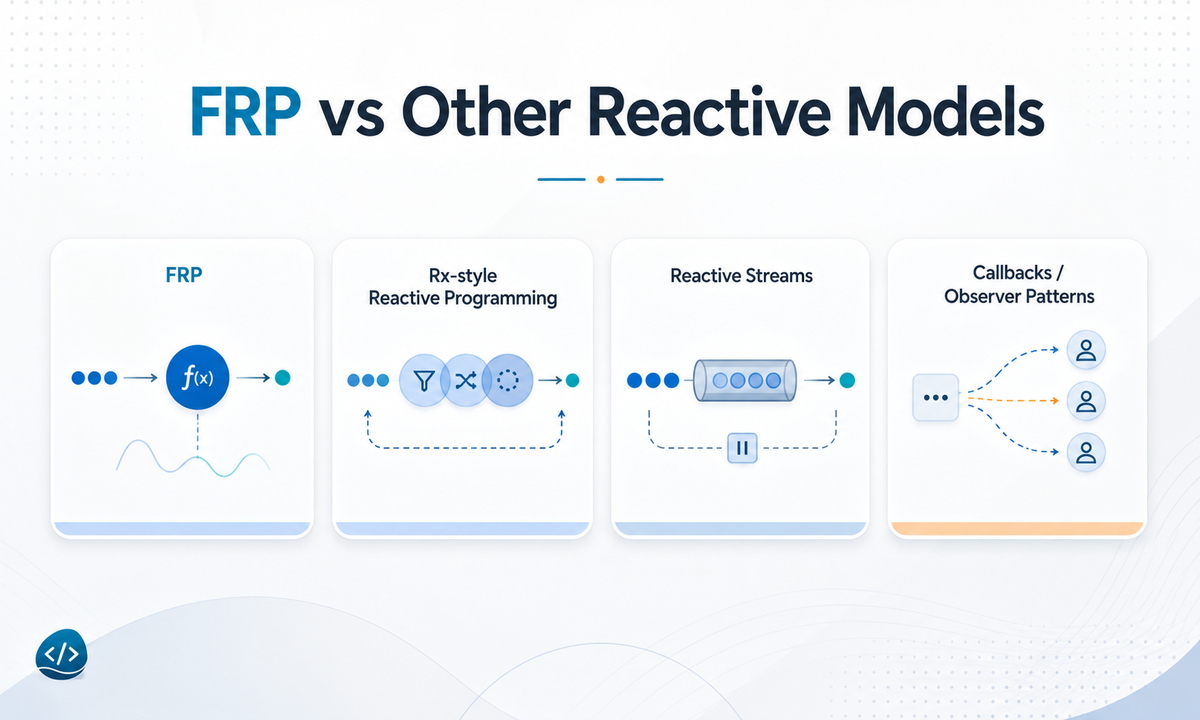
These labels get swapped around freely, but they answer different questions. Classic FRP defines relationships between values across time. Rx-style reactive programming composes observable sequences with operators. Reactive Streams is a protocol for asynchronous flow control with backpressure. Reactive systems, in the Reactive Manifesto sense, are an architectural property of a running system rather than a language semantics.
Comparison table: semantics, state, backpressure, and scope
Compare these models by the problem each one solves rather than by shared surface syntax. Two APIs can both expose a map method while promising very different things about time, subscriptions, ordering, and demand.
| Model | Primary abstraction | Main concern | Backpressure | Typical scope | | --- | --- | --- | --- | --- | | Classic FRP | Signals or behaviors and events | Values and relationships over time | Not part of the core semantics | Interactive, time-aware logic | | Rx-style reactive programming | Observables and operators | Composable async and event sequences | Library-dependent | UI events, async workflows | | Reactive Streams | Publisher, Subscriber, Subscription | Asynchronous flow control | Core requirement | Cross-component stream processing | | Observer and callbacks | Listeners and handlers | Notifying code when something occurs | Usually manual | Local event handling | | Reactive systems | Message-driven components | Resilience, responsiveness, elasticity | Architectural | Distributed system architecture |
Reactive Streams exists to govern the exchange of stream data across an asynchronous boundary with non-blocking backpressure, so a slow consumer is never forced to buffer unbounded data. Version 1.0.4 was released in May 2022, and the JDK 9 java.util.concurrent.Flow interfaces are semantically equivalent to it. The Reactive Manifesto, published in its 2.0 form in September 2014, defines reactive systems by four properties, responsive, resilient, elastic, and message driven, all of which describe how a whole system behaves under load and failure rather than how one value updates.
Common naming mistakes to avoid
Shared vocabulary does not make these ideas interchangeable. Stream, reactive, observable, and FRP mean different things depending on who is speaking, which is how two teams end up with different expectations of the same guarantee.
- A UI framework that re-renders on state change is not automatically FRP. React's own repository describes the library as declarative, where you design simple views for each state and React updates and renders the right components when data changes. That is a real property, and it is still not signal-and-event semantics. Layered state or stream libraries can add FRP-like relationships on top.
- An Rx operator pipeline is not automatically classic FRP. Reactor's guide notes that reactive programming is usually presented in object-oriented languages as an extension of the observer pattern, which classic FRP predates and formalizes differently.
- Reactive Streams is a protocol for moving data across an asynchronous boundary, not an application architecture.
- A system is not reactive in the Manifesto sense because it imports an Observable API. That label describes the whole system's behavior under load and failure.
When should you use functional reactive programming?
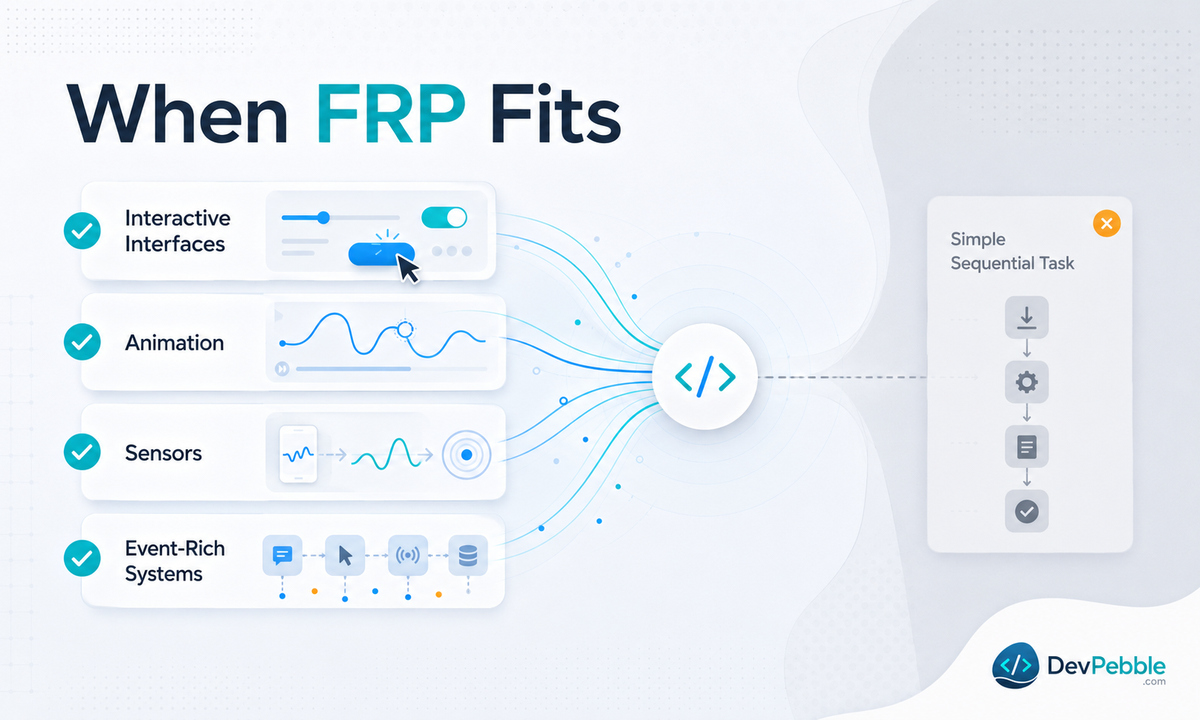
FRP earns its complexity when several values or events change over time and have to stay consistently related to one another. It adds abstraction you will resent when the logic is short, sequential, and thin on dependencies. Judge the coordination problem in front of you rather than the popularity of a library.
Strong-fit use cases
FRP tends to fit domains where inputs, outputs, and internal state change continuously and depend on each other:
- interactive interfaces and forms, with many fields, validation states, and view states that must stay in sync
- animation, games, and simulation, where logic is tied to elapsed time and continuous motion
- sensors, robotics, and temporal control, where readings are filtered, combined, and acted on inside time constraints
- event-rich business logic, where rules are built from combinations and sequences of events
The original animation research is the ancestor of the first two, and Yampa is still documented as a language for hybrid discrete and continuous-time systems, with cross-platform games among its uses.
Poor-fit cases and practical alternatives
When a problem involves little ongoing change, few dependencies, or a plain request-response lifecycle, the coordination machinery costs more than it returns.
| Problem | Better fit than FRP | | --- | --- | | A single one-shot asynchronous call | Promise or future | | An explicit, finite workflow | State machine | | An isolated notification | Plain callback or the observer pattern | | Independent concurrent entities | Actor model | | A high-volume pipeline needing demand control | A Reactive Streams implementation | | A straightforward batch transformation | Ordinary functional or imperative code |
What are the benefits of FRP?
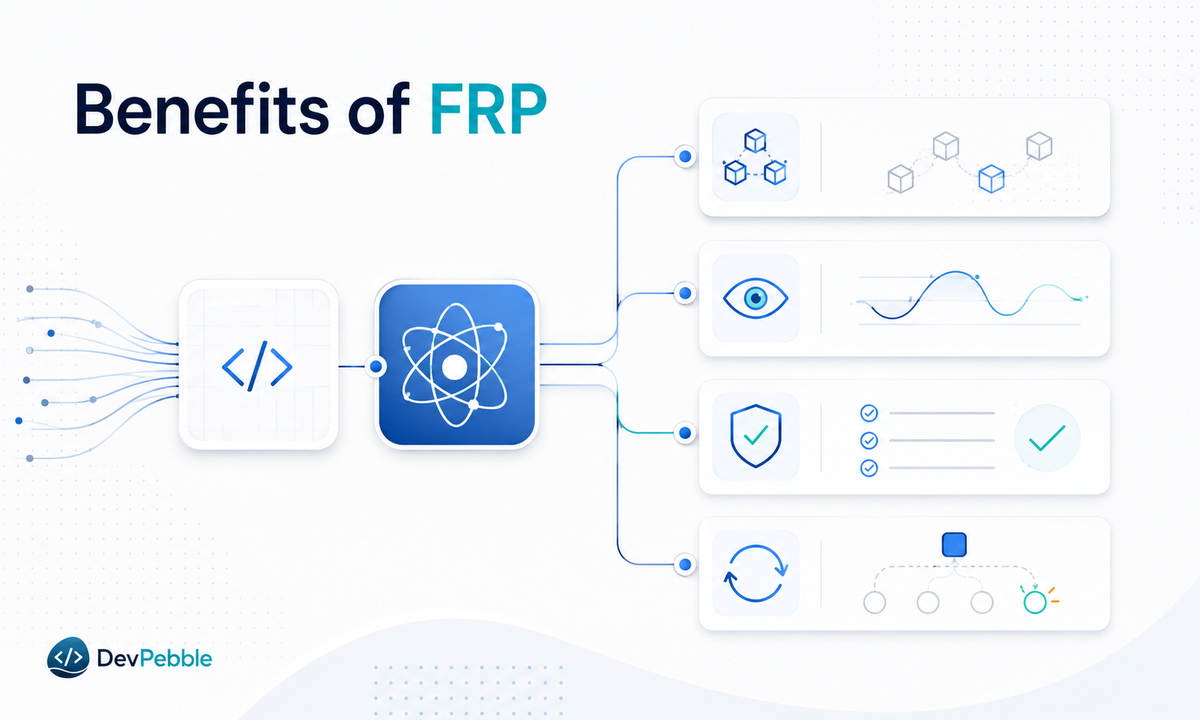
The central benefit is making relationships among changing values explicit and composable instead of scattering them across callbacks. Whether that benefit shows up depends on three conditions: a problem that genuinely involves change propagation, correctly understood runtime semantics, and disciplined separation of effects.
- less manual synchronization between dependent values
- declarative composition of transformations
- temporal rules in one place instead of timers spread across handlers
- a clearer line between pure logic and I/O
- tests that drive the logic with controlled input timelines
Composability, clarity, testability, and change propagation
Each benefit traces to a specific practice rather than to the paradigm in the abstract.
| Benefit | Mechanism | Condition it depends on | | --- | --- | --- | | Composability | Reusable signal functions or operators with explicit inputs and outputs | Boundaries chosen deliberately, not by accident | | Clarity | Dependencies stated in code instead of implied by callback ordering | Pipelines kept shallow enough to read in one pass | | Testability | Pure logic separated from clocks, network calls, and rendering | Effects genuinely pushed to the boundary | | Change propagation | The runtime updates dependents when sources change | You know what the runtime promises about ordering |
A deeply nested operator chain with vague names undoes most of this. Clarity comes from how the code is written, not from the label on the library.
What are the limitations and risks of FRP?
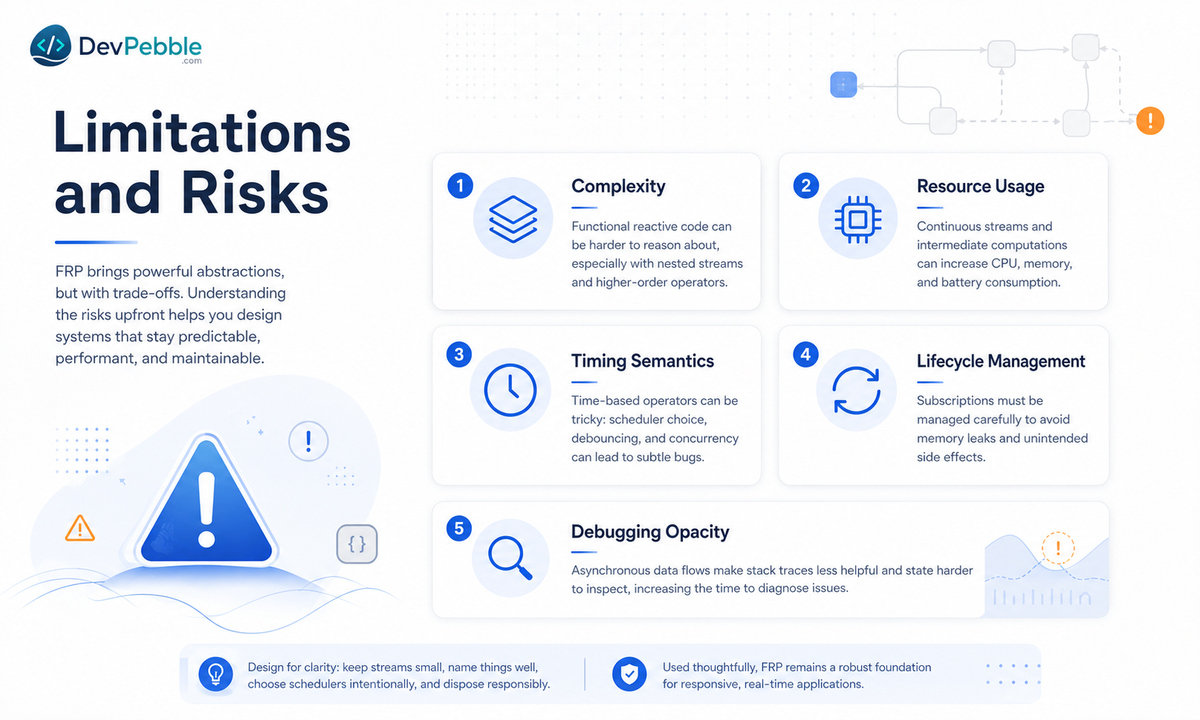
FRP shifts complexity rather than eliminating it. Manual update code goes away, and in its place developers have to understand time, ordering, subscription lifecycle, and what their runtime guarantees about resources. Misunderstand those and you get a fresh class of bugs in exchange for the old one.
Learning curve, debugging, glitches, and resource leaks
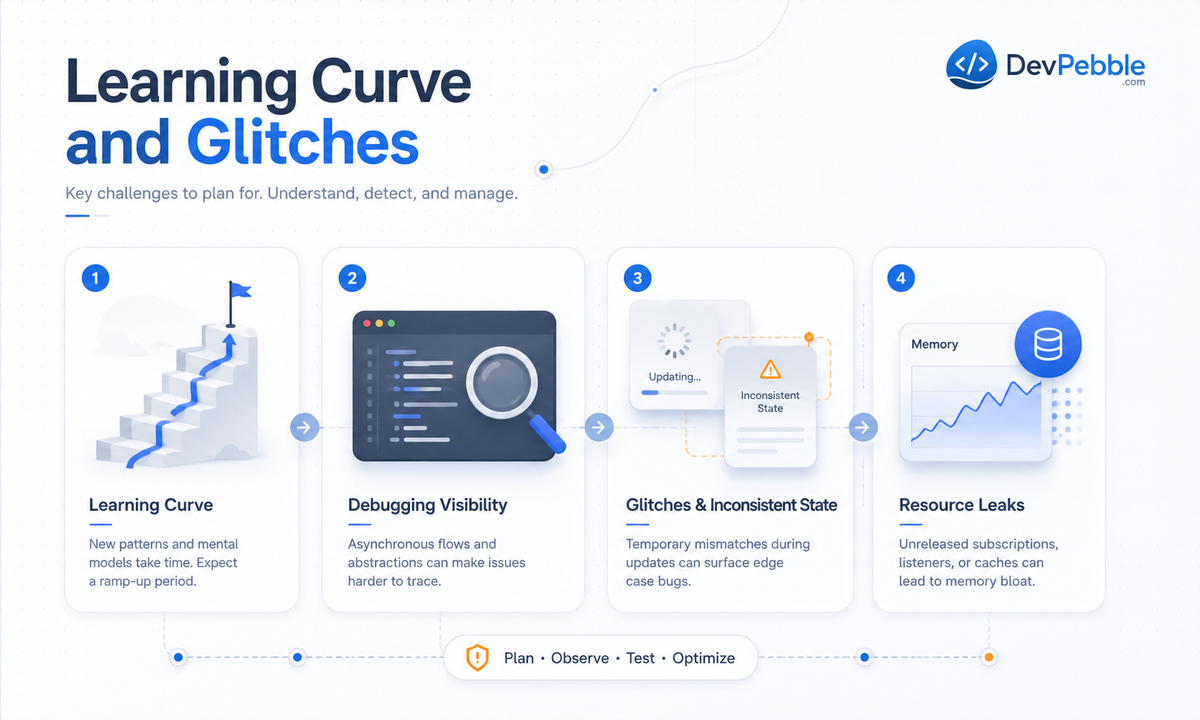
Most FRP risk comes from assuming one library behaves like another. The ACM survey sorts reactive languages by how they represent time-varying values, how they evaluate them, and whether they avoid glitches, and glitch freedom turns out not to be universal. Research on resource use is blunter still: the POPL 2012 paper Higher-Order Functional Reactive Programming in Bounded Space notes that the abstraction and expressivity making FRP attractive often produce programs whose resource usage is excessive and hard to predict, and the paper exists to address space leaks in discrete-time reactive programs.
| Risk | What you see | Mitigation | | --- | --- | --- | | Update-order glitch | A derived value briefly reflects only one of the inputs it depends on | Check the runtime's ordering and consistency guarantees before trusting derived state | | Time and space retention | Memory growth or rising per-update cost across a long session | Profile long-running sessions, and prefer implementations with documented resource behavior | | Subscription lifecycle | Duplicate network calls, listeners outliving their scope | Make ownership and disposal explicit at every boundary | | Debugging opacity | Stack traces that do not match the logical order of events | Trace at boundaries and test with controlled input timelines |
How do you evaluate and adopt FRP?
Start with one coordination-heavy feature instead of rewriting an application. Choose a model, whether signals, observable streams, or backpressured publishers, only after checking its semantics, its lifecycle rules, and how well it meets the I/O your codebase already has.
Prerequisites and selection criteria
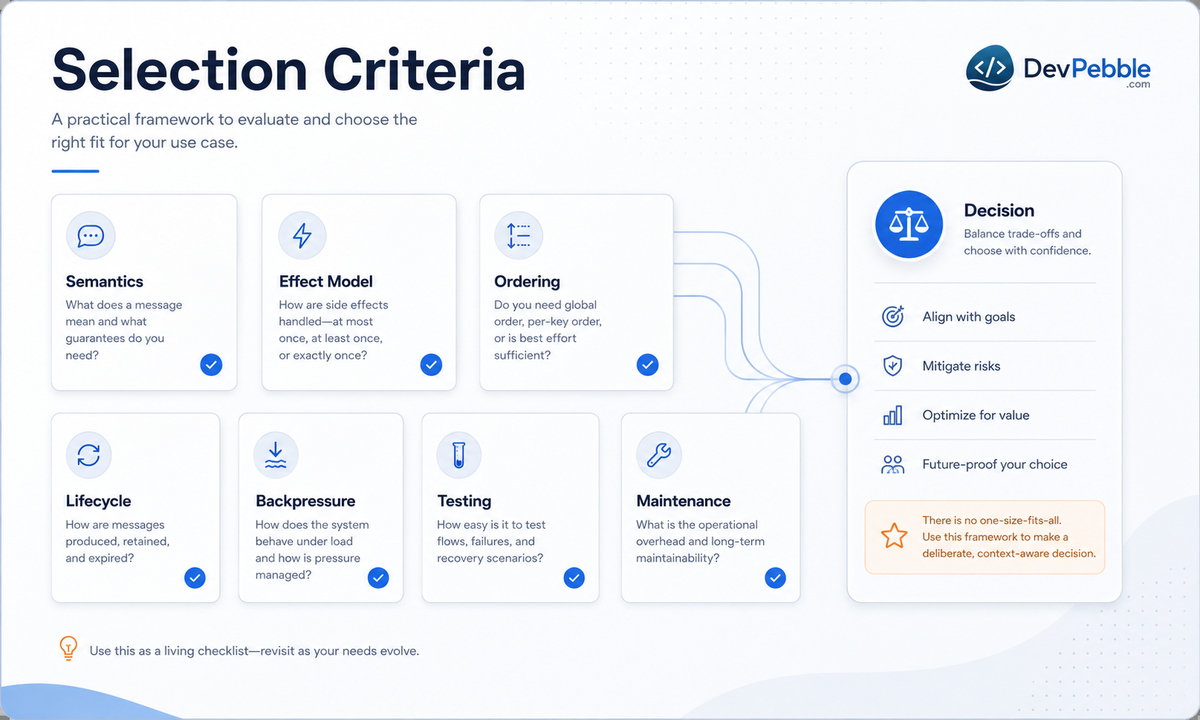
Most practical FRP-style libraries ask for functional composition, event handling, and asynchronous error handling. They do not ask for category theory or denotational semantics, whatever the papers look like. Before committing, answer these:
- Semantics: signals, events, observable sequences, or signal functions?
- Effect model: where do I/O and mutation happen?
- Ordering: what does the runtime promise about update order and glitches?
- Lifecycle: who owns cancellation and disposal?
- Backpressure: does this workload need demand control, and does the library provide it?
- Testing: is there support for virtual time or controlled input timelines?
- Maintenance: what does the library's repository show about current activity, checked at the time you adopt it?
A five-step adoption path
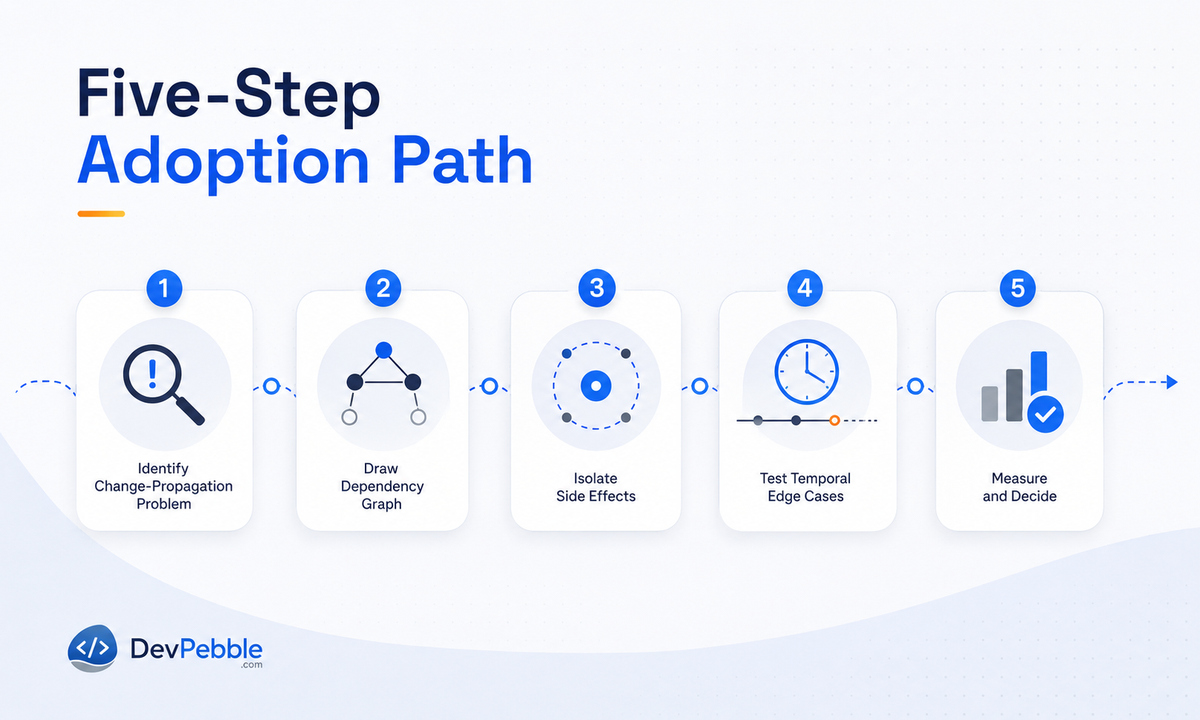
A reversible pilot, such as a live search box, a validation workflow, or a dashboard, surfaces timing and lifecycle problems without betting the codebase on the answer.
- Identify a real change-propagation problem, and document its inputs, derived values, events, effects, and failure states.
- Draw the dependency graph, separating source signals from derived state before writing code.
- Isolate side effects, keeping network calls, storage, logging, and rendering at named boundaries.
- Test the temporal edge cases: cancellation, reordering, simultaneous events, errors, and disposal.
- Measure and decide, comparing readability, test complexity, memory behavior, and operational visibility before expanding.
Is FRP worth adopting?
FRP is a modeling choice rather than a universal upgrade. It earns its complexity where several time-varying values must stay correctly related, in interactive interfaces, animation, sensor-driven systems, and event-rich logic, and it adds friction where the underlying problem is short, sequential, or thin on dependencies. The classic-versus-Rx-style distinction matters most when you need to reason precisely about time, ordering, or resource guarantees. For everyday UI work, either model can be productive once you know what your library actually promises.
Pick one coordination-heavy feature, confirm the library's semantics around ordering and cancellation, keep effects at defined boundaries, and measure what changes. That pilot will tell you more about fit than any general comparison, this one included.