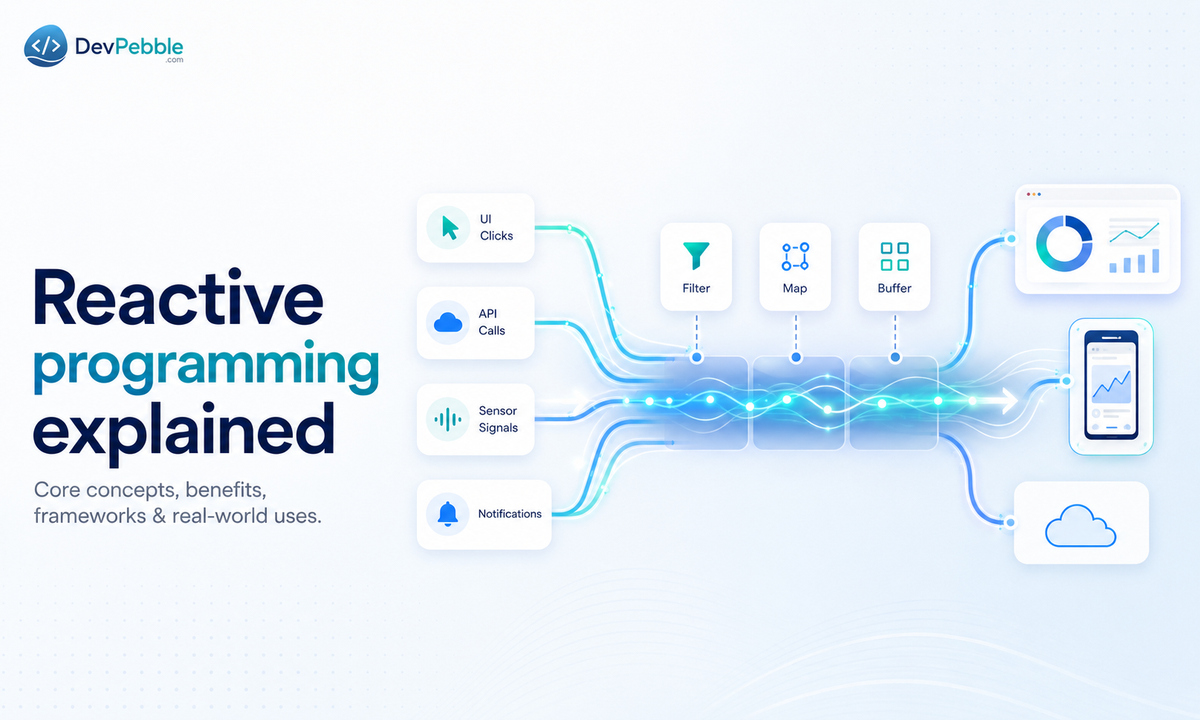
Reactive programming explained: core concepts, benefits, frameworks, and real-world uses
Reactive programming explained — core concepts, data streams and backpressure, reactive vs imperative code, libraries like RxJava and RxJS, and real-world use cases.
On this page⌄
- What is reactive programming and how does it work?
- The core principles of reactive programming
- How data streams, events, and asynchronous processing work
- Backpressure: keeping fast producers from overwhelming slow consumers
- Reactive programming vs imperative programming
- Reactive programming vs reactive systems
- Benefits and trade-offs of reactive programming
- Languages, libraries, and frameworks that support reactive programming
- Real-world use cases for reactive programming
- Best practices and design patterns for reactive programming
- Conclusion
- FAQ
Modern applications juggle a lot at once: user clicks, sensor readings, API calls, background jobs, all competing for the same limited resources. The old model of one blocking step after another struggles under that pressure, producing sluggish interfaces, wasted capacity, and code that resists scaling. A trading platform processing thousands of price ticks a second, or a ride-hailing app tracking hundreds of thousands of moving cars in real time, quickly runs the request-and-wait model out of road.
Reactive programming exists to close that gap. It treats data as a continuous flow of events rather than one-off calls, giving you a cleaner way to handle asynchronous work, manage load, and stay responsive under unpredictable traffic. This guide covers what it is, the principles behind it, how streams and backpressure work, how it compares to imperative code, and where it earns its place in production.
What is reactive programming and how does it work?
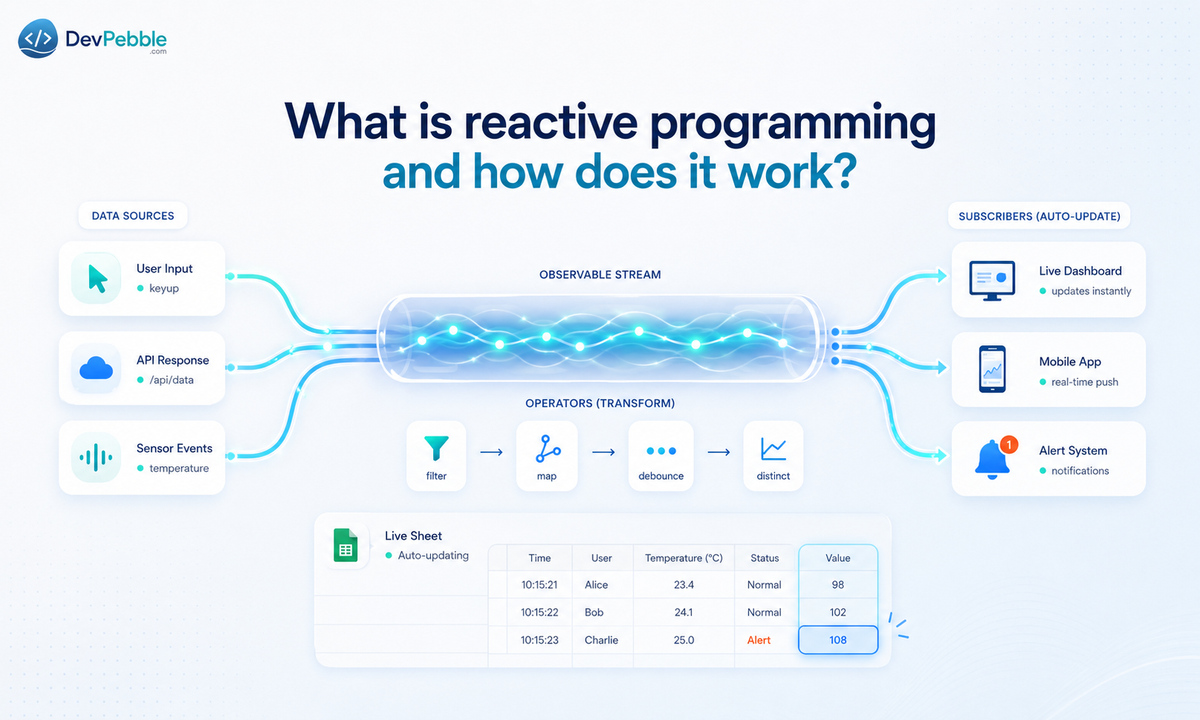
Reactive programming is a declarative style built around data streams and the propagation of change. Instead of code that says "give me this value now," you write code that says "whenever this value changes, do something with it."
A normal function call blocks: execution stops until it returns. A spreadsheet works differently. If cell C1 is defined as A1 plus B1, you never recalculate C1 by hand when A1 changes; the spreadsheet propagates the change for you. That is reactive behavior in its simplest form.
The spreadsheet analogy in practice
In a reactive codebase, data producers (user input, database updates, sensor feeds, network responses) are modeled as observable streams. Consumers subscribe rather than poll, so the subscribed logic runs on its own when new data appears.
Push-based versus pull-based execution
Conventional code is mostly pull-based: your program asks for data when it wants it. Reactive programming flips that into a push-based model, where the source notifies interested parties as soon as something changes. Pull-based systems burn cycles checking for updates that might not exist; push-based systems only do work when there is something to react to. That efficiency is why reactive programming fits high-concurrency apps, real-time dashboards, and anything where latency shapes the user experience.
Under the hood, most implementations combine the observer pattern with functional composition. A source (an Observable or Publisher) emits values over time, and subscribers decide what happens when a new value, an error, or a completion signal arrives.
The core principles of reactive programming
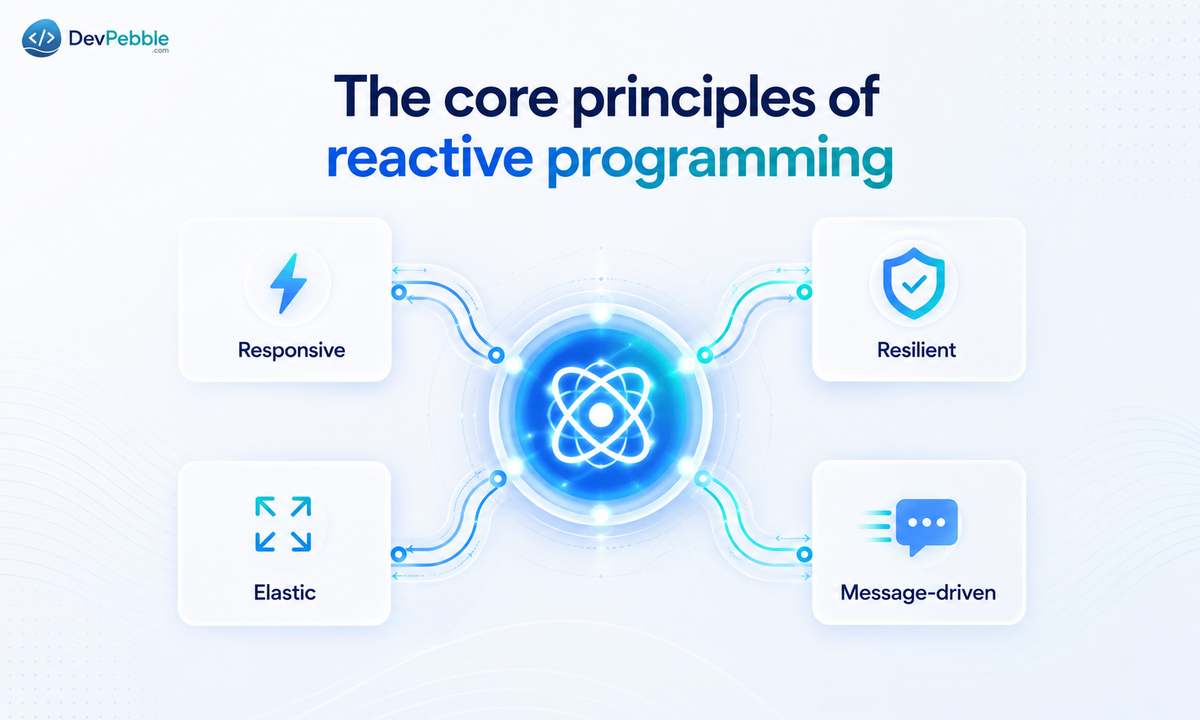
Reactive programming rests on a set of design principles laid out in the Reactive Manifesto, first published in 2013, which shaped how the industry thinks about responsive, distributed systems.
| Principle | What it means | Why it matters | |---|---|---| | Responsive | The system responds in a timely way, even under load | Keeps the user experience consistent and predictable | | Resilient | The system stays responsive even when parts of it fail | Prevents cascading outages and isolates failure | | Elastic | The system adapts to changing workloads by scaling resources | Handles traffic spikes without manual intervention | | Message-driven | Components communicate asynchronously through messages | Decouples components and enables non-blocking operation |
Resilience relies on isolating failures so a stumbling payment service does not take down checkout or inventory with it, using patterns like bulkheads, circuit breakers, and supervision hierarchies (popularized by Akka). Elasticity is cheaper here because non-blocking operations handle more concurrent work with fewer threads, so a flash-sale spike does not tie up one thread per connection. And message-driven communication means components exchange asynchronous messages rather than calling each other and waiting, so a slow component does not stall the whole chain.
Three engineering ideas sit alongside the manifesto: asynchronous execution (operations do not block the calling thread while they wait), functional composition (building behavior by chaining small reusable operators), and backpressure handling (keeping fast producers from burying slow consumers). That last one gets its own section, since it is where a lot of reactive systems quietly fall apart in production.
How data streams, events, and asynchronous processing work
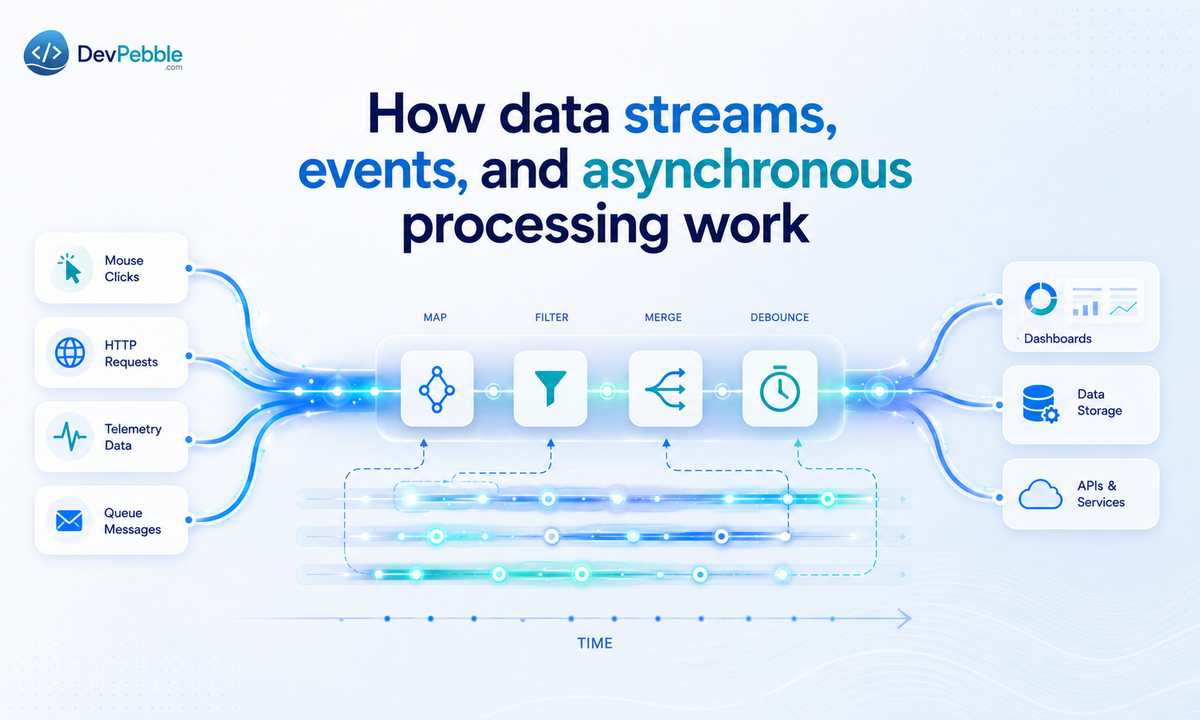
Everything in reactive programming comes back to streams: sequences of data or events spread over time, such as mouse clicks, HTTP requests, sensor telemetry, or queue messages. Unlike a plain array, the values do not all exist at once; they arrive bit by bit, and your code reacts to each as it shows up.
A reactive stream follows a defined contract, usually four signals: onNext (a new value arrived), onError (something broke and the stream is ending), onComplete (finished normally), and onSubscribe (a subscriber started listening). The Reactive Streams specification standardized this, which lets different libraries interoperate regardless of which one produced the stream; it was later adopted into the JDK as java.util.concurrent.Flow.
Operators: the building blocks of stream logic
Streams get useful once you apply operators. A map operator transforms each value (a raw sensor reading into a formatted temperature), a filter operator lets only relevant values through (dropping failed logins from an auth stream), and a debounce operator fires an API call only once the user pauses in a search field. Operators like merge and zip combine streams, joining GPS coordinates with traffic data to compute a delivery ETA. Chained together, they give a readable, declarative way to express asynchronous logic that would otherwise need tangled callbacks or manual thread juggling.
Backpressure: keeping fast producers from overwhelming slow consumers
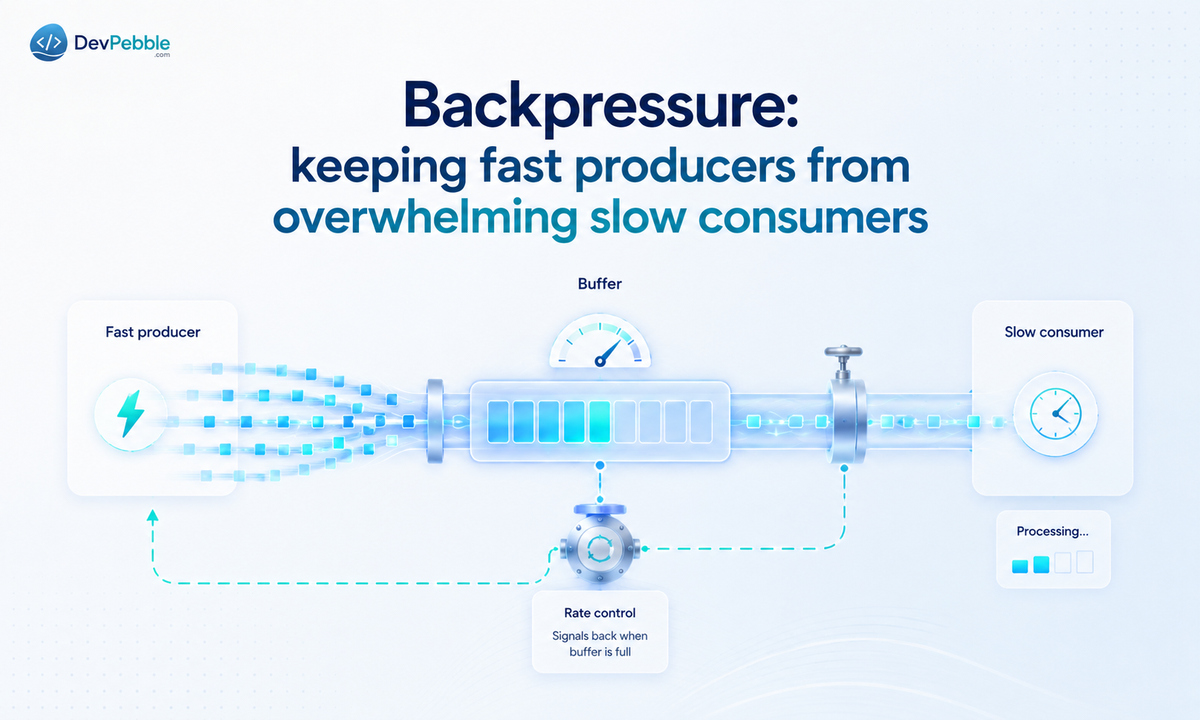
Backpressure sounds abstract until you have watched a system fall over without it. It is a feedback mechanism that lets a slow consumer tell a fast producer to ease off, instead of drowning in more data than it can process.
Picture a pipe feeding a narrow drain. If water pours in faster than the drain clears it, pressure builds until something gives, which in software means a memory spike, dropped events, or a crash. That is what happens when a sensor emitting ten thousand readings a second feeds a consumer that can only write five hundred a second: the backlog piles up in memory until the app runs out of room.
Reactive Streams handles this with an explicit request-based protocol. Rather than blindly pushing everything, the subscriber signals how many items it can take through a method like request(n); the producer sends up to that number, waits, then continues. That turns backpressure into a negotiated handoff, sometimes called a pull hidden inside a push.
When that coordination is not possible, say the source is an external feed you do not control like a live market data provider, frameworks fall back on a few strategies:
- Buffering stores excess items in memory until the consumer catches up. Fine for short bursts, risky if the backlog keeps growing.
- Dropping discards new values once a buffer fills, acceptable when only the freshest data matters.
- Latest-only keeps the most recent value and throws away everything before it, common in UI updates where an intermediate state adds nothing.
- Error signaling ends the stream with an overflow error, forcing the app to handle the failure deliberately instead of losing data silently.
The right pick depends on context. Dropping a stale reading on an IoT dashboard is harmless; dropping a financial transaction is not, so that system would buffer with monitoring or scale the consumer side. Ignoring backpressure is one of the most common reasons reactive systems fail in production: a pipeline runs cleanly in testing, then collapses under real traffic because nobody planned for the consumer falling behind.
Reactive programming vs imperative programming
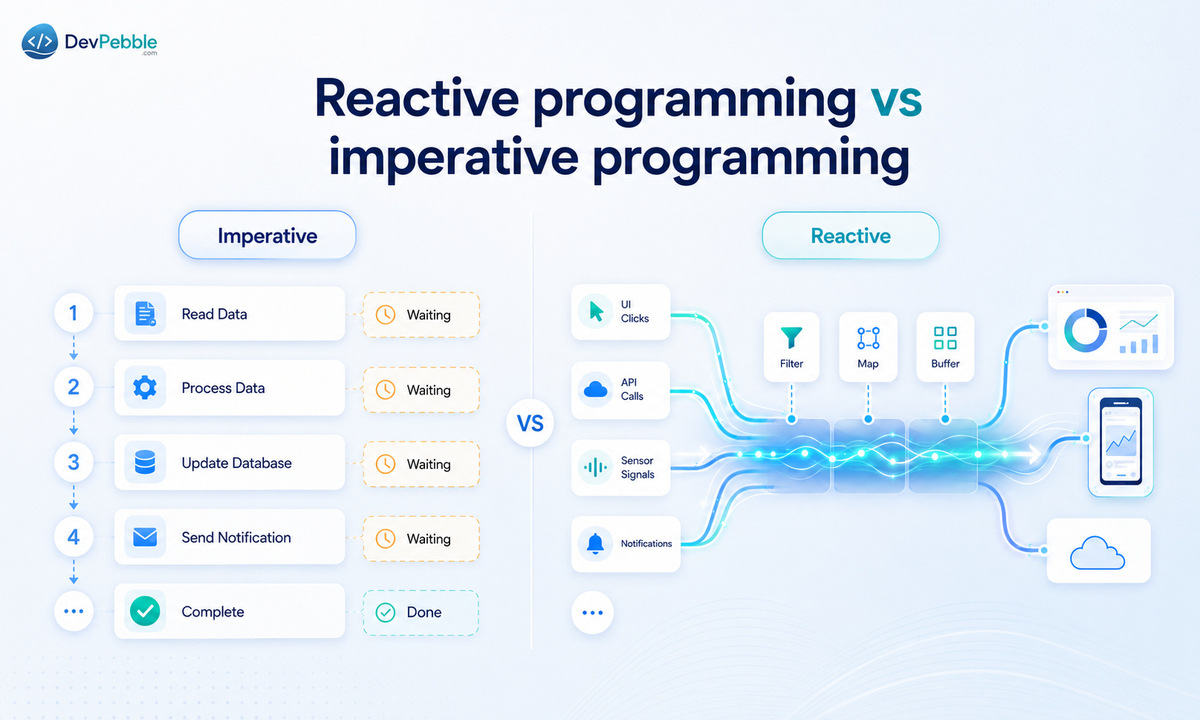
Imperative programming spells out an explicit sequence: do this, then that, check a condition, return a value. It is easy to trace because execution runs top to bottom. Reactive programming instead describes what should happen when data changes, without dictating the order or timing of every step, so control flow follows the data rather than a fixed list of instructions.
An example makes it concrete. Say an app needs a user's profile, order history, and recommendations, then renders all three together. In imperative style you write three sequential calls, each waiting on the last. In reactive style you define three independent streams and combine them with an operator like zip or combineLatest, letting the engine run them concurrently and update the page once all three emit. The reactive version reads more cleanly and can finish faster, since none of the calls waits on the others.
| Aspect | Imperative programming | Reactive programming | |---|---|---| | Execution model | Sequential, step-by-step | Event-driven, asynchronous | | Data handling | Pull-based, request data when needed | Push-based, react as data arrives | | Concurrency | Managed manually with threads and locks | Handled inside the stream pipeline | | Error handling | try/catch around each step | Centralized through the stream's error channel | | Code structure | Procedural and order-dependent | Declarative, built from composable operators | | Best suited for | Simple, linear workflows | Real-time, high-concurrency workflows |
Error handling shows another gap: imperative code wraps each risky operation in its own try/catch, while a reactive pipeline routes errors through the stream to be handled once, or recovered with operators like onErrorReturn or retry. Concurrency is similar, since reactive frameworks handle the thread scheduling that imperative code manages by hand. None of this makes reactive programming a blanket upgrade, though. A short script that reads a config file and prints a value has no use for an observable stream. In most codebases the two coexist: imperative logic for linear tasks, reactive logic for continuous data and heavy concurrency.
Reactive programming vs reactive systems
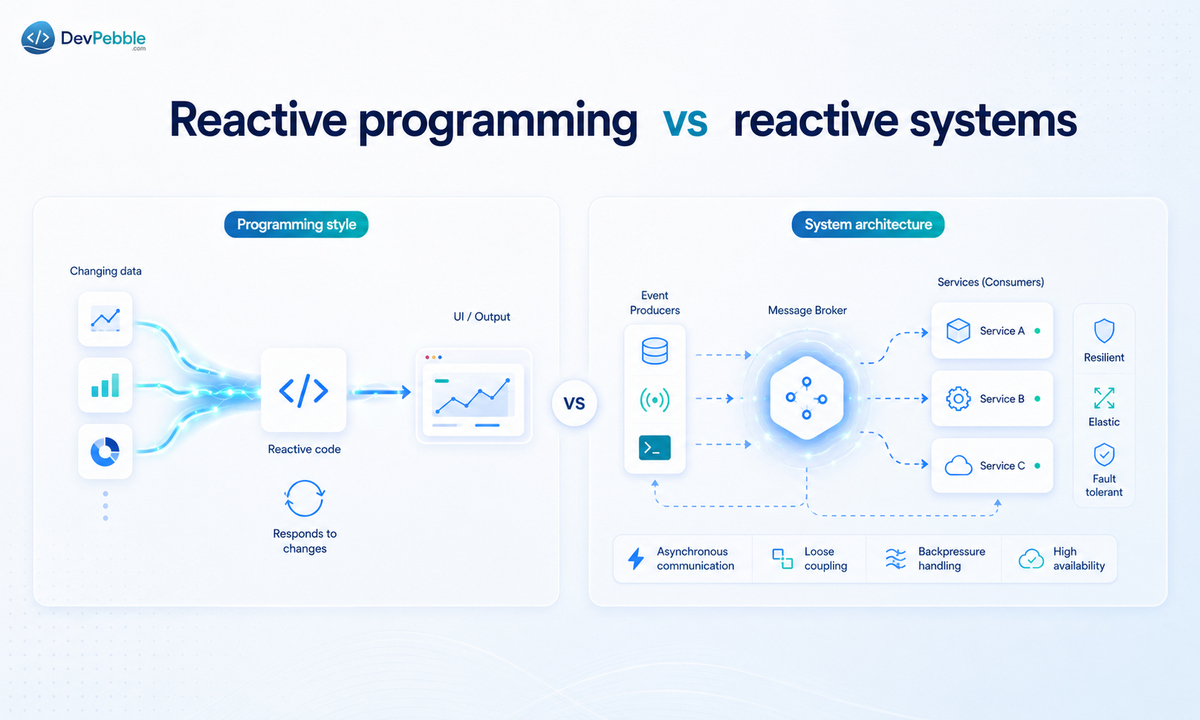
These terms get swapped far too often. Reactive programming is a coding paradigm, a way of writing individual pieces of software with streams, observables, and operators. A reactive system is a broader architectural idea about how a whole application behaves: responsive, resilient, elastic, and message-driven, the same four traits from the manifesto.
Put plainly, reactive programming is a tool you use; a reactive system is a goal you build toward. You can write reactive code with RxJava or Project Reactor inside one service without that service, or the platform around it, qualifying as a reactive system. A mobile app that uses RxJava only to manage UI state is doing reactive programming, but that says nothing about how the backend handles failure or scales.
The reverse holds too. A platform can be a reactive system without any reactive programming library, using the actor model, message queues, and auto-scaling microservices to satisfy every trait of the manifesto through plain messaging. The distinction matters because adopting a reactive library does not automatically make an app resilient or elastic; those are architectural decisions.
Benefits and trade-offs of reactive programming
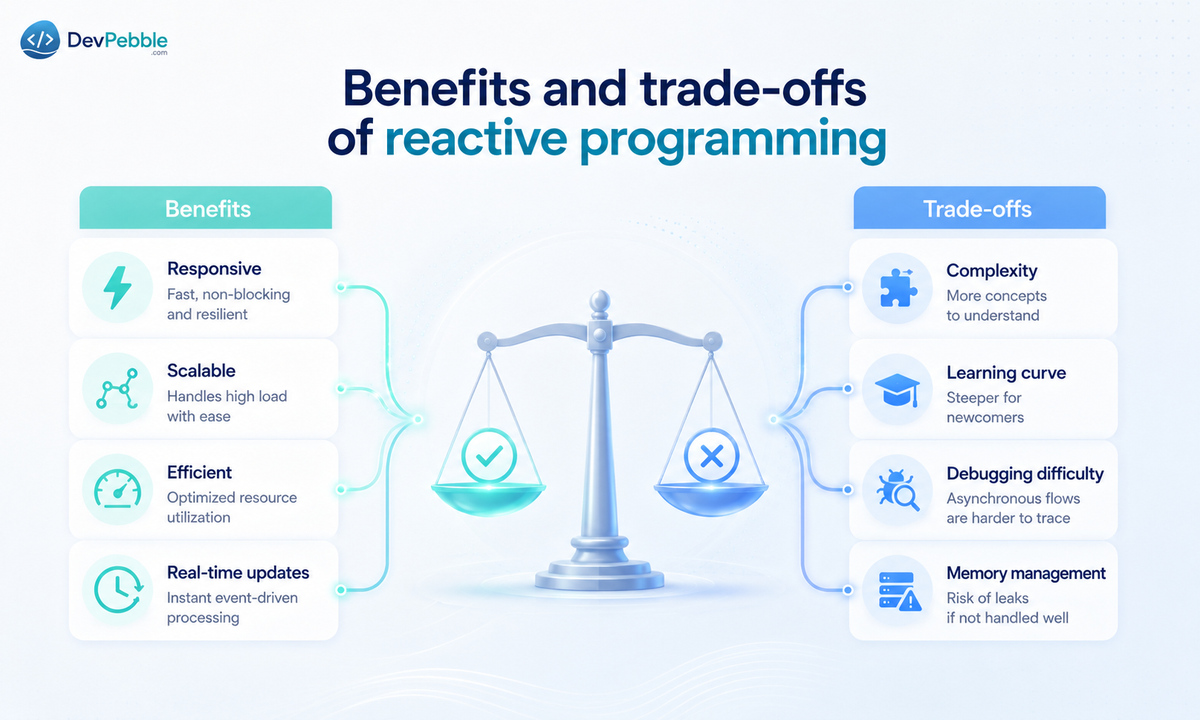
Reactive programming earns its popularity by solving real problems, but it carries costs worth weighing before you commit a team to it.
On the upside, non-blocking operations keep an app usable during traffic spikes instead of freezing on slow I/O, and a handful of threads can serve thousands of concurrent connections instead of one per request. Live data such as stock prices, chat messages, IoT telemetry, and game state maps cleanly onto the stream model, complex workflows read better as chained operators than nested callbacks, retries and fallbacks can live inside the stream, and predictable behavior under concurrent load makes horizontal scaling more effective.
The friction is just as real. There is a genuine learning curve, since thinking in streams is a shift for developers used to sequential code, and debugging is harder because execution is not linear and an error can surface far from where it started. Wrapping a simple one-time operation in an observable adds complexity for no payoff, a forgotten subscription can quietly leak memory in long-lived apps, backpressure mismanagement remains a leading cause of production failures, and uneven team experience can slow reviews and maintenance.
The honest read: reactive programming pays off for high concurrency, real-time data, or unpredictable load, and adds needless overhead for low-traffic CRUD apps, so the strongest codebases apply it selectively rather than by default.
Languages, libraries, and frameworks that support reactive programming
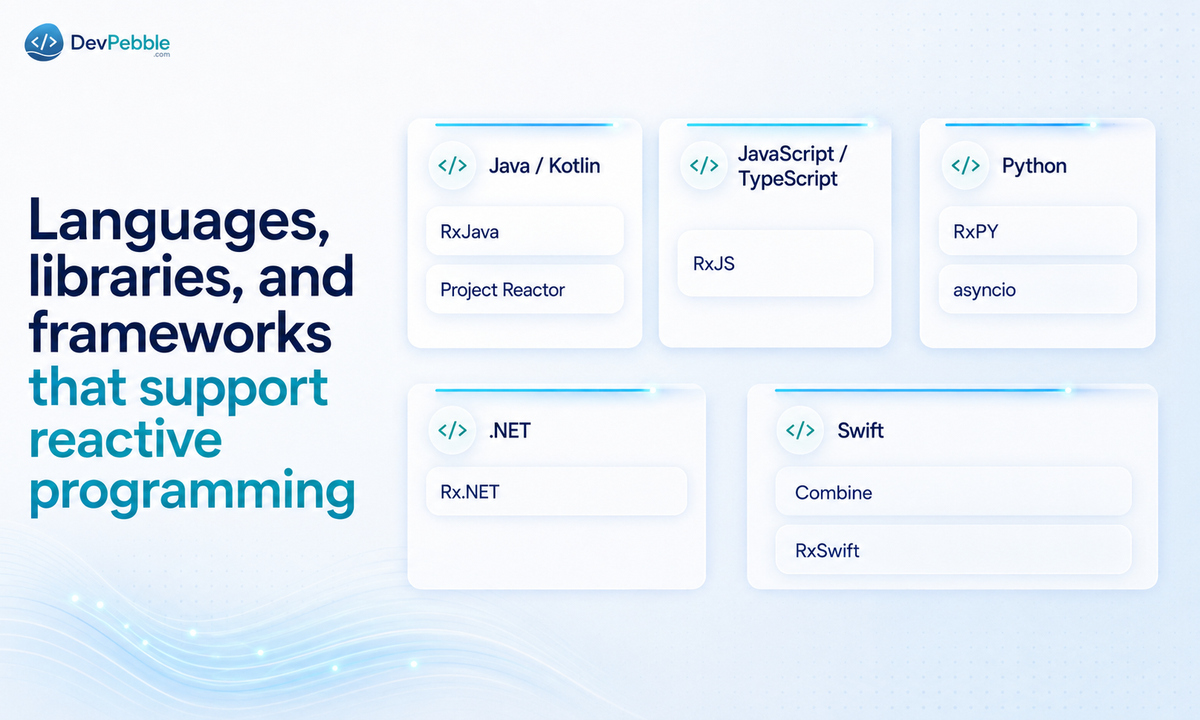
Reactive programming has reached nearly every major ecosystem, though the tooling differs per language. In Java and Kotlin it is well established: RxJava became the Android standard years ago for handling UI events, network calls, and threading without callback chains. Project Reactor, built for the Spring ecosystem, powers Spring WebFlux and its fully non-blocking REST APIs. Akka Streams, built on the actor model, gets reached for when a system needs strong fault tolerance and distributed processing, and Vert.x targets high-throughput, event-driven microservices.
One thing to flag on Akka: in 2022 Lightbend moved it from Apache 2.0 to the Business Source License (BSL) v1.1, starting with Akka 2.7. Organizations under 25 million dollars in annual revenue can use it in production for free, larger companies need a paid commercial license, and each version reverts to Apache 2.0 three years after release. It is still strong technically, but the licensing is worth checking before building a large commercial system on it.
On the front end, JavaScript and TypeScript rely heavily on RxJS, which grew prominent through Angular, where it manages HTTP requests, form state, and routing events. Python leaned on asyncio for years, but RxPY brings the observable-and-operator model to code that needs real stream handling. Apple introduced Combine for Swift at WWDC 2019, alongside the older RxSwift, and on .NET, Rx.NET was one of the original inspirations behind the ReactiveX family and remains a solid choice for C# developers processing live feeds.
| Language / platform | Common reactive libraries | Typical use case | |---|---|---| | Java / Kotlin | RxJava, Project Reactor, Akka Streams, Vert.x | Android apps, Spring WebFlux backends, distributed systems | | JavaScript / TypeScript | RxJS | Angular apps, front-end state and event coordination | | Python | RxPY, asyncio | Data pipelines, async backend services | | C# / .NET | Rx.NET | Desktop apps, services handling live data feeds | | Swift | Combine, RxSwift | iOS and macOS app development |
Not every asynchronous tool counts as reactive programming. Go's goroutines and channels, or JavaScript's native Promises, handle asynchronous work well, but they lack the declarative stream composition (operators like map, filter, and merge chained together) that defines the paradigm. That distinction helps when deciding whether a project needs a dedicated reactive library or whether built-in async tools already cover it.
Real-world use cases for reactive programming
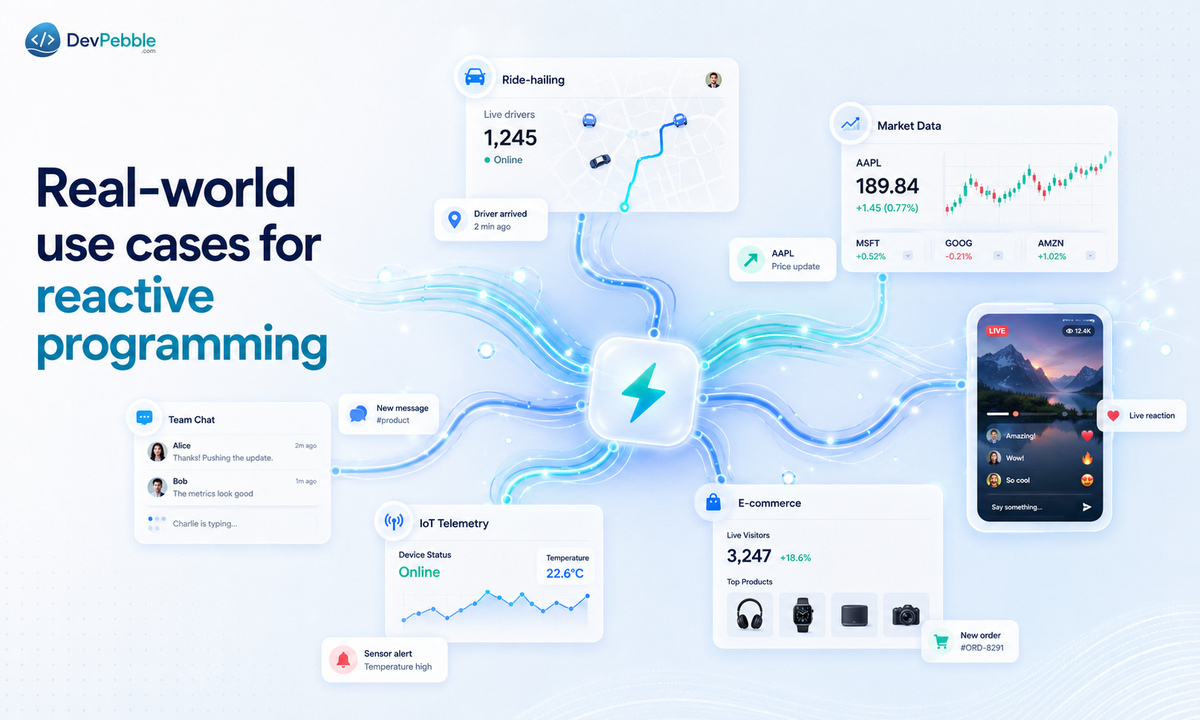
Reactive programming proves itself fastest where data is constant and unpredictable and users expect instant feedback.
Streaming and media platforms process huge volumes of viewing activity (pauses, skips, replays, ratings) without ever blocking playback, so recommendations shift in near real time. Netflix is the classic example: its engineers created RxJava and open-sourced it, building parts of the backend around reactive principles to stay responsive under massive concurrent load.
Transportation and logistics apps track thousands of moving vehicles at once, updating a rider's screen the instant the driver moves and recalculating ETAs as traffic shifts, across huge numbers of concurrent trips; the same pattern covers food delivery and fleet monitoring. Financial trading systems are the least forgiving case, since market ticks arrive continuously and even a brief delay can mean real money lost, so reactive pipelines ingest, filter, and react to these events with minimal latency, often merging prices, order books, and news sentiment into one decision pipeline.
Chat and collaboration tools push messages, typing indicators, and presence updates to clients the instant they happen, instead of every device polling a server. IoT platforms produce constant telemetry from thousands or millions of devices, where backpressure-aware pipelines matter because activity can spike without warning. E-commerce platforms lean on reactive systems during flash sales, where inventory, pricing, and order processing must stay accurate under sudden demand. Multiplayer games fit too, since every action and state change is an event that has to reach other players with minimal delay.
Best practices and design patterns for reactive programming
Getting reactive programming right comes down to a few patterns and habits teams land on after learning what breaks at scale.
The observer pattern is the base of nearly every implementation: a subject emits changes, and observers react without it knowing who is listening. The publisher-subscriber pattern builds on that, routing events through an intermediary so a system can add or drop consumers without touching the code that produces the data. Functional composition is where reactive code either stays maintainable or turns into a mess: rather than one enormous operator chain, well-structured code breaks logic into small, named, reusable functions, so a search feature keeps its debounce logic, API call, and result filtering as distinct testable pieces.
A few habits reliably separate solid reactive codebases from fragile ones:
- Dispose of subscriptions once they are no longer needed, especially in long-lived apps where forgotten subscriptions are a top source of memory leaks.
- Keep blocking calls out of a reactive chain, since a single synchronous database call or file read can stall an entire thread pool and undo the benefit.
- Be deliberate about schedulers, because running heavy computation on a thread meant for I/O causes performance problems that are hard to trace.
- Plan backpressure handling before it becomes an incident, rather than assuming a pipeline will just cope.
- Test with tools built for reactive code, like TestObserver in RxJava or StepVerifier in Project Reactor, which let you assert on the exact sequence of emitted values, errors, and completion signals.
- Introduce reactive patterns at natural boundaries, such as a service handling high-concurrency I/O, rather than rewriting an entire codebase for consistency.
For resilience, the circuit breaker pattern (which stops sending requests to a failing service so it can recover) pairs naturally with reactive pipelines and is usually built into the stream with retry and fallback operators. Applied with judgment, these patterns make reactive programming a dependable way to build software that holds up under real conditions.
Conclusion
Reactive programming changes how software deals with change, moving from rigid step-by-step execution toward systems that respond to data as it happens. It does not belong everywhere: plenty of applications are still better served by simple sequential code, and forcing streams onto a basic CRUD app just adds friction. But for systems built around real-time data, high concurrency, or unpredictable traffic, it offers a genuinely different and effective way to think about software, which is why so many high-scale platforms have leaned on it for years.