Procedural vs functional programming: differences, examples, and when to use each
Procedural vs functional programming compared across state, testing, concurrency, and performance, with the same Python task both ways and when to use each.
On this page⌄
- What is the difference between procedural and functional programming?
- What is procedural programming?
- What is functional programming?
- How do procedural and functional programming compare?
- What does the same task look like in procedural and functional code?
- When should you use procedural or functional programming?
- Can procedural and functional programming be combined?
- Common misconceptions about procedural and functional programming
- How should you choose between the two?
- FAQ
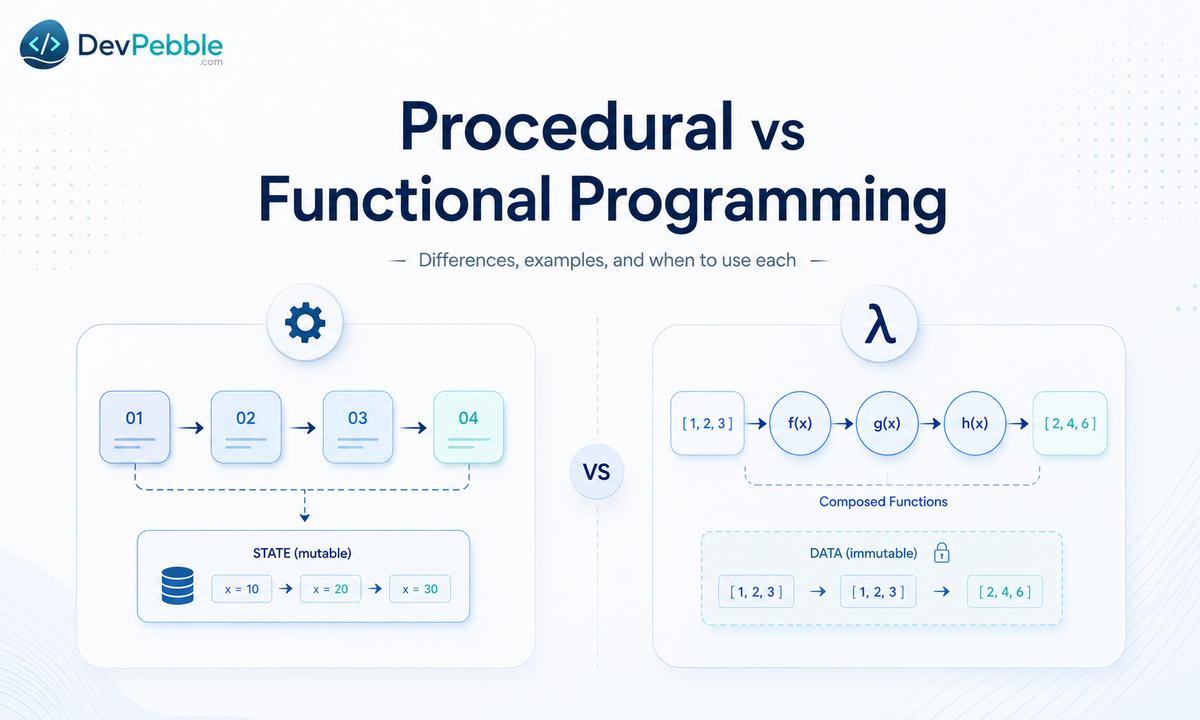
Procedural programming solves a problem through an explicit sequence of commands, updating variables as execution moves forward. Functional programming solves the same kind of problem by composing functions that transform inputs into outputs, while keeping changes to state either minimal or contained. The real difference is not whether functions exist, since both styles use them constantly. What separates the two is how each one organizes computation and state.
Most widely used languages now support both approaches, often within a single codebase. That makes the practical question less about which paradigm is correct and more about which one fits the code in front of you, a decision that can flip from one part of a program to the next.
What is the difference between procedural and functional programming?
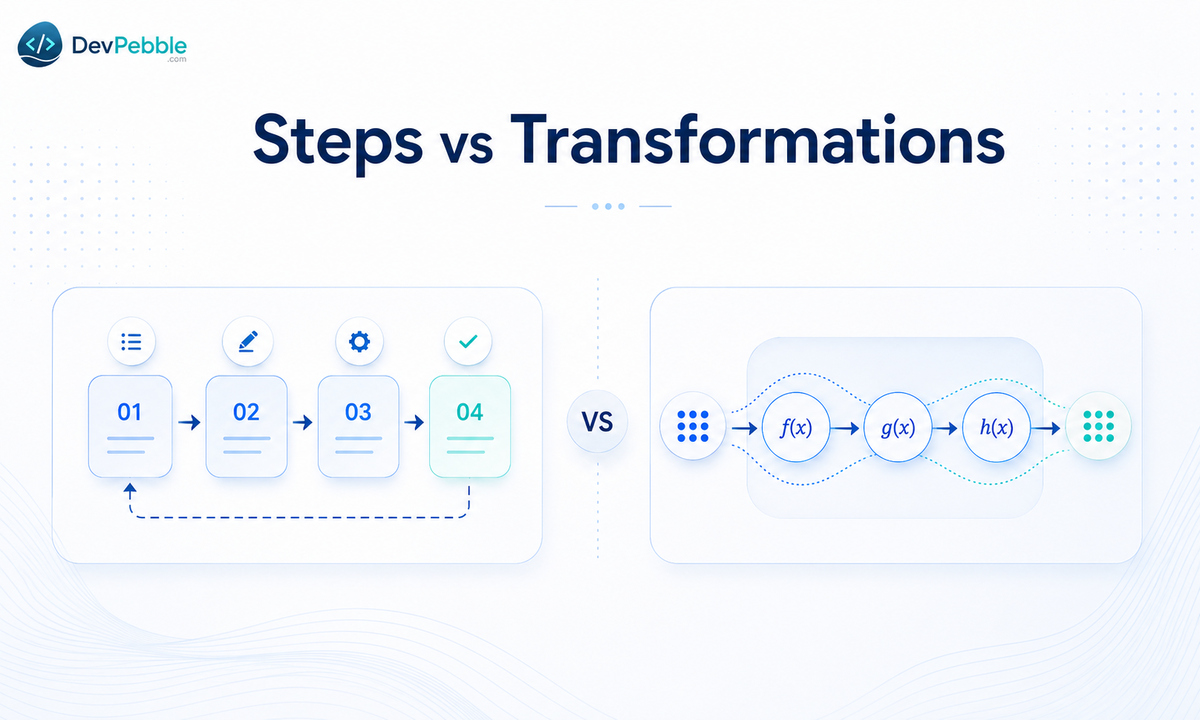
Procedural programming expresses a solution as an ordered series of steps that may change program state along the way. Functional programming expresses it as a chain of transformations, favoring immutable values and functions that depend only on their own inputs. Procedural code tends to show what happens next; functional code tends to show what value results.
Both styles rely on callable routines, and both can produce clean, well-organized programs. The distinction sits in how each one treats state and side effects, not in code quality.
| Dimension | Procedural | Functional | |---|---|---| | Basic unit | Procedure or routine | Function or expression | | Main focus | Steps and control flow | Values and transformations | | State | Often updated in place | Commonly immutable or isolated | | Side effects | Common and explicit | Minimized, separated, or modeled | | Control | Loops and statements | Composition, recursion, combinators | | Functions | Callable routines | Often first-class values | | Typical use | Workflows, system operations | Data transformation, rules, concurrent logic |
What is procedural programming?
Procedural programming organizes a program as a set of procedures that run instructions in a defined order. A procedure takes inputs, performs calculations, may update local or shared state, calls other procedures, and returns a result. It is built from ordinary parts: assignments, conditions, loops, and function calls.
Python's documentation describes procedural code as the model most languages follow, where a program is an ordered list of instructions acting on its input, and it names C, Pascal, and even Unix shells as familiar examples. Well-written procedural code can still be modular, with narrow scopes and reusable functions. The label describes how execution is organized, not how carefully the code is structured.
How does procedural programming work?
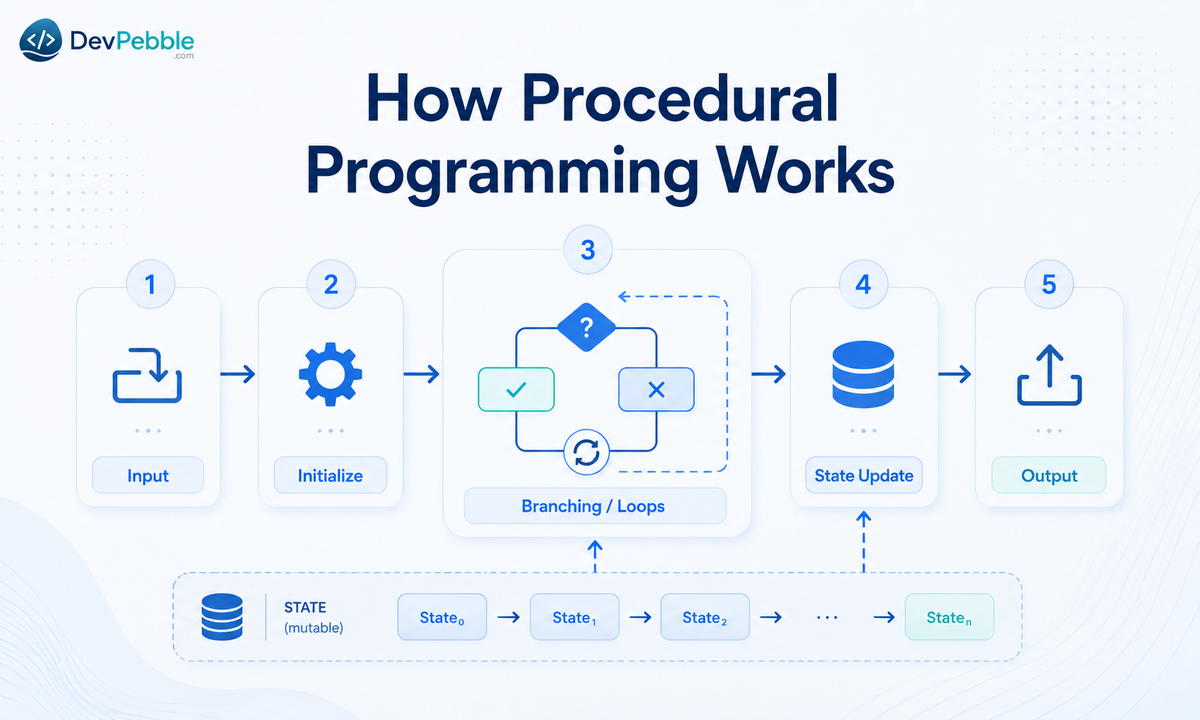
A procedural program starts from an initial state and changes it through ordered instructions. Each statement can assign a value, call another procedure, check a condition, repeat a block, return a result, or trigger an external action. Because of that, execution order is central to understanding what the program does.
- Receive input
- Initialize variables
- Execute statements in sequence
- Branch or loop as needed
- Update state
- Return or emit output
What characterizes procedural code?
Procedural code is usually easy to recognize by its focus on execution order: named routines, mutable variables, loops, conditions, and direct input and output, with data often kept separate from the procedures that act on it. The approach gets risky mainly when state is shared too widely, or when one procedure quietly depends on a change made somewhere else in the program.
Where is procedural programming commonly used?
It fits command-line scripts, straightforward request-handling workflows, embedded or device-control routines, and numerical procedures that benefit from direct, in-place updates.
What is functional programming?
Functional programming treats computation mainly as the evaluation and composition of functions. Rather than repeatedly modifying existing data, it usually produces new, transformed values, and it favors pure functions, immutable data, and functions that can be passed around like any other value. Unavoidable effects such as file or network access get pushed toward controlled boundaries.
Scala's documentation defines a pure function as one whose output depends only on its declared inputs and its own implementation, with no "back doors" to the outside world. Call it with the same input any number of times and you get the same result. Haskell is a well-known purely functional language built on exactly this idea, combining referential transparency, immutability, and lazy evaluation.
How does functional programming work?
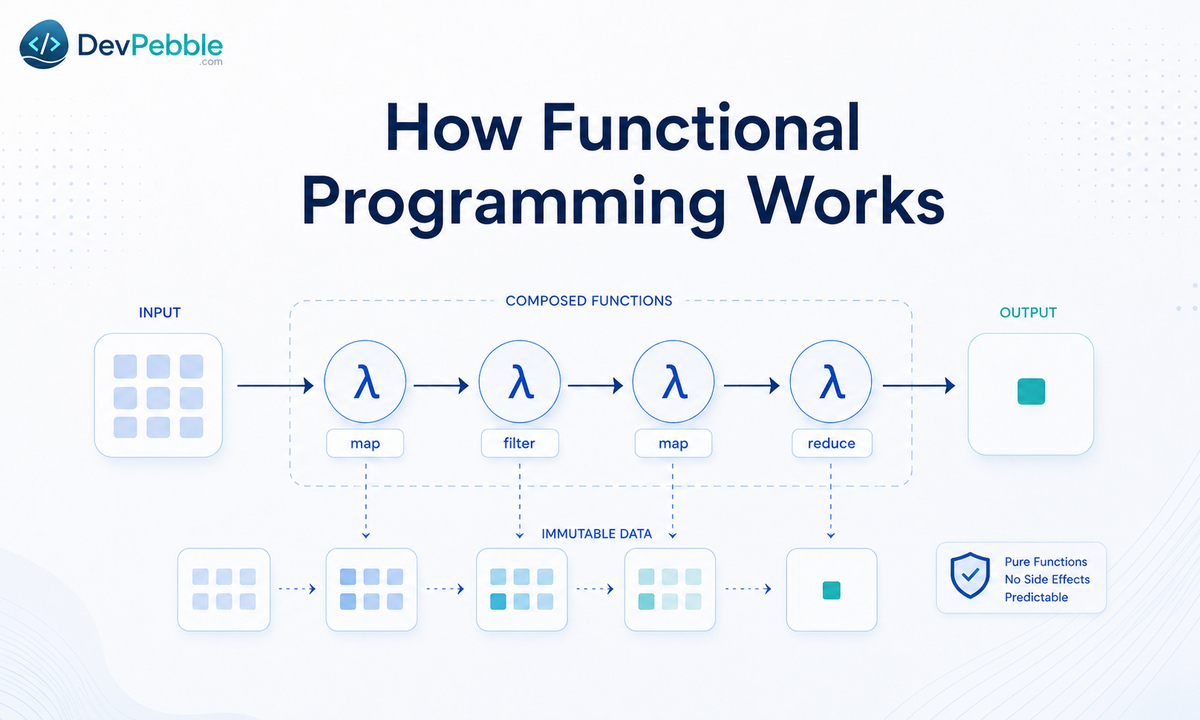
Functional code expresses a result as a combination of smaller transformations. Data enters one function, its output feeds the next, and the final expression produces the result. The programmer focuses on how values depend on each other, while the language handles the mechanics of evaluation through tools like map, filter, and higher-order functions that take or return other functions.
Is functional programming always pure?
No. Purely functional languages tightly control observable mutation, but most functional-style code lives in multi-paradigm languages like Python, Java, or Scala, which allow functional transformations right next to assignments, exceptions, and mutable objects. Python's Functional Programming HOWTO says a large program might mix procedural and functional sections rather than commit to one. Scala describes the common pattern as a pure functional core wrapped by functions that handle interaction with the outside world.
What concepts are associated with functional programming?
Purity, immutability, first-class and higher-order functions, composition, recursion, pattern matching, and effects that are controlled rather than removed.
How do procedural and functional programming compare?
Procedural and functional programming diverge most clearly in how they handle state, effects, control flow, and reusable logic. Procedural code makes the sequence of operations explicit; functional code makes the relationships between values explicit. Which one works better depends on the problem, the language, the runtime, and the team, not on the paradigm by itself.
How do state and side effects differ?
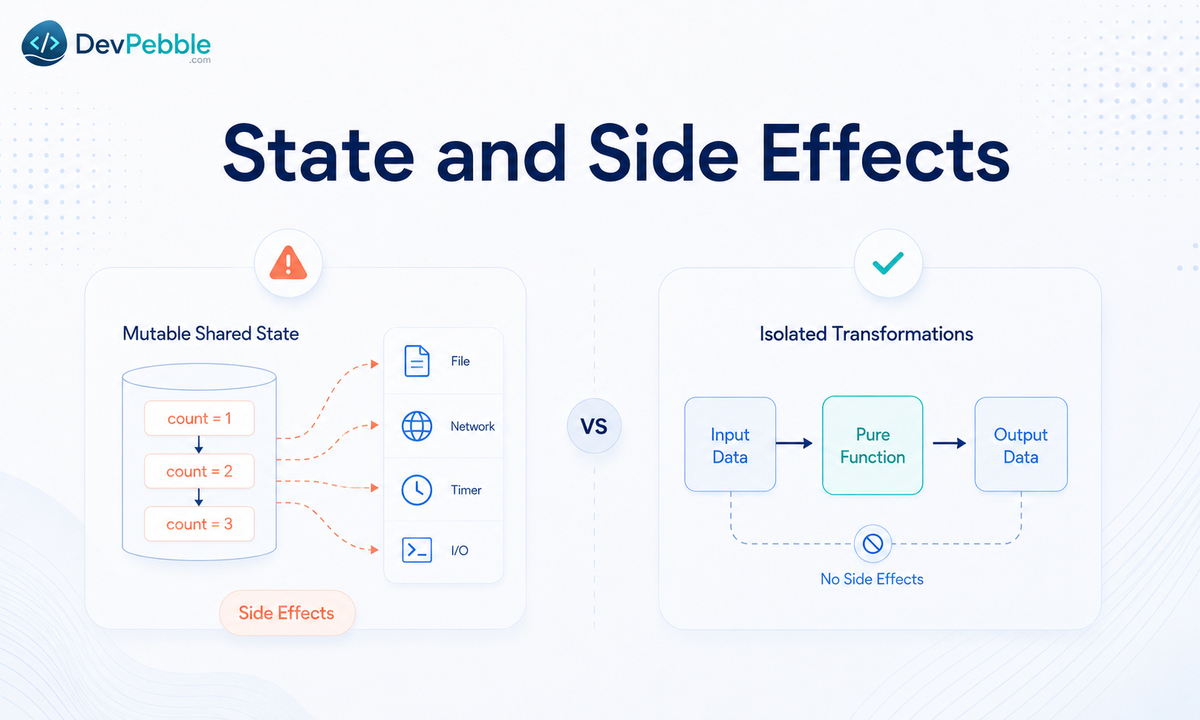
Procedural code usually records progress by changing a variable or data structure in place. Functional code usually produces a new value from an old one instead of altering it. Functional design does not pretend effects can disappear; it tries to make them explicit, localized, and easy to trace back to a source.
Local mutation inside a single function is low risk. The real concern is shared mutable state that several parts of a program read and write with no clear owner. File writes, network calls, timers, and random values count as effects in either style, and functional programs tend to corral them at defined boundaries rather than let them spread through the logic.
How do control flow and composition differ?
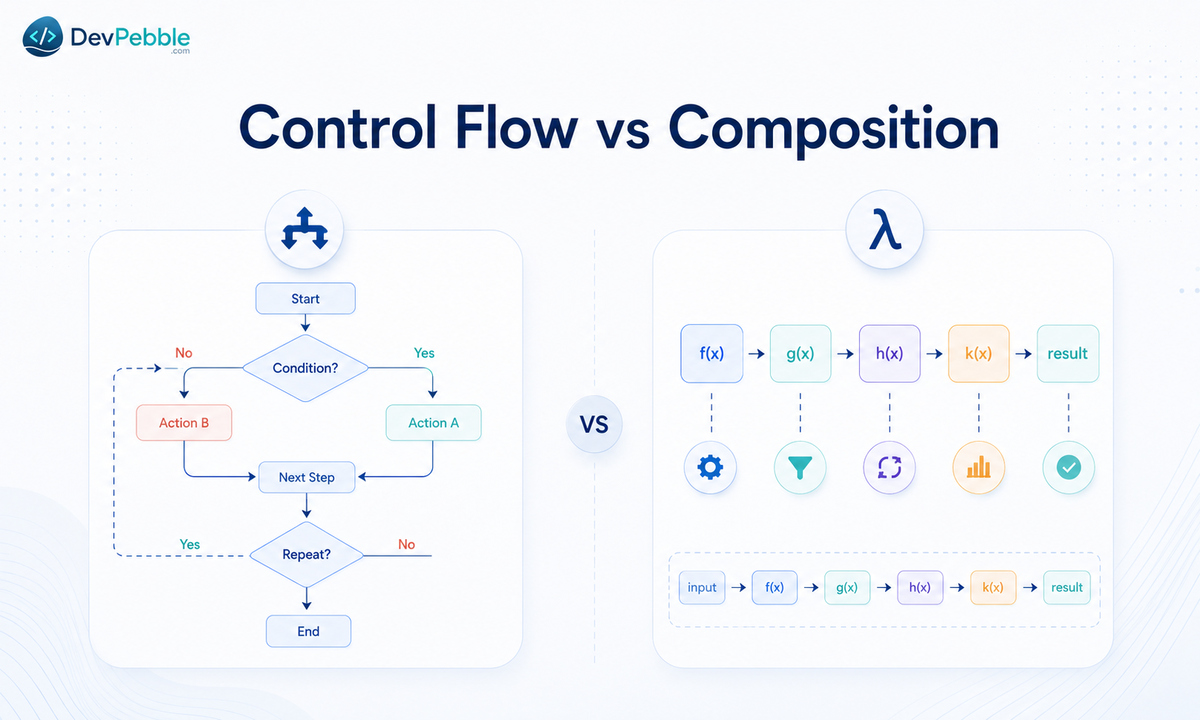
Procedural programming usually shows the route to a result through loops, branches, and ordered calls. Functional programming more often describes the result as a composition of expressions, with one function's output feeding the next. Both run the same operations in the end; they just surface different information to the reader.
A for loop puts the how in front of you, step by step. A filter and map pipeline puts the what, the transformation being applied. Recursion shows up often in functional teaching examples, but it is not required, since iteration and library combinators do the same work. Explicit loops can read better when the control flow is irregular; pipelines can read better when each stage stands on its own.
Which style is easier to test and debug?
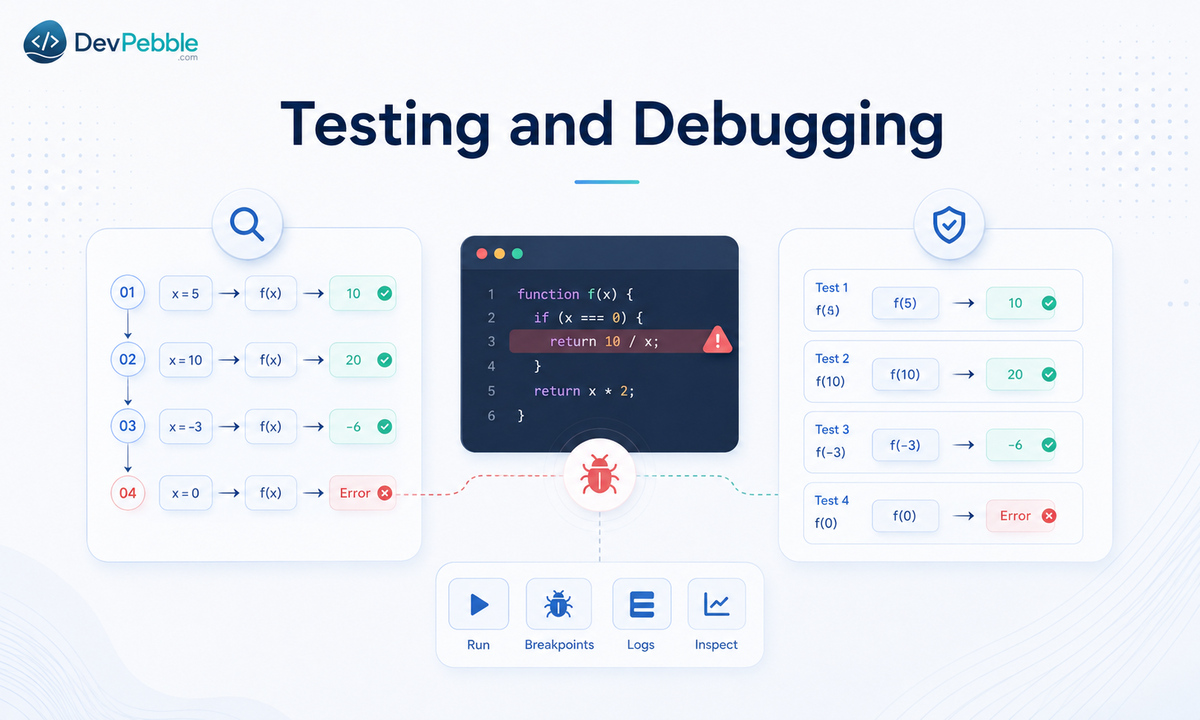
Pure functions are usually simple to test, because a test just supplies inputs and checks the returned value, with no hidden state to set up first. Procedural code can be easy to follow one statement at a time, but testing gets harder once procedures read globals, mutate shared objects, or depend on the order calls happen in.
Deterministic, parameter-driven functions lend themselves to isolated unit tests. Ordered procedures lend themselves to step-by-step tracing, which helps when a bug is about when something happened rather than what a function returned. Either way, debugging quality still comes down to naming, decomposition, and tooling.
Is functional programming better for concurrency?
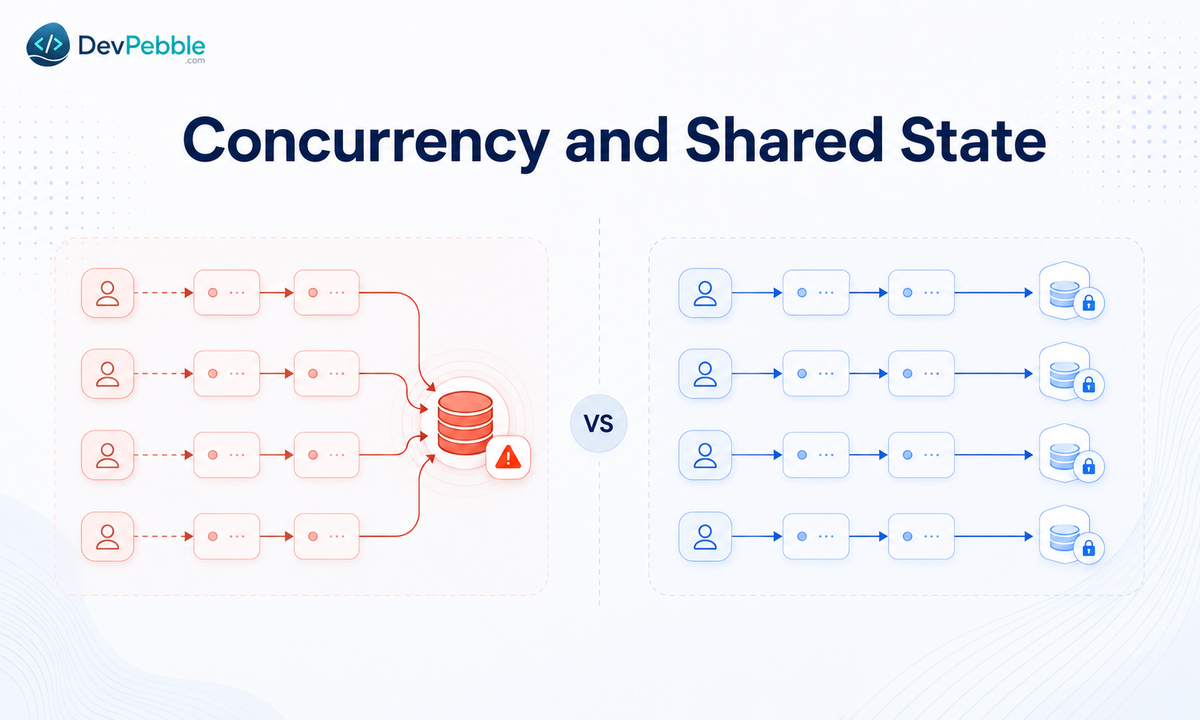
Functional techniques can make concurrent code easier to reason about, because pure transformations do not fight over shared state, and independent computations are often simpler to schedule in parallel. But functional syntax does not create parallel execution on its own. Effects, synchronization, and data movement still decide the real outcome.
Java's documentation on stream operations is blunt about this: passing stateful lambda expressions into a parallel pipeline can produce inconsistent or unpredictable results, and behavioral parameters are expected to be non-interfering and, in most cases, stateless for reliable parallel execution.
| Functional habit | What it helps with | What it does not guarantee | |---|---|---| | Immutable values | Fewer data races on shared state | Automatic parallel scheduling | | Pure functions | Safe reordering of independent work | Faster execution by default | | Stateless lambdas | Predictable results in parallel streams | Thread safety of the surrounding program |
Which paradigm has better performance?
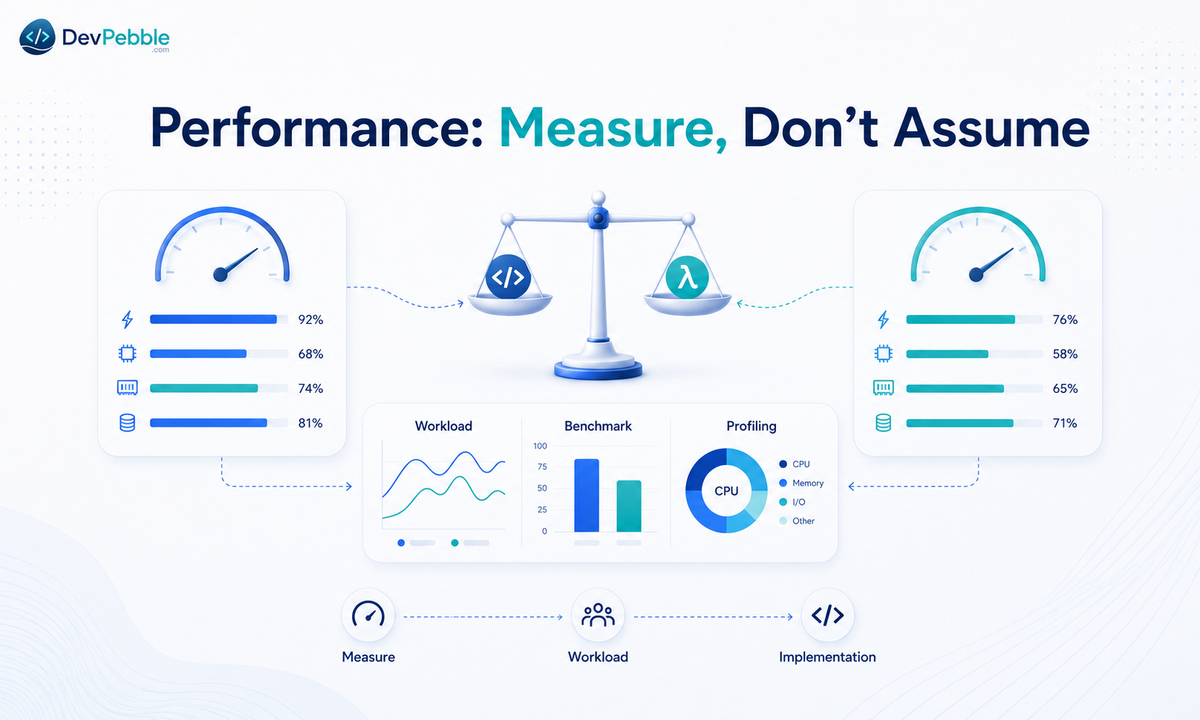
Neither paradigm is universally faster. Performance depends on the algorithm, the data structures, the compiler, the runtime, and implementation quality, not on whether the code reads as a loop or a pipeline. In-place procedural updates can cut down on allocation; well-optimized functional abstractions can compile to comparable machine code.
Rust's documentation makes the point concretely. Its guide calls iterators one of the language's zero-cost abstractions and shows a benchmark where an iterator chain and a hand-written loop finish in almost the same time. That result belongs to Rust's compiler and that specific benchmark, though, and does not generalize into a claim that functional style is always as fast in every language for every task. Anything performance-sensitive should be measured against a realistic workload rather than settled by paradigm.
What does the same task look like in procedural and functional code?
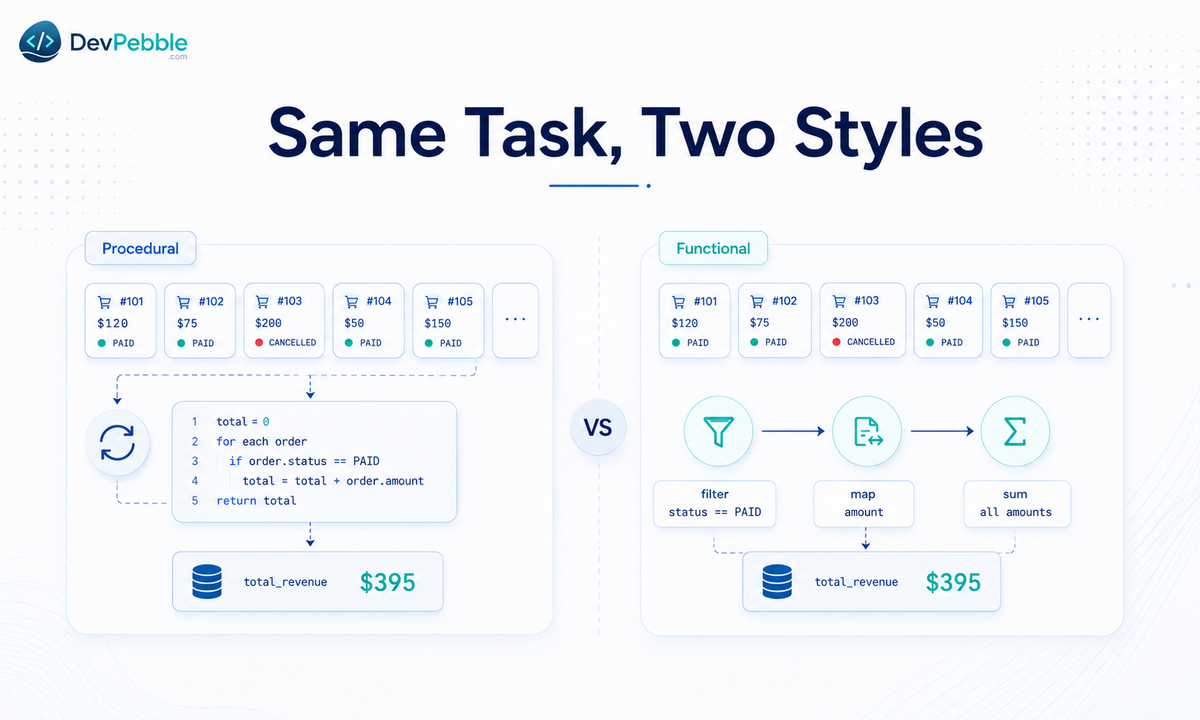
The clearest comparison uses one task, one language, and identical input and output. Given a list of orders, both versions below keep only the completed ones, apply a fixed tax rate to each total, and add up the results. The procedural version updates an accumulator inside a loop; the functional version composes a small transformation pipeline. Python works well here because it supports both styles, which keeps the focus on the paradigm rather than on syntax differences between two languages.
What input and output should both versions share?
Both versions use the same dataset, the same filtering rule, the same tax rate, and the same rounding behavior, so any difference in the result would point to a bug rather than a mismatched setup.
orders = [
    {"status": "completed", "total": 100.00},
    {"status": "cancelled", "total": 50.00},
    {"status": "completed", "total": 75.00},
]
TAX_RATE = 0.08
# Expected result: (100.00 + 75.00) * 1.08 = 189.00
Floating-point values keep the example readable. Production code handling money would normally use Decimal instead, to avoid rounding drift.
How would a procedural version solve the task?
The procedural version makes each operation and its order visible. It starts a running total at zero, walks through every order, skips the ones that do not qualify, works out the taxed value, and updates the accumulator.
def procedural_revenue(orders, tax_rate):
    total = 0.0
    for order in orders:
        if order["status"] != "completed":
            continue
        total += order["total"] * (1 + tax_rate)
    return round(total, 2)
How would a functional version solve the task?
The functional version describes a chain of transformations instead of advancing a counter by hand. One step selects completed orders, another applies the tax, and a final step sums the result. The original list is never touched.
def functional_revenue(orders, tax_rate):
    completed = filter(lambda o: o["status"] == "completed", orders)
    taxed = map(lambda o: o["total"] * (1 + tax_rate), completed)
    return round(sum(taxed), 2)
What does the code comparison actually reveal?
The procedural version exposes the changing state and the exact sequence of operations. The functional version exposes the transformations that connect input to output. Neither is automatically more readable. The loop may feel more natural to a beginner, while the pipeline may feel clearer once the transformations are independent and composable.
What changed?
- How intermediate progress is represented, a mutable accumulator against a sequence of transformed values
- How visible the execution order is
- How finely the logic is broken into named steps
- How easily each step can be tested on its own
What did not change?
- The input data
- The business rule of completed orders only at a fixed tax rate
- The expected output
- The underlying need to filter, transform, and aggregate the data
When should you use procedural or functional programming?
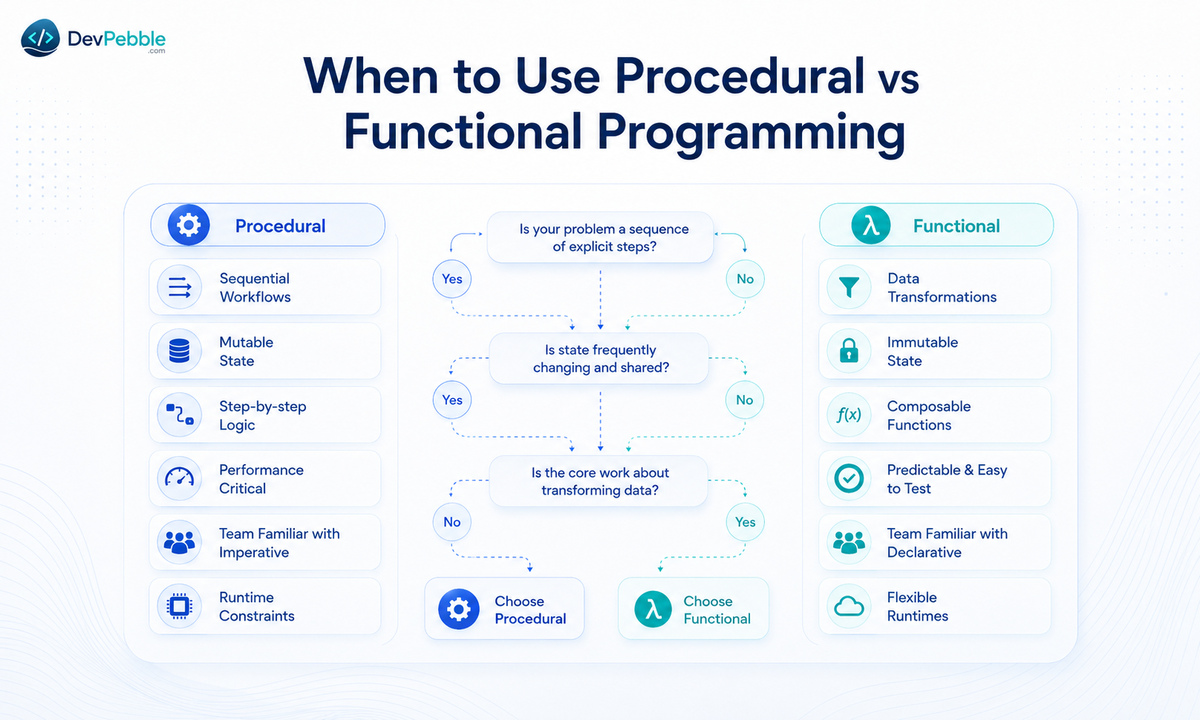
Choose procedural style when an operation is naturally sequential, stateful, and easiest to understand as explicit steps. Choose functional style when the problem is mostly a set of independent transformations or rules that benefit from predictable inputs and outputs. Plenty of real projects use both, applied wherever each one fits best.
When is procedural programming a good fit?
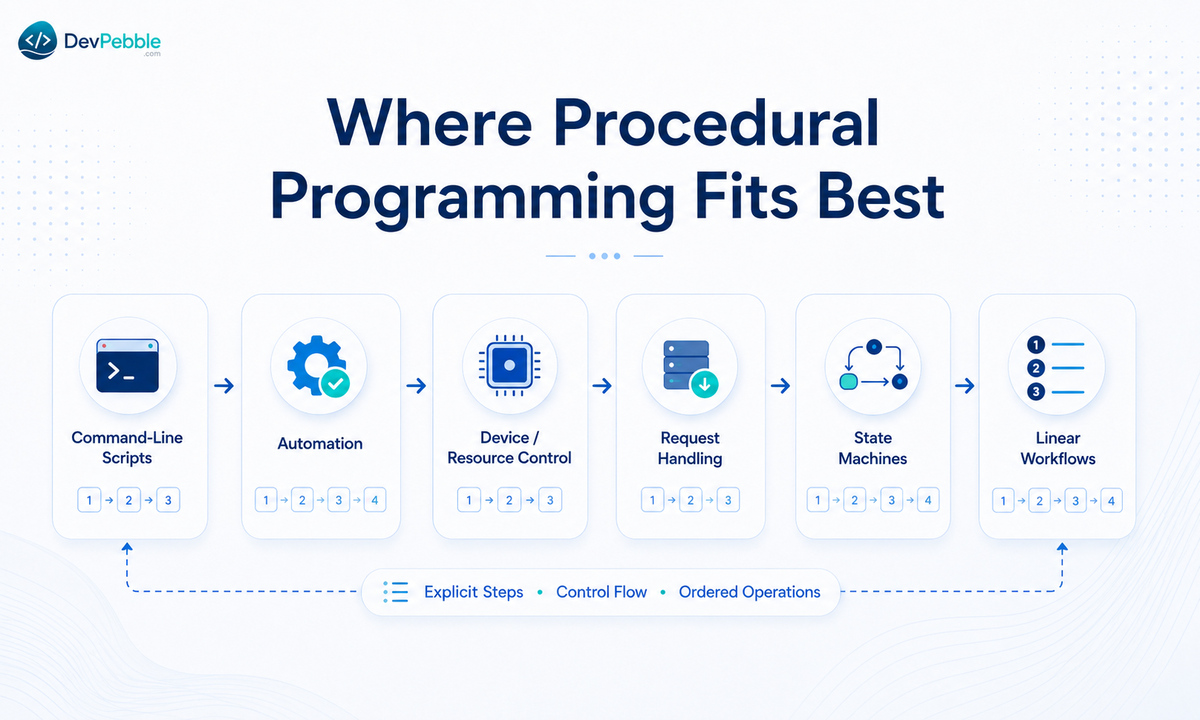
Procedural programming works well when the order of operations matters to the problem itself, state changes stay limited and intentional, and the team needs close control over resources or execution.
- Command-line scripts and automation
- Device- or resource-control routines
- Parsers built around explicit state machines
- Small programs with simple, linear control flow
When is functional programming a good fit?
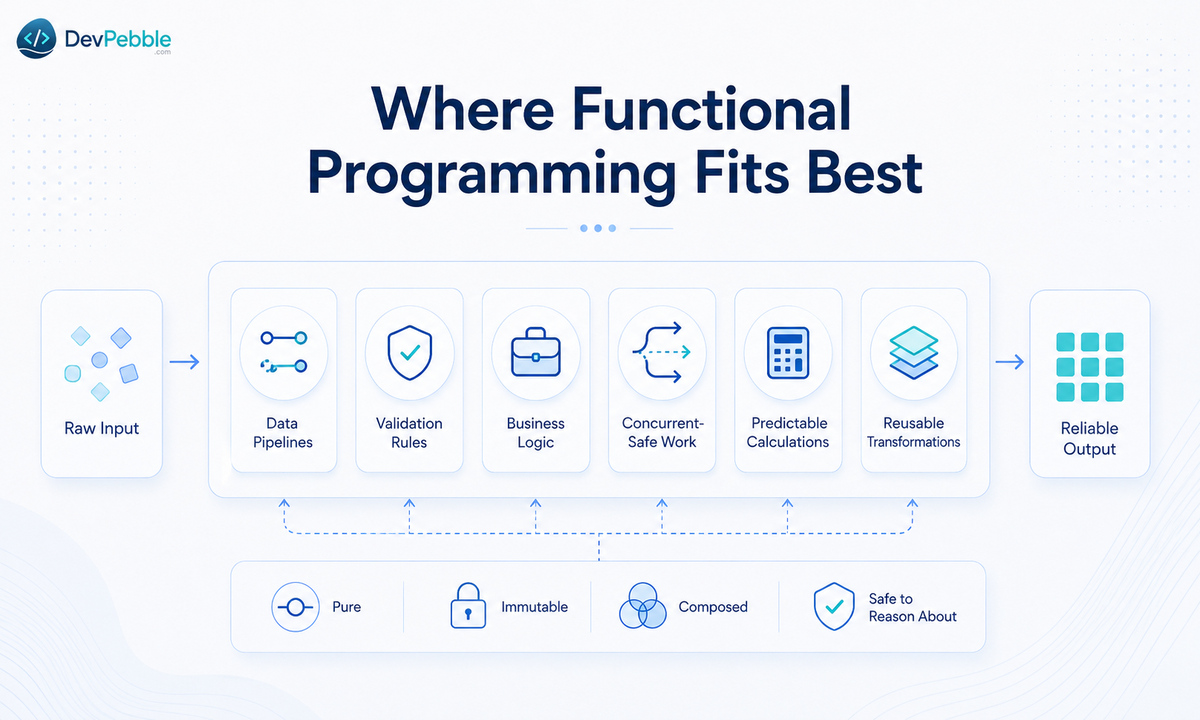
Functional programming works well when logic can be written as independent transformations, when deterministic behavior is valuable, or when shared mutable state would complicate testing and concurrency.
- Data transformation and validation pipelines
- Pricing or business-rule calculations
- Independent calculations that could run in parallel
- Reusable logic that needs predictable, auditable output
What project requirements should influence the decision?
Beyond the shape of the problem, weigh how familiar the team is with each style, how well the language supports it, what profiling and debugging tools are available, and how effects will be handled at the boundaries.
Can procedural and functional programming be combined?
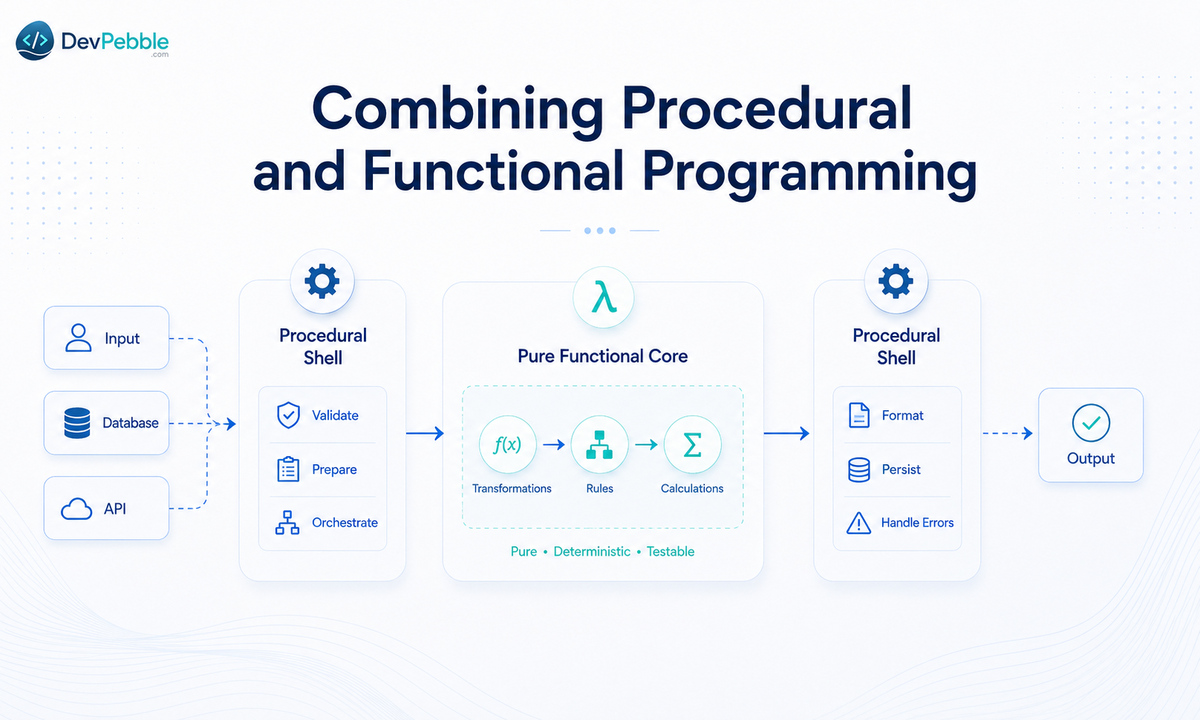
Yes. A common hybrid keeps calculations, validation, and transformations in pure or mostly pure functions, while procedural code coordinates input, databases, files, network calls, logging, and user interfaces. That separates decision logic from effects without forcing an entire application into one paradigm.
A simple version of the architecture looks like this:
Input / DB / API -> procedural shell -> pure transformations -> procedural shell -> output
The shell owns timing, retries, and error handling. The pure core stays easy to test because it never touches the outside world directly.
Common misconceptions about procedural and functional programming
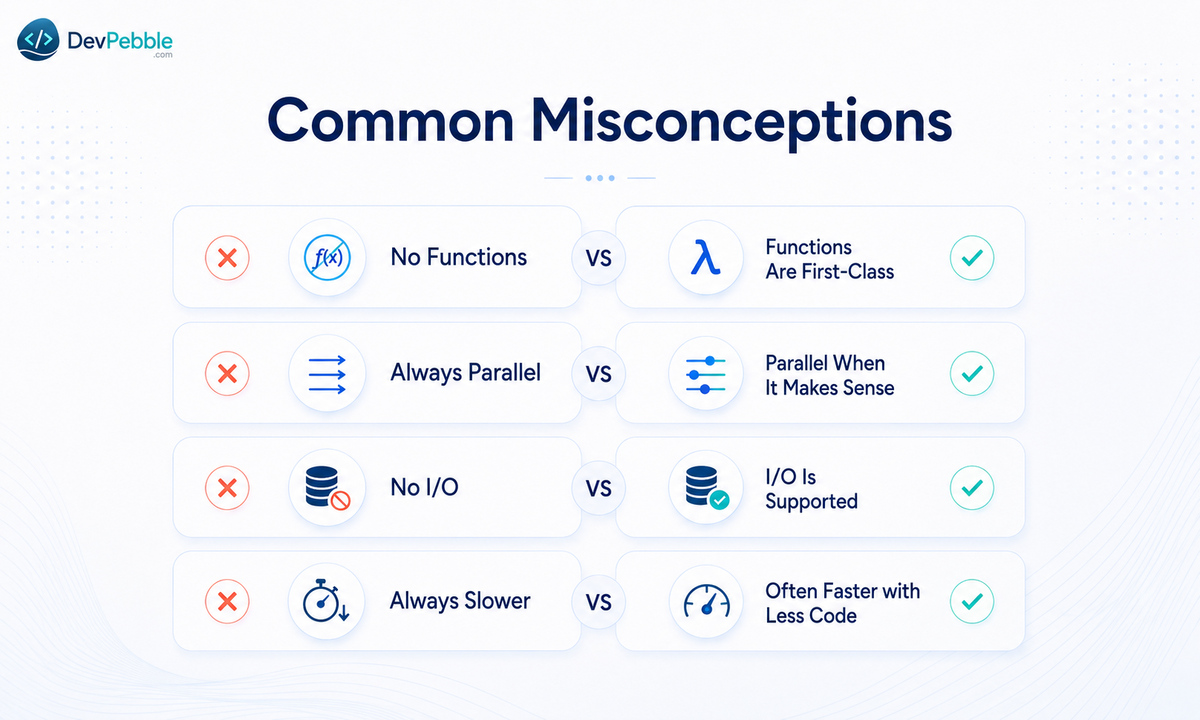
"Procedural programming does not use functions"
Procedural programs are routinely organized into procedures, routines, subroutines, or functions. The name varies by language, but the style never bans reusable callable units.
"Any code using map or lambdas is functional"
Functional syntax can appear inside otherwise imperative code. How a program handles state and effects matters far more than whether it uses a particular keyword or construct.
"Functional programs cannot perform I/O"
Real programs need effects. Functional design isolates, models, or controls input and output at defined boundaries instead of pretending the outside world does not exist.
"Functional programming automatically makes code parallel"
Purity can make independent work easier to schedule in parallel, but the runtime, the algorithm, and the synchronization strategy still decide whether anything actually runs concurrently.
"Procedural code is always simpler"
Explicit steps help with some problems. Widespread shared mutable state can also make a procedural program's behavior hard to predict or safely extend.
"Functional programming is always slower"
Performance depends on the implementation, compiler, and runtime, not the paradigm. Some functional abstractions optimize away cleanly; others add real overhead.
How should you choose between the two?
Start with the problem, not the paradigm. Work out where state lives, whether the task is naturally sequential or transformational, how much the logic needs to be tested, and whether mutation buys a real, measured benefit here. Then write whichever version is clearest to read, and refactor only where evidence supports the change.
- Identify which effects are unavoidable
- Locate where state is mutable, and who owns it
- Separate orchestration from calculation
- Prototype the clearest approach for your team
- Benchmark only the paths that are genuinely performance-critical
- Combine styles wherever that reduces overall complexity
Neither paradigm is a safe default on its own. The strongest design is usually whichever one, or whichever mix, makes the next six months of maintenance easier.