Event-driven programming explained: core concepts, architecture, patterns, and best practices
Event-driven programming explained: how the event loop works, core components, pub/sub and event sourcing patterns, real benefits, trade-offs, and best practices.
On this page⌄
- What is event-driven programming, and how does it work?
- Event-driven programming vs procedural programming
- The core components of an event-driven system
- How producers, consumers, and handlers communicate
- Common event-driven models and design patterns
- Why event-driven programming matters: the main benefits
- The challenges and limitations to plan for
- Languages and frameworks that support event-driven programming
- Real-world use cases
- Best practices for building reliable event-driven systems
- Conclusion
- FAQ
Every time you tap a button on your banking app, watch a stock ticker refresh on its own, or get a notification the second someone messages you, something is running that has nothing to do with a program marching through instructions from top to bottom. Traditional sequential code was never built for a world where people expect instant reactions, live updates, and systems that stay responsive no matter what is happening in the background. Software needed a way to wait, listen, and respond without freezing up or running everything in a fixed order.
That is the gap event-driven programming fills. Instead of forcing an application to run instructions in one rigid sequence, it lets the program sit back, watch for things happening, and react only when something actually occurs. It is why your phone does not freeze while a download finishes, and why a single order can trigger inventory updates, a confirmation email, and a shipping notification at once. This guide covers what it is, how it works, the design patterns you will run into, the real benefits and honest trade-offs, and the practices that keep a system standing under load.
What is event-driven programming, and how does it work?
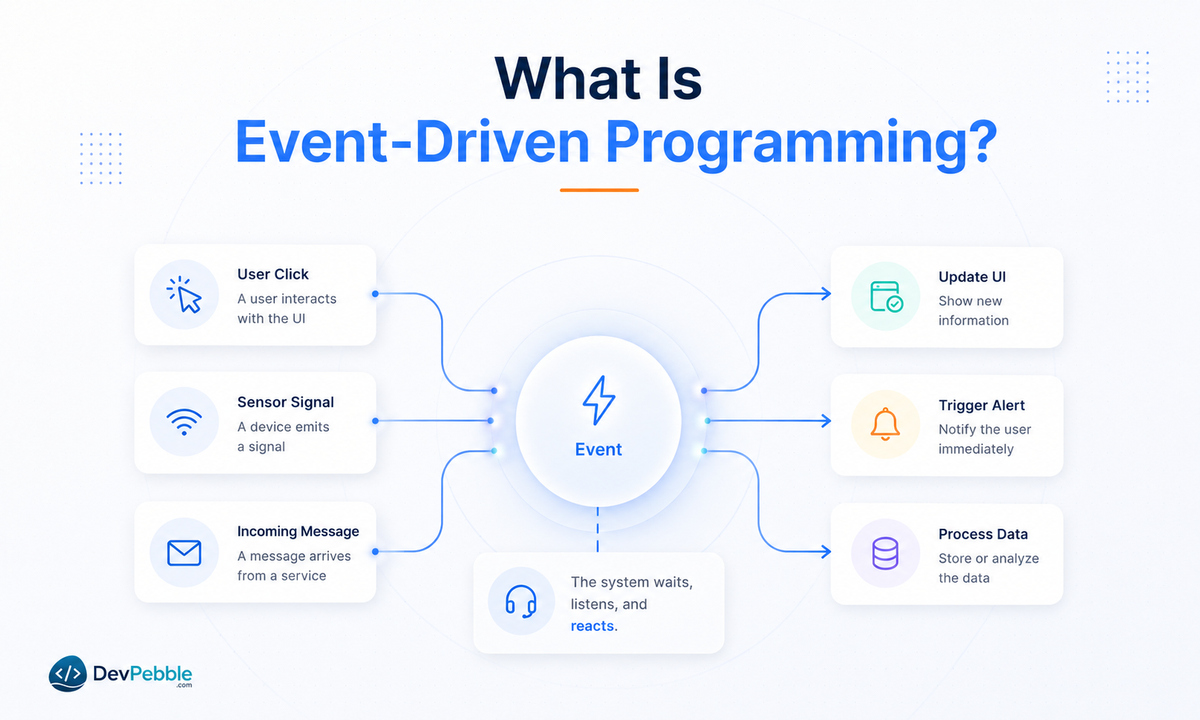
Event-driven programming is a software design approach where the flow of a program is decided by events, such as user actions, sensor outputs, incoming messages, or system triggers, rather than by a fixed sequence written into the code. Instead of running from the first line to the last, the program spends most of its time idle, waiting for something to happen. When that something occurs, a piece of code written specifically to handle it runs, and then the program goes back to waiting.
A checkout button makes this concrete. Nothing happens on that part of the page until a shopper clicks it. The moment they do, a click event fires, a function runs to validate the cart and process the order, and the interface returns to its resting state. The system responds only when it is told to.
The alternative, where a program repeatedly asks "has anything changed yet?" in a tight loop, is called polling, and it is exactly the waste event-driven design avoids. A payment gateway might confirm in two seconds or two minutes, and rather than constantly checking, an event-driven program just waits to be notified.
The event loop that makes it all run
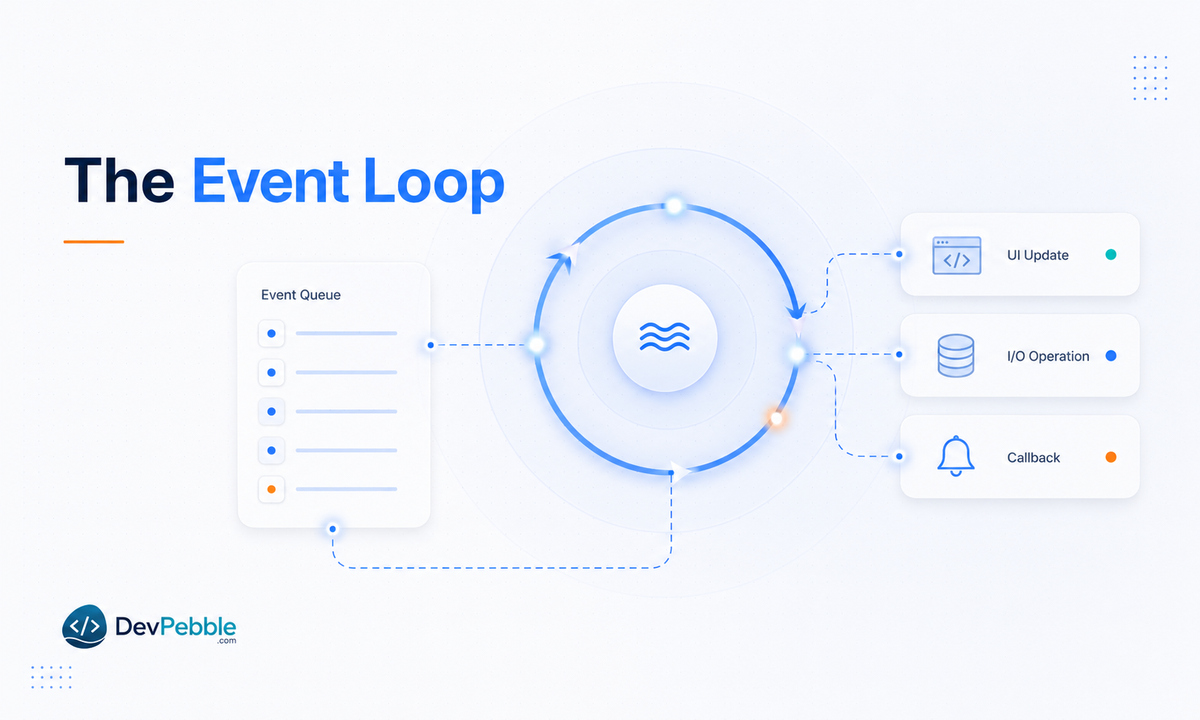
Much of this responsiveness comes down to a mechanism called the event loop. Running continuously in the background, it checks whether any new events have landed in a queue and, if so, hands them to the right piece of code. This is the same mechanism that lets JavaScript in a browser stay responsive to clicks and scrolls while a network request is still in flight, and it is a big reason Node.js can handle thousands of simultaneous connections without spinning up a separate thread for each one.
The key trait is that the event loop does not block. While waiting on something slow, like a database query or an external API call, it moves on to other work and comes back once a response is ready. That non-blocking behavior is what makes the model such a good fit for real-time systems that have to stay responsive while slow work happens in the background.
Event-driven programming vs procedural programming
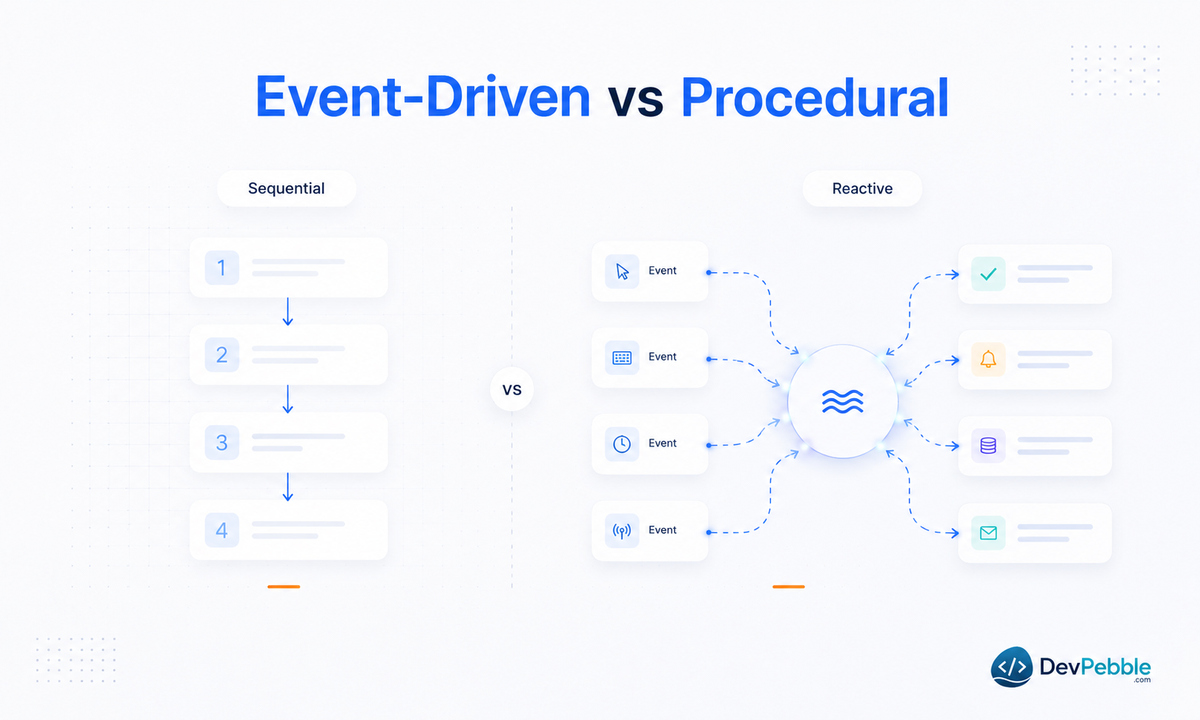
The clearest way to understand event-driven programming is to put it next to the procedural style most developers learn first. In procedural programming, the computer runs instructions in a strict, predetermined order, with loops and conditionals being the only things that change the path. The program is always in control of what happens next.
Event-driven programming flips that. The program does not dictate what comes next. The events do. A piece of code sits idle until something external, a click, a message, a sensor reading, an API response, tells it to act. That single shift changes how the whole application is structured, tested, and scaled.
Picture a payroll script as the procedural case. It reads employee records, calculates wages one by one, and writes a report, finishing the same way every run. Now picture a food delivery app, where a customer places an order, a driver accepts it, a restaurant marks it ready, and a payment clears, all in an order that is impossible to predict and that plays out across thousands of users at once. Procedural code has no natural way to handle that without polling, which wastes cycles and adds lag. The other big difference is coupling: procedural systems tend to be tightly bound, while event-driven systems stay loosely coupled through events instead of direct calls.
| Aspect | Procedural programming | Event-driven programming | |---|---|---| | Execution order | Fixed, sequential | Decided by events, non-linear | | Coupling | Tightly coupled components | Loosely coupled producers and consumers | | Responsiveness | Often blocking, waits for each step | Non-blocking, reacts as events arrive | | Best suited for | Batch jobs, linear workflows | Real-time systems, user interfaces, distributed apps | | Scalability | Harder under unpredictable load | Built for concurrent, high-volume activity |
Neither approach is universally better. A nightly data migration script has no need for event-driven complexity, while a live chat platform would be miserable to build without it. The right choice comes down to whether your problem is a set of predictable, linear steps or a stream of unpredictable, concurrent activity.
The core components of an event-driven system
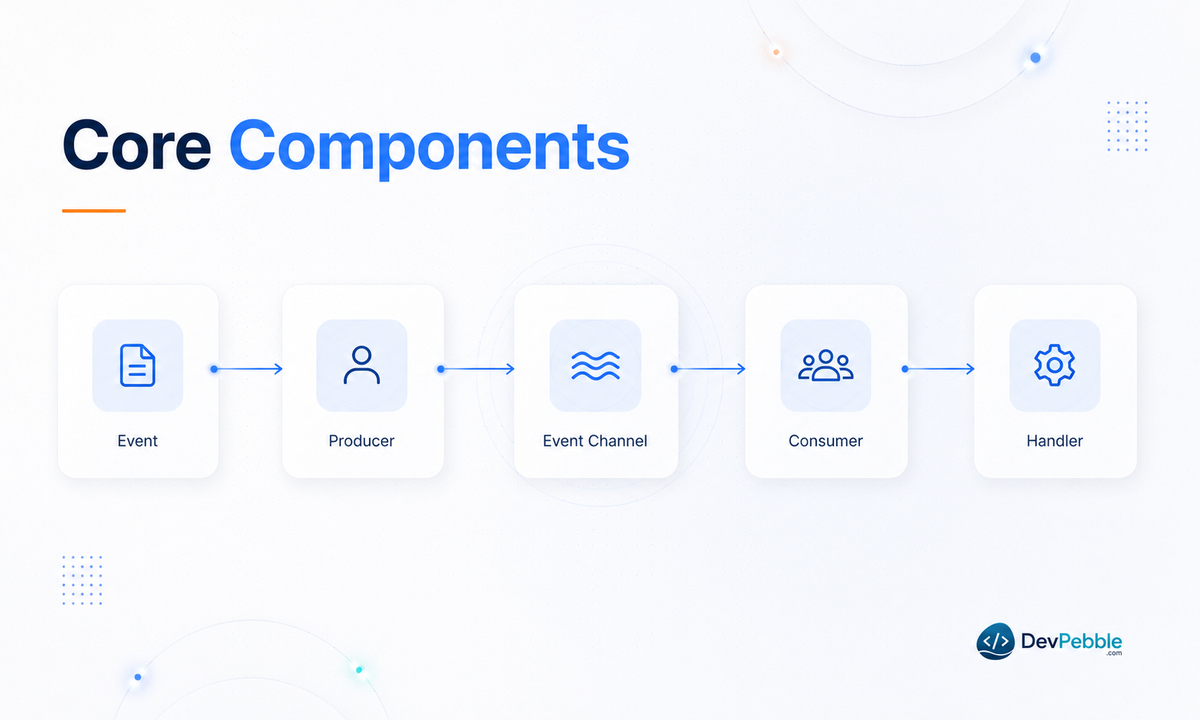
To see how one of these systems works, it helps to break it into its essential parts, and the concepts stay consistent across almost every language.
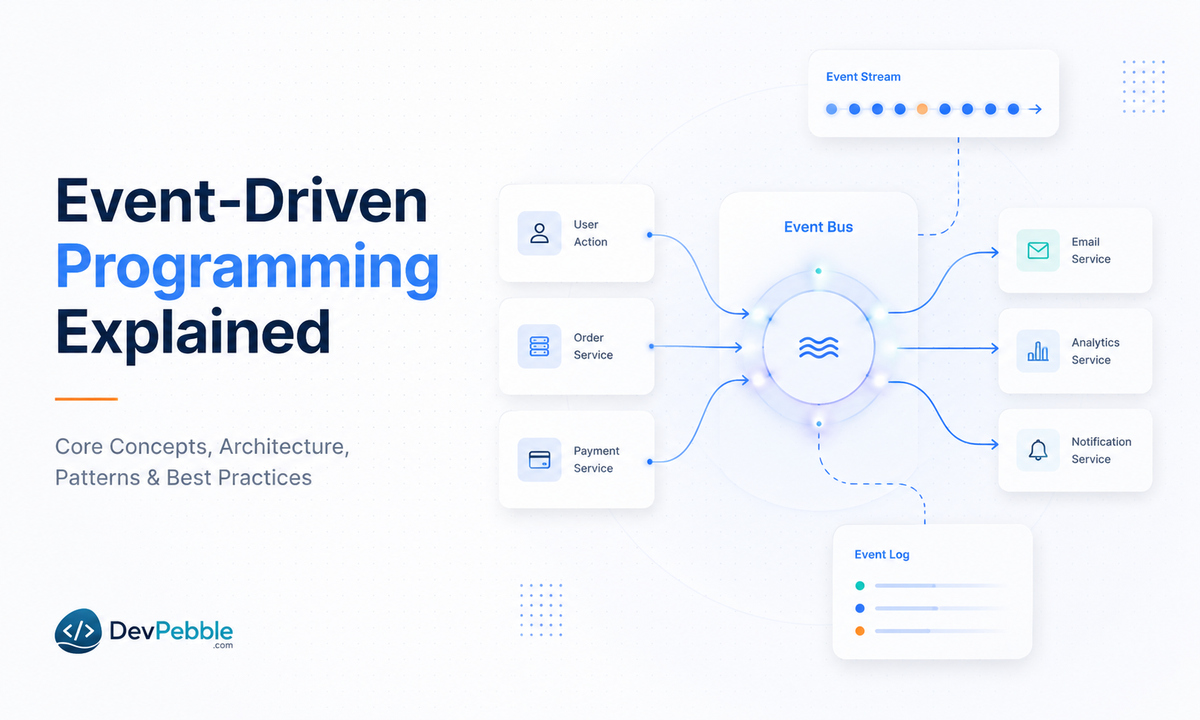
Events are the starting point. An event is a signal that something worth noting has happened: a button click, a file upload finishing, a new row landing in a database. It usually carries a small payload describing what happened. Event producers, sometimes called emitters or sources, generate those events, and a producer does not need to know who is listening. Event consumers, also called listeners or subscribers, are the components waiting for specific events, and a single event can have several consumers reacting independently. Event handlers are the code that runs when a matching event arrives, such as a function that updates a screen or writes to a database.
Event channels, often built as an event bus or message broker, sit between producers and consumers and route events to whichever components registered interest. This is what lets producers and consumers stay decoupled. The table below maps these pieces onto a familiar scenario: placing an order on an online store.
| Component | Role | Example in an e-commerce app | |---|---|---| | Event | The signal that something occurred | "Order placed" | | Event producer | Generates the event | Checkout service | | Event channel | Routes the event to interested parties | Message broker such as Kafka or RabbitMQ | | Event consumer | Listens for relevant events | Inventory, email, and shipping services | | Event handler | Executes the response | Deduct stock, send confirmation email, schedule shipment |
How producers, consumers, and handlers communicate
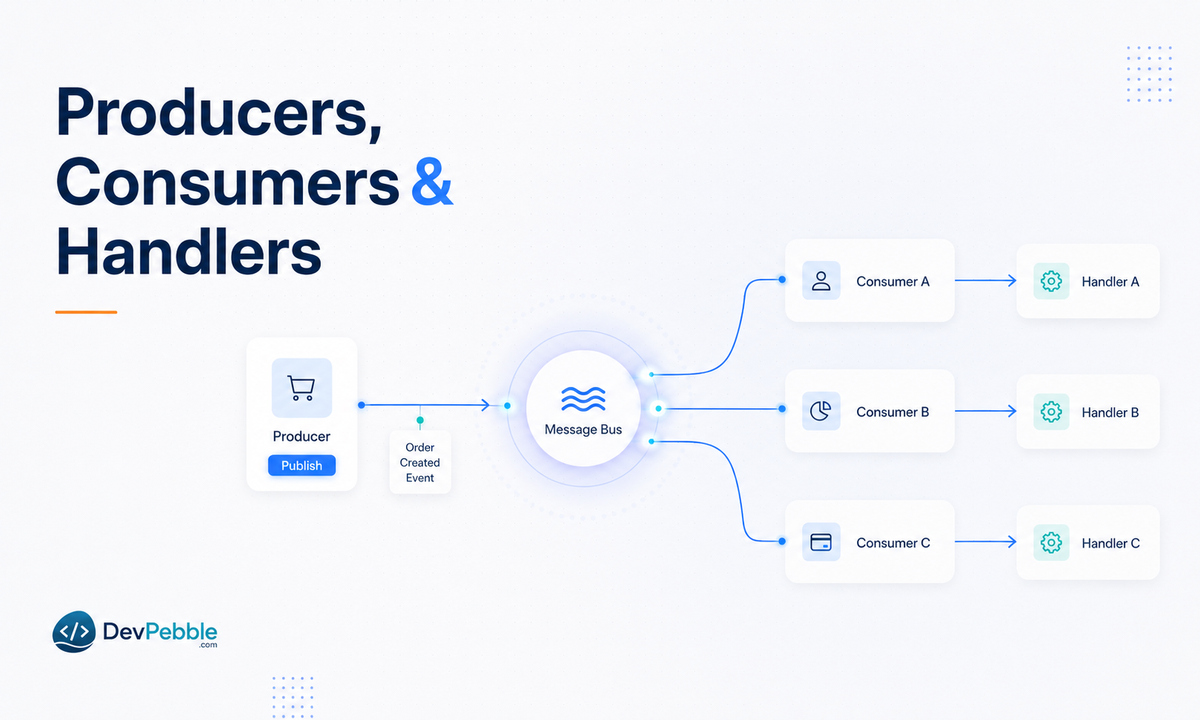
The real strength of the model shows up in how loosely connected these parts are. In a well-designed system, producers, consumers, and handlers do not talk to each other directly. They communicate through an intermediary, usually an event bus, message queue, or broker, which keeps a clean architecture from becoming a tangle of direct calls.
A producer generates an event and publishes it to a channel without needing to know which consumers, if any, are listening. Any consumer subscribed to that event type picks it up and passes it to its handler. This publish-subscribe arrangement, usually shortened to pub/sub, means a producer can be changed, scaled, or replaced without breaking the consumers that depend on it, as long as the event format stays stable.
Back to the order example. The checkout service does not send separate messages to inventory, email, and shipping. It publishes a single "order placed" event, and three independent services, each unaware of the others, react in their own way.
This can happen synchronously, where the handler runs immediately and the producer waits for a result, or, far more often in scalable systems, asynchronously, where the producer fires the event and moves on. Asynchronous delivery is what gives these systems their resilience: if the email service is briefly down, checkout does not stall waiting for it.
Common event-driven models and design patterns
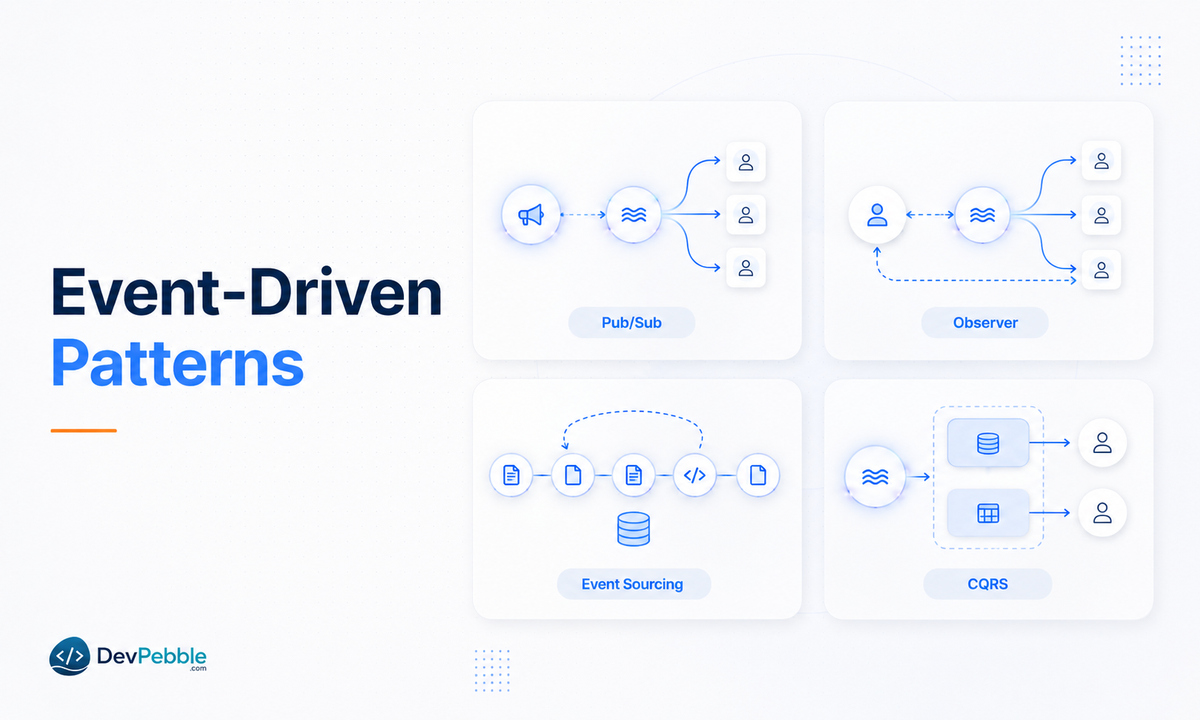
Once you accept that events drive the program, a handful of established patterns emerge for organizing how events are generated, routed, and consumed, and most production systems combine more than one.
Publish-subscribe (pub/sub) is the most widely used model, and the primitive most other patterns build on. A publisher sends events to a channel without knowing who is listening, and any number of subscribers can independently register to receive them. Kafka, RabbitMQ, AWS SNS, and Google Cloud Pub/Sub are all built around this idea. A single "payment received" event can trigger fraud checks, update a ledger, and notify a customer, none of them aware of the others.
The observer pattern is a close cousin, usually applied inside a single application rather than across distributed services. An object called the subject keeps a list of dependents called observers and notifies them directly when its state changes. React's state updates work this way, as does a plain JavaScript button that runs a callback the instant it is clicked.
Event sourcing takes a different angle. Instead of storing only the current state, it stores every event that led to that state as an immutable, ordered log. A bank account balance would not be saved as a single number but rebuilt by replaying every deposit and withdrawal. This is popular in financial and audit-heavy systems because it gives you a complete, tamper-resistant history. CQRS (Command Query Responsibility Segregation) often pairs with it, splitting the part that changes data (commands, which emit events) from the part that reads data (queries) so each side scales on its own.
The mediator pattern introduces a central coordinator that manages communication between components instead of letting them emit events freely into a shared channel. It suits cases that need tighter orchestration, like a workflow engine that has to guarantee certain steps run in order. One trend worth knowing: the CloudEvents specification, backed by the Cloud Native Computing Foundation, defines a common event format so different tools and platforms can exchange event data without custom translation.
Why event-driven programming matters: the main benefits
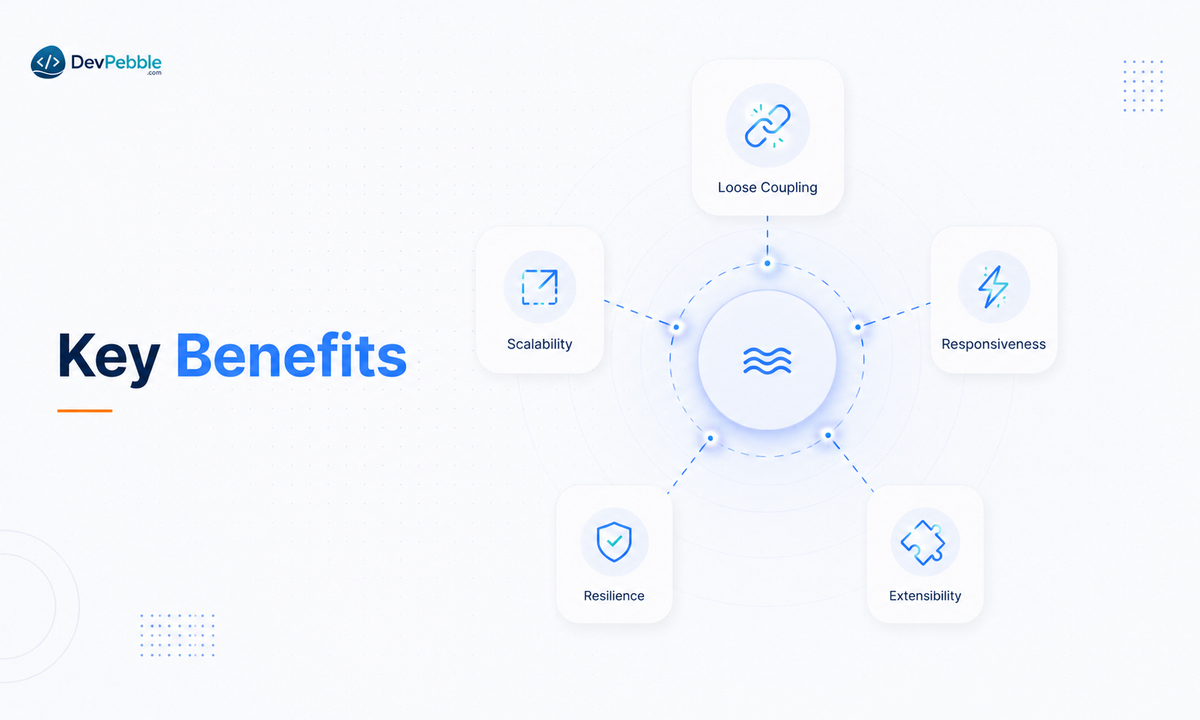
Event-driven programming became dominant because it directly addresses problems older paradigms struggle with as systems grow larger, more distributed, and more real time.
Loose coupling is arguably the biggest win. Because producers and consumers interact through events rather than direct references, teams can build, deploy, and update individual services without a synchronized release across the whole system. Scalability follows from that decoupling: since components communicate asynchronously instead of blocking on each other, services can be scaled independently based on their own load. A platform can scale its notification service separately from payment processing, even when both react to the same event.
Real-time responsiveness is the reason this model underpins live dashboards, trading platforms, multiplayer games, and messaging apps. Users get immediate feedback the instant something happens rather than on a fixed polling interval. Resilience improves too: if one consumer goes down, events usually sit safely in a queue until it recovers, instead of taking the whole system down with it.
Finally, these systems tend to be more extensible. Adding functionality often means subscribing a new service to an existing event stream. A company adding loyalty rewards can subscribe to the existing "order placed" event rather than reworking the checkout flow, meaning new behavior with zero changes to the original path.
The challenges and limitations to plan for
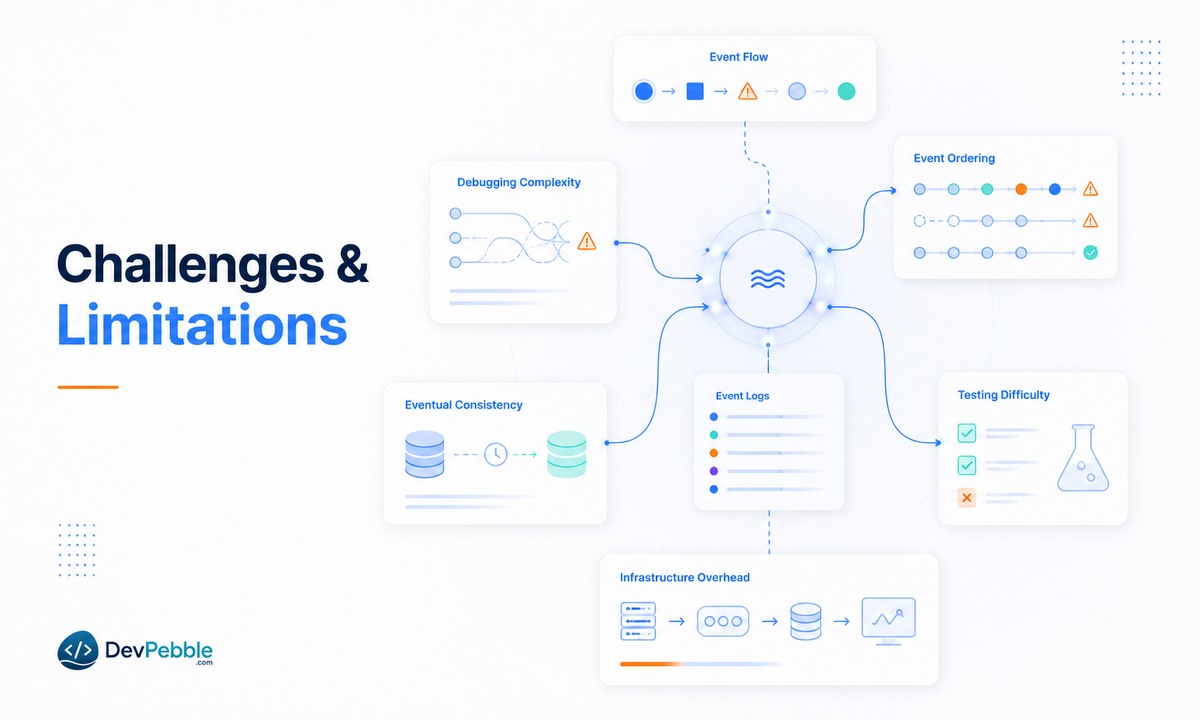
None of this comes free, and it is worth being honest about where event-driven programming adds complexity rather than removing it.
Debugging and tracing get harder. In a sequential program, finding a bug means reading the code top to bottom. In an event-driven system, one action can trigger a chain of events across several services, and reconstructing exactly what happened and in what order is genuinely difficult, especially when something fails quietly in a consumer nobody is watching.
Event ordering and consistency are another challenge. Events do not always arrive in the order they were generated, especially with multiple producers and consumers involved. Systems that depend on strict ordering, like financial transactions, need extra design work such as sequencing identifiers or ordering guarantees from the broker. Closely related is eventual consistency: because consumers process events asynchronously, different parts of a system can briefly show different states. A customer might see their order confirmed a moment before inventory finishes deducting stock. That is usually fine, but it forces deliberate decisions about which parts can tolerate the lag.
Testing gets more involved. Unit testing a single handler is easy; verifying that a whole chain of events behaves correctly across services, including failures and retries, needs serious integration and end-to-end testing. Then there is infrastructure overhead. These architectures usually depend on message brokers, event buses, or streaming platforms that have to be deployed, monitored, and maintained. For a small app with predictable, low-volume traffic, that cost can outweigh the benefits. Reaching for event-driven design before you actually need it is a common way to make a simple project harder than it should be.
Languages and frameworks that support event-driven programming
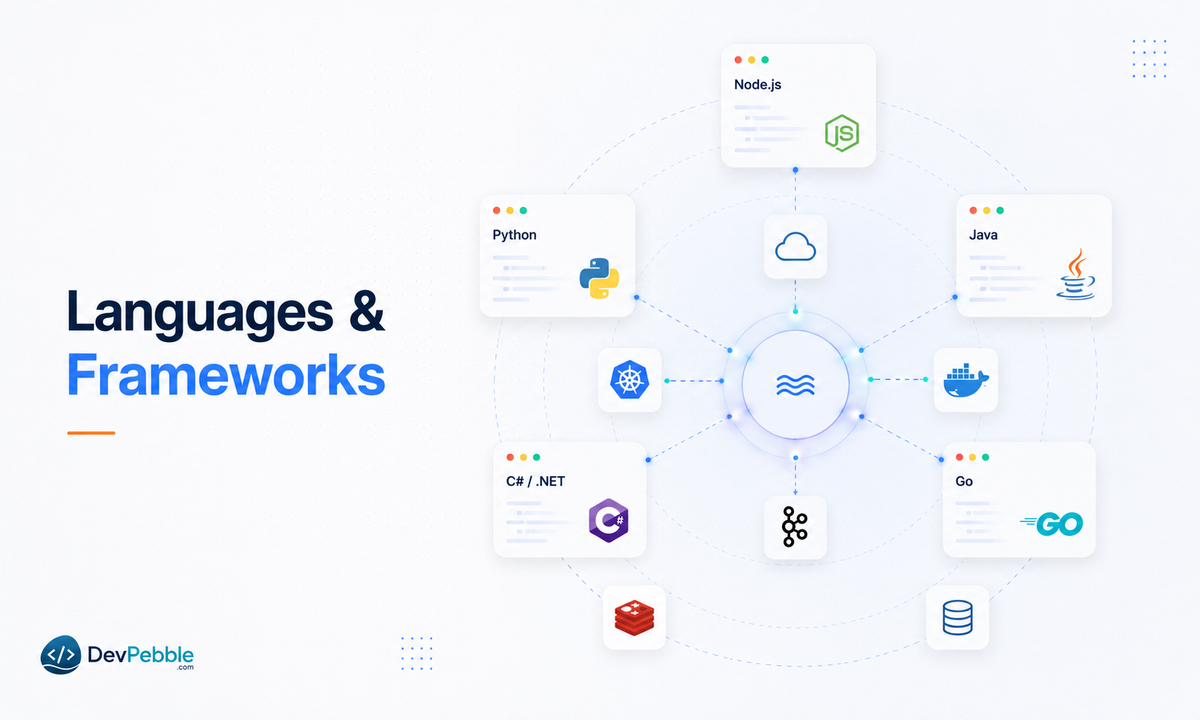
Nearly every modern language offers some way to write event-driven code, though the tools and vocabulary vary. JavaScript is perhaps the most natural fit, since the language and the browser are both built around an event loop. Node.js extends that model to the server through its EventEmitter class, which is why it is popular for real-time APIs, chat backends, and streaming services.
Python supports the style through asyncio, its built-in library for asynchronous, non-blocking operations, along with older network-focused frameworks like Twisted. Java handles events through Spring's application events and through Vert.x, a toolkit built for reactive systems on the JVM. In the .NET world, C# has built-in support for events and delegates, and Reactive Extensions (Rx.NET) treats event streams as data you can filter, combine, and transform. Go takes a different route with channels and goroutines, letting concurrent processes communicate by passing messages rather than through callbacks.
Beyond individual languages, a whole ecosystem supports event-driven architecture at scale. Apache Kafka and RabbitMQ are long-standing choices for streaming pipelines and message queues, and newer brokers like Apache Pulsar and NATS have gained ground for high-throughput and lightweight use cases. Cloud providers offer managed services too: AWS Lambda and EventBridge, Google Cloud Pub/Sub, and Azure Event Grid all let you build serverless, event-driven applications without running the broker infrastructure yourself.
| Language or platform | Common tool or library | Typical use case | |---|---|---| | JavaScript / Node.js | EventEmitter, browser DOM events | Web UIs, real-time APIs | | Python | asyncio, Twisted | Async services, network apps | | Java | Spring Events, Vert.x | Enterprise microservices | | C# / .NET | Delegates, Rx.NET | Desktop apps, reactive systems | | Go | Channels, goroutines | Concurrent backend services | | Cloud-native | Kafka, Pulsar, AWS EventBridge, Pub/Sub | Serverless and distributed systems |
Real-world use cases
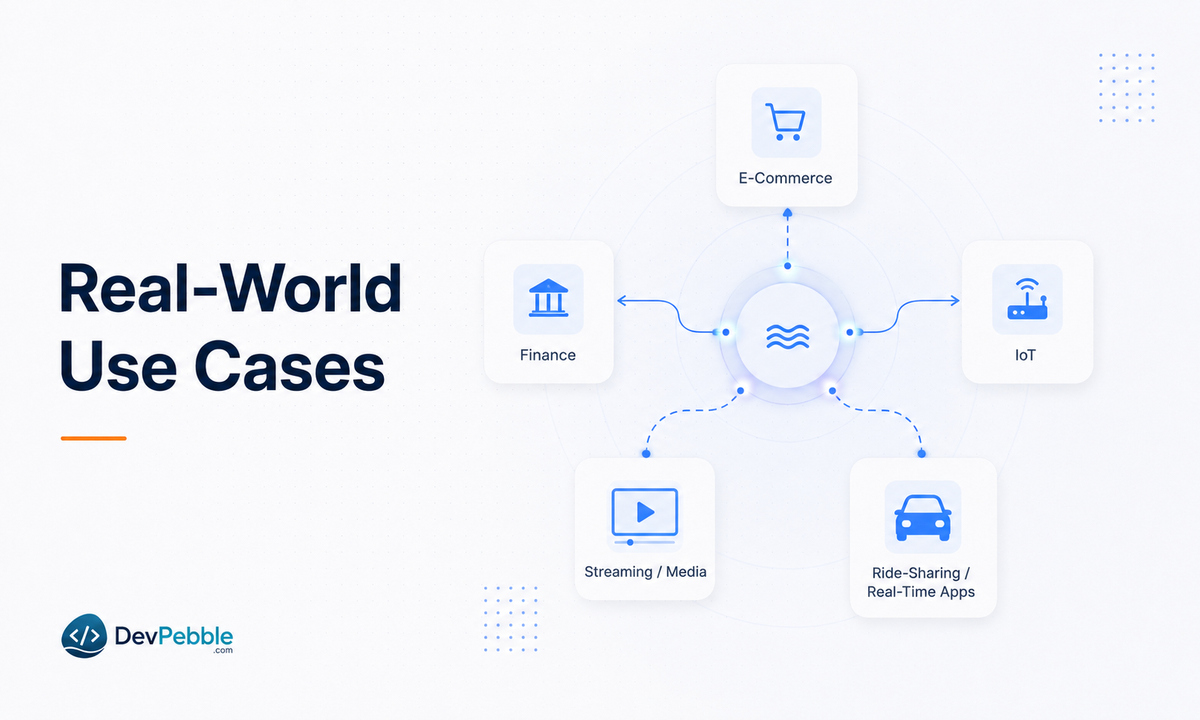
The best way to appreciate event-driven programming is to look at where it already runs quietly in everyday technology.
E-commerce leans on it heavily. Placing an order triggers a cascade of independent events covering inventory updates, payment confirmation, shipping notifications, and loyalty point calculations, with no single monolithic process doing everything in sequence. IoT is another major case: a smart thermostat, security camera, or industrial sensor produces a constant stream of events, and event-driven systems process those signals the instant they arrive rather than through periodic checks. Ride-sharing apps like Uber react in real time to a driver accepting a trip or a fare being finalized.
Financial services use the model extensively for fraud detection and trading, where a suspicious transaction has to trigger an immediate review, sometimes within milliseconds. Streaming platforms such as Netflix use event-based pipelines to track viewing behavior and update recommendations continuously instead of in scheduled batches. Even routine application monitoring works this way, emitting events on every error or performance anomaly so engineers can respond before users notice.
Best practices for building reliable event-driven systems
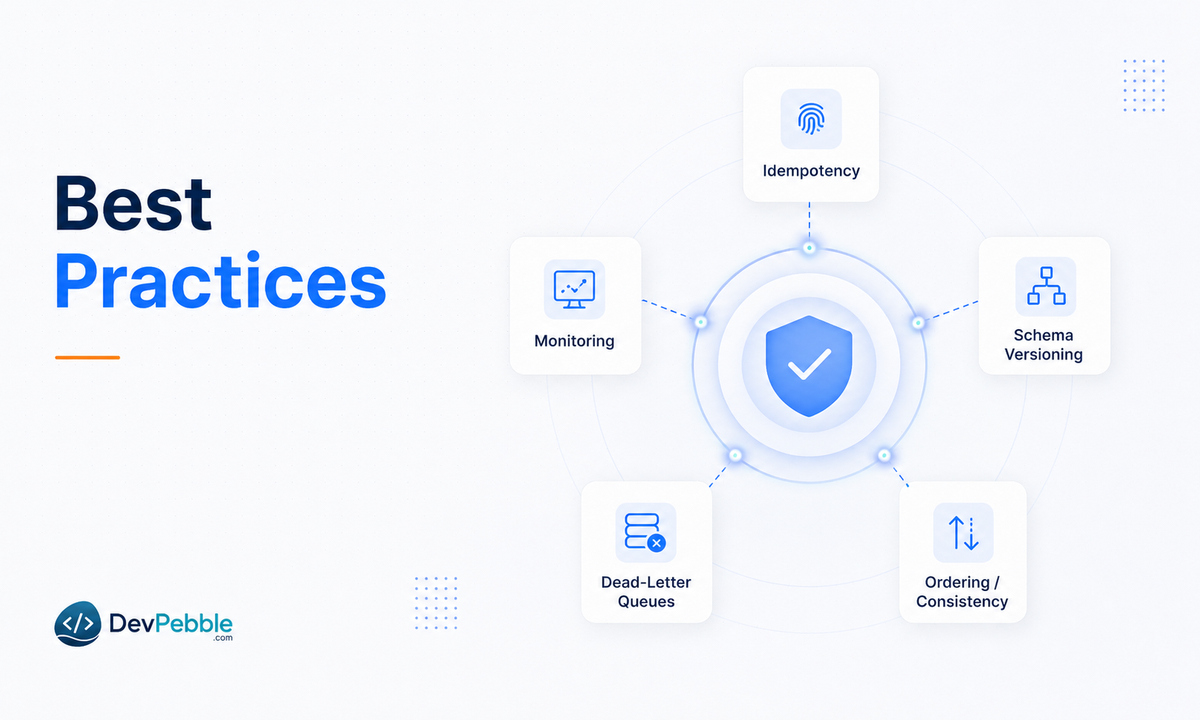
Wiring a producer to a consumer is the easy part. Building something that holds up under real traffic takes a few habits that consistently separate reliable systems from fragile ones.
Make your event handlers idempotent. An idempotent handler produces the same result even if the same event is processed more than once. Retries and redelivery are normal in distributed systems, so a non-idempotent handler can quietly cause duplicate charges or corrupted data. This is the one practice I would not skip.
Choose a broker that matches your reliability needs, and use dead-letter queues, which capture events that repeatedly fail processing instead of silently dropping them. Version your event schemas from the start, too. As a system grows, event structures change, and versioning keeps older consumers from breaking when a producer updates its format.
Invest in monitoring and observability sooner than feels necessary. Because event flows do not show up in a single call stack, tools that trace an event's journey across services are essential for debugging as the system scales. Finally, be deliberate about where strict ordering and consistency actually matter. Not every part of a system needs them, and forcing strong consistency everywhere undermines the very scalability that made event-driven design worth choosing.
Conclusion
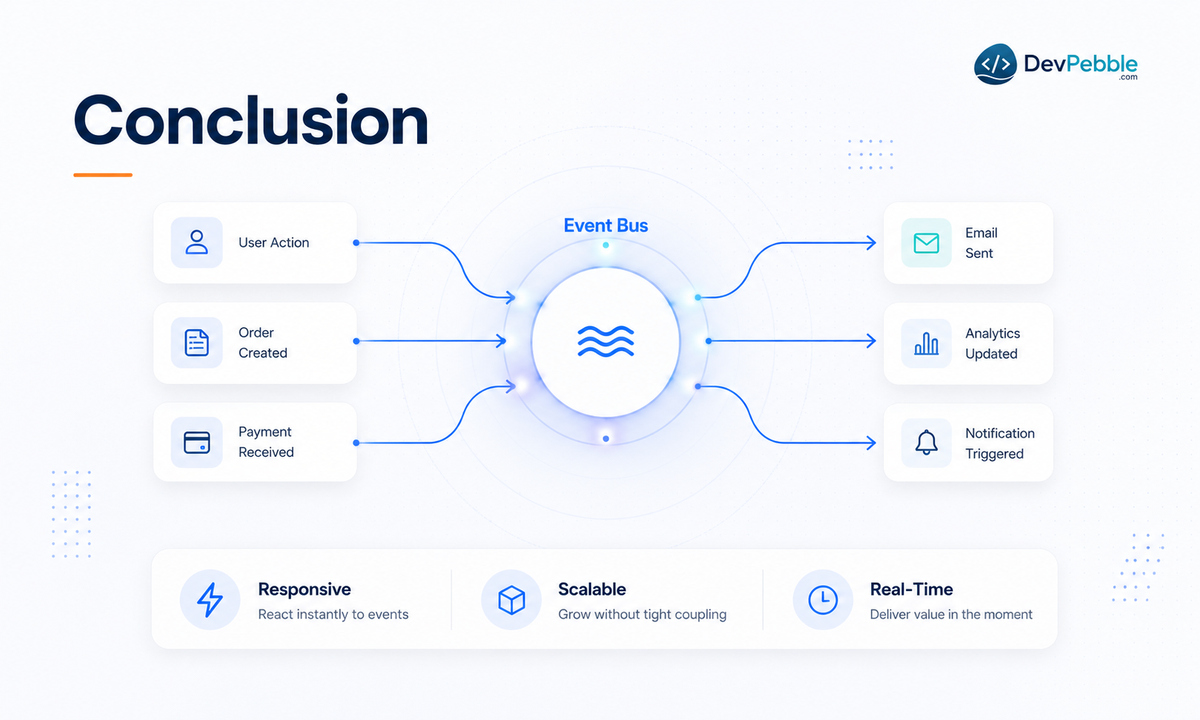
Event-driven programming has reshaped how modern software is built, shifting from rigid, sequential execution toward systems that listen, react, and scale in response to real-world activity. It has proven itself across e-commerce, finance, and IoT, and knowing when and how to apply it is what separates a system that merely runs from one that performs under pressure.
The practical takeaway is simple: let your system's actual needs decide how far you lean into this model. A nightly batch job does not need it; a real-time platform is hard to imagine without it. The real skill is not memorizing patterns, but learning to think in terms of reactions instead of rigid sequences.