Functional programming in Scala: concepts, examples, and trade-offs
Functional programming in Scala explained: pure functions, immutability, pattern matching, Option and Either, a runnable order-pricing pipeline, and trade-offs.
On this page⌄
- What is functional programming in Scala?
- Which Scala features make functional programming work?
- How do you write a functional Scala program?
- How should functional Scala handle errors?
- How do functional programs manage side effects and I/O?
- What are the main benefits of functional programming in Scala?
- What are the trade-offs and edge cases?
- Functional programming vs OOP in Scala: which style should you use?
- How should you learn functional Scala next?
- FAQ
Functional programming in Scala means building programs out of pure functions, immutable values, and composable transformations, with failure represented as an ordinary return value instead of a thrown exception. Scala does not enforce any of this. The language is multi-paradigm by design, so the style is a discipline you opt into rather than a mode the compiler switches on.
This guide uses Scala 3 and builds toward one runnable example: an order-pricing pipeline. You will not need Cats, Cats Effect, ZIO, or any category theory to follow it. It covers the programming approach, not the Manning book or the Coursera specialisation that share the name.
What is functional programming in Scala?
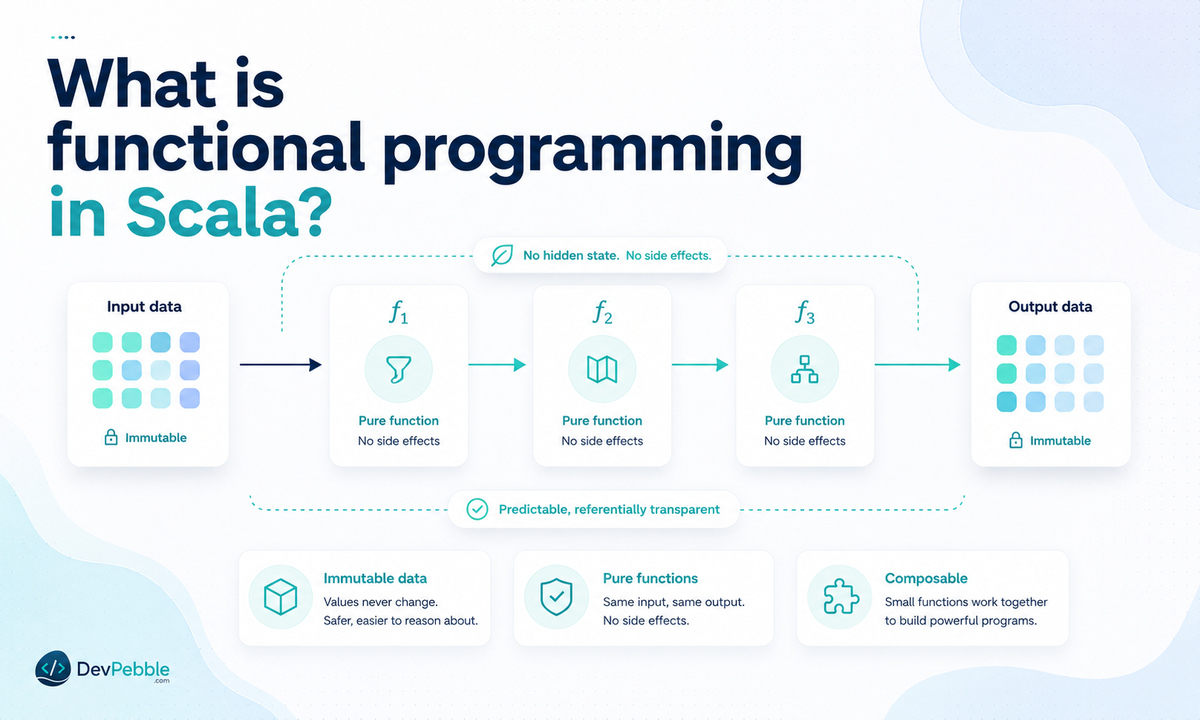
Functional programming in Scala is a style built on immutable data, functions treated as ordinary values, and expressions that compute results without hidden side effects. It is not a library or a compiler flag. The official Scala 3 documentation describes the language as supporting object-oriented code, functional code, and a hybrid of the two, so mixing mutable objects with pure functions is a legitimate choice when it fits.
Strict purity is stricter than everyday idiomatic Scala, and most production code sits in between. The useful question is not whether a function is pure but whether you can predict what it does from its signature.
How does Scala combine functional and object-oriented programming?
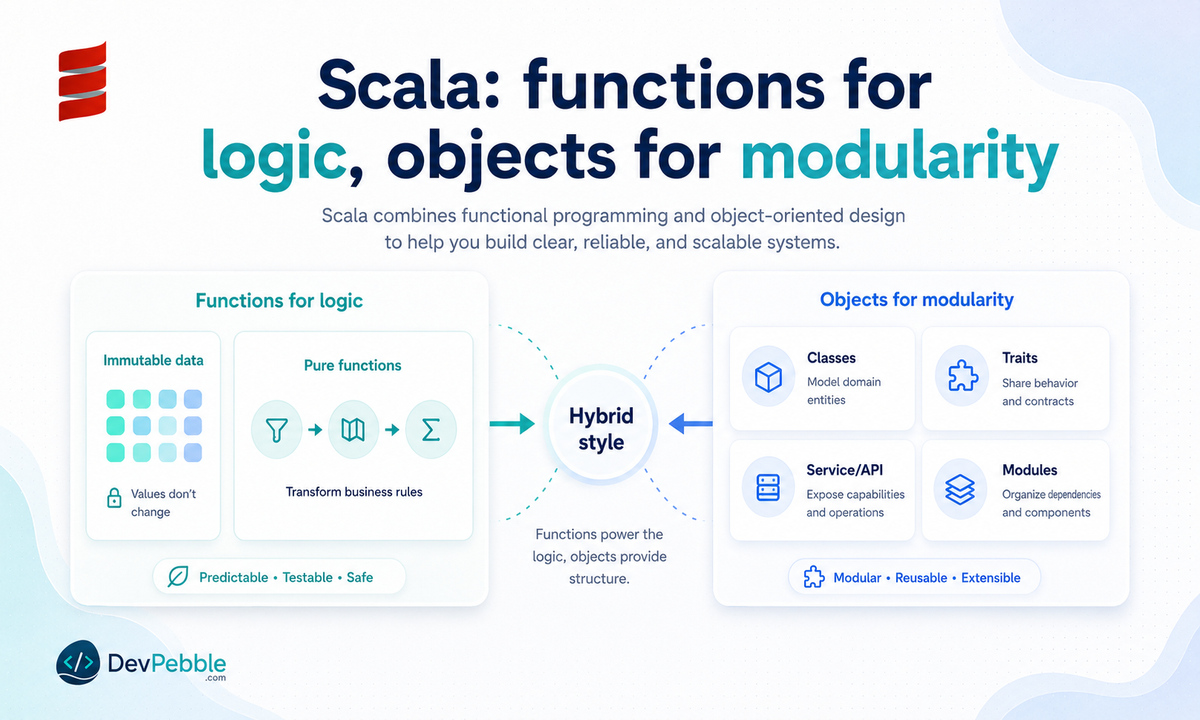
Scala uses functions to express calculations and transformations, and uses classes, traits, and objects to organise behaviour, APIs, and dependencies. Neither approach excludes the other. A case class models immutable data while remaining an ordinary class, and any method can accept or return a function value.
The Scala documentation attributes a short formulation to Martin Odersky, the language's creator: "Functions for the logic; objects for the modularity." In practice, pricing rules live in small functions while a service wraps them for the rest of the application: a LineItem case class holds immutable order data, and an OrderService exposes methods that call those pure functions underneath.
| Concern | Typically expressed with | |---|---| | Business rules, calculations, validation | Functions and immutable data | | Modules, APIs, dependency wiring, lifecycles | Objects, traits, classes |
Which Scala features make functional programming work?
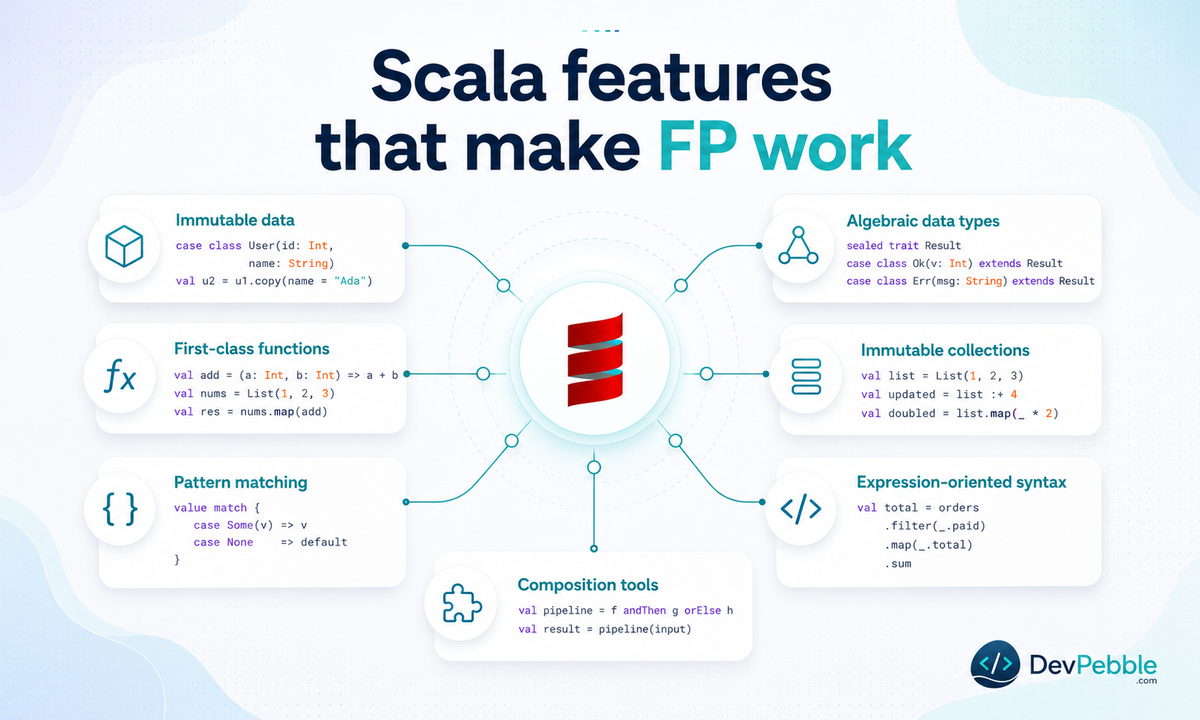
Scala supports functional programming through a small set of concrete features: immutable values, pure functions, functions as first-class values, expression-oriented syntax, immutable collections, pattern matching, algebraic data types, and composition operators such as map, fold, and flatMap. They work as a connected system. Learning them as an isolated glossary is why the style often feels harder than it is.
Why do immutability and pure functions matter?
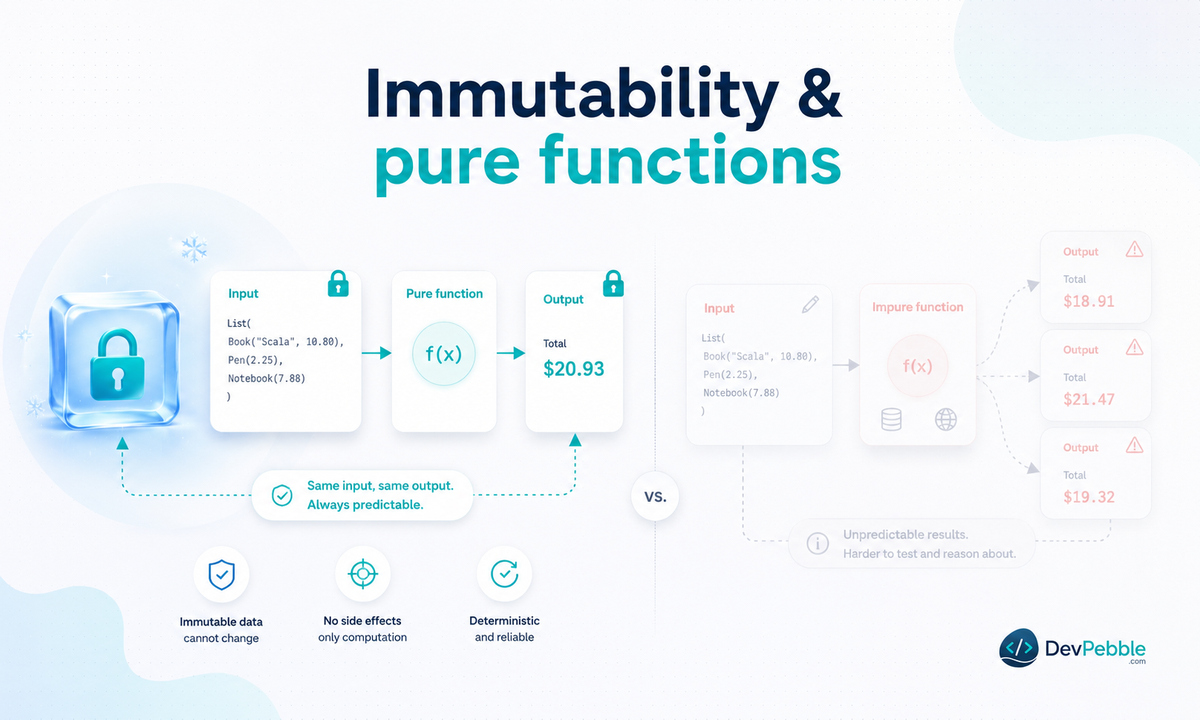
Immutable values do not change after creation, and pure functions calculate results from their declared inputs without reading or modifying anything else. Together these two properties make a function's dependencies visible: you can predict the output from the arguments, without tracing state elsewhere in the program.
Scala's documentation defines a pure function as one that depends only on its declared inputs and its own implementation, and that does not modify the outside world. Printing to the console, reading the clock, and throwing exceptions all break that rule, because the result depends on something the parameters do not describe.
If double(2) always returns 4, you can substitute 4 for the call anywhere without changing behaviour. That property is referential transparency. One limit worth knowing: val prevents reassignment of the reference, not deep mutation of what it points at, so a val holding a mutable Java collection is still mutable. Case classes sidestep this by updating through copy, so order.copy(quantity = 3) returns a fresh Order and leaves the original alone.
How do first-class and higher-order functions work?
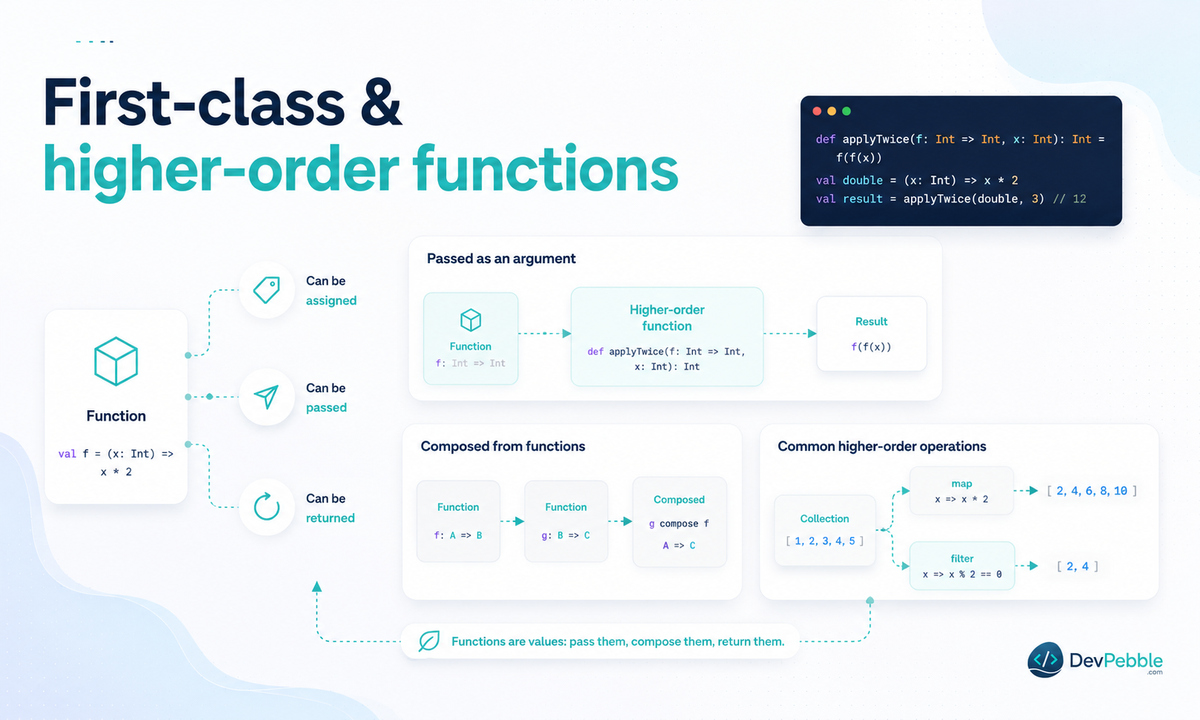
Scala treats functions as values. You can assign them to variables, pass them as arguments, and return them from methods. A higher-order function is one that takes a function as a parameter or returns one, which is exactly what makes map and filter possible.
val isCheap: LineItem => Boolean = item => item.unitPrice < 10
val cheapItems = items.filter(isCheap)
The type LineItem => Boolean is the whole contract, so one filter implementation serves every rule you will ever write. Underscore shorthand (items.filter(_.unitPrice < 10)) says the same thing and is fine in short chains, though naming the predicate reads better once the condition gets interesting.
How do expressions, pattern matching, and algebraic data types fit together?
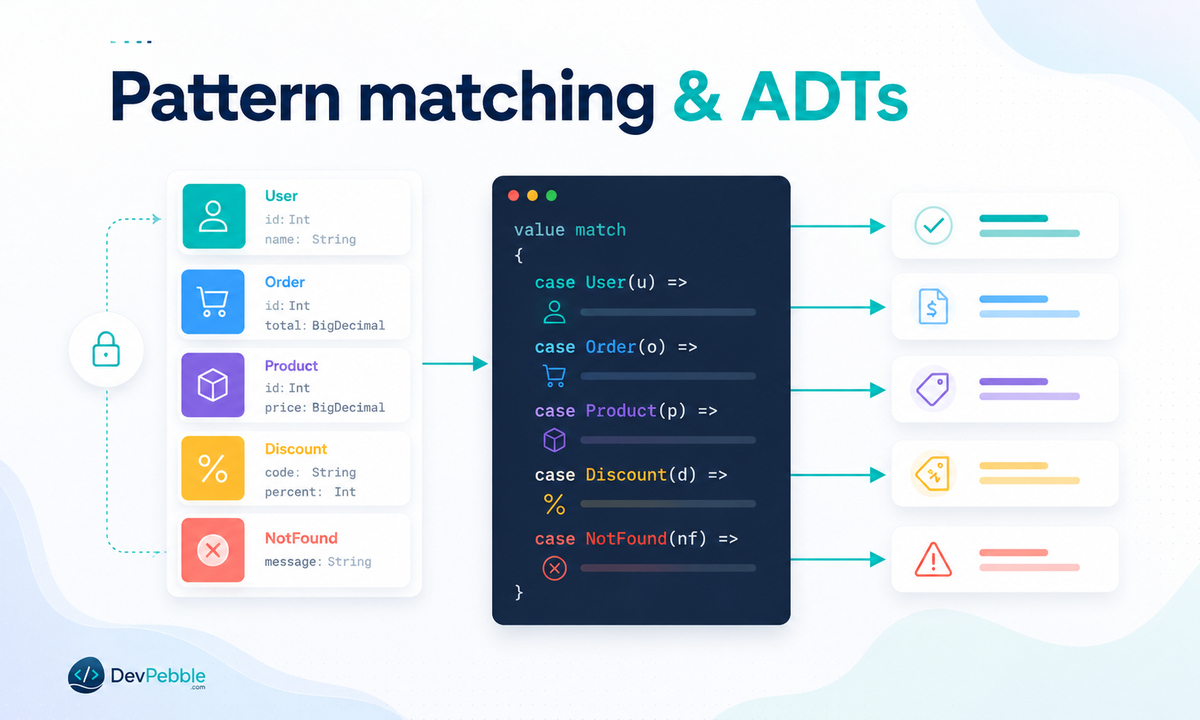
In Scala, if, match, and blocks all produce values rather than just executing steps. Algebraic data types make the valid alternatives for a piece of data explicit, and pattern matching selects behaviour based on which alternative you have. Control flow then follows the shape of the domain instead of a chain of conditionals.
Scala 3 builds ADTs with enum. Cases can be plain names or carry data, the way the standard Option[+T] pairs a parameterised Some(x: T) with a bare None. A Discount type with NoDiscount, Percentage, and FixedAmount works the same way. Because the compiler knows every case a closed enum can take, an incomplete match produces a warning at compile time rather than a MatchError in production, and -Werror turns that warning into a build failure.
What do map, filter, fold, flatMap, and for comprehensions do?

map transforms every element while keeping the collection's shape, filter keeps only elements matching a predicate, fold reduces a structure to a single accumulated result, and flatMap transforms and flattens a nested computation in one step. A for comprehension is readable syntax over those same operations.
items.map(lineTotal)              // List[BigDecimal]
items.filter(_.quantity > 1)      // List[LineItem]
items.map(lineTotal).foldLeft(BigDecimal(0))(_ + _)  // BigDecimal
Comprehensions are not a list feature. The Tour of Scala states that any datatype supporting withFilter, map, and flatMap with the right types can be used in one, which is why Option and Either compose in a for block as cleanly as a collection does.
Scala 3.8, released in January 2026, stabilised the "Better Fors" desugaring (SIP-62): aliases can now appear before the first generator, and the compiler skips an unnecessary final map call. Existing comprehensions keep working.
How do you write a functional Scala program?
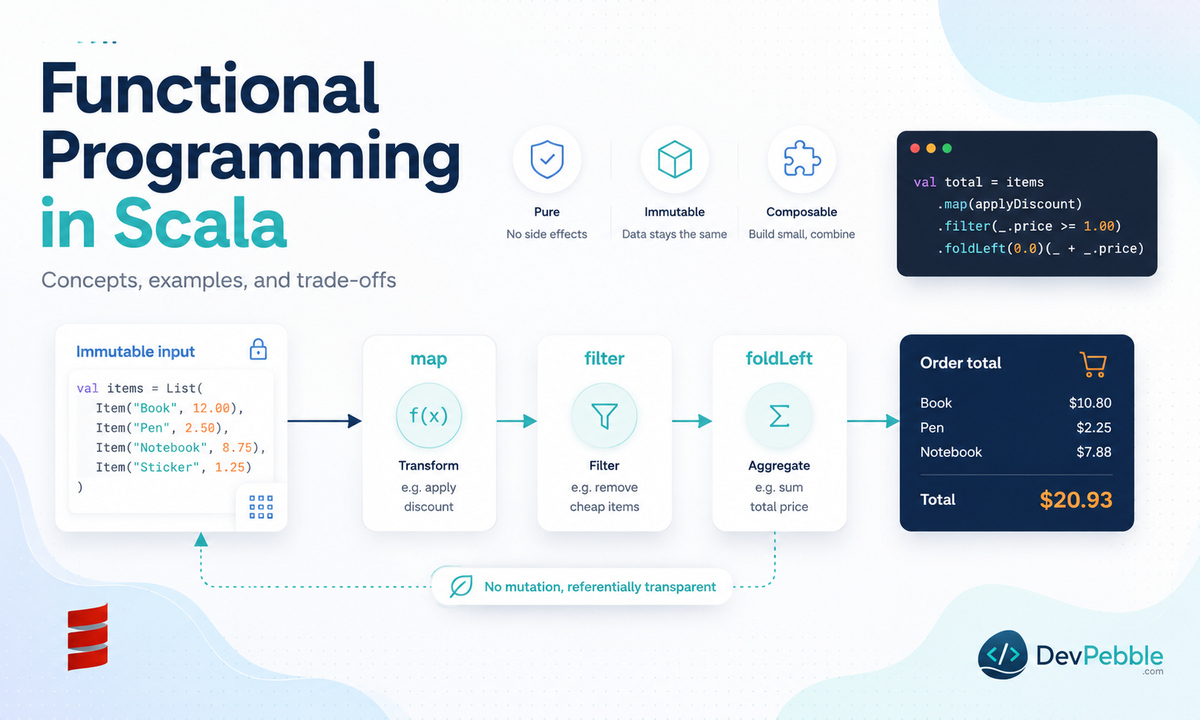
Model the domain as immutable data, write each business rule as a small pure function, compose those functions with the collection and Either operations above, and push side effects such as printing or reading input to the outermost edge. What you end up with is a pipeline you can test, reorder, and reuse without touching the parts that talk to the outside world.
What do you need before starting?
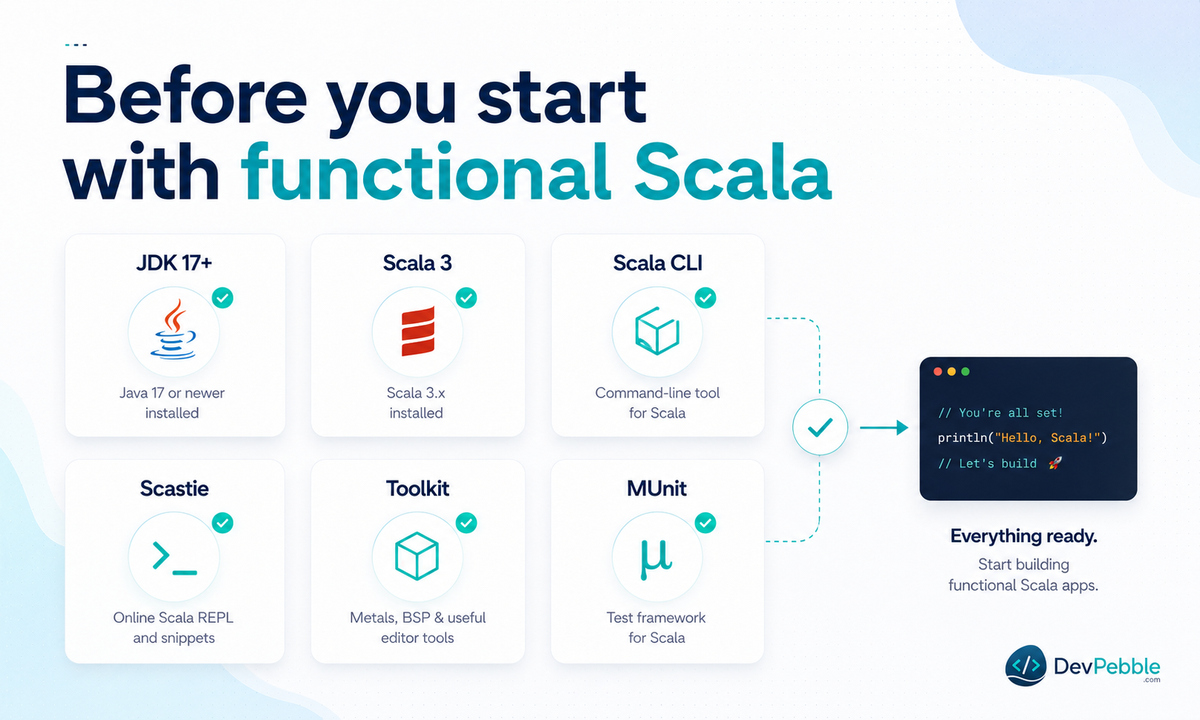
You need working knowledge of Scala functions, collections, and case classes, plus a way to run Scala 3. Scastie handles browser experiments with no install. For a local file, the scala command shipped by the official installer is powered by Scala CLI, so scala run pricing.scala compiles and executes directly with no build tool.
Check your JDK first, because the floor moved recently. The current release is Scala 3.8.4 and the current LTS release is Scala 3.3.8, both published in June 2026 to the official release archive. Scala 3.8 and everything after it, including the forthcoming 3.9 LTS, require JDK 17 or later. Only the 3.3 LTS line still produces JDK 8 compatible bytecode.
For tests, the Scala Toolkit bundles MUnit alongside utilities for files, JSON, and HTTP. Under Scala CLI, test code has to live in a .test.scala file or a test directory, which trips up people on their first run.
Worked example: build an immutable order-pricing pipeline
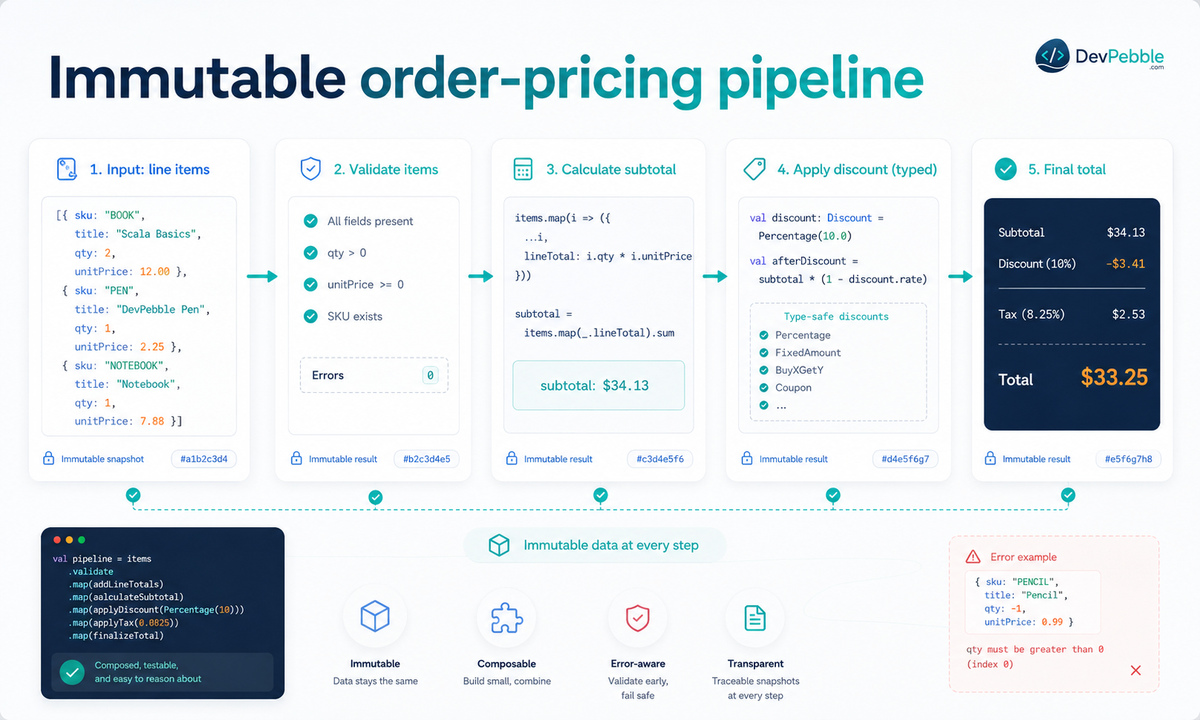
This example validates an order's line items, sums a subtotal, applies a typed discount, and returns either a total or a specific error. No mutable variable, no thrown exception, and no printing anywhere in the business logic. It is complete enough to paste into a file and run.
Model the domain with immutable case classes and an enum
//> using scala 3.8.4

case class LineItem(name: String, unitPrice: BigDecimal, quantity: Int)
case class Order(items: List[LineItem])

enum Discount:
  case NoDiscount
  case Percentage(rate: BigDecimal)
  case FixedAmount(amount: BigDecimal)

enum OrderError:
  case EmptyOrder
  case InvalidQuantity(item: String)
  case DiscountExceedsSubtotal
Every field is immutable by default, so changing a value means calling copy to build a new instance. The two enums do real work: Discount says which discounts exist, OrderError says which failures the pricing logic can produce.
Write small pure pricing and validation functions
def lineTotal(item: LineItem): BigDecimal =
  item.unitPrice * item.quantity

def subtotal(items: List[LineItem]): BigDecimal =
  items.map(lineTotal).sum

def requireNonEmpty(order: Order): Either[OrderError, Unit] =
  Either.cond(order.items.nonEmpty, (), OrderError.EmptyOrder)

def validateQuantities(items: List[LineItem]): Either[OrderError, Unit] =
  items.find(_.quantity <= 0) match
    case Some(bad) => Left(OrderError.InvalidQuantity(bad.name))
    case None      => Right(())
Nothing here reads a file, calls a service, or prints, so each function can be understood and tested on its own. Giving the validators explicit Either[OrderError, Unit] return types is worth the extra line, because it pins the error type down instead of leaving it to inference.
Compose the operations with collections and Either
def applyDiscount(sub: BigDecimal, discount: Discount): Either[OrderError, BigDecimal] =
  discount match
    case Discount.NoDiscount       => Right(sub)
    case Discount.Percentage(rate) => Right(sub * (BigDecimal(1) - rate))
    case Discount.FixedAmount(amt) =>
      if amt > sub then Left(OrderError.DiscountExceedsSubtotal)
      else Right(sub - amt)

def priceOrder(order: Order, discount: Discount): Either[OrderError, BigDecimal] =
  for
    _     <- requireNonEmpty(order)
    _     <- validateQuantities(order.items)
    total <- applyDiscount(subtotal(order.items), discount)
  yield total
The comprehension short-circuits on the first Left. An empty order, a zero quantity, or an oversized discount stops the pipeline immediately, and the caller receives one specific OrderError rather than a stack trace. Because the three steps are independent functions, reordering the validations is a two-line edit.
Run effects only at the program boundary
@main def runPricing(): Unit =
  val order = Order(List(
    LineItem("Mug", BigDecimal("12.50"), 2),
    LineItem("Notebook", BigDecimal("4.00"), 3)
  ))
  priceOrder(order, Discount.Percentage(BigDecimal("0.10"))) match
    case Right(total) =>
      println(s"Total: ${total.setScale(2, BigDecimal.RoundingMode.HALF_UP)}")
    case Left(error) =>
      println(s"Could not price order: $error")
println and the match that decides what to print live inside @main and nowhere else. Two details are deliberate. Money uses BigDecimal("12.50") rather than the literal 12.50, so the value never passes through binary floating point. Rounding happens at the boundary with setScale, because multiplying by a rate widens the scale and the pricing functions should not decide how a number is displayed.
How can you test and refactor functional code?
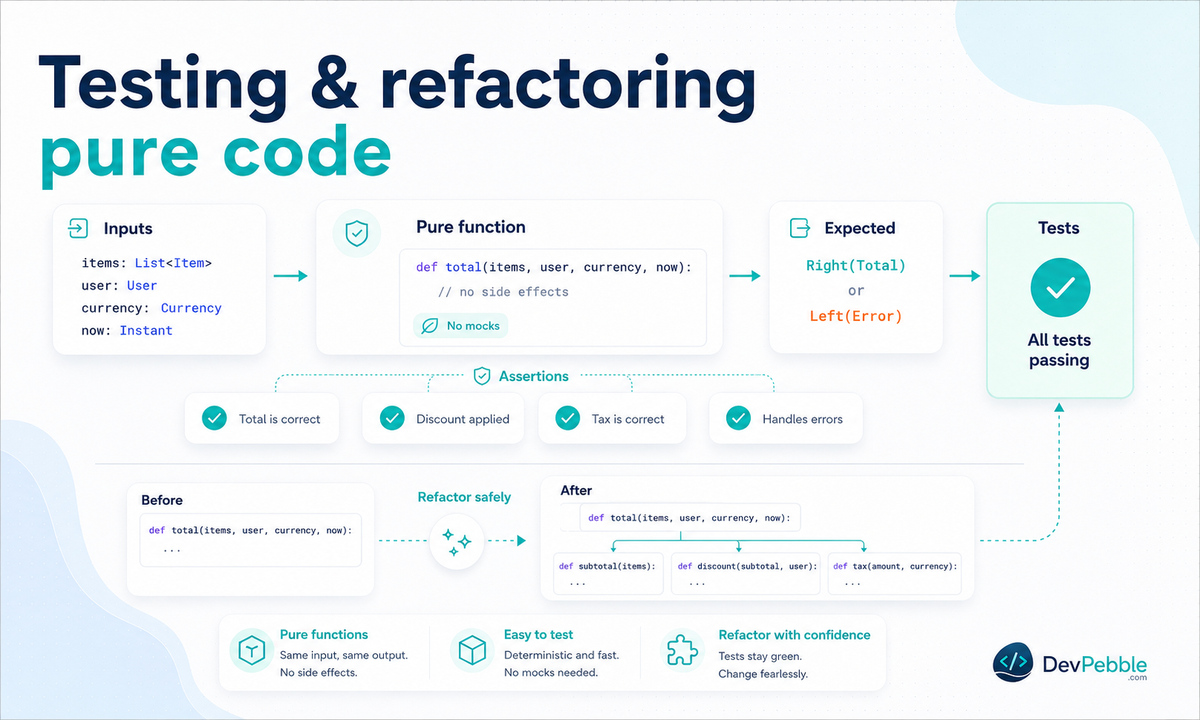
Because priceOrder is pure, testing it means calling it with different orders and asserting on the Either that comes back. No mocks, no fixtures, no teardown.
// pricing.test.scala
//> using dep org.scalameta::munit:1.1.0

class PricingSuite extends munit.FunSuite:
  test("no discount preserves the subtotal"):
    val order = Order(List(LineItem("Mug", BigDecimal("12.50"), 2)))
    val expected: Either[OrderError, BigDecimal] = Right(BigDecimal("25.00"))
    assertEquals(priceOrder(order, Discount.NoDiscount), expected)

  test("empty order is rejected"):
    val expected: Either[OrderError, BigDecimal] = Left(OrderError.EmptyOrder)
    assertEquals(priceOrder(Order(Nil), Discount.NoDiscount), expected)
Run it with scala test .. The same shape covers the remaining cases: a negative quantity and a fixed discount larger than the subtotal. Refactoring gets safer for the same reason. Swap foldLeft for sum, rename an enum case, or split a function in two, and the suite tells you straight away whether behaviour changed.
How should functional Scala handle errors?
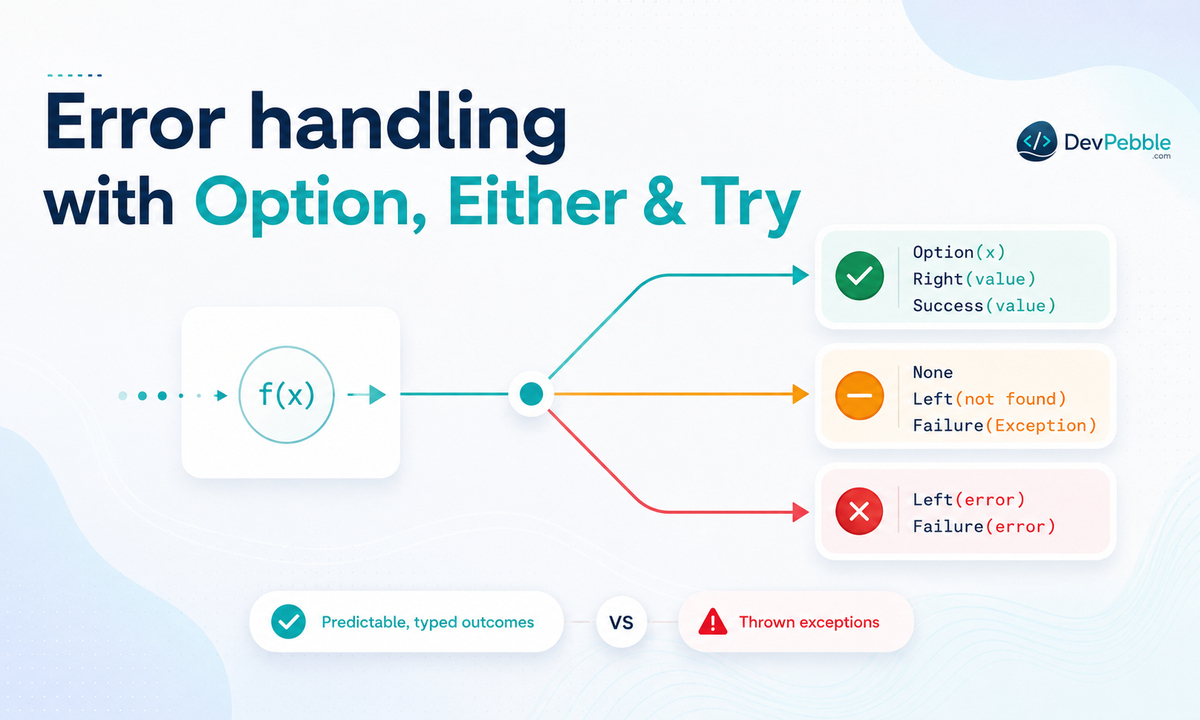
Functional Scala represents expected failures as return values rather than exceptions or null. A missing lookup, an invalid input, a recoverable domain error: each becomes part of the type. The official error-handling guidance covers Option, Either, and Try, and the OrderError enum above is really just a domain-specific left type for Either.
This is representation, not prohibition. Unexpected defects can still throw. The point is that a caller reading the signature knows which failures are part of the contract.
When should you use Option?
Reach for Option[A] when a value may simply be absent and the reason does not matter: a lookup that finds nothing, an optional configuration field, the first element of a possibly empty list. Some and None force the caller to handle both cases, unlike a null that is easy to forget.
headOption is the standard illustration. Calling head on an empty list throws a NoSuchElementException, while headOption returns None. Treat .get as a last resort, since it quietly reintroduces the crash Option was meant to prevent. When you genuinely do want a partial operation, Scala 3.8 stabilised runtimeChecked, which marks the decision explicitly instead of hiding it behind a bare .get.
When should you use Either or Try?
Either[E, A] is the right choice when you want to keep a specific, typed reason for the failure, which is exactly what OrderError does above. Try[A] suits code that calls into something that can throw, such as parsing text or reading a file, when catching the exception matters more than designing a custom error type.
Convention puts success on the right: Right holds the good value, Left holds the error. A for comprehension over Either short-circuits on the first Left, as priceOrder demonstrated.
| Type | Use when | Carries |
|---|---|---|
| Option[A] | Absence is normal and needs no explanation | Nothing about why |
| Either[E, A] | The reason for failure drives a decision | A typed error value |
| Try[A] | Wrapping code that throws, usually at a boundary | The Throwable |
Try is Either narrowed to Throwable in shape. It earns its place at a boundary you do not control, and converting its failures into domain errors there beats letting Throwable leak into the core.
How do functional programs manage side effects and I/O?
Real programs read files, call services, and print output. Functional design does not forbid that; it keeps those effects out of ordinary calculations so they cannot surprise you. The common pattern is a pure core, like priceOrder, wrapped by a thin effectful shell that handles input, output, and anything else touching the outside world.
What is a functional core and an effectful shell?
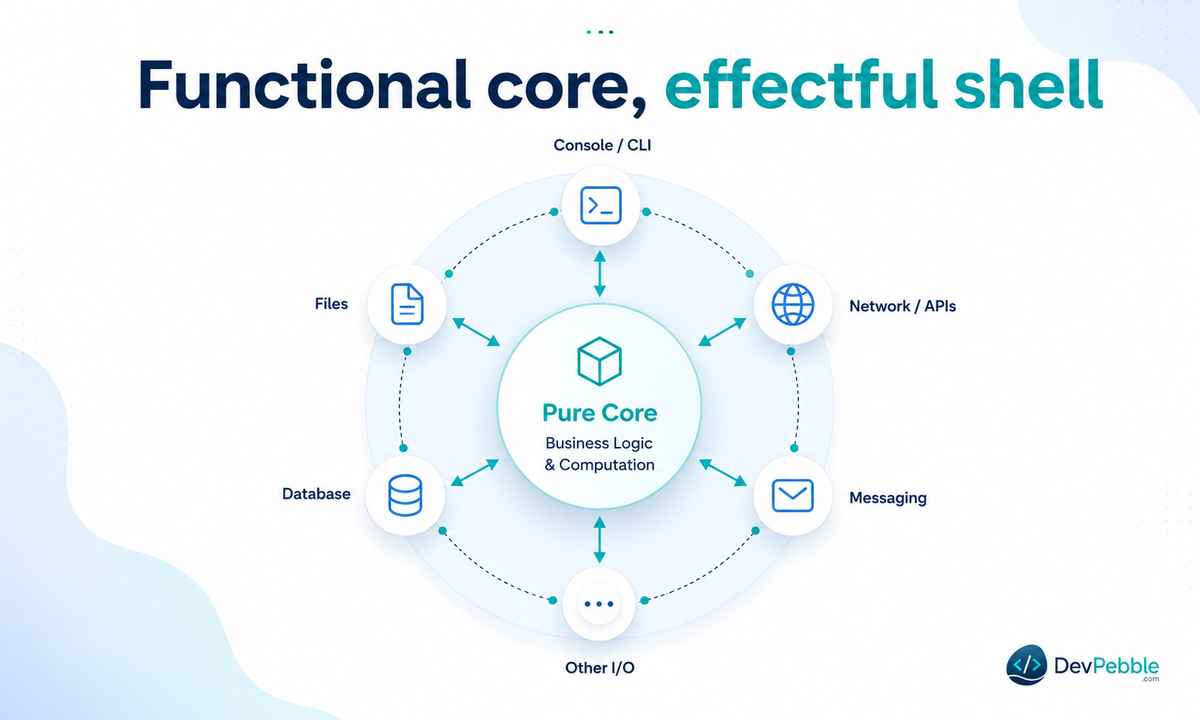
The core holds deterministic logic: the same inputs always produce the same output, as the pricing functions do. The shell reads arguments, calls the core, and decides what to print or send, which is what runPricing does with @main and a match.
input → shell (parse, fetch) → pure core (decide) → shell (print, write) → output
This split needs no library. It is a rule about where println, file reads, and network calls are allowed to live. It also settles a recurring question: values that change on their own, such as the current time or a random seed, get passed into the core as parameters rather than read inside it.
When should you use Cats Effect or ZIO?
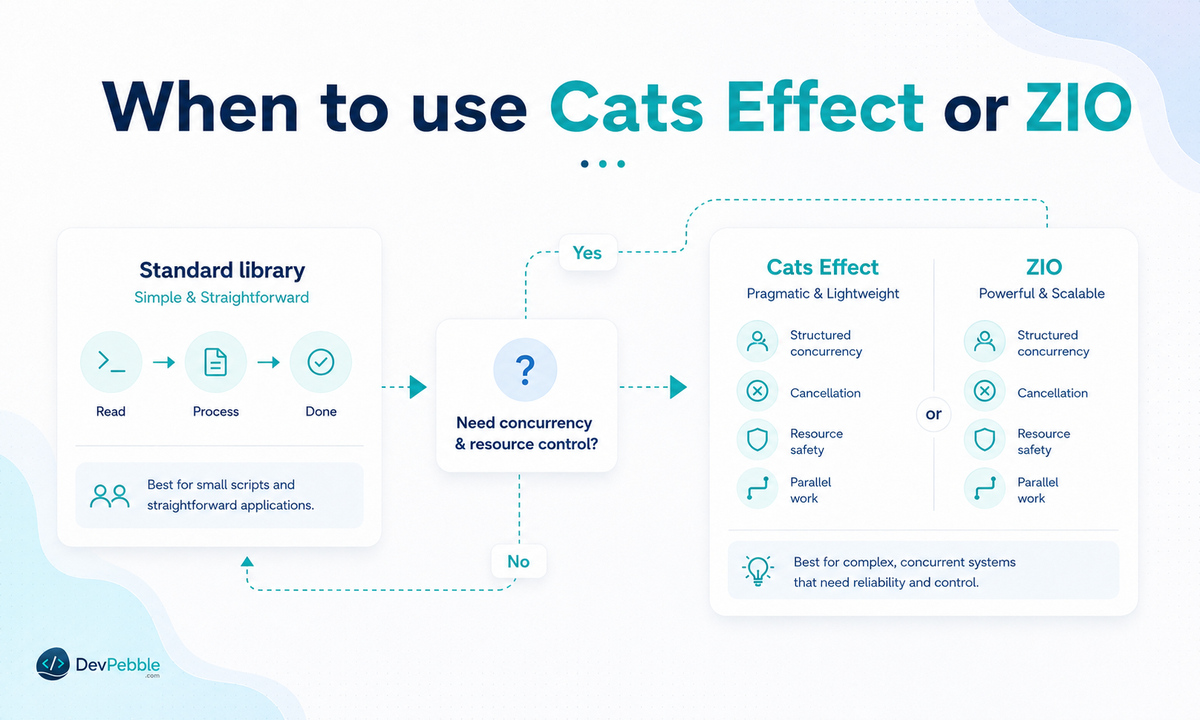
Neither library is required to write functional Scala. The Either-based pipeline above uses nothing outside the standard library. Reach for one when an application needs structured concurrency: running requests in parallel with timeouts, cancelling work safely, or holding a resource that must be released even when something fails.
Cats Effect treats its IO type as a description of a program rather than a running computation, which puts you in control of when and how effects are evaluated, with lightweight fibers standing in for cheap cancellable threads. ZIO describes itself as type-safe, composable asynchronous and concurrent programming for Scala, and ships its own effect type plus built-in testing and dependency-injection support.
Choose on requirements rather than reputation: team familiarity, the error model you want, and which ecosystem your HTTP and database libraries already use. Neither is a sensible default for a small script.
What are the main benefits of functional programming in Scala?
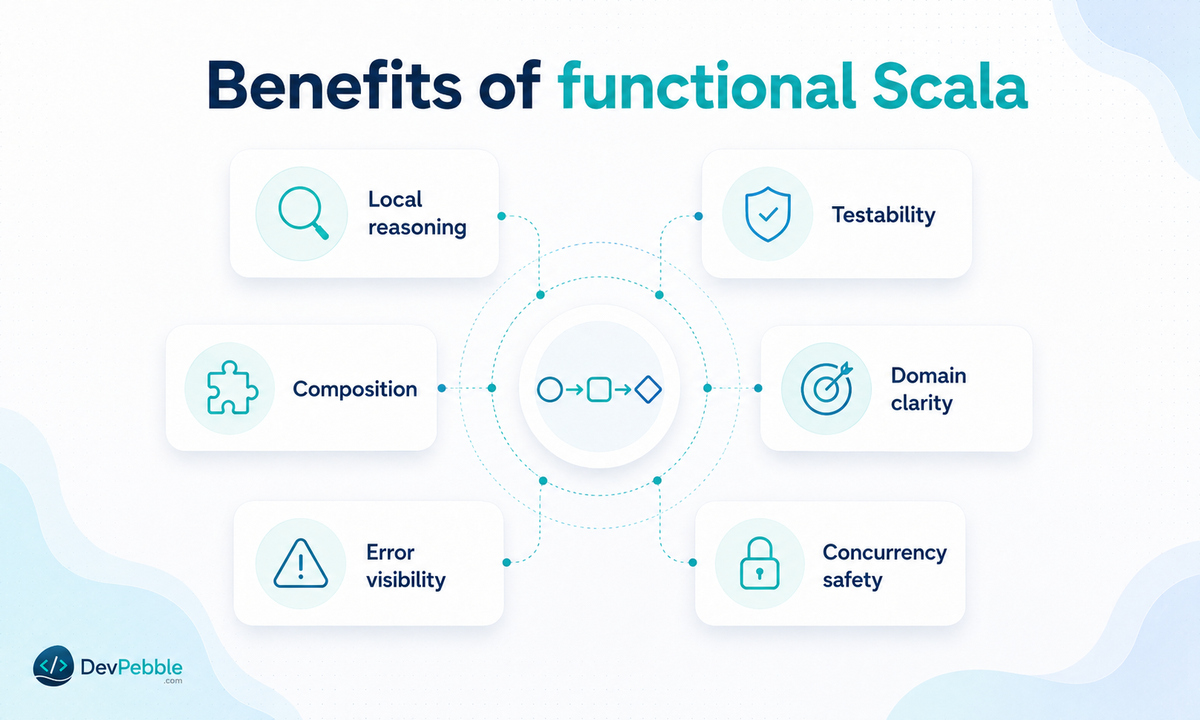
Functional style in Scala buys local reasoning, cheaper tests, and safer concurrent code, because small functions compose into pipelines like the pricing example. Each item below points at something the example actually demonstrated.
- Local reasoning:
lineTotalandsubtotalcan be understood without tracing state anywhere else. - Testability:
priceOrderneeded no mocks, only inputs and an assertion on the returnedEither. - Composition:
applyDiscountand the two validators slot into aforcomprehension with no glue code. - Domain clarity: the
DiscountandOrderErrorenums put every valid state in the type system instead of a comment. - Error visibility: the return type tells a caller that pricing can fail and names the ways it can.
- Concurrency safety: immutable values can be shared across threads without locks.
Manning's description of Functional Programming in Scala frames functional code as easier to test, reuse, and parallelise, and less prone to state-related bugs. That matches the pricing example, but it is publisher framing rather than measured evidence. Applied mechanically, the same techniques can produce code harder to read than the imperative version it replaced.
What are the trade-offs and edge cases?
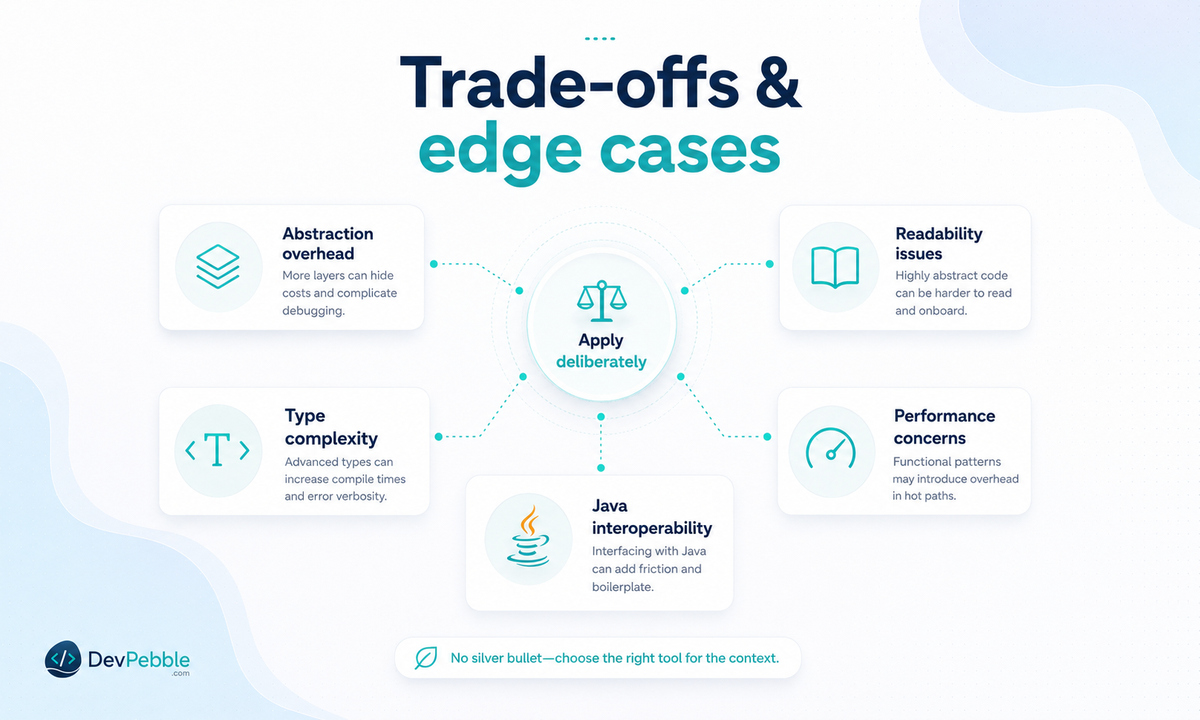
Functional Scala has real costs. Unfamiliar abstractions and heavily generic types can make code harder to read, and a mutation-free style carries its own performance and interoperability quirks. None of these argue against the style. They argue for applying it deliberately.
Why can functional Scala be difficult to read?
Code gets hard to read when unfamiliar terms and generic abstractions arrive before the business logic is clear, not because functional style is inherently opaque. A for comprehension over three Either values is no harder to follow than the equivalent nested if statements once you recognise the pattern.
The warning signs are consistent: underscore chains stacked three deep, one-letter type parameters with no explanation, implicit context values that make a call site unreadable, and abstractions introduced before any duplication justified them. The fixes are equally consistent: name intermediate values, keep type parameters descriptive, and generalise only after a pattern repeats.
What performance and interoperability edge cases matter?
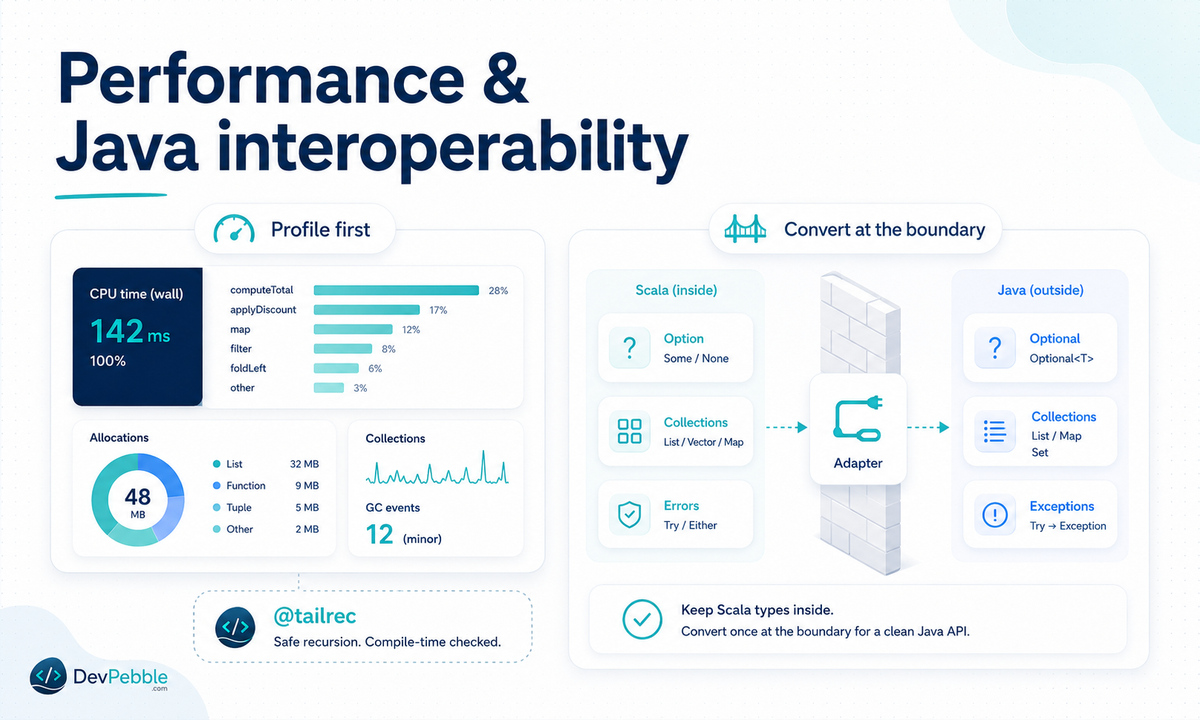
Functional style does not set performance by itself. Allocation, collection choice, recursion shape, and algorithm design matter far more than whether code is written functionally, so any performance question needs profiling rather than reasoning from style. Two edge cases come up often enough to name.
Deep non-tail recursion overflows the JVM stack. The @tailrec annotation causes compilation to fail when a method is not actually tail-recursive, so use it on every hand-written recursive function you intend to be tail-recursive.
At a Java boundary, types do not line up. Scala's Option and Java's Optional need an explicit conversion through scala.jdk.OptionConverters, and collections need a similar one. Java libraries also return null and throw, so convert and validate at the boundary before any of it reaches the core. Local mutation inside a single function is fine, as long as the mutable value never escapes.
Functional programming vs OOP in Scala: which style should you use?
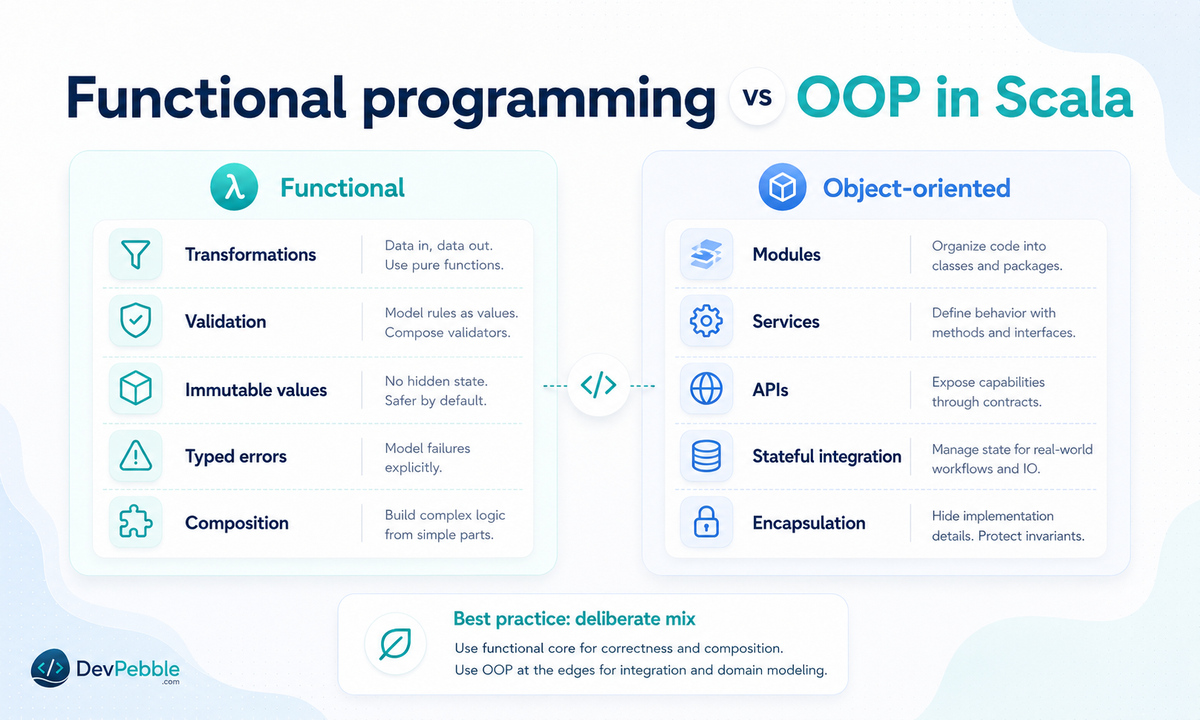
Most Scala codebases do not need an all-or-nothing answer. Functional technique suits transformations, validation, and data modelling, which is the pricing pipeline. Object-oriented technique suits modular APIs, stateful components, and framework integration. The practical answer is a deliberate mix, chosen per problem.
| Criterion | Functional emphasis | Object-oriented emphasis | Practical choice |
|---|---|---|---|
| Best fit | Transformations, validation, business rules | Stateful components, framework glue, Java interop | Functions for rules, objects for structure |
| State | Immutable values, explicit transitions | Encapsulated object state | Immutable domain state, contained mutation |
| Failure handling | Typed values (Option, Either) | Exceptions, framework handling | Typed domain errors, adapt framework exceptions |
| Extending behaviour | Composition, new functions | Inheritance, new subclasses | Whichever dimension changes more often |
| Testing | Input and output checks on pure functions | Object and interaction tests | Pure core tested directly, boundaries separately |
The LineItem case class and priceOrder function are functional. The service that calls them, wires in a database, and exposes an HTTP route is usually object-oriented. Both belong in one codebase.
How should you learn functional Scala next?
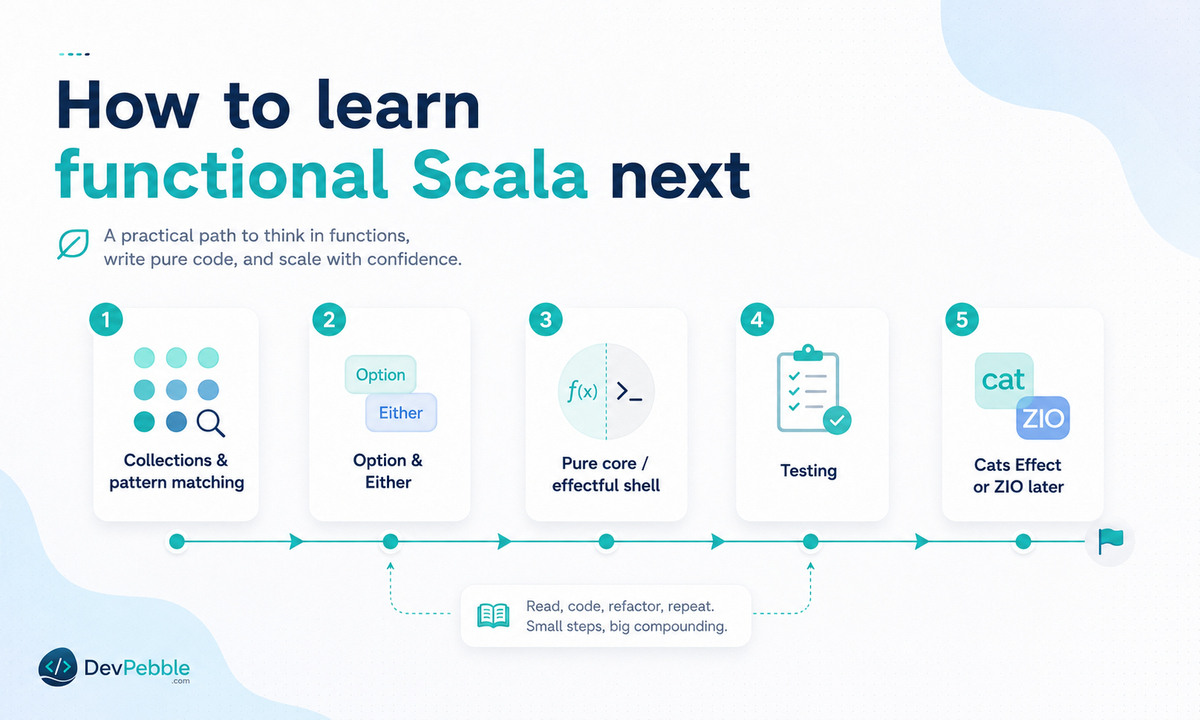
Build on what this guide already used rather than jumping to abstractions. Solidify collections and pattern matching, get comfortable with Option and Either, then write one small project with a pure core and an effectful shell before reaching for an effect library.
- Practise
map,filter,fold, and pattern matching until they stop feeling like syntax. - Replace
null-prone code withOption, and ad hoc exceptions with typedEithererrors. - Build a pipeline with a pure core and one effectful entry point, as
priceOrderandrunPricingdid. - Add a property-based test once table-driven tests feel routine. Applying no discount should preserve the subtotal, and reordering line items should not change it.
- Pick up Cats Effect or ZIO only when a project genuinely needs structured concurrency.
For deeper study, the official Scala 3 Book is free and current, the second edition of Functional Programming in Scala covers Scala 3 at a slower and more rigorous pace, and the Scala online courses page lists the EPFL curriculum. The most useful next step is smaller than any of them: take one function in your current codebase that reads shared state, pass that state in as a parameter, and see what the test looks like afterwards.