Imperative vs declarative programming: key differences, examples, and when to use each
Imperative vs declarative programming compared across control flow, state, side effects, and performance, with paired JavaScript, SQL, and Terraform examples.
On this page⌄
- What is imperative programming?
- What is declarative programming?
- Imperative vs declarative programming: the core difference
- What do imperative and declarative code look like side by side?
- When should you use imperative programming?
- When should you use declarative programming?
- Can imperative and declarative programming be combined?
- How do you choose the right style?
- Final takeaway: use the highest useful abstraction, not a dogma
- FAQ
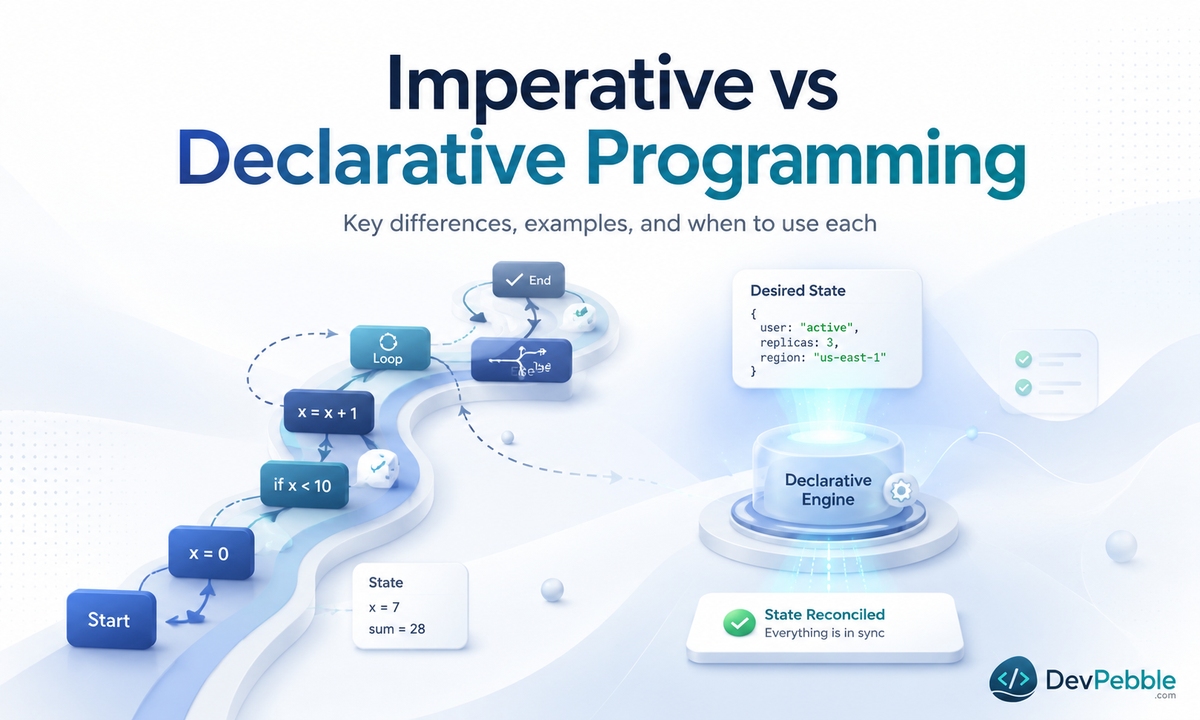
Imperative programming states the steps a computer should take to reach a result. Declarative programming states the result, rule, or relationship you want, and leaves the steps to a compiler, framework, planner, or runtime. Neither style is better in general. The choice depends on whether you need visible control over execution or want to describe an outcome and trust a mature engine with the mechanics.
What follows covers both definitions, the dimensions where the two styles actually diverge, four paired examples in JavaScript, React, SQL, and infrastructure tooling, and a framework for choosing. One qualification runs through all of it: the line between the styles is a spectrum rather than a wall, and the same code can look declarative from above and imperative one layer down.
What is imperative programming?

Imperative programming means writing instructions that tell a computer how to perform a task, in a specific order, usually while changing stored state along the way. The programmer decides the sequence of operations rather than delegating that decision to an engine. Not every imperative program mutates global state, and no language that supports the style forces it everywhere.
How does imperative programming work?
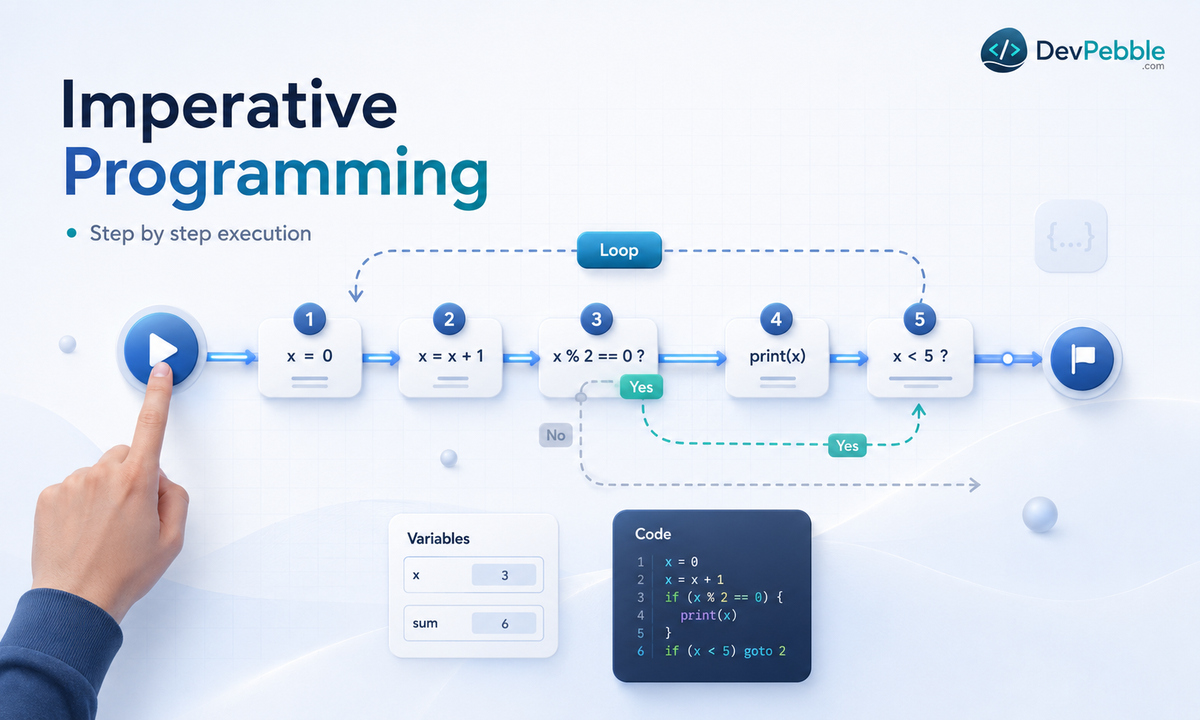
An imperative program runs statements in sequence. Assignments store or update values, conditionals branch on those values, loops repeat a block until a condition changes, and function calls hand control elsewhere before returning. Each statement usually depends on the state left behind by the one before it, so execution order is part of the program's meaning rather than an implementation detail.
That ordering is what makes step-by-step tracing possible. You can watch a variable change through each pass of a loop because the sequence is written out instead of inferred by a separate system. Microsoft's .NET documentation calls this algorithmic programming: the developer specifies the steps the computer must take, and both state changes and order of execution matter.
How to recognize imperative code
A few surface signals usually give it away. Variables get reassigned as the program runs. Loops iterate with explicit counters or conditions. Calls change something directly, such as a DOM element, a file, or a database row. A for loop that builds a result array by pushing values onto it one at a time is the textbook case.
Treat those signals as shorthand rather than a test. MDN describes JavaScript as a prototype-based, multi-paradigm, dynamic language supporting object-oriented, imperative, and declarative styles, so one language, and often one file, can mix imperative sections with everything else.
What is declarative programming?
Declarative programming means expressing what result, rule, or relationship you want instead of the sequence of operations that produces it. You supply a description, and a separate system works out how to satisfy it. Python's functional programming HOWTO puts it plainly: in declarative languages you write a specification describing the problem, and the language implementation figures out how to perform the computation efficiently.
How does declarative programming work?
Declarative code operates on two layers. The author writes a description of the desired outcome, and an engine underneath evaluates that description and decides the actual operations.
React frames its rendering model this way. Instead of manipulating individual pieces of the interface directly, you describe the states a component can be in and let React switch between them in response to input. A database does something comparable. The Python documentation uses SQL as its example: a query describes the data set you want, and the engine decides whether to scan tables or use indexes and which subclauses to run first. In both cases the visible code is a specification, and the operational work happens one layer down.
What forms of code are genuinely declarative?
Declarative style covers more ground than any single syntax:
- SQL queries, which state which rows and columns you want.
- Functional transformations such as
mapandfilter, which state a rule for selecting or reshaping data. - Logic programming, where you supply facts and rules and the system searches for answers.
- UI descriptions, where a component's output is a function of its current state.
- Infrastructure configuration, which describes a target rather than a provisioning sequence.
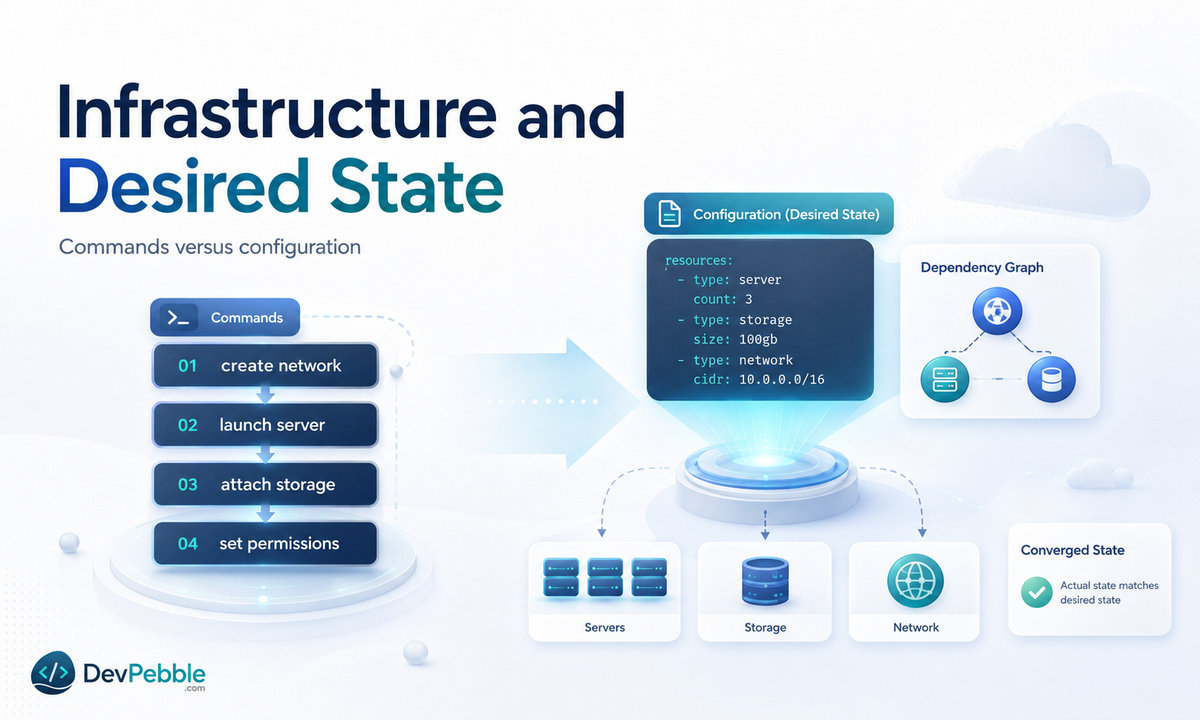
Terraform's documentation calls its configuration files declarative because they describe the end state of your infrastructure, with Terraform handling the underlying logic and building a resource graph to work out dependencies. Kubernetes goes further and names three separate object management techniques: imperative commands, imperative object configuration, and declarative object configuration, each with its own recommended environment and learning curve.
Imperative vs declarative programming: the core difference
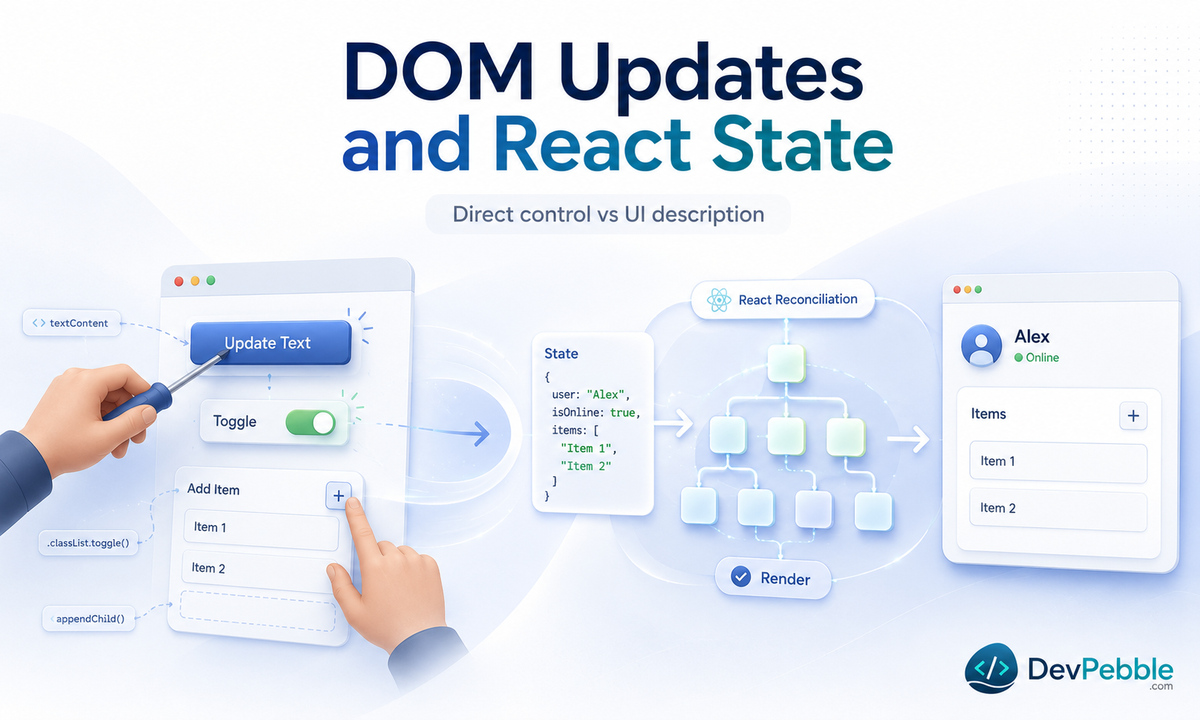
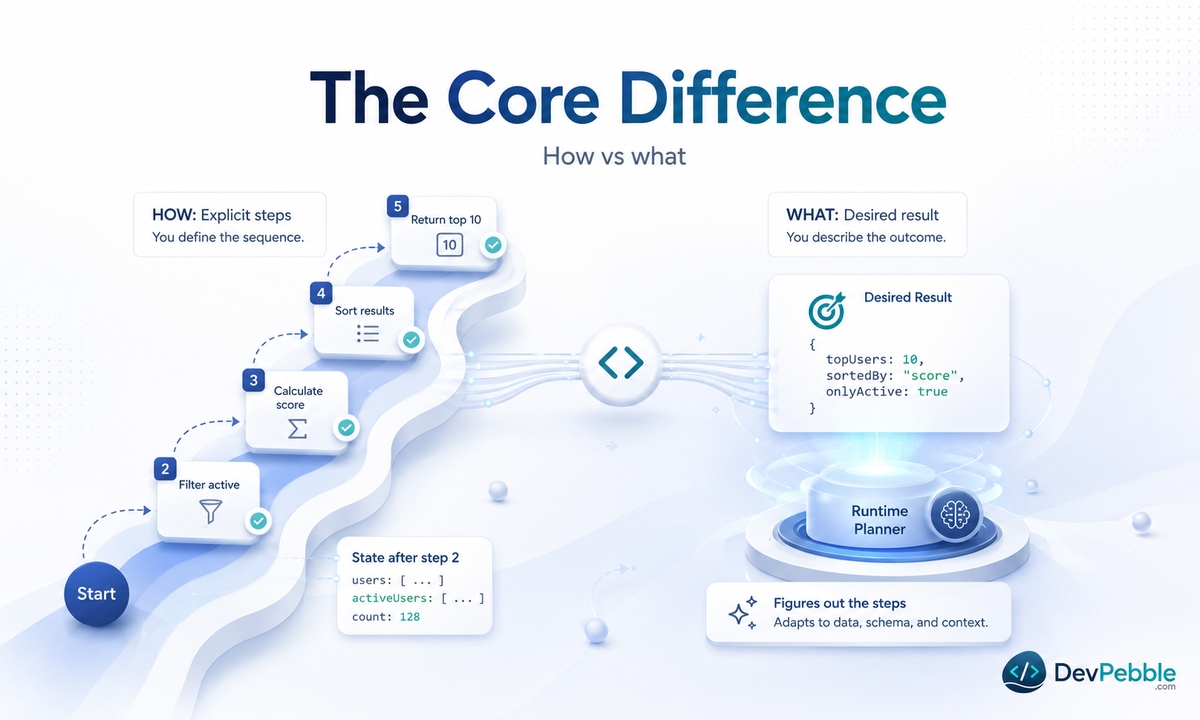
The core difference is what the code makes visible. Imperative code exposes the procedure, meaning the steps, their order, and the state changes along the way. Declarative code exposes the intended result and hands more of the procedural choice to something else. That shift changes who owns execution order and state management, not just how the code reads.
| Dimension | Imperative | Declarative | | --- | --- | --- | | Primary focus | Operations and procedure | Result, rule, or desired state | | Control flow | Usually explicit | Partly delegated | | Execution order | Commonly visible and significant | Often chosen or inferred by another system | | State handling | Frequently updated directly | Often derived, constrained, or reconciled | | Side effects | Commonly written as commands | Often separated or triggered by the runtime | | Abstraction level | Exposes more mechanics | Hides more mechanics | | Optimization | Programmer has direct control | Engine may have more freedom | | Debugging | Step-by-step execution often visible | May require reading plans or framework behavior | | Typical examples | Loops, scripts, direct DOM calls | SQL, React rendering, Terraform configuration | | Main risk | State and control-flow complexity | Hidden behavior and leaky abstractions |
Why "how versus what" is useful but incomplete
The how-versus-what split is a good starting point and a poor classification system. The same expression can look declarative from the caller's position and imperative one level down: a filter() call states a rule, and its own implementation still runs a loop.
The distinction blurs at the language level too. The Stanford Encyclopedia of Philosophy's entry on the philosophy of computer science records the objection that procedural programming languages can often be translated into declarative ones, and that some languages, Prolog among them, can be interpreted both procedurally and declaratively. Classifying a specific piece of code is usually reasonable. Classifying a whole language rarely survives contact with real programs.
How do they differ in control flow, state, and side effects?
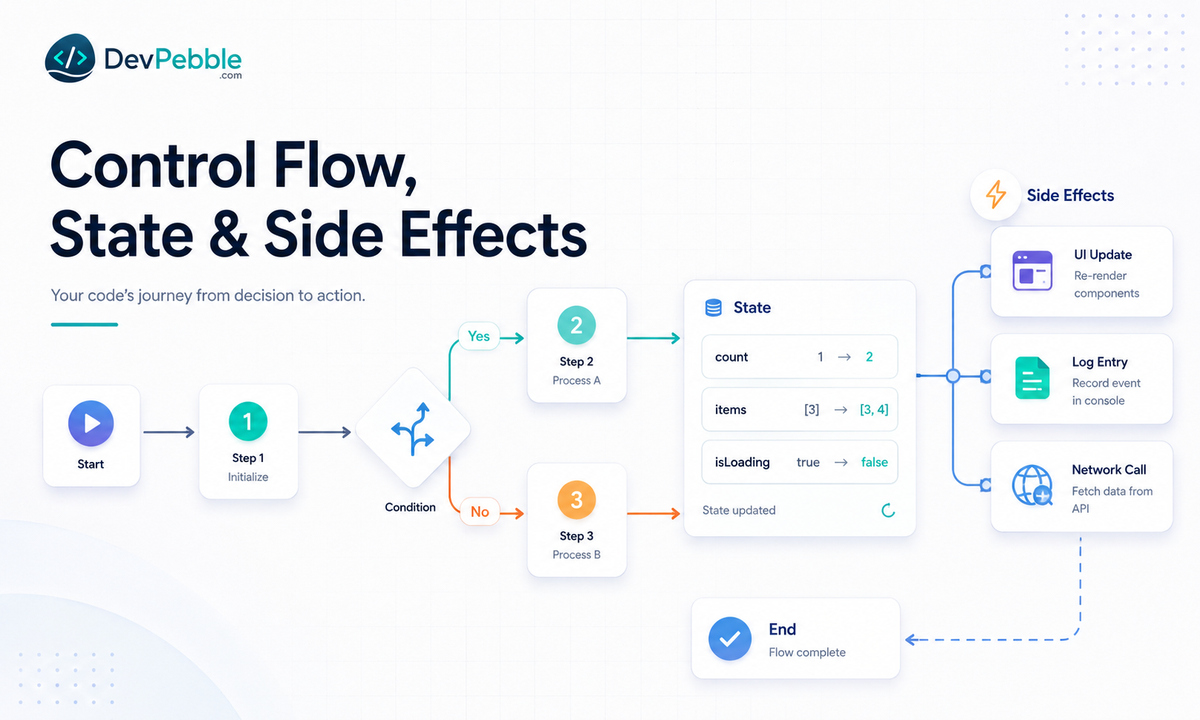
Imperative code specifies execution order directly. Each statement runs after the one before it, and the programmer keeps state consistent across that sequence by hand. Declarative code separates the what from the ordering: a SQL query, a filter() call, or a Terraform file describes a target, and the runtime chooses the operations that reach it.
Side effects do not disappear in declarative code. They move. React's Rules of React require components to be idempotent and state that side effects must run outside of render, which pushes data fetching, subscriptions, and logging into event handlers and Effects rather than into the description of the UI. The relocation is the real distinction, not the absence of effects.
How do they differ in abstraction, readability, and debugging?
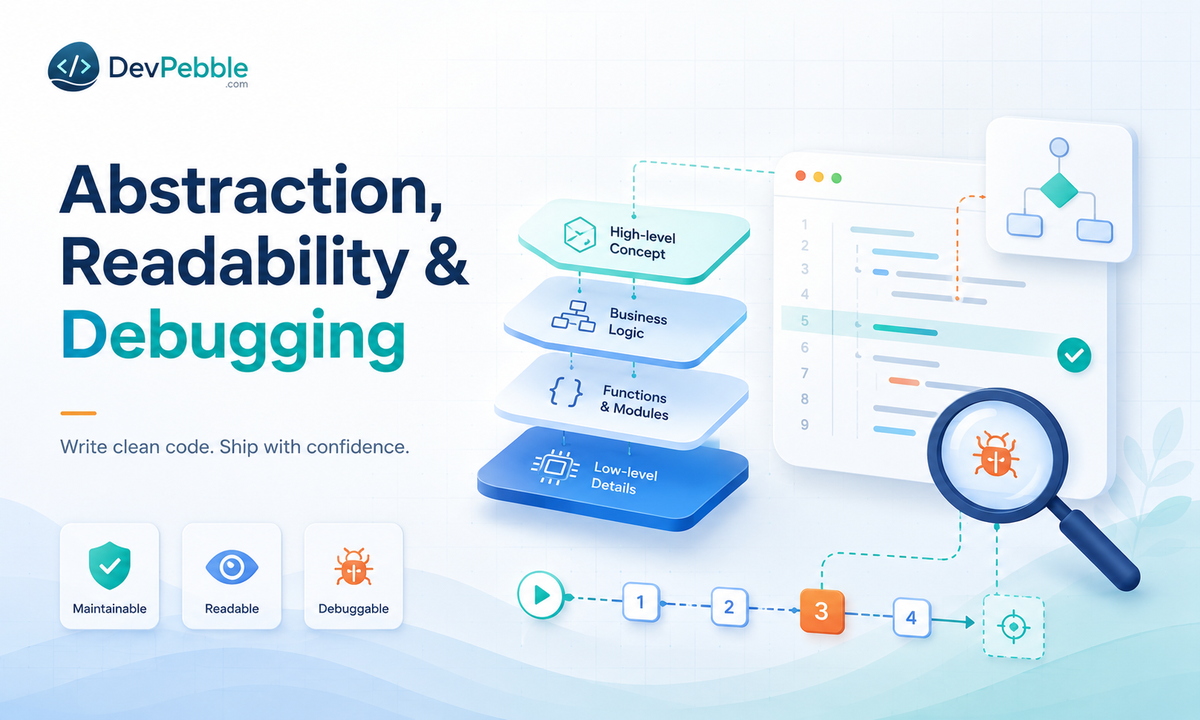
Declarative code often reads closer to the problem statement. A SELECT clause names columns and conditions instead of scans and joins, and a component function names UI states instead of DOM operations. The cost lands in debugging, which shifts from stepping through your own code to reading a plan, a diff, or a reconciliation loop built by someone else. Imperative code keeps every step local and inspectable, at the price of more code to read and more state to track by hand.
The comprehension evidence is narrower than the arguments built on it. A randomized controlled trial presented at ICSE 2022 asked 20 participants to determine the results of collection operations written either with Java's Stream API or with traditional loops. Response times were significantly better with the Stream API, and those versions produced significantly fewer errors. That covers one language, one task type, and a small sample, so read it as a counterweight to the assumption that more explicit always means easier to follow.
How do they differ in performance, optimization, and flexibility?

Surface syntax does not decide what happens at runtime. Imperative code gives direct control over allocation, iteration count, and short-circuiting, which matters when a hot path needs manual tuning. Declarative code trades that control for the possibility of better global optimization: PostgreSQL builds a query plan for every query it receives, and the planner picks among sequential scans, index scans, and several join strategies using cost estimates drawn from table statistics.
That trade pays off only when the optimizer is good. A naive interpreter behind declarative syntax offers no such guarantee, and comparing the two styles on speed without measuring the real workload produces claims that rarely survive outside the benchmark that produced them.
What do imperative and declarative code look like side by side?
Four paired examples make the difference concrete without claiming full equivalence: a JavaScript array filter, a UI update, a database query, and an infrastructure change. Each pair reaches the same outcome while exposing different decisions to the person writing the code.
JavaScript array filtering

Imperative version: loop, test, and mutate the result
const adults = [];
for (let i = 0; i < users.length; i++) {
  if (users[i].age >= 18) {
    adults.push(users[i]);
  }
}
This version names every step: initialize a result array, walk the source by index, test each element, mutate the result. The counter, the condition, and the push are all explicit and independently steppable.
Declarative version: express the selection with filter()
const adults = users.filter((user) => user.age >= 18);
MDN's reference for Array.prototype.filter() describes the method as creating a shallow copy of the array containing only the elements that pass the test in the callback. The code states the rule, keep adults, and leaves traversal and result construction to the method.
What stays imperative inside the abstraction
MDN also describes filter() as an iterative method that calls the callback once per element and builds a new array from the values that pass. The loop is still there; the abstraction moved it out of view rather than removing it.
UI updates: direct DOM manipulation vs React state descriptions
Imperative version: find and modify DOM elements
const button = document.querySelector("#toggle");
button.addEventListener("click", () => {
  const panel = document.querySelector("#panel");
  panel.style.display = panel.style.display === "none" ? "block" : "none";
});
Each line locates an element, checks its current state, and mutates it. React's own comparison of the two approaches notes that this works well enough in isolated examples but gets harder to manage as systems grow, since adding one interaction means checking every existing update path.
Declarative version: describe output for the current state
function Panel({ open, onToggle }) {
  return (
    <div>
      <button onClick={onToggle}>Toggle</button>
      {open && <div id="panel">Contents</div>}
    </div>
  );
}
The component describes what should render for a given open value. React updates the DOM to match that output when state changes, so nobody writes toggle logic against DOM nodes.
Where imperative effects still belong
React does not eliminate direct DOM access, it isolates it. The documentation on manipulating the DOM with refs covers the cases with no declarative equivalent, such as focusing a node, scrolling to it, or measuring its size and position. Refs are the escape hatch; the rest of the component stays declarative.
Data retrieval: an SQL statement vs the database execution plan

The declarative SQL request
SELECT id, email FROM users WHERE age >= 18 AND email_verified;
The query states the result set, meaning which columns and which conditions, without saying whether the database should scan sequentially or use an index.
The execution steps PostgreSQL selects
PostgreSQL builds the plan as a tree of nodes, with scan nodes at the bottom and joins, sorts, or aggregations above them, and EXPLAIN prints that tree along with the planner's cost and row estimates. It shows which plan was chosen and what it was estimated to cost, not the planner's reasoning.
The same statement can produce different plans over time, because the planner reconsiders cost as statistics change. The documentation warns against extrapolating from toy-sized tables, since a table occupying a single page will nearly always get a sequential scan whether an index exists or not.
Infrastructure: imperative commands vs desired-state configuration
Ordered shell or cloud CLI operations
A script that calls a cloud provider's CLI to create a virtual machine, then a network rule, then attach the two, works only if the commands run in that order. Rerunning it against infrastructure that already exists tends to fail or duplicate resources unless the script handles that case itself.
Terraform desired-state configuration
resource "aws_instance" "web" {
  ami           = "ami-0123456789abcdef0"
  instance_type = "t3.micro"
}
Terraform's documented workflow is write, plan, and apply. It generates a plan describing what it will create, update, or destroy, prompts for approval, and tracks real infrastructure in a state file that it compares against your configuration to work out the changes needed. If the two already match, the plan has nothing to propose.
Kubernetes imperative commands and declarative object configuration
The Kubernetes documentation separates imperative commands, which operate on live objects and leave no history of previous configurations, from declarative object configuration, where you operate on directories of files and kubectl detects create, update, and delete operations per object. It rates imperative commands as the lowest learning curve and recommends them for development projects, and rates declarative object configuration as the highest, recommending it for production while noting it is harder to debug when results are unexpected. One warning is worth repeating: a single object should be managed with only one technique, since mixing them produces undefined behavior.
When should you use imperative programming?

Imperative code fits when execution order, low-level behavior, or direct effects have to stay visible and controllable rather than delegated. The deciding factor is what the task demands, not the industry you work in.
Which requirements favor imperative code?
Reach for imperative code when:
- Hardware or system resources need direct management, such as memory allocation, device I/O, or tight timing loops.
- A sequence of steps must run in a specific order for the result to be correct.
- The workflow is unusual enough that no existing declarative abstraction models it well.
- Performance needs tuning that a general-purpose optimizer will not deliver.
- Effects such as logging, network calls, or file writes must happen at a precise, auditable point.
- The available abstraction is immature or has known gaps, so wrapping the problem in it would hide failures instead of preventing them.
When should you use declarative programming?
Declarative code works well when a mature engine can turn a stable description of a domain into reliable operations, which frees you from respecifying the steps every time.
Which requirements favor declarative code?
Declarative code tends to fit when:
- The problem domain is stable enough that a general-purpose engine, whether a query planner, a renderer, or an infrastructure tool, has had time to mature around it.
- The same description runs repeatedly against changing state, as with a UI re-rendering or infrastructure reconciled toward a target.
- Reviewability matters more than manual tuning, since a versioned configuration file or a readable query is easier to audit than the equivalent script.
- The available optimizer can plausibly do better than hand-written procedural code for that domain.
Can imperative and declarative programming be combined?
Yes, and most production systems do. Microsoft's .NET documentation makes the same point about C# and Visual Basic, which support both approaches so a developer can pick whichever suits the scenario, and notes that programs often combine the two.
What a hybrid application architecture looks like
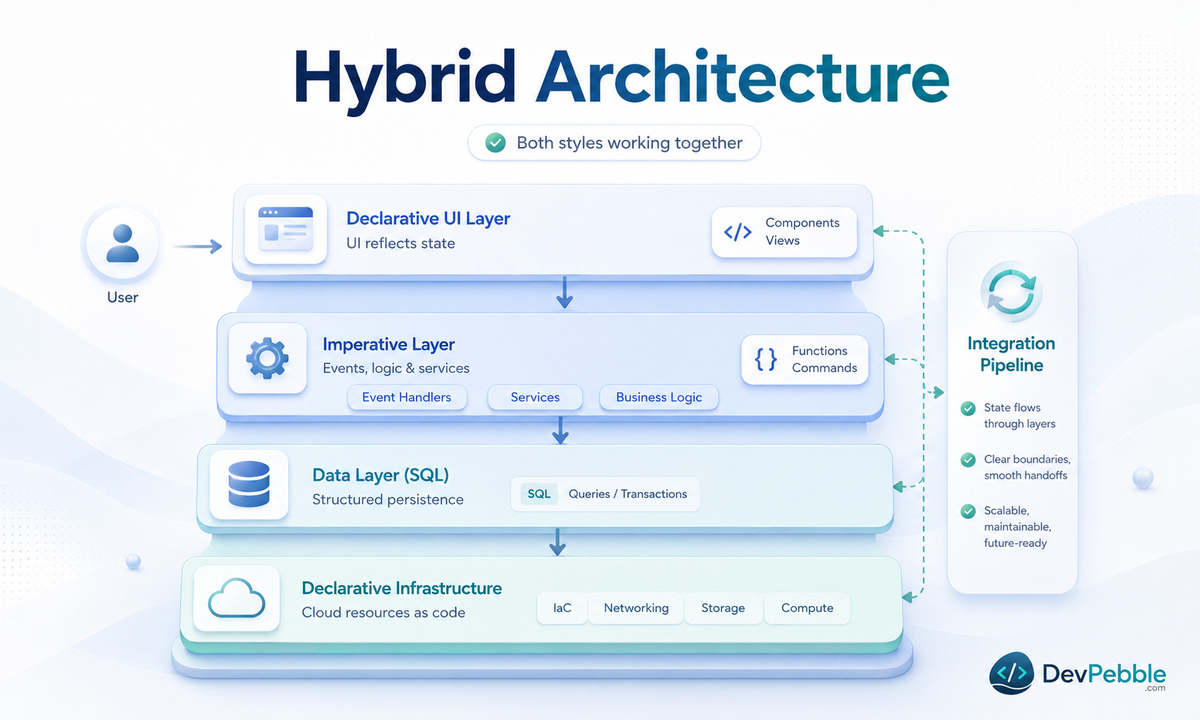
Take a typical web application as an illustration rather than a case study. React describes the UI as a function of state. Event handlers and service code fetch data, validate input, and handle errors imperatively. A SQL query declares what data is needed while application logic decides what to do with the rows. Terraform describes the target infrastructure while deployment scripts glue steps together around it. Each layer owns a different kind of decision, and the boundaries between them are where most of the design work happens.
Misconceptions and edge cases that cause confusion
A handful of category errors come up often enough to name directly.
Functional programming is not a synonym for declarative programming
Microsoft's .NET documentation describes functional programming as a form of declarative programming, which makes it a member of the category rather than the category itself. Logic programming and configuration languages are declarative without being functional.
Object-oriented programming is not the opposite of declarative programming
The same documentation notes that most mainstream languages, including object-oriented ones such as C#, Visual Basic, C++, and Java, were designed primarily to support imperative programming. Object orientation describes how data and behavior are organized, a separate axis from how execution is expressed.
HTML and CSS are declarative but not general-purpose programming languages
They describe structure and style rather than arbitrary computation. Calling a page declarative does not make markup a substitute for a programming language.
Declarative code still has operational behavior
A planner, renderer, or reconciler executes real steps. Declarative syntax relocates that work into an engine instead of eliminating it, which is why the debugging tools change rather than disappear.
One language can support several paradigms
The Python documentation lists Lisp, C++, and Python as multi-paradigm languages in which programs or libraries can be largely procedural, object-oriented, or functional, and notes that different sections of a large program often use different approaches.
How do you choose the right style?
Choose the highest-level abstraction that still preserves the control, observability, and correctness the task requires. That is a judgment about requirements rather than a preference for whichever style feels more modern.
A five-step decision framework
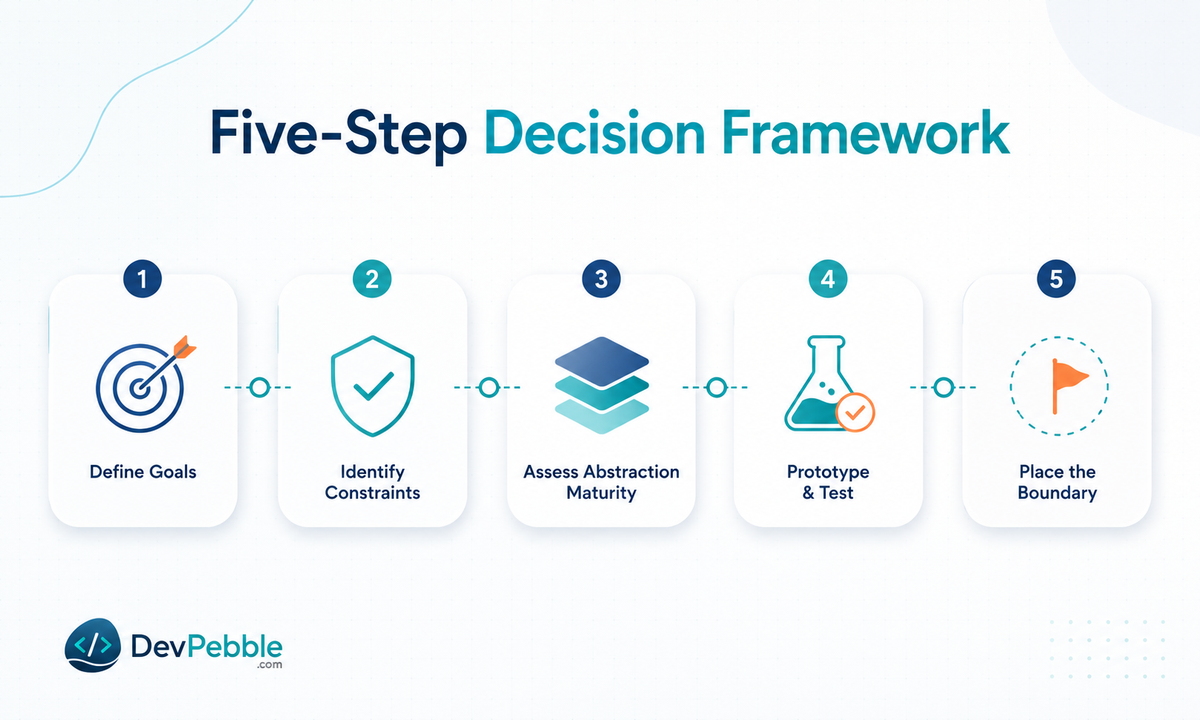
- State the required outcome and the invariants that must always hold, independent of how the result gets produced.
- Identify where order matters, where effects must be precise, and where tuning is non-negotiable.
- Evaluate the abstraction's maturity and observability. Check whether the engine is documented, widely used, and inspectable through plans, diffs, or logs when it misbehaves.
- Prototype both approaches wherever the answer is unclear, and measure the actual workload instead of assuming.
- Place imperative escape hatches at clear boundaries, the way React's refs and Kubernetes' imperative commands sit alongside their declarative defaults.
Final takeaway: use the highest useful abstraction, not a dogma
Expose the steps when order, control, or tuning genuinely matter. Describe the outcome when a capable system can manage the steps safely. Most real programs need both, placed deliberately at clear boundaries. If you are unsure which side a component belongs on, build the smallest version of each and read the plan, the diff, or the trace before committing.