What Is the Hardest Programming Language? A Criteria-Based Comparison
The hardest programming language depends on what you mean: Malbolge for deliberate design, and Assembly, C++, Rust, Haskell, and Prolog for practical difficulty.
On this page⌄
- What Is the Hardest Programming Language?
- What Makes a Programming Language Difficult?
- Which Programming Languages Are the Hardest, and Why?
- How Do the Hardest Programming Languages Compare?
- Which Difficult Language Should You Learn?
- Is Learning a Hard Programming Language Worth It?
- How Can You Learn a Difficult Language Without Getting Stuck?
- Do AI Coding Tools Make Hard Languages Easier?
- The Hardest Language Depends on the Difficulty That Matters
- FAQ
No single programming language is hardest in every sense. Malbolge is the strongest answer if "hardest" means deliberately, intentionally difficult. Among languages people actually use to build software, Assembly, C++, Rust, Haskell, and Prolog each lead a different kind of difficulty: hardware control, mastery breadth, ownership reasoning, functional thinking, and logic-based search.
That split matters because most articles on this topic answer a different question than the one they claim to, ranking languages by how confusing the syntax looks, how much prior knowledge they demand, or how long real fluency takes. Those are different measurements, and they produce different winners. This article compares languages on a consistent set of criteria, separating intentional from practical difficulty and getting started from achieving mastery, so you can match the right kind of "hard" to what you're actually trying to learn.
What Is the Hardest Programming Language?
Under a strict reading of "hardest," Malbolge wins, because it was built specifically to resist ordinary programming rather than to solve real problems. No production language, meaning one people actually use to build software, is hardest across every dimension. Assembly, C++, Rust, Haskell, and Prolog each dominate a different category instead.
This isn't a hedge. Malbolge and other esoteric languages were designed as an exercise in obstruction, closer to computational art than software engineering. C++, Rust, Haskell, Prolog, and Assembly were designed to get real work done, and their difficulty is a side effect of the problems they solve, not the point of their design. Ranking both groups on one scale is like comparing an escape-room puzzle to a licensing exam. Both are demanding, but the word means something different in each case.
The table below summarizes the category verdicts this article develops. Later sections explain the reasoning behind each one.
| Meaning of "hardest" | Strongest candidate | Core reason | |---|---|---| | Deliberately difficult | Malbolge | Built to resist ordinary programming, not to support it | | Hardware-level practical work | Assembly | Direct reasoning about registers, memory, and instruction sets | | Broad mainstream mastery | C++ | Large multi-paradigm feature set, decades of legacy behavior, undefined behavior | | Modern ownership model | Rust | Compile-time enforcement of borrowing and lifetime rules | | Functional-paradigm shift | Haskell | Purity, laziness, and composition replace familiar mutation-based habits | | Logic-paradigm shift | Prolog | Unification and backtracking replace explicit control flow |
What Makes a Programming Language Difficult?
A language's difficulty rarely comes from one property. It comes from several independent sources: syntax, underlying semantics, required background knowledge, resource responsibility, tooling, debugging burden, and the number of features a person eventually has to hold in mind. A fair comparison evaluates these separately, since a language can rank high on one and low on another.
Learning Difficulty, Language Complexity, and Project Complexity Are Different
A hard project doesn't prove its language is hard. The difficulty could sit in the problem, the libraries, the deployment process, or the language itself, and these rarely move together. Language complexity is the design of the language: its rules, syntax, and semantic model. Project complexity is the problem being solved, which can be difficult in any language. Ecosystem complexity is build tools, package managers, and documentation, which shape how difficulty feels even when the language itself is simple.
These variables interact constantly. A well-designed language can feel unbearable on a genuinely hard problem, like distributed consensus. A demanding language like C++ can feel deceptively approachable on a small task where its trickier features never surface. It helps to separate three clocks: time to a first working program, time to work independently, and time to advanced mastery. A language can be fast on the first clock and slow on the third, and C++ is a common example. None of this makes "hardest" meaningless. It means an honest answer names which clock, and which source of difficulty, it's actually about.
The Criteria Used in This Comparison
This article compares languages on twelve dimensions rather than one composite score, because no publicly disclosed rubric currently justifies collapsing them into a single number:
- Syntax and notation
- Semantic-model novelty, meaning how far the language's core ideas sit from what most learners already know
- Required prerequisite knowledge
- Type-system and compiler constraints
- Memory and resource responsibility
- Debugging and diagnostic complexity
- Toolchain and ecosystem friction
- Portability and hardware dependence
- Time to a first useful program
- Long-term mastery burden
- Maintenance and collaboration difficulty
- Practical applicability
Several widely shared articles assign languages a numerical score, a 70 out of 100 or a 9 out of 10, without naming a rubric, a rater group, or a weighting scheme behind the number. That reads as precise but isn't measuring anything a reader can check. This article uses plain qualitative labels instead (Low, Moderate, High, Very High) and explains the reasoning in prose, so the basis for each claim stays visible. That approach fits what learnability research actually shows: work on programming-language syntax and comprehension finds that notation is a real barrier to reading and writing code, but one that interacts with a reader's prior exposure to similar notation rather than acting as a fixed, language-independent score. That supports treating syntax as one criterion among twelve, not the whole story.
Why the Learner's Background Changes the Answer
Programmers disagree about which language is hardest largely because prior experience creates both useful transfer and active interference. A developer already comfortable with pointers and manual memory management will recognize much of what Assembly and C++ ask, even where the syntax is new. That same developer may resist Rust's ownership rules precisely because those rules forbid patterns they've relied on for years, or find Haskell and Prolog unfamiliar because neither rewards habits built around sequential, mutation-heavy code.
Mathematical background, operating-system exposure, and familiarity with the problem domain shift the answer further. Someone who has never worked below a high-level language will find Assembly's register- and memory-level reasoning unfamiliar for reasons that have more to do with practice than aptitude, which is why each profile below notes who tends to find that language easier or harder to approach first.
Which Programming Languages Are the Hardest, and Why?
Six languages anchor this comparison, each representing a different category rather than a rung on one shared ladder. Malbolge covers intentional design, Assembly covers hardware-level control, and C++ covers broad mainstream mastery here, followed by Rust, Haskell, and Prolog later on. Each profile covers the same elements: the core source of difficulty, what a learner needs going in, where the language is actually used, and a qualification that keeps the profile honest.
Malbolge — Hardest by Deliberate Design
Malbolge is the strongest answer to "hardest programming language" under a deliberate-difficulty reading, because its creator built it specifically to resist ordinary programming rather than to support it. Ben Olmstead released Malbolge in 1998, naming it after the eighth circle of Hell in Dante's Inferno, and its goal was never efficiency or elegance. It was resistance to being used at all.
That resistance comes from several layered obstacles rather than one gimmick. Malbolge runs on a virtual machine built around ternary (base-3) arithmetic instead of binary logic, its central operation was deliberately constructed to behave counterintuitively, and its code is self-modifying: instructions rewrite themselves as they execute, so one pass through a program doesn't predict the next. According to the Esolang wiki's entry on Malbolge, the first working "Hello, world!" program wasn't hand-written at all. It was generated by a Lisp program running a beam search across the space of possible programs. That program appeared around 2000, roughly two years after the language's 1998 release, a gap that captures how thoroughly Malbolge resists ordinary human reasoning.
That history is why Malbolge doesn't win the practical category later on. It sits in a separate bucket from Assembly, C++, Rust, Haskell, and Prolog, not because it's easier, but because its difficulty was never meant to be productive.
Assembly — Hardest Practical Language for Hardware-Level Control
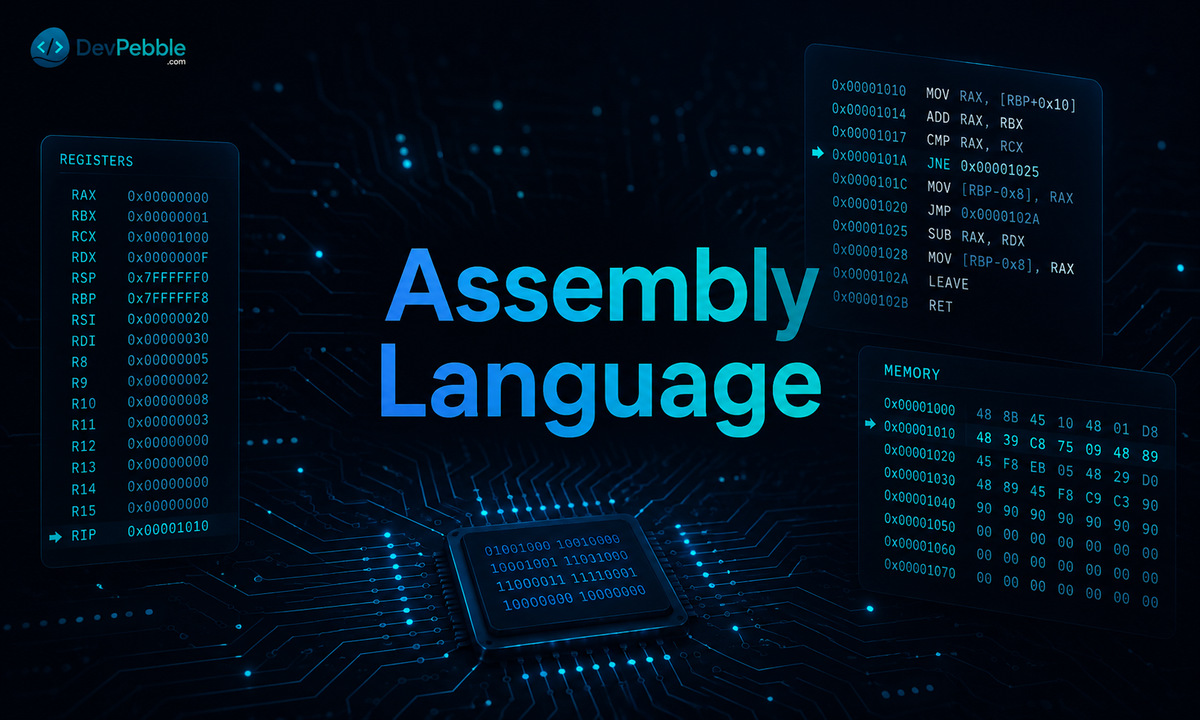
Assembly is the hardest practical language for direct hardware control because it removes nearly every abstraction between the programmer and the machine, requiring explicit reasoning about registers, memory addresses, and individual instructions instead of variables and control structures. "Assembly" isn't one language. It's a family of languages, one per instruction-set architecture (ISA), such as x86-64, AArch64, or RISC-V, and code written for one architecture generally won't run on another without a rewrite.
Working in Assembly means thinking in terms a high-level language normally hides. According to Arm's documentation on its instruction sets, Arm's architecture is a load/store design, where ordinary data-processing instructions operate only on values already sitting in a fixed set of general-purpose registers, and only dedicated load and store instructions may touch memory directly. Every calculation and branch has to be expressed through this narrow instruction vocabulary and a calling convention governing how functions pass and return values. Debugging happens at the level of individual instructions and register contents rather than the higher-level diagnostics a C++ or Rust compiler provides.
This is also why Assembly and machine code aren't identical. Machine code is the binary sequence a processor executes; Assembly is the human-readable, symbolic form of those instructions, translated into binary by an assembler. Assembly remains genuinely useful in embedded systems, kernels, reverse engineering, and performance-critical optimization, but it demands architecture-specific knowledge and low-level debugging skill that most application languages were built to hide.
C++ — Hardest Mainstream Language to Master Broadly
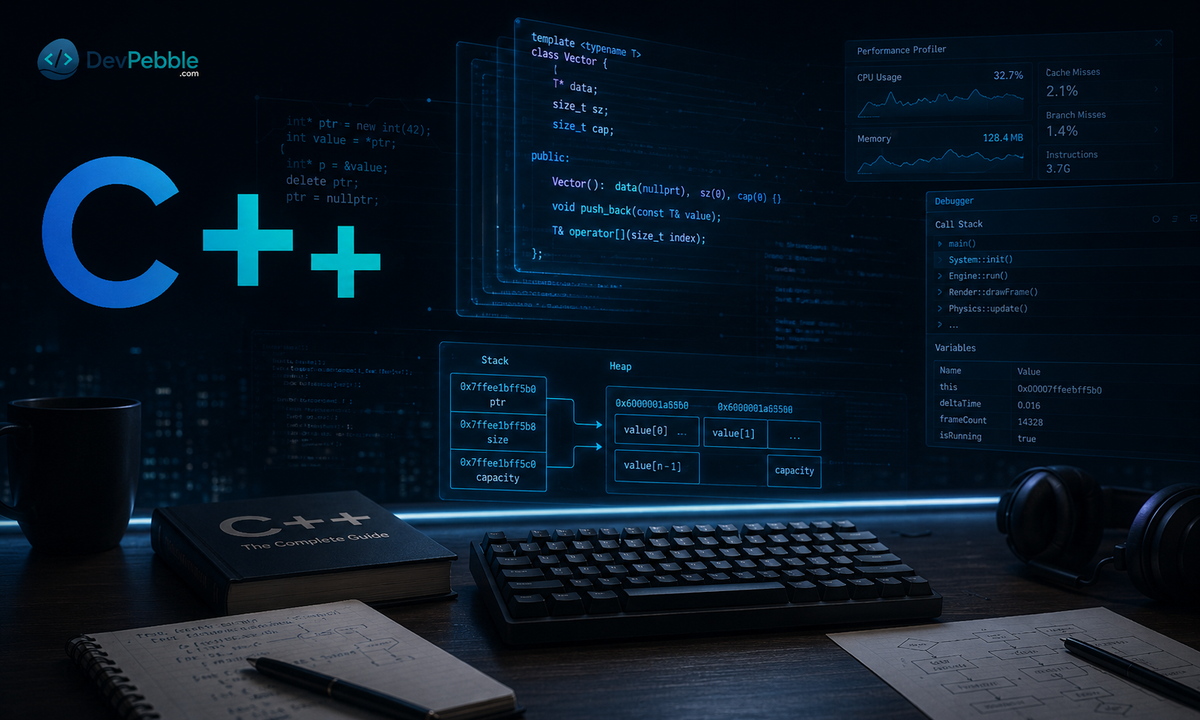
C++ is comparatively approachable to start writing but unusually difficult to master, because its difficulty comes less from any single feature than from the size of its multi-paradigm surface and the number of ways those features interact. A newcomer can write a working program in a single session. Becoming someone who can safely combine templates, overload resolution, move semantics, and concurrency, while respecting decades of backward-compatible legacy behavior, takes considerably longer.
That difficulty is often reduced, inaccurately, to manual memory management with raw new and delete. Modern C++ practice instead centers on RAII (Resource Acquisition Is Initialization), where a constructor acquires a resource and the destructor releases it automatically, tying the resource's lifetime to an object's scope. Smart pointers such as std::unique_ptr and std::shared_ptr build on this pattern to manage memory without a garbage collector, and the C++ Core Guidelines present RAII as the standard mechanism for both memory and general resource safety, including files and locks. That doesn't remove the difficulty; it relocates it, from remembering to call delete toward understanding ownership and object lifetimes well enough that RAII behaves as expected.
The rest of the mastery burden comes from breadth. Procedural, object-oriented, generic, and functional styles coexist in the same language, template code can behave in ways that surprise experienced developers, and undefined behavior means some incorrect programs compile cleanly and fail only unpredictably at runtime. As of mid-2026, the published ISO standard remains C++23, while the committee finished technical work on C++26 in March of that year ahead of formal publication, a reminder that idiomatic C++ keeps shifting even for developers who've written the language for years.
Rust, the next profile in this comparison, asks a related but distinct question. Instead of trusting a programmer's judgment about ownership, as C++ largely does, it enforces ownership rules at compile time.
Rust — Hardest Modern Systems Language for Ownership-Oriented Learning
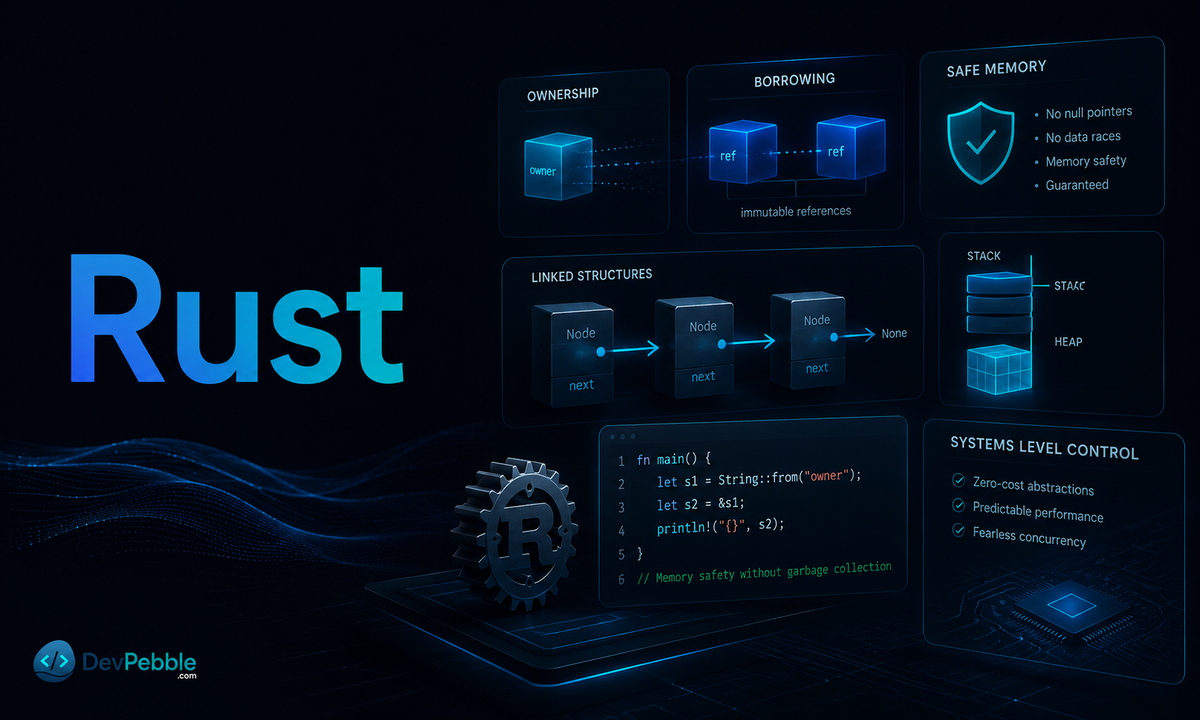
Rust's main learning challenge isn't its syntax. It's building an accurate mental model of ownership, borrowing, and lifetimes, the rules the compiler uses to guarantee memory and thread safety without a garbage collector. Every value has exactly one owner, references borrow access temporarily under strict rules, and lifetimes describe how long a reference stays valid. Getting any of these wrong produces a compile error, not a runtime crash.
That upfront friction is documented, not anecdotal. The Rust Programming Language, Rust's official book, acknowledges that newcomers routinely struggle against the borrow checker, which rejects code the author believes should work, usually because their mental model of ownership doesn't match Rust's actual rules. A randomized controlled trial with volunteers from a 633-person Rust class found that, on a task requiring management of complex aliasing, participants using an experimental garbage-collector library finished in about a third of the time of those using standard ownership rules (four hours versus twelve), and survey responses from the same study identified ownership, borrowing, and lifetimes as the primary source of learners' difficulty.
Rust's difficulty doesn't stop at ownership. Traits and generics enable powerful abstraction but add another layer of rules to learn, and Result and Option push error handling and the possibility of absence into the type system instead of leaving them implicit. Developers coming from C or C++ often find this doubly disorienting, since they already understand why memory bugs happen but must unlearn patterns, like freely aliasing mutable data, that Rust's compiler no longer permits. In exchange, once code compiles, it's free of an entire class of memory-safety and data-race bugs that other systems languages must catch through testing or discipline alone. Cargo, Rust's build tool and package manager, meaningfully reduces the ecosystem friction that compounds language difficulty elsewhere.
Haskell — Hardest Functional-Paradigm Shift for Many Imperative Programmers
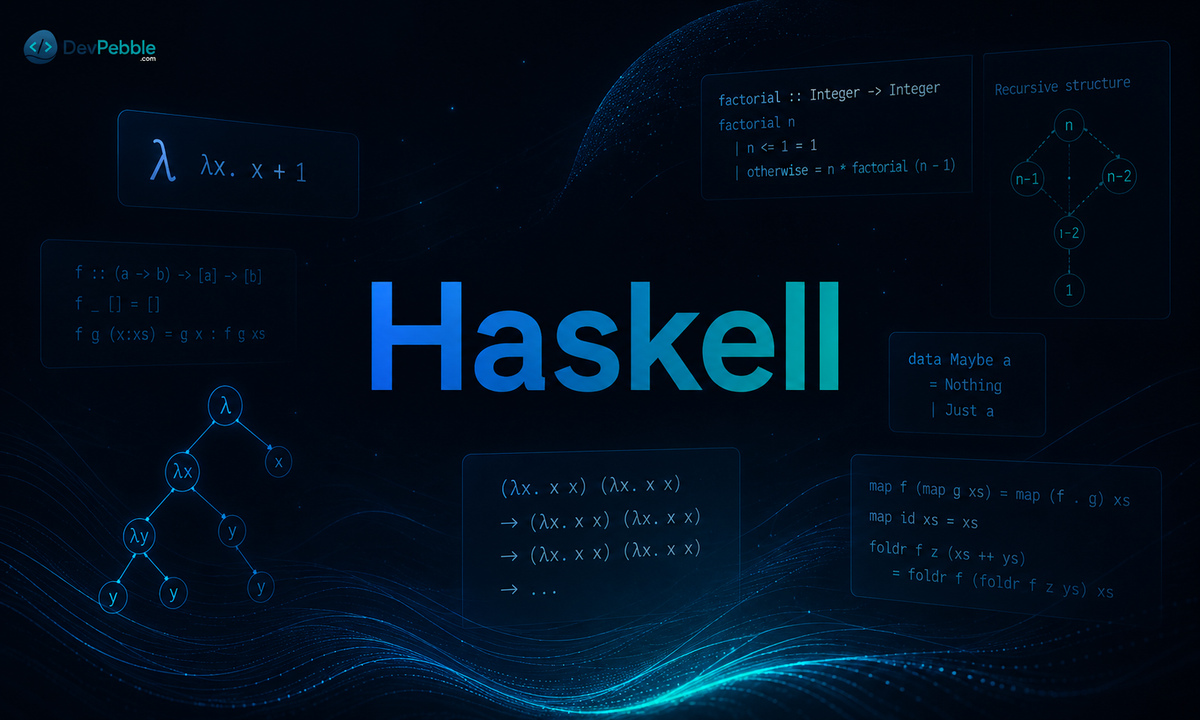
Haskell's central difficulty for most learners isn't mathematics. It's that pure, immutable, lazily evaluated functions replace the assignment- and mutation-based habits most programmers build first, requiring a genuinely different way to construct programs rather than a new syntax for a familiar one. Haskell's own description of itself centers on this shift: it is a purely functional language built on referential transparency, immutability, and lazy evaluation, where every function behaves as a mathematical function and side effects like I/O are represented as values rather than performed as statements.
That framing has concrete consequences for how code gets written and read. Loops give way to recursion and higher-order functions, and state changes give way to passing new values through pure transformations, while evaluation order becomes something the type system and laziness manage rather than something the programmer states line by line. Algebraic data types let programmers encode the shape of a problem directly into the type system, and type inference means most Haskell code doesn't need explicit type annotations to compile, though reading unfamiliar Haskell still means understanding what a type signature implies about a function's behavior. Programmers who already think in terms of functions, recursion, or type systems, whether from Scheme, OCaml, or even strongly typed Java, generally adapt faster than those coming from loop- and mutation-heavy backgrounds. That's a real qualification, not a caveat: Haskell's difficulty is concentrated almost entirely in the paradigm shift, not in memory management, hardware dependence, or an unusually large feature surface.
Prolog — Hardest Logic-Programming Shift
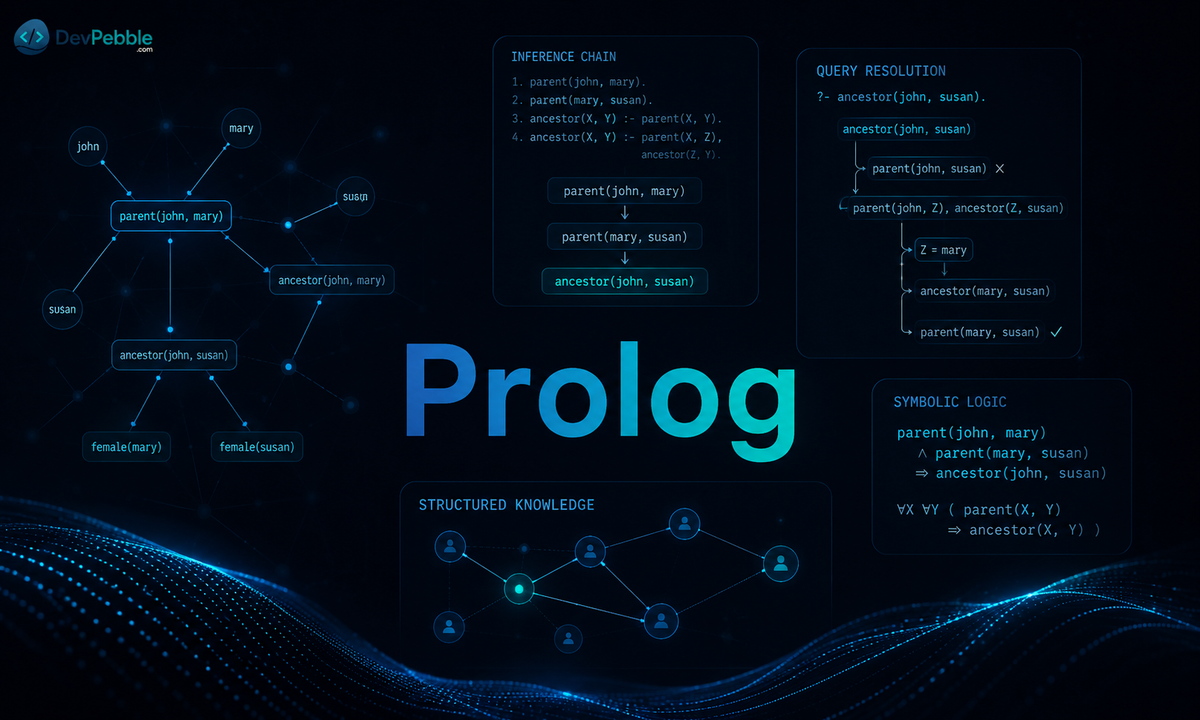
Prolog's core difficulty is that programmers describe facts and relationships rather than a sequence of steps, and the language's execution engine, not the programmer, decides how to search for an answer through unification and backtracking. According to SWI-Prolog's glossary of terms, a Prolog program consists of facts and rules; a query, or goal, is proven by matching it against these clauses, with unification binding variables to make two terms equal, and backtracking retrying alternative clauses whenever a later step in the proof fails.
That model asks for a different kind of debugging instinct. A program can be logically correct yet perform badly, or fail unexpectedly, because of the order in which Prolog tries clauses, something a programmer has to reason about explicitly through choice points, the decision points backtracking returns to when a path fails. Recursion replaces loops here too, but in service of proof search rather than iteration. Constraint logic programming extensions, such as CLP(FD), let Prolog solve problems like scheduling or combinatorial puzzles with far less code than an imperative language would need, which is exactly where Prolog remains genuinely useful today, alongside natural-language processing and automated reasoning, even though it rarely appears in general application development.
Other Frequent Contenders That Do Not Win Every Category
Several other languages are commonly nominated as "hardest," but each wins a narrower category than the six profiled above rather than displacing them. Brainfuck and Whitespace push minimalism or unusual representation to an extreme, Brainfuck with eight symbols and Whitespace using only spaces and tabs, making them hard to read but conceptually simpler than Malbolge, since neither was built around a deliberately counterintuitive execution model.
APL, and its descendants J and K, use dense, symbol-heavy array notation that can express a whole loop in a single character sequence; the difficulty here is almost entirely notational density rather than semantic novelty. Lisp and Scheme ask programmers to think in nested symbolic expressions and, at an advanced level, in macros that generate code. Scala combines object-oriented and functional features with one of the more elaborate type systems in mainstream use, raising its mastery burden without matching C++'s legacy-compatibility problem. Ada is a strict, broadly scoped systems language common in safety-critical and aerospace software, demanding rather than exotic. Erlang's difficulty centers on actor-based concurrency and its own approach to immutable data, distinct from Haskell's purity-first design. None of these unseats Malbolge, Assembly, C++, Rust, Haskell, or Prolog as this article's category leaders. They simply show that "hard" has more entries than a six-language list can fully capture.
How Do the Hardest Programming Languages Compare?
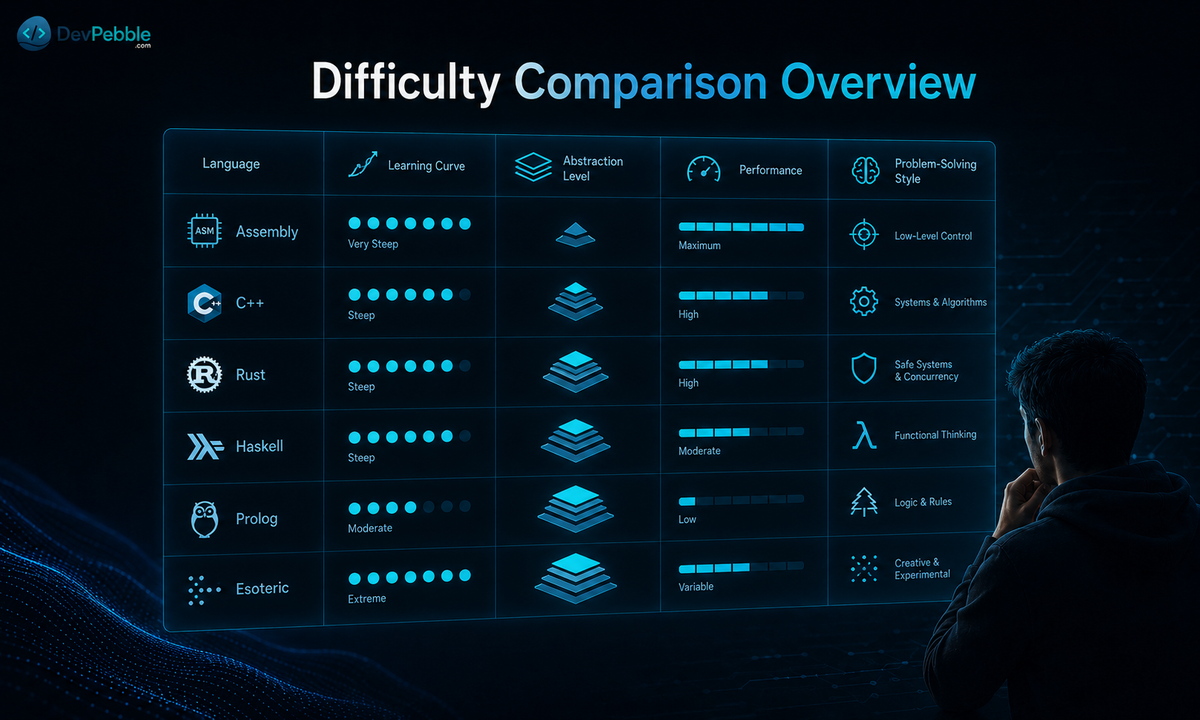
No single row in the table below should be read in isolation: a "Very High" rating in one dimension doesn't make a language worse overall, it just names where that language's difficulty concentrates. The ratings reflect the evidence in each profile above rather than a hidden numerical formula, and are most useful compared column by column for a language you're actually choosing between.
Comparison Matrix
| Criterion | Malbolge | Assembly | C++ | Rust | Haskell | Prolog | |---|---|---|---|---|---|---| | Syntax and notation | Very High | Moderate | Moderate | Moderate | Moderate | Low–Moderate | | Semantic-model novelty | Very High | High | Moderate | High | Very High | Very High | | Prerequisite knowledge | Low | High | Low–Moderate | Moderate | Moderate | Moderate | | Type/compiler constraints | Low (untyped) | Low | High | Very High | High | Low (untyped) | | Memory/resource responsibility | Moderate | Very High | High | Moderate | Low | Low | | Debugging complexity | Very High | High | High | Moderate | Moderate | High | | Toolchain/ecosystem friction | High | Moderate | Moderate | Low | Moderate | Moderate–High | | Portability/hardware dependence | Low | Very High | Low–Moderate | Low | Low | Low | | Time to a first useful program | Very High | Moderate | Low | Moderate | Moderate–High | Low–Moderate | | Long-term mastery burden | Not comparable | High | Very High | High | High | Moderate–High | | Maintenance/collaboration difficulty | Very High | High | High | Moderate | Moderate | High | | Practical applicability | Very Low | Moderate | Very High | High | Moderate | Low–Moderate |
A few patterns stand out. C++ and Rust both carry a heavy mastery burden, but differently: C++'s difficulty spreads across a wide feature surface, while Rust concentrates its difficulty in one demanding rule system the compiler enforces before code ever runs. Assembly is the only profile here where hardware dependence is close to absolute, since portability essentially doesn't exist across instruction sets. Malbolge's row breaks the pattern everywhere else in the table, which is the point. Its difficulty was engineered, not incidental.
Category Winners
Six answers cover six different meanings of "hardest": Malbolge for deliberate design, Assembly for hardware-level control, C++ for broad mainstream mastery, Rust for compiler-enforced ownership, Haskell for the functional-paradigm shift, and Prolog for the logic-paradigm shift. Each verdict holds only within its own category. Asking which is hardest "overall" is a different, less answerable question, since it would require weighing mastery burden against paradigm novelty against hardware dependence on a common scale nobody has validated.
Which Difficult Language Should You Learn?

The right difficult language to learn depends on the capability you actually want, not on which one has the most intimidating reputation. Matching a language to a concrete goal, whether systems programming, hardware control, functional design, or logic-based reasoning, gives a clearer answer than ranking languages by how hard they are in the abstract.
Match the Language to Your Goal
| Goal | Recommended language | Prerequisites | Easier preparation route | |---|---|---|---| | Systems programming with memory safety | Rust | Variables, functions, basic data structures | A garbage-collected language first, for general fluency | | High-performance, game, or native ecosystems | C++ | Procedural programming basics | C, for manual memory handling first | | Embedded hardware, reverse engineering | Assembly | Binary/hex, CPU basics | A systems language like C, for memory and pointers first | | Functional composition, type-driven design | Haskell | Functions, recursion | Scheme, for recursion-first thinking | | Rules, symbolic reasoning, constraints | Prolog | Recursion, formal relationships | A small rule engine or constraint solver first | | Esoteric challenge, language-design curiosity | Malbolge | Patience, programming background | A simpler esoteric language, such as Brainfuck |
Rust's practical relevance is reinforced by current developer sentiment, not just its design. The 2025 Stack Overflow Developer Survey, drawing on more than 49,000 responses, rated Rust the most admired programming language at 72% among developers who used it. That figure measures satisfaction among people already using Rust; it says nothing about how hard the language was to learn.
Who Should Start With an Easier Language First?
Complete beginners, and anyone with limited study time, are usually better served learning control flow, data structures, and basic debugging in a lower-friction language before adding one of these six on top. None of that is a permanent restriction. It's about not stacking two hard problems, a new language and programming itself, at once. Strong motivation can still justify starting directly with Rust, C++, or Haskell as a first language, provided the learner accepts a slower first few weeks and leans on structured material over trial and error. The clearest sign that someone should prepare first is difficulty with basic debugging, meaning reading an error message and forming a hypothesis about its cause, a skill easier to build somewhere with less conceptual overhead, then transfer.
Is Learning a Hard Programming Language Worth It?
Learning one of these languages is worth the effort when its concepts or capabilities match a goal you actually have, whether deeper hardware understanding, a new paradigm, or stronger safety guarantees, not because difficulty itself is a credential. Rust and C++ teach resource and memory reasoning that transfers to systems work broadly; Haskell and Prolog teach ways of decomposing problems that carry over even into languages that don't share their paradigm; Assembly builds intuition for what higher-level code actually costs at runtime.
There's a real security dimension to this choice too, particularly for Rust versus C or C++. In June 2025, CISA and the NSA jointly published guidance encouraging organizations to adopt memory-safe languages, citing memory-safety flaws as a recurring source of exploitable vulnerabilities in critical software. The guidance recommends evaluating a migration path where practical; it doesn't claim any language eliminates vulnerabilities outright, and adopting a memory-safe language is one part of a broader security strategy, not a complete one.
Set against these benefits are real costs: slower initial project delivery, a narrower job market for some of these languages than for widely used general-purpose ones, and the risk of choosing a language for prestige rather than fit. Partial learning still counts. Understanding Rust's ownership model or Prolog's search process well enough to reason about it, even without full fluency, transfers real value to other work.
How Can You Learn a Difficult Language Without Getting Stuck?

Success with any of these six languages depends less on memorizing syntax than on learning the execution model first, practicing the language's defining difficulty in isolation, and treating compiler or interpreter feedback as information rather than an obstacle. The sections below cover what to know before starting, a repeatable sequence for learning, and the mistakes that most often stall progress.
Prerequisites by Language
Each language expects a different starting point, and skipping it is the most common reason learners stall in the first week. Malbolge needs little formal background beyond curiosity about esoteric languages and a basic grasp of how an interpreter executes instructions. Assembly needs binary and hexadecimal number systems, memory and CPU basics, and comfort with a command line. C++ needs control flow, functions, basic data structures, and a working compiler. Rust needs general programming fundamentals; stack-versus-heap concepts help but aren't mandatory. Haskell needs comfort with functions and recursion. Prolog needs recursion and a willingness to think in relationships rather than sequential steps.
| Language | Minimum useful foundation | |---|---| | Malbolge | Basic interpreter concepts, patience | | Assembly | Binary/hex, memory and CPU basics, command line | | C++ | Control flow, functions, basic data structures | | Rust | General programming fundamentals | | Haskell | Functions, recursion | | Prolog | Recursion, comfort with formal relationships |
A Seven-Step Learning Plan
The most effective path through any of these languages follows a consistent sequence: understand the execution model before the advanced syntax, then build up through progressively larger exercises rather than jumping straight to a full project.
- Choose a concrete outcome and target platform. Decide what you want to build and, for Assembly, which instruction-set architecture you're targeting.
- Install one current, officially supported toolchain. Use the language's own installer and documentation rather than a possibly outdated third-party guide.
- Learn the execution and resource model before the advanced syntax. For Rust, that means ownership before macros; for Haskell, purity and laziness before type classes; for Prolog, unification and backtracking before constraint libraries.
- Complete focused exercises for the language's defining difficulty. Small, repeatable drills on the specific hard part beat broad tutorials that touch everything lightly.
- Build one small project with tests. A test suite gives you a concrete way to know whether a change actually worked.
- Record and classify errors instead of just patching them. Noting whether a failure was a syntax slip, a misunderstanding of ownership, or a wrong assumption about evaluation order turns each error into a data point about what to study next.
- Review idiomatic code from the language's own ecosystem, then rebuild your project with fewer references. Reading real, well-regarded code exposes patterns a tutorial won't, and rebuilding from memory tests what actually stuck.
Step three has real evidence behind it. A study evaluating a new teaching approach for Rust's ownership model, based on data from 342 learners, found that teaching ownership through a conceptual model of memory permissions, rather than syntax rules alone, raised scores on a standardized ownership assessment by an average of 9%, a moderate effect size. The gain came from reordering what was explained and when, not from any tool or shortcut.
Common Mistakes and Troubleshooting

Most stalls come from skipping the execution model, attempting a project that's too large too soon, or changing several things at once when debugging. The table below maps common symptoms to their usual cause and a fix that targets it directly, instead of patching the error and moving on.
| Symptom | Likely cause | Corrective exercise |
|---|---|---|
| Treating the new language as "syntax on top of" a familiar one | Trying to port old habits instead of learning the new execution model | Rewrite a small, already-working program from scratch, without referencing the old version |
| Excessive cloning or unsafe blocks in Rust | Fighting the borrow checker instead of adjusting the data's ownership structure | Redesign the data structure around a single clear owner before adding references |
| Assigning variables or writing loops in Haskell | Treating Haskell as an imperative language with unfamiliar syntax | Rewrite the same logic using only recursion and pure functions, with no loop constructs |
| Ignoring why a Prolog query returns results in an unexpected order | Not accounting for clause order and backtracking | Trace a small query by hand, predicting each choice point before running it |
| Writing Assembly that only works on one machine by accident | Mixing instructions or calling conventions from more than one architecture | Fix a single target ISA and toolchain before writing anything else |
| Copying AI-generated code that "just works" | Accepting output the learner can't explain line by line | Rewrite the same function unaided, then compare it to the original |
Do AI Coding Tools Make Hard Languages Easier?
AI coding assistants reduce some friction around these languages, such as explaining compiler errors, generating boilerplate, and drafting a first attempt at a function, but they don't remove the need to understand ownership, types, machine state, or logical search, and their suggestions still need verification rather than trust. That distinction matters more here than for mainstream languages, because the difficulty in these six tends to sit in concepts an assistant can describe but can't internalize on the learner's behalf.
The risk isn't hypothetical. A large-scale study across 16 code-generating language models generated more than 576,000 Python and JavaScript samples and found that roughly a fifth of recommended packages referenced libraries that don't exist, with commercial models averaging at least a 5.2% hallucination rate and open-source models 21.7%. That study covers Python and JavaScript, but the same failure mode, plausible-looking output referencing something nonexistent, applies just as easily to an invented Rust crate, a fabricated Prolog predicate, or Assembly written for the wrong calling convention. Verification differs by language: Rust and C++ benefit from compiler warnings and sanitizers, Haskell from its type checker, Prolog from tracing a query by hand. Across all six, one rule still holds: don't keep code you can't explain line by line.
The Hardest Language Depends on the Difficulty That Matters

No single language wins every category of "hardest," and treating this as a one-name answer misses the more useful question underneath it. Malbolge earns the title when difficulty means deliberate design. Assembly, C++, Rust, Haskell, and Prolog each lead a different practical category: hardware control, mastery breadth, ownership discipline, a functional-paradigm shift, and a logic-paradigm shift, respectively.
The practical takeaway is to pick based on what you're trying to build or understand, not on reputation. Someone chasing memory safety and systems work gets more from Rust than from a vague sense that "hard languages are good for you." Your own background changes which of these feels hardest, so weigh a language's difficulty against the specific skill you actually want, then start with the profile above that matches it.