Remote programming jobs: how to find work-from-home developer roles
A practical guide to remote programming jobs — what the work involves, beginner-friendly roles, the skills employers screen for, where to find legit listings, and what they pay.
On this page⌄
- What a remote programming job actually involves
- Best remote programming jobs for beginners in 2026
- The skills employers actually screen for
- Best programming languages for remote work
- Where to find legitimate remote programming jobs
- Do you need a degree?
- How to land a remote role
- What remote developers actually earn
- The hard parts, and how to handle them
- Where to start
- FAQ
Hiring changed for good somewhere in the last few years. Plenty of companies now bring on programmers they will never meet in person, and for a lot of developers that is the point: flexibility, access to employers in other countries, and pay that often matches or beats a local office job. The catch is that the market is more crowded and more selective than it was at the peak of the remote boom. This guide covers what these roles involve, which entry-level jobs are realistic, the skills employers screen for, where to find legitimate listings, what the work pays, and how to land your first offer.
What a remote programming job actually involves

A remote programming job is any developer role you do outside a company office, usually from home or anywhere with a stable connection. Some positions are fully distributed with no office visits at all; others are hybrid. This guide leans toward the fully remote end, which still makes up a meaningful share of developer postings.
Day to day, the work runs on digital tools. Teams coordinate in Slack or Microsoft Teams and run stand-ups over Zoom or Google Meet, though many remote-first teams keep meetings minimal and lean on written, asynchronous communication. Code ships through Git, with repos on GitHub or GitLab; pull requests and code reviews are where most collaboration happens between people who may be five time zones apart. Jira, Linear, or Trello track who owns what.
Writing matters more here than in an office. When you cannot lean over and ask a colleague, your tickets, notes, and PR descriptions carry the load, and remote-first employers weigh communication and self-management about as heavily as raw technical skill. A reality check worth absorbing early: companies are pickier than they were a few years ago. The roles exist, but the market is not chasing candidates the way it briefly did.
Best remote programming jobs for beginners in 2026
Breaking in as a new developer means targeting roles genuinely open to people with limited experience. These show up regularly on the major boards, though hiring volume and competition vary by region.
Junior web developer is one of the most commonly advertised. You build and maintain web apps alongside more senior developers: writing tests, fixing bugs, opening pull requests. Employers usually want HTML, CSS, one JavaScript framework, and a portfolio that shows you can actually ship something.
Front-end developer roles are in steady demand worldwide, with React still appearing in a large share of listings. They tend to be reachable for self-taught and bootcamp developers who can demonstrate responsive design and component-based thinking.
WordPress developer work is everywhere, because WordPress runs a huge slice of the web. Entry-level work centers on themes, plugin customization, and page builders, with listings often asking for HTML, CSS, JavaScript, some MySQL, and basic REST API experience.
Junior software developer is a broader title spanning back-end, full-stack, and general application work. Most listings want at least one back-end language, usually Python or Java. Competition is real, and your portfolio does a lot of the talking.
QA automation is an underrated way in. Junior QA roles involve writing and running test cases, finding bugs, and validating behavior alongside senior engineers. Comfort with API testing tools like Postman and a bit of Python scripting makes you stand out.
Technical support developer sits between engineering and customer support: diagnosing product issues, writing small scripts and tools, and translating between users and the engineering team. It builds real debugging experience while you work remotely.
None of these guarantees a job. Offers come down to portfolio quality, how mature your skills are, how many openings exist where you are, and timing.
The skills employers actually screen for
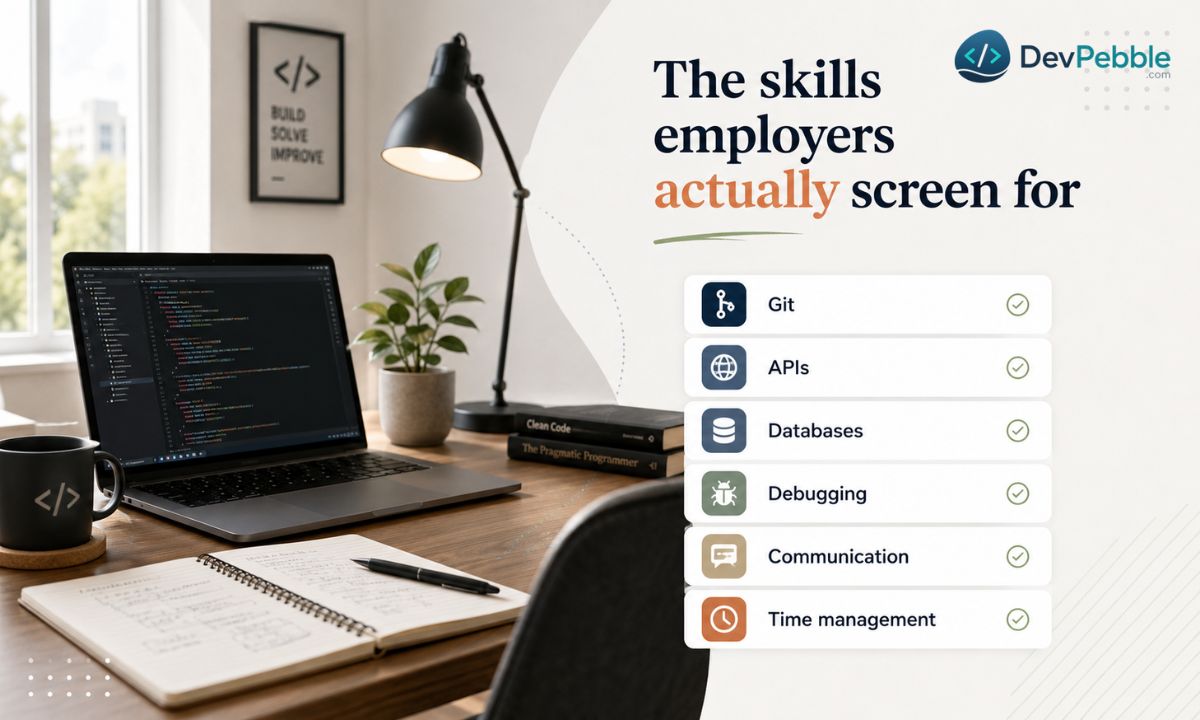
HTML, CSS, and JavaScript are the floor for any front-end or full-stack role, and Python is the other language that comes up constantly, especially for back-end, data-adjacent, and QA automation work. (More on specific languages below.)
Git is not negotiable. A clean GitHub profile with real projects and a steady commit history now carries weight alongside your résumé, especially when you do not have years of employment to point to. Employers read your activity as a signal of consistency.
Beyond languages, most junior roles expect you to understand how APIs work (making and reading HTTP requests, interpreting responses), the basics of relational databases and simple queries, and methodical debugging: reading an error, tracing it to its source, testing a fix. Interviewers probe all three.
Then there are the skills with no certificate attached. Written communication is the most underrated tool a remote developer has: when your manager cannot watch you work, a clear status update or a well-reasoned PR description becomes the proxy for your professionalism. Time management is the other. Remote work strips away the structure an office imposes, and developers who cannot run their own schedule tend to struggle no matter how good their code is.
Best programming languages for remote work
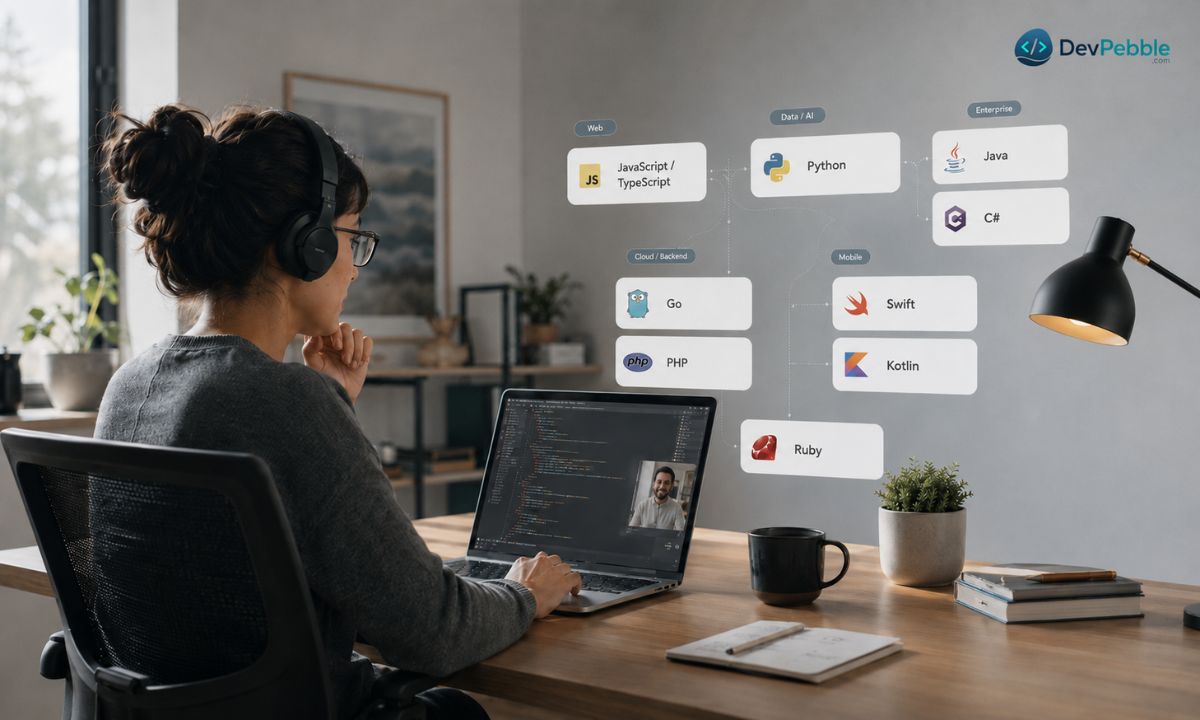
There is no single best language. The right one depends on the work you want, the employers you are targeting, and where you are.
JavaScript and TypeScript cover the widest surface area in remote web work. Most major front-end frameworks (Next.js, Angular, SvelteKit, Remix) scaffold new projects in TypeScript by default, so you are working in it from day one. On freelance platforms, JavaScript is the most requested language in web listings.
Python dominates data science, ML, and AI-adjacent back-end work. It is the most popular language going into 2026, but that popularity cuts both ways: so many people know it that Python alone is a weak differentiator. Pair it with a real data or ML stack and it gets a lot stronger.
Java still anchors a lot of enterprise engineering, particularly at banks, large software vendors, and shops running long-lived systems. Go has been climbing in cloud infrastructure and DevOps; it is not a first language, but it is a smart addition if you want to move toward platform engineering. PHP keeps much of CMS and e-commerce work alive, Ruby hangs on at some startups, C# owns Microsoft-stack and Unity game roles, and Swift and Kotlin lead native iOS and Android, though the mobile market is smaller than web.
The best language is the one that connects to a specific role, stack, and employer you are actually targeting. Real depth in one or two beats spreading yourself thin across five.
Where to find legitimate remote programming jobs
LinkedIn is still the widest net for remote engineering roles; its remote filter and direct recruiter contact make it a sensible starting point. Indeed surfaces a lot of work-from-home listings with salary filters, though quality is uneven since many are aggregated from elsewhere.
Remote-only boards cut through the hybrid noise. We Work Remotely is well established and reviews listings before they go live. Remote OK refreshes often and includes salary filters. Remotive pairs a curated board with a community newsletter. Arc.dev connects remote and freelance developers with international employers and has a section for junior listings. FlexJobs charges a subscription but hand-screens every post to remove scams, which some candidates find worth paying for.
For freelance work, Upwork and Fiverr host short-term contracts rather than salaried jobs. They are a decent way to build a track record, but income swings and benefits are absent, so treat them as a supplement rather than the whole search. Wellfound (formerly AngelList Talent) is built around startup hiring and lists plenty of fully remote roles; startups often move faster and care less about credentials. And do not skip company career pages, where a lot of remote roles get posted first or never reach the boards at all.
How to spot a scam

Fake listings have gotten more convincing. Scammers now spin up fabricated companies, realistic job posts, and even fake employee profiles using AI-generated sites to extract fees or personal data for jobs that do not exist. Reliable warning signs: any request to pay upfront for equipment or onboarding, pay that is wildly high for vague entry-level work, "interviews" run through personal WhatsApp or generic Gmail rather than a company domain, a company you cannot verify through its own site and Glassdoor, and requests for bank details or a national ID before any offer. Check the employer independently before you engage.
Do you need a degree?
Sometimes yes, sometimes no, depending on the company. Several large firms, Google and IBM among them, have publicly dropped degree requirements for many roles, weighing portfolios, certifications, and demonstrated problem-solving instead. Plenty of startups and product companies have moved the same way, especially for web and software roles.
But it is not uniform. Government contractors, defense-adjacent firms, big financial institutions, and some established enterprises still list a CS or related degree as a hard requirement, and plenty of current entry-level listings ask for one. Assuming a degree never matters will waste applications.
Where ability counts more than credentials, a few things carry weight. A strong GitHub portfolio is the closest thing a new developer has to a track record, and a few months of documented project work can outweigh years of unrelated coursework in a skills-first process. Certifications from Google, AWS, Microsoft, or Coursera signal structured learning; reputable bootcamps place graduates into entry-level roles, though outcomes vary; open-source contributions show you can read unfamiliar code and collaborate asynchronously; and any paid experience, even short freelance work, reads differently than personal projects do. Alternative credentials open some doors, not all of them, so research each employer before applying.
How to land a remote role
Without office visits or in-person networking, your application materials and online presence do nearly all the work.
Tailor every application. A generic résumé rarely lands; read the job description, mirror its specific technologies and responsibilities, and keep it focused on output rather than duties. A short, specific cover letter still differentiates you, precisely because most people skip it.
Your portfolio is where you prove you can build. Pick depth over volume: two to four finished, documented projects beat fifteen tutorial clones, because reviewers judge you by your best work. Each should answer three things at a glance: what problem it solves, how you solved it, and how someone can see it running. Include a live demo (Vercel, Netlify, and Render host personal projects for free) and a clear README. Descriptions that show decision quality win out: "Designed an API gateway with rate-limiting and caching that cut median response time by 32%" says far more than "Built an API with Node and Redis."
Keep GitHub clean too. Pin your six strongest repos, make sure none are broken, add a short profile README, and hide the abandoned tutorial repos that only lower the signal. Keep LinkedIn consistent with all of it, since recruiters often search there before a role is even posted.
Expect the process to test how you work remotely. Most include a coding assessment, take-home, or live technical interview, so practice on LeetCode, HackerRank, or Codewars over weeks rather than the night before. Employers run structured interview rounds and will probe how you handle distributed work, so be ready to talk about working independently, writing clearly, and managing your own time.
What remote developers actually earn

Any single average figure for remote developers misleads, because location, specialization, experience, and employment type pull pay in wildly different directions. Many companies pay based on where you live; some fully distributed firms benchmark everyone against a US or Western European standard regardless of geography.
In the US, BLS data from May 2024 put the median wage for software developers at $133,080, with the bottom 10% under $79,850 and the top 10% above $211,450. Those are base salaries, before equity or bonuses. ZipRecruiter's data through early 2026 pegs the average remote software developer in the US at about $111,845, with the middle 50% falling between $90,000 and $130,000. Entry-level base salaries generally land between $75,000 and $95,000; two to five years of experience pushes that to roughly $95,000 to $140,000.
In the UK, Python engineers run roughly £48,000 to £75,000, React and front-end developers £45,000 to £70,000, and data engineers with ML experience up to £80,000. Across Western Europe, senior engineers in direct employment typically earn €70,000 to €110,000, with Germany and the Netherlands toward the top.
Asia is more spread out. Self-reported data puts the average engineer salary there near $56,000, against roughly $70,000 for Western Europe and $86,000 for Oceania. India is especially wide: a junior at a domestic firm and a senior on a US remote contract can share a title and earn ten times apart, with international contract rates often starting at $40 to $60 an hour.
Treat all of these as reference points, not promises. Cross-check against live listings for your region, role, and level before you set expectations.
The hard parts, and how to handle them
Distributed work has real downsides worth knowing before you start.
Communication gaps are the big one. Without the ambient awareness of an office, things slip. The fix is deliberate over-communication: write things down, confirm verbal decisions in writing, and never read silence as agreement. Time-zone spread shrinks your overlap hours, but the better distributed teams turn that into an advantage, structuring async handoffs into near-continuous progress with recorded updates and shared docs.
Isolation is harder to see coming. Working alone wears on your well-being over months, so counter it actively: social calls with colleagues, the occasional café or co-working day, and a real boundary between work and the rest of life. That boundary is its own challenge, because remote work removed the commute but also the line between work and rest. Set an end to the day and hold it.
A few practical things round it out. Confirm fuzzy requirements in writing before you build, since clarification loops are slower remotely and a misread brief costs more. Have a connectivity backup ready before you need it, not during a live incident. And take security seriously: you are handling company code and credentials from your own network, so use a VPN on untrusted Wi-Fi, keep credentials in a password manager, turn on two-factor everywhere, and never work on company projects from shared devices. Employers increasingly expect this as they move to zero-trust access models.
Where to start
Work-from-home programming is a real, growing slice of the global software market, and a more competitive one than it used to be. The developers who do well build skills in stacks employers are hiring for, prove them with deployed and documented work, and apply to roles that match where they are now rather than where they want to be.
So be honest about your level, close the one or two gaps most likely holding you back, get two or three strong projects live, and apply steadily to legitimate roles that fit your profile. The opportunity is genuine. So is the work it takes to get there.