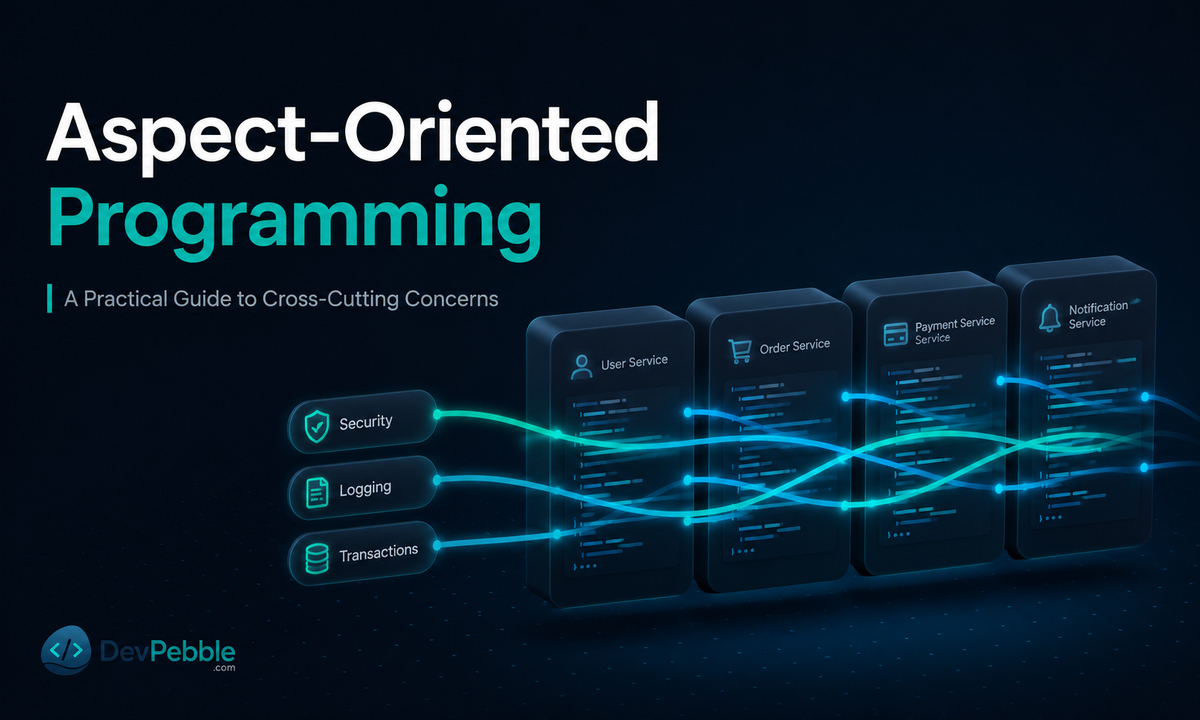
Aspect-Oriented Programming: A Practical Guide to Cross-Cutting Concerns
Aspect-oriented programming explained: how weaving works, the four core concepts (aspect, join point, pointcut, advice), AOP vs OOP, frameworks, and use cases.
On this page⌄
- What is aspect-oriented programming?
- How aspect-oriented programming works
- The four core concepts: aspect, join point, pointcut, and advice
- Aspect-oriented programming examples for beginners
- Benefits of AOP in modern applications
- AOP vs OOP: how they relate
- Common use cases: logging, security, and transactions
- Popular AOP frameworks and languages
- How to implement AOP step by step
- Best practices and limitations
- Conclusion
- FAQ
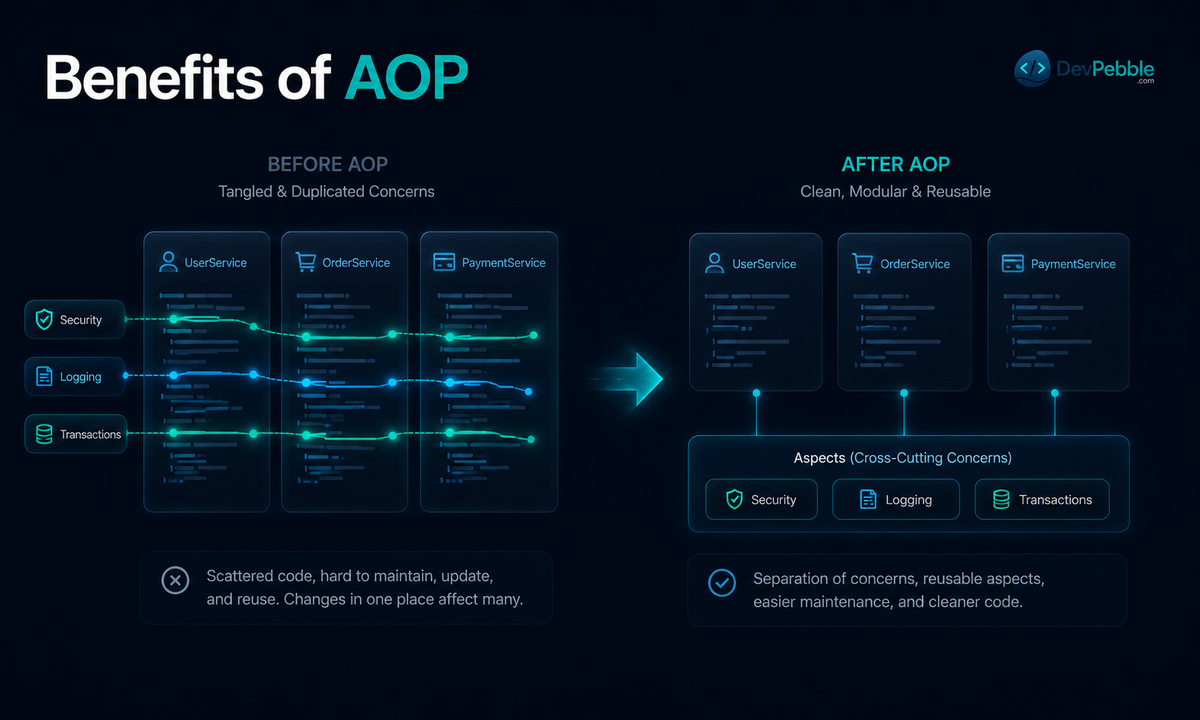
Open almost any method in a mature enterprise codebase and you'll find the same thing: three lines of real business logic buried under twenty lines of logging, permission checks, and transaction handling. The purpose of the function gets lost in supporting machinery, and it isn't one file. The same clutter repeats across hundreds of classes, so every new requirement (audit logging, caching, metrics) means editing code that has nothing to do with it.
Aspect-oriented programming exists to close that gap. Instead of copy-pasting supporting code everywhere, AOP lets you pull it into one reusable unit and apply it wherever it belongs, without rewriting the core logic. This guide covers what AOP is, how weaving works, the four building blocks you need to know (aspects, join points, pointcuts, and advice), the frameworks worth using in 2026, and where AOP helps versus where it quietly makes things worse.
What is aspect-oriented programming?
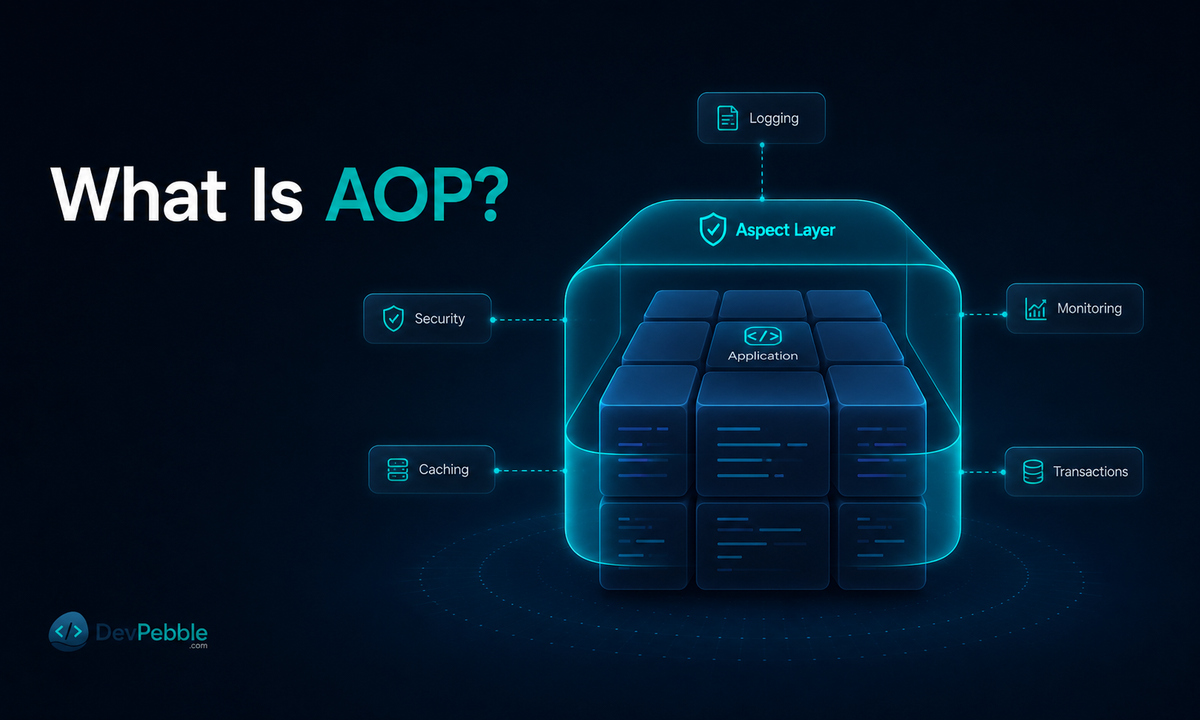
Aspect-oriented programming is a paradigm for separating cross-cutting concerns from an application's core business logic. A cross-cutting concern is any behavior that shows up across many unrelated parts of a system: logging, authentication, caching, transaction management, performance monitoring. None of these belong to a single module, yet they appear almost everywhere.
Here's the problem in plain terms. Say you want every method in a payment service to record its execution time. In traditional OOP, you'd write that timing code inside each method. Do that across a hundred methods and you've got duplicated logic that's painful to keep consistent. Change the log format once and you're editing files across the whole project.
AOP flips this around. You define the timing behavior once, then tell the framework to apply it wherever it's relevant, without touching the original method code. The payment logic stays clean; the monitoring gets "woven in" separately. That word, weaving, is the key idea.
Why teams actually adopt it
Most teams don't reach for AOP on day one. They reach for it once a project grows and the cross-cutting duplication starts to hurt. Business logic stays focused instead of drowning in infrastructure code. One aspect definition updates behavior everywhere, instead of a company-wide search-and-replace. Boilerplate for exception handling or auditing gets written once, and tests get simpler because the business logic isn't tangled up with peripheral concerns. There's a compliance angle too: in banking or healthcare, one consistent place where access logging happens makes audits far less painful than proving a scattered check was applied correctly in four hundred methods.
Take a banking app. Nearly every transaction method (deposit, withdrawal, transfer) needs to verify permissions, log the operation, and wrap the whole thing in a transaction. With AOP, one security aspect and one transaction-logging aspect cover all of them automatically, and the business rules stay readable.
How aspect-oriented programming works
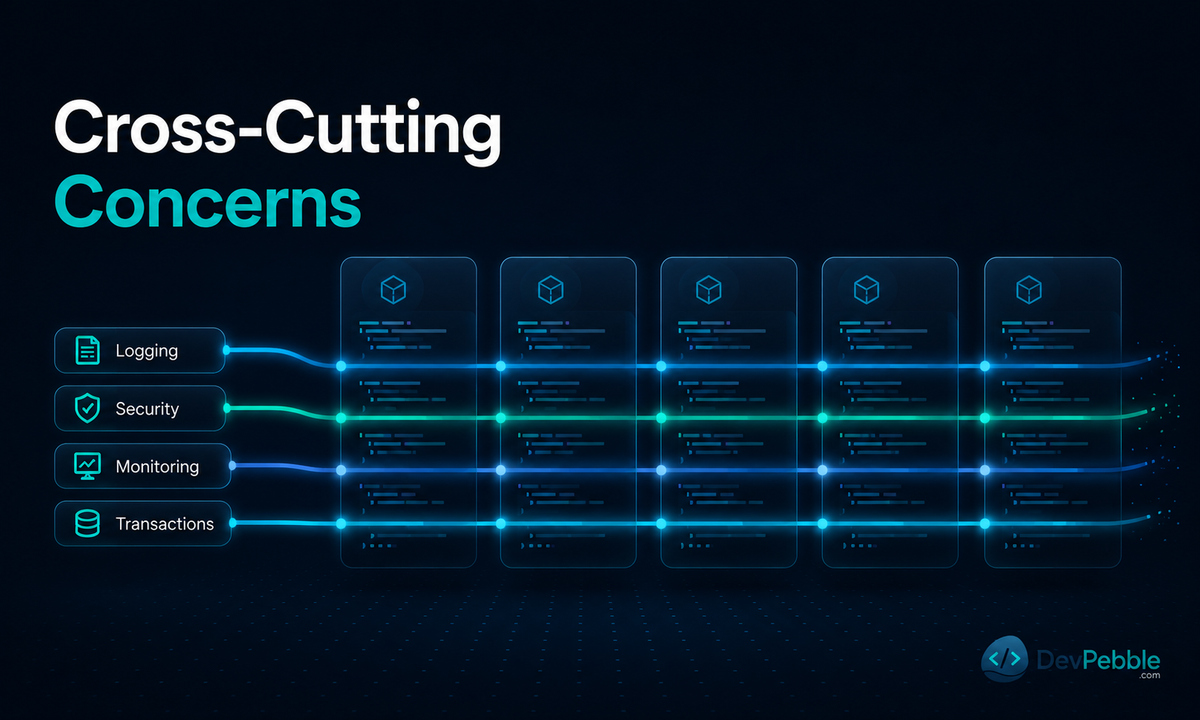
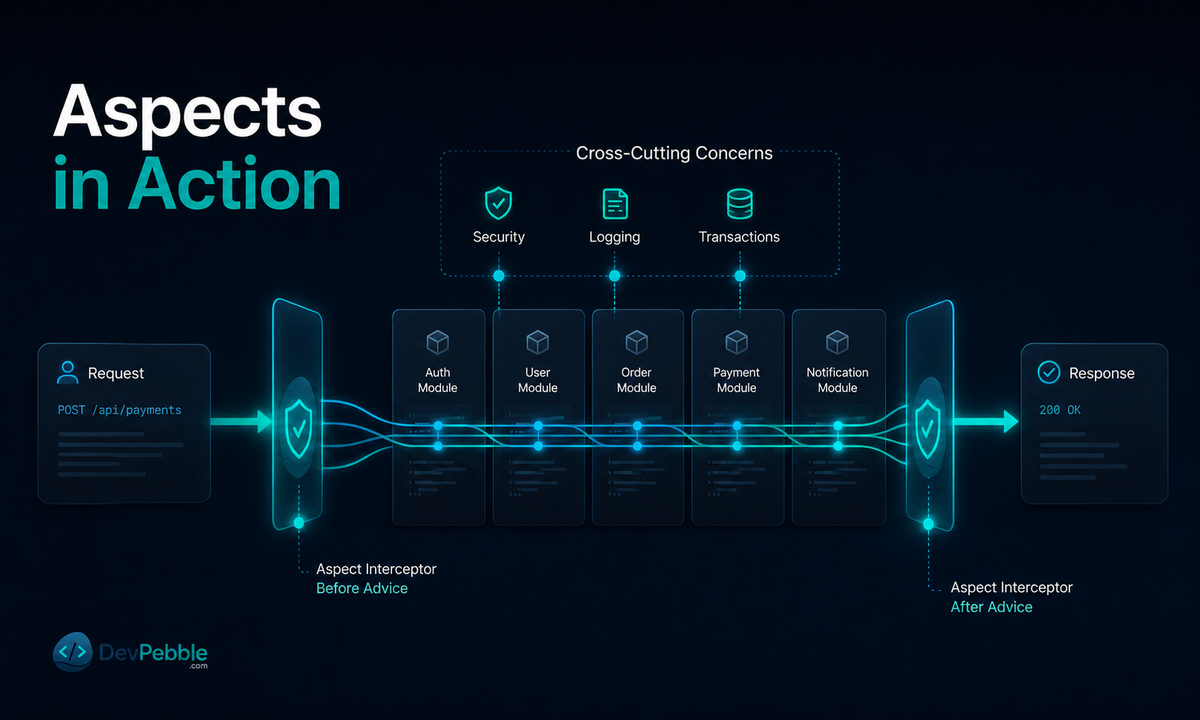
At its core, AOP works through weaving: the mechanism that combines your cross-cutting code (the aspect) with the main program logic. Instead of a developer inserting logging or security checks into every relevant method, a weaver inserts that behavior automatically at points defined by rules the developer writes.
Weaving can happen at three different stages, and the difference matters a lot when you're picking a framework.
Compile-time weaving merges the aspect code into the source or bytecode during the build, before the app runs. This is how AspectJ typically operates. The upside is performance, since there's no runtime cost to figure out where aspects apply. The trade-off is a more involved build pipeline that needs a special compiler step.
Load-time weaving happens when classes are loaded into the JVM, right before execution. It's more flexible, because you adjust configuration and reload instead of recompiling the whole application to change an aspect. It's the middle ground between performance and flexibility.
Runtime weaving applies aspects dynamically while the app is already running, usually through proxy objects. This is Spring AOP's approach. When a call comes in, the proxy intercepts it, runs any aspect logic before or after, then calls the real method. It's the easiest to configure and needs no special compiler, though it carries a small runtime cost. Spring's version has a catch we'll get to: it only intercepts public methods on Spring-managed beans.
| Weaving type | When it happens | Common framework | Performance | Flexibility | |---|---|---|---|---| | Compile-time | During the build | AspectJ | High | Lower (requires rebuild) | | Load-time | When classes load into the runtime | AspectJ (LTW mode) | Moderate to high | Moderate | | Runtime | While the app executes | Spring AOP | Slightly lower | High (easy reconfiguration) |
To make this concrete: in an e-commerce app where every method in an OrderService needs timing, you define one aspect that says "before any method in OrderService runs, record the start time; after it finishes, log how long it took." The weaver inserts that behavior everywhere the rule matches. You never touch placeOrder(), cancelOrder(), or refundOrder(), yet all of them report execution time consistently. You describe where behavior should run; the framework does the mechanical work.
The four core concepts: aspect, join point, pointcut, and advice
To implement AOP in any real project, you need four building blocks. These terms show up in nearly every framework, whether you're using AspectJ in Java or a decorator-based approach in another ecosystem.
An aspect is the module that packages a cross-cutting concern, bundling the logic (logging, caching) with the rules for where it applies. In code, it's usually a class the framework recognizes as cross-cutting behavior rather than ordinary business logic.
A join point is a specific point during execution where an aspect could apply: a method call, an object being created, an exception being thrown. In Java-based frameworks these are almost always method executions, though the concept is broader in principle.
A pointcut is the rule that selects which join points an aspect actually applies to. If a join point is a possible location, a pointcut is the filter. One might say "any method whose name starts with get in com.example.service," or "only methods annotated with @Transactional." This is where precision lives: instead of applying an aspect blindly, you target exactly what needs it.
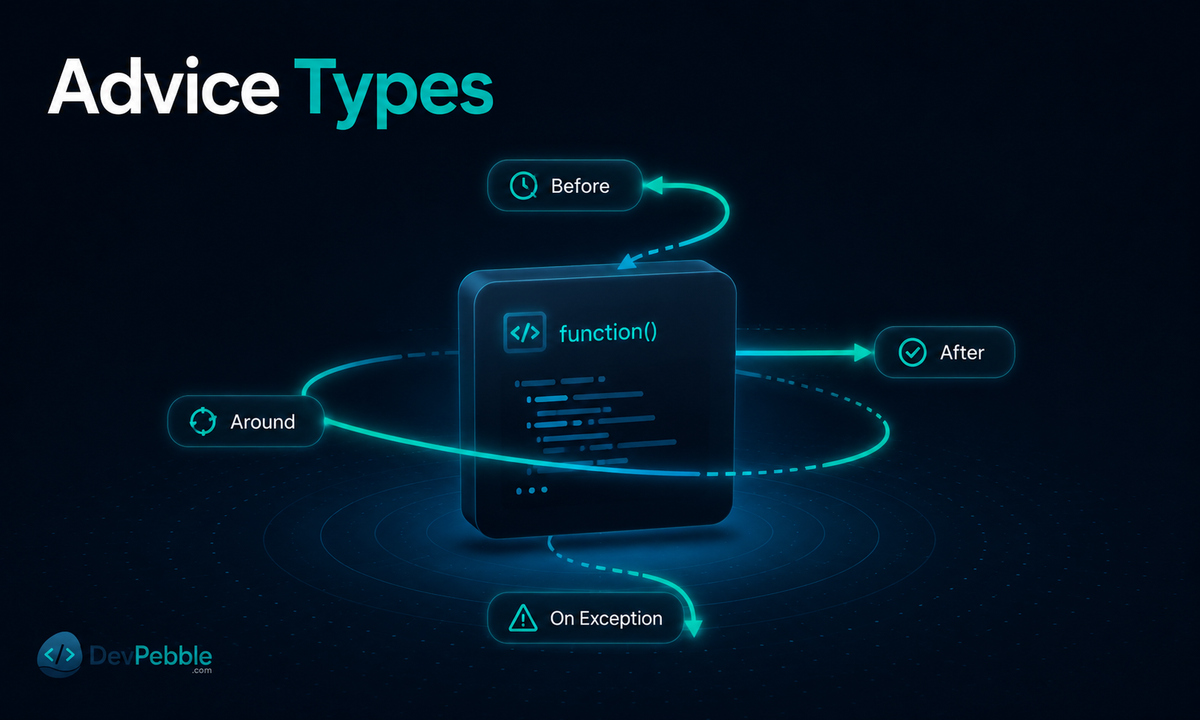
Advice is the code that runs when a pointcut matches a join point. It's the "what to do" part. Advice comes in a few flavors:
- Before advice runs immediately before the matched method (good for permission checks).
- After advice runs after the method completes no matter what (good for cleanup).
- After-returning advice runs only if the method succeeds (often used to log results).
- After-throwing advice runs only if the method throws (used for error handling or alerting).
- Around advice wraps the entire call, giving full control over whether the original method even runs and letting you modify its input or output. This is what makes performance timing and caching possible.
Tying it together
Put together: to track how long every database query takes, the aspect is a class like PerformanceMonitoringAspect, the pointcut is "any method inside classes ending in Repository," the join points are the executions that match at runtime (findUserById() and friends), and the advice is the around logic that timestamps before and after, then logs the difference. Once woven in, every repository method (present and future, as long as the naming holds) gets tracking with zero timing code inside the classes. That's the quiet elegance of AOP: one small piece of reusable logic reinforcing an entire codebase instead of being pasted across it.
Aspect-oriented programming examples for beginners
Theory only goes so far. The examples below use Spring AOP-style Java, one of the most approachable ways to see the paradigm work. The same logic carries over to most frameworks.
Logging method calls
Start with a service that handles user registration:
public class UserService {
    public void registerUser(String username) {
        // core business logic
        System.out.println("Registering user: " + username);
    }
}
Without AOP, you'd add a log statement inside the method. Now imagine doing that for fifty other methods across ten service classes. Instead, define one aspect:
@Aspect
public class LoggingAspect {

    @Before("execution(* com.example.service.*.*(..))")
    public void logBeforeMethod(JoinPoint joinPoint) {
        System.out.println("Method called: " + joinPoint.getSignature().getName());
    }
}
This logs the name of every method called inside com.example.service. The UserService class never changes; the logging happens invisibly in the background.
Measuring execution time
A step up is timing how long a method runs, which nearly every application eventually needs:
@Aspect
public class PerformanceAspect {

    @Around("execution(* com.example.service.OrderService.*(..))")
    public Object trackExecutionTime(ProceedingJoinPoint joinPoint) throws Throwable {
        long start = System.currentTimeMillis();
        Object result = joinPoint.proceed();
        long end = System.currentTimeMillis();
        System.out.println(joinPoint.getSignature() + " took " + (end - start) + "ms");
        return result;
    }
}
The @Around advice wraps the method entirely: start the clock, let the real method run through joinPoint.proceed(), stop the clock, log the result. Beginners hit this pattern constantly, because timing and monitoring are cross-cutting by nature.
A simple validation aspect
One more. Suppose an app needs to confirm a user is logged in before certain methods run. Rather than repeating an if (!user.isLoggedIn()) check in every controller method, a @Before advice tied to a pointcut over those methods performs the check centrally and throws if it fails. No check appears inside the controllers themselves.
All three examples share the same move: find behavior that repeats, isolate it into an aspect, and let a pointcut decide where it applies. Once that clicks, the rest of AOP gets much easier to reason about.
Benefits of AOP in modern applications
Modern systems (microservices, cloud-native platforms, large enterprise apps) are full of repetitive non-functional requirements: logging, monitoring, retry logic, rate limiting. That's exactly where AOP earns its keep, and the value goes beyond "less duplicate code."
The maintainability gain compounds with scale. A team supporting 200 services can't update logging by hand across every one; with aspects centralized, adding a new audit field to every logged request is one change, not a coordinated sweep. It enforces consistency, too: when the aspect defines the standard, every module that matches the pointcut inherits it, instead of one team logging in JSON and another in plain text.
Development speeds up because developers focus on business requirements instead of rewriting scaffolding. Add a new service and it inherits existing aspects as long as it fits the pointcut. Debugging gets easier for the same reason: when cross-cutting behavior lives in one place, you know where to look when it misbehaves. And because business logic isn't intertwined with supporting code, you can refactor core functionality with less risk of breaking logging or transactions. These are the reasons AOP stays relevant well beyond its early Java-enterprise days.
AOP vs OOP: how they relate
A common source of confusion is how AOP relates to object-oriented programming. They aren't competitors. AOP is typically layered on top of OOP, and they solve different problems.
OOP organizes code around objects and classes, grouping data with the behavior that belongs to it. It's excellent at modeling real-world entities (a Customer, an Order, an Invoice). But it has a known blind spot: it struggles to cleanly handle behavior that cuts across many unrelated classes. Logging, security, and caching don't belong to any single class, yet OOP forces you to put them somewhere, which usually means duplication or awkward inheritance built just to share that behavior. That's the gap AOP fills, introducing a separate dimension (the aspect) that attaches behavior to many classes without those classes sharing a parent or interface.
| Dimension | Object-oriented programming | Aspect-oriented programming | |---|---|---| | Primary organizing unit | Classes and objects | Aspects | | Best suited for | Modeling entities and their behavior | Handling cross-cutting concerns | | Reuse mechanism | Inheritance, interfaces, composition | Pointcuts and weaving | | Handles logging/security cleanly? | Needs manual repetition or wrapper classes | Handled centrally in one aspect | | Relationship to the other | The foundation the app is built on | A complementary layer on top of OOP | | Common use | Application structure and business modeling | Logging, security, transactions, caching |
A useful framing: OOP answers "what does this system consist of, and how do those parts behave?" AOP answers "what behavior needs to apply across many of those parts, regardless of what each one does?" Real applications use both. A banking system gets modeled with OOP (Account, Transaction, Customer) while AOP handles the logging, auditing, and security that apply uniformly across all of them.
Common use cases: logging, security, and transactions
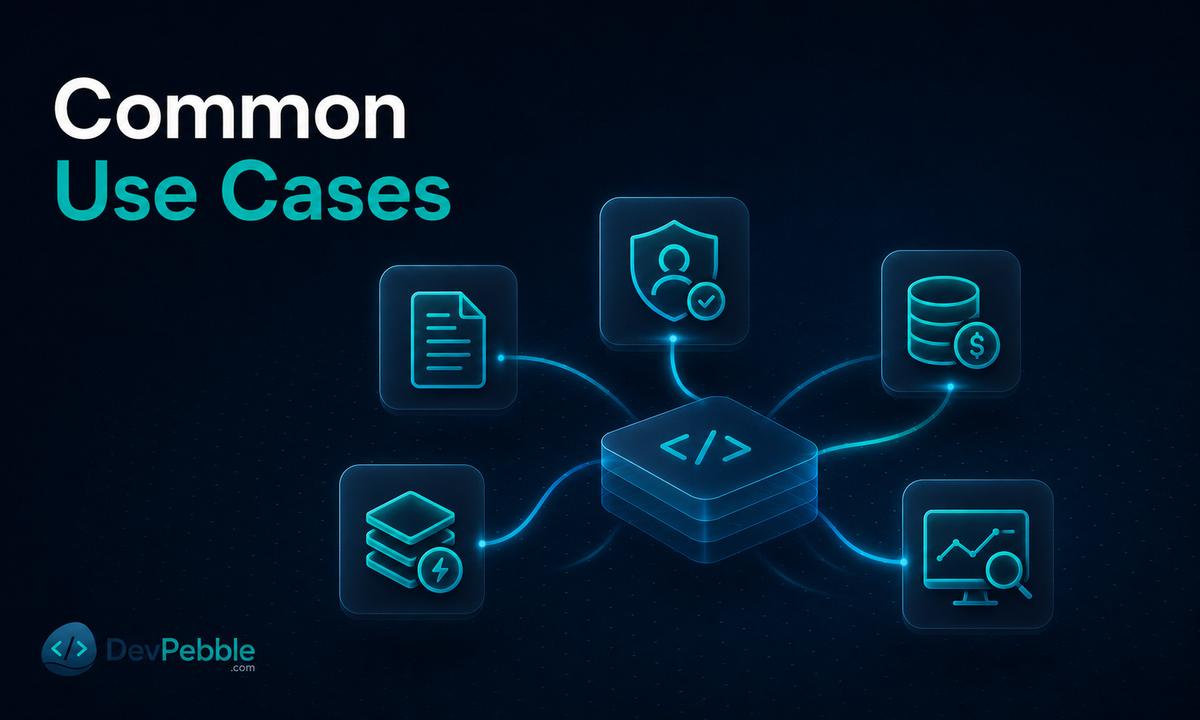
AOP can technically handle almost any cross-cutting behavior, but three use cases dominate production systems.
Logging and audit trails
Logging is usually the first thing developers do with AOP. Instead of scattering logger.info() calls everywhere, a logging aspect captures method entry, exit, parameters, and return values across an entire package. Audit trails in regulated industries are where this gets serious. A healthcare app handling patient records may need to log every access to sensitive data (who accessed it, when, what was retrieved) to satisfy regulations like HIPAA. An audit aspect over all data-access methods makes that logging consistent, instead of depending on each developer remembering to add it to every new method.
Security and access control
Security is inherently cross-cutting, because almost every part of an app needs authorization. Rather than sprinkling if (!hasPermission()) checks through controllers and services, a security aspect intercepts calls that match a pointcut (say, every method annotated @RequiresAdmin) and verifies permissions before execution continues. This is common in apps enforcing role-based access control: one security aspect tied to an annotation enforces the rule across every relevant method, present and future, with no repeated manual checks.
Transaction management
Database transactions are the textbook cross-cutting concern. Many data-modifying methods need the same wrapper: begin, commit on success, roll back on error. Frameworks like Spring handle this through AOP under the hood. Annotating a method @Transactional triggers an aspect that wraps the call in a transaction and manages commit and rollback transparently. A developer writing transferFunds() never manages transaction boundaries by hand. If any part fails, the aspect rolls the whole thing back, preserving data integrity without cluttering the business logic.
Beyond these three, AOP also handles caching (storing method results to skip redundant computation), centralized exception handling, and rate limiting. Same principle every time: find behavior that repeats, isolate it, and let pointcuts decide where it applies.
Popular AOP frameworks and languages
AOP isn't tied to one language. It's been implemented across several ecosystems, each with its own weaving strategy and syntax.
AspectJ (Java) is the most mature and complete implementation, and often the first one developers meet. It extends Java with dedicated syntax for aspects, pointcuts, and advice, and supports compile-time, load-time, and limited runtime weaving. Because it works at the bytecode level, it intercepts far more than method calls, reaching into field access, constructor calls, and exception handlers, which gives it more reach than framework-based alternatives.
Spring AOP (Java / Spring Framework) is the far more common choice inside the Spring ecosystem. Instead of modifying bytecode, it uses proxy-based runtime weaving to intercept calls to Spring-managed beans. It's simpler to configure than AspectJ and integrates naturally with annotations like @Transactional, @Async, and custom security annotations. The trade-off is scope. Because it's proxy-based, Spring AOP only intercepts public methods on Spring-managed beans, and it has one famous gotcha: self-invocation. If a method inside a bean calls another method on the same object (this.otherMethod()), the call bypasses the proxy entirely and the aspect never fires. The usual fix is to move the annotated method into a separate bean. This behavior is documented in the Spring Framework reference, and it trips up nearly everyone at least once.
Metalama and PostSharp (.NET) cover the C# world, and this is worth updating if you're working from older tutorials. PostSharp was for years the go-to .NET AOP tool, using compile-time weaving to inject aspects into compiled assemblies. Its successor, Metalama, went open-source with its 2025.1 release and is now the more actively developed of the two, built on the Roslyn compiler rather than post-compile IL rewriting. Interestingly, PostSharp's own team no longer markets Metalama primarily as an "AOP framework," describing it instead as a code generation and validation framework, even though it remains the most complete AOP-style tool for .NET. The practical takeaway: for new C# projects, look at Metalama first, and treat "PostSharp" in older articles as pointing you toward that lineage.
Other ecosystems approach the idea differently. Python has no dominant AOP framework, but aspectlib and ordinary decorators achieve similar results, since Python makes wrapping functions easy. In JavaScript and TypeScript, decorator and middleware patterns (NestJS is a good example) borrow heavily from AOP even when they don't use the label. PHP has Go! AOP; Ruby developers reach for metaprogramming.
| Framework | Language | Typical weaving | Common use case | |---|---|---|---| | AspectJ | Java | Compile-time / load-time | Deep, fine-grained interception across the whole app | | Spring AOP | Java (Spring) | Runtime (proxy-based) | Transactions, security, logging in Spring apps | | Metalama / PostSharp | C# / .NET | Compile-time | Logging, caching, validation in .NET apps | | aspectlib | Python | Runtime | Lightweight aspect application via decorators | | Go! AOP | PHP | Runtime | Cross-cutting concerns in PHP frameworks |
Choosing usually comes down to how much control you need versus how much simplicity you want. A small Spring Boot app rarely needs the full power of AspectJ, while a performance-critical system that needs fine-grained control over weaving might justify the added complexity.
How to implement AOP step by step
Implementing AOP for the first time can feel intimidating, but a few steps make it manageable. The walkthrough below adds a logging aspect to a Spring Boot app, one of the most common starting points.
First, identify the cross-cutting concern. Before writing anything, pin down exactly what behavior needs to apply across multiple classes. Here, the goal is logging every method call in the service layer.
Second, add the dependency. For a Spring project, add spring-boot-starter-aop to your Maven or Gradle build file. It pulls in the AspectJ libraries Spring AOP relies on internally.
Third, create the aspect class. Mark a new class with @Aspect and register it as a Spring component with @Component so the framework applies it automatically.
@Aspect
@Component
public class ServiceLoggingAspect {
}
Fourth, define the pointcut. Decide which methods to target. A pointcut over every method in the service package looks like this:
@Pointcut("execution(* com.example.app.service.*.*(..))")
public void serviceMethods() {}
Fifth, write the advice. Attach the behavior. For basic logging, @Before and @AfterReturning pair well:
@Before("serviceMethods()")
public void logMethodStart(JoinPoint joinPoint) {
    System.out.println("Starting: " + joinPoint.getSignature().getName());
}

@AfterReturning(pointcut = "serviceMethods()", returning = "result")
public void logMethodEnd(JoinPoint joinPoint, Object result) {
    System.out.println("Completed: " + joinPoint.getSignature().getName());
}
Sixth, run and verify. Start the app and call any service-layer method. If it's wired correctly, the console shows log entries automatically, with no logging code inside the service classes.
From there you refine and extend. As the app grows, narrow or widen the pointcut, for instance restricting the aspect to methods annotated with a custom @Loggable instead of a whole package. Once logging works, reuse the same pattern for security, monitoring, or transactions with different pointcuts and advice types. Following the sequence in order (identify, set up the aspect, define the pointcut, attach advice, test) keeps things structured instead of trial-and-error.
Best practices and limitations
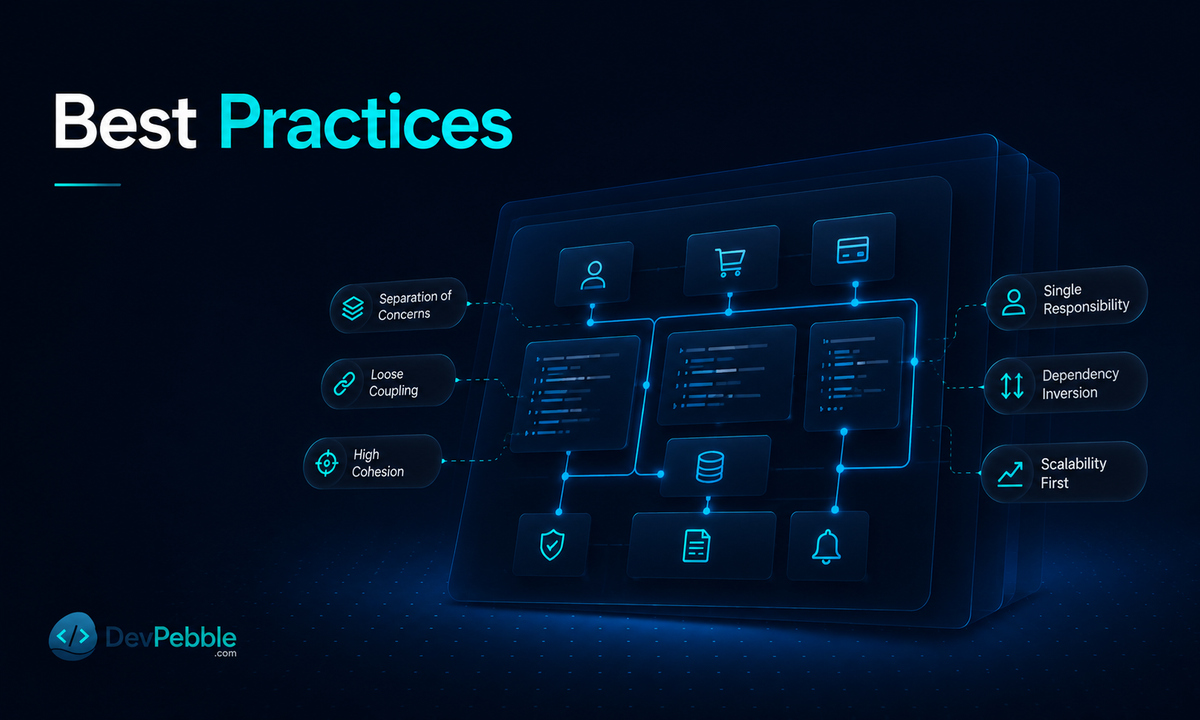
Like any architectural approach, AOP rewards discipline and punishes carelessness. It's worth knowing both sides before rolling it out widely.
What to do
Keep pointcuts specific. Overly broad ones that match entire packages can apply aspects to methods that shouldn't be touched, causing subtle bugs that are miserable to trace.
Document aspects clearly. Because they change behavior invisibly, good naming and docs let other developers understand what's happening without digging through weaver config.
Keep business logic out of aspects. They should handle supporting concerns only (logging, security, caching), never core decisions that belong in the service or domain layer.
Test aspects on their own. Write dedicated tests confirming the logging aspect actually logs and the security aspect actually blocks unauthorized access, rather than assuming it works because the pointcut looks right.
Limit how many aspects hit a single join point. Stacking several onto the same method makes execution order hard to predict.
Where it bites
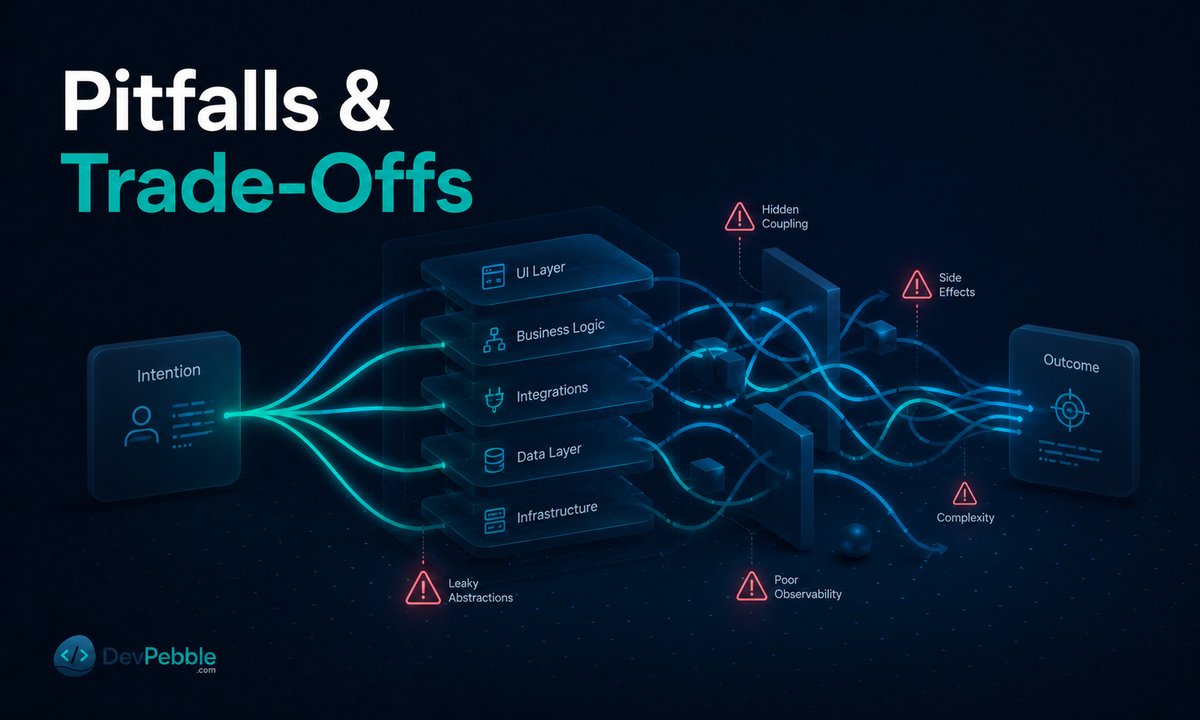
Debugging gets harder, because aspect logic runs invisibly around the method and the execution flow isn't obvious from reading the business class alone. There's a learning curve too: pointcut syntax, weaving types, and advice ordering take time to learn. Runtime weaving adds a small performance cost from proxying, which matters in extremely performance-sensitive systems.
And there's the temptation to overuse it. Not everything that repeats is truly cross-cutting. Convert every repeated pattern into an aspect and you make a codebase harder to follow, not easier. Tooling support varies as well: AspectJ and Spring AOP have solid IDE integration, but newer ecosystems can be rougher.
Applied to genuinely cross-cutting concerns, with clear documentation and well-scoped pointcuts, AOP is one of the cleaner solutions for keeping large codebases maintainable. Applied carelessly, it's a good way to hide bugs. The difference is almost entirely about discipline.
Conclusion
Aspect-oriented programming solves a problem nearly every growing codebase eventually hits: cross-cutting concerns like logging, security, and transactions that don't belong to any single class but appear everywhere. Pull those concerns into aspects, apply them through pointcuts and advice, and you keep business logic clean while getting consistent, centrally managed supporting behavior across the whole app.
Start small, with a single logging aspect, before expanding into security and transactions as your confidence grows. Used thoughtfully alongside solid object-oriented design rather than as a replacement for it, AOP stays one of the more practical tools for building software that stays readable as it scales.